










Cyclamen: The Colourful Winter-Blooming Indoor Plant That Brightens the Cold Season
Introduction to Cyclamen: A Winter Gem
When the days grow shorter and the garden outside retreats into bare branches and frost, indoor plant lovers everywhere turn to one of nature’s most cheerful solutions: the cyclamen. With its vivid, upswept petals in shades of deep crimson, soft pink, pure white, and rich purple, cyclamen brings an undeniable warmth and vibrancy to the interior spaces we retreat into during winter. It is a plant that seems almost designed to counter the season’s grey monotony, offering beauty precisely when we need it most.
Cyclamen belongs to the genus Cyclamen within the family Primulaceae, and while there are around 23 species spread across Europe, the Mediterranean, and parts of western Asia, it is Cyclamen persicum that dominates the world of indoor gardening. This species has been cultivated and hybridised extensively over centuries, resulting in the wide variety of flower colours, sizes, and leaf patterns available to modern plant enthusiasts. The indoor cyclamen you find at garden centres and florists today bears a richer, more elaborate flower than its wild ancestors, yet it retains a delicate grace that makes it endlessly appealing.
Beyond its visual charm, cyclamen is also a plant with genuine longevity when properly cared for. Unlike many seasonal gift plants that fade within weeks, a well-tended cyclamen can bloom for several months through winter, then be coaxed back into growth the following season. This makes it not just a decorative purchase but a lasting investment in the life and colour of your home. Understanding how to care for cyclamen properly is the first step toward building a rewarding long-term relationship with this exceptional plant.
History and Origins of Cyclamen
The story of cyclamen stretches back thousands of years, intertwining with the histories of ancient civilisations around the Mediterranean basin. Wild cyclamen species were known and used in ancient Greece, where they were associated with love and were believed to have medicinal properties. The plant’s tubers were used in folk remedies across Europe and the Middle East, with applications ranging from treating skin conditions to acting as a purgative. While modern medicine has moved on, these historical uses speak to the plant’s deep presence in human culture across millennia.
The name “cyclamen” is derived from the Greek word kyklos, meaning circle, which likely refers to the round, flattened tubers from which the plant grows, or perhaps to the way the flower stalks curl downward in a circular fashion after blooming. Roman author Pliny the Elder wrote about cyclamen in his encyclopaedic work Naturalis Historia, noting its medicinal uses and wide distribution. Throughout the medieval period, European herbalists continued to document the plant, and it eventually found its way into the ornamental gardens of aristocrats and monasteries as its beauty became increasingly celebrated.
Serious cultivation of Cyclamen persicum as an indoor ornamental plant began in earnest during the nineteenth century, particularly in Britain and Germany, where Victorian plant breeders developed increasingly showy varieties. The natural habitat of Cyclamen persicum includes rocky hillsides, scrublands, and oak woodland edges in countries such as Turkey, Lebanon, Israel, and parts of North Africa, where it blooms in the cooler months of autumn and winter. This native preference for cool conditions is a key clue to understanding why the plant thrives in cool indoor environments rather than the warm, centrally heated rooms many people instinctively provide for it.
Varieties and Flower Forms
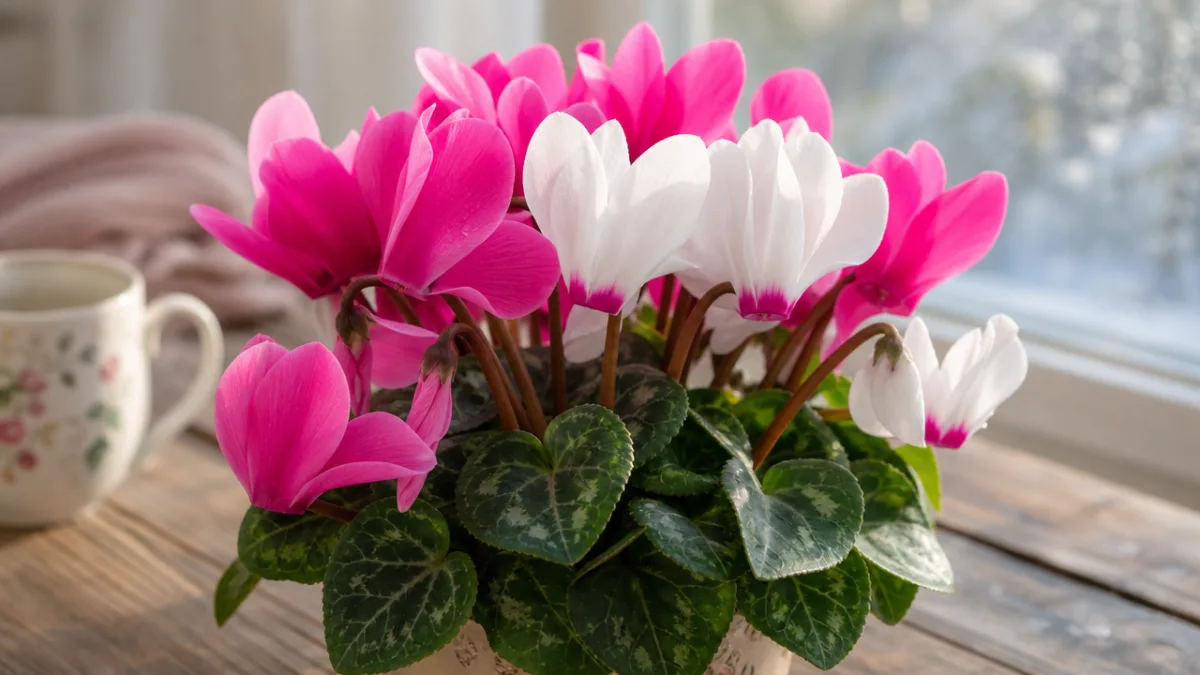
The diversity within cultivated cyclamen is remarkable, and the modern plant buyer has an extraordinary range of options to choose from. Standard-sized cyclamen produce large, boldly coloured blooms and can grow to 30 centimetres in height, making them impressive statement plants for a windowsill or dining table centrepiece. Mini or dwarf cyclamen varieties, on the other hand, are more compact, typically reaching only 10 to 15 centimetres in height, but they produce a similarly prolific display of blooms and are well suited to smaller spaces, bathroom shelves, or clustered plant arrangements.
Flower forms have been developed to satisfy a wide variety of tastes. Single-flowered varieties with clean, swept-back petals are the most classic and widely available. Frilled or ruffled varieties feature petals with decorative wavy or serrated edges, adding an extra layer of ornamental detail. Double-flowered cultivars, while less common, produce fuller blooms that some gardeners find reminiscent of small roses. There are also fragrant varieties, selectively bred to combine visual beauty with a light, sweet scent, though many common cultivars are unscented.
Foliage is another area where cyclamen dazzles beyond its flowers. The leaves are heart-shaped to kidney-shaped, deep green, and frequently decorated with intricate silver marbling or patterning that varies significantly from plant to plant. This silver variegation means that even when cyclamen is not in bloom, it remains an attractive foliage plant worth keeping around. Leaf patterns can range from a simple silver wash over most of the leaf surface to fine, delicate tracery outlining the veins, giving each plant an almost individually unique appearance.
Popular colour groups include:
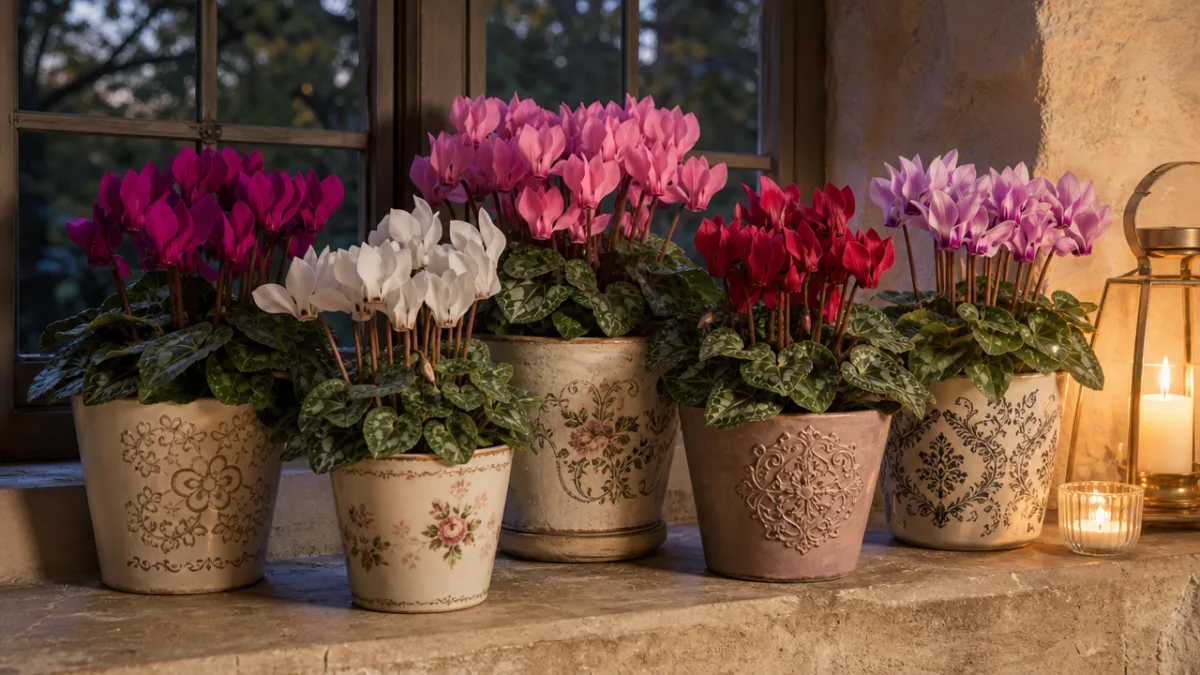
- Crimson and scarlet — bold, deeply saturated reds that create striking visual impact against pale walls or white surfaces.
- Soft and deep pinks — from the palest blush to vivid rose, these are among the most popular and widely grown shades.
- Pure white — elegant and versatile, white cyclamen pairs beautifully with other plants or stands alone as a sophisticated accent.
- Lavender and purple — cooler-toned varieties that bring a sense of calm and richness to a room.
- Bicolour varieties — featuring petals with contrasting edges or throats, adding visual complexity to each individual bloom.
How to Care for Cyclamen Indoors
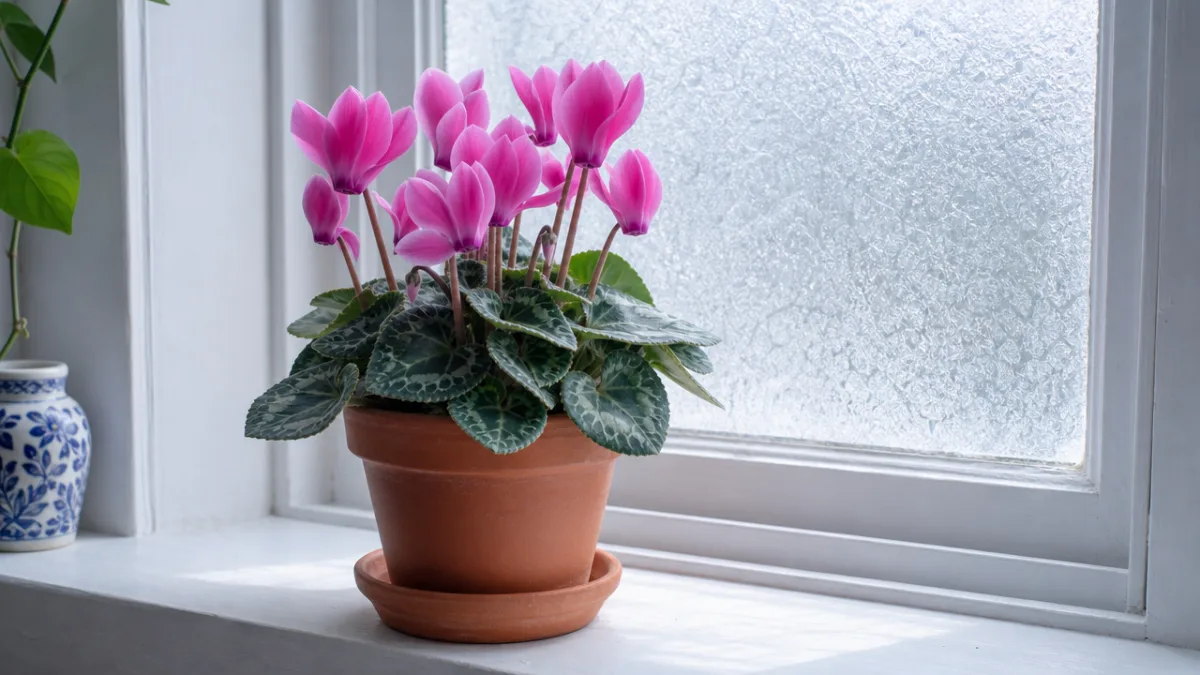
Caring for cyclamen successfully hinges on understanding and working with the plant’s natural preferences rather than against them. The single most important thing to know about cyclamen is that it is a cool-season plant that does not enjoy warmth. Ideal indoor temperatures for cyclamen range from about 10 to 15 degrees Celsius, which means a cool hallway, a bright but unheated spare room, or a draught-free windowsill away from radiators is far better for the plant than the warm living room where most people are tempted to place it. Temperatures above 20 degrees Celsius will cause the plant to decline rapidly.
Watering is another area that requires careful attention. Cyclamen is susceptible to rot, particularly at the crown of the plant where the leaves and stems emerge from the tuber. For this reason, it is strongly recommended to water cyclamen from below, by placing the pot in a tray of water for about 20 to 30 minutes and allowing the compost to absorb moisture before removing it and letting it drain thoroughly. The surface of the compost and the crown of the plant should remain as dry as possible. Watering should be done when the compost feels dry to the touch about a centimetre below the surface — cyclamen prefers to be slightly on the dry side rather than waterlogged.
Light requirements for cyclamen are moderate. The plant does best in bright, indirect light, such as near a north-facing or east-facing window where it receives good natural brightness without the intense heat of direct afternoon sunlight. A south or west-facing windowsill is manageable if the plant is set back from the glass or shielded from direct rays, particularly in brighter winter periods. Feeding with a potassium-rich liquid fertiliser every couple of weeks during the flowering period supports prolonged blooming and healthy growth.
Key care points at a glance:
- Keep in a cool room, ideally between 10 and 15 degrees Celsius.
- Water from the base to avoid crown rot, allowing thorough drainage after each watering.
- Place in bright, indirect light — avoid direct sunlight and radiators.
- Deadhead spent flowers and yellowing leaves by twisting and pulling the entire stalk cleanly from the tuber.
- Feed every two weeks with a high-potassium liquid fertiliser during the growing and blooming season.
- Maintain moderate humidity — occasional misting of leaves (not flowers) or a pebble tray with water nearby can help.
Getting Cyclamen to Rebloom: The Dormancy Cycle
One of the most rewarding aspects of growing cyclamen is the possibility of bringing the plant back into bloom year after year. Unlike many seasonal plants that are discarded after their initial display, cyclamen is a perennial that naturally enters a period of dormancy during the warmer months before regenerating and reblooming in autumn and winter. Understanding and guiding this cycle is the key to keeping a cyclamen for multiple seasons, and it is a process that becomes increasingly satisfying once you have successfully navigated it for the first time.
As winter transitions into spring, you will notice the cyclamen beginning to slow down. New flowers become fewer, leaves may start to yellow, and the plant generally takes on a tired appearance. This is entirely natural and signals that the plant is preparing for dormancy. At this stage, gradually reduce watering and stop feeding altogether. Once the foliage has died back completely, allow the compost to dry out fully and move the pot to a cool, dry, dark location — a garage shelf, a cool cupboard, or a shaded outdoor spot in mild climates works well. The tuber can remain in its pot throughout this rest period.
In late summer, typically around August or September, signs of new growth will emerge from the tuber in the form of tiny, tightly curled leaf shoots. This is the signal to bring the plant back into a cool, bright location and begin watering again — cautiously at first, increasing as growth becomes more vigorous. Fresh compost can be introduced by gently top-dressing the pot or repotting into a slightly larger container if the tuber has grown. With patience and consistent cool conditions, the plant will build towards a full new season of flowering, often producing an even more abundant display than the year before as the tuber matures and strengthens.
Cyclamen in the Home: Display Ideas and Companion Plants
Cyclamen’s compact size, vivid colouring, and upright flower form make it an exceptionally versatile plant for interior display. A single specimen in a simple ceramic pot makes an elegant statement on a kitchen windowsill or a hallway console table, bringing a burst of colour to spaces that can feel particularly cold and bare in winter. Grouping three or five plants of different colours together — odd numbers tend to create more visually dynamic arrangements — produces a lush, garden-like effect that is especially effective in larger spaces such as dining room tables or bay windows.
Cyclamen pairs beautifully with a range of other cool-season plants, both indoors and in outdoor container arrangements that can be brought inside on frosty nights. Consider combining cyclamen with the rich purple foliage of Heuchera, the silvery textures of dusty miller (Senecio cineraria), or the delicate white blooms of winter-flowering jasmine. Trailing ivy in deep green or variegated forms makes an excellent companion, its trailing habit softening the edges of a pot while the cyclamen’s upright blooms provide height and colour contrast. For a monochromatic winter display, pairing white cyclamen with silver-leafed plants creates a cool, sophisticated palette that feels both seasonal and stylish.
Beyond living arrangements, cyclamen makes one of the finest seasonal gifts available. It is a thoughtful alternative to cut flowers, lasting far longer and offering the possibility of reblooming in subsequent years. A beautifully potted cyclamen presented in a decorative container or wrapped in hessian and ribbon conveys both warmth and a genuine botanical generosity that many recipients find far more meaningful than a bunch of flowers that will fade within a week. It is, in every sense, a gift designed to grow.
Creative display ideas for cyclamen include:
- Placing a group of mini cyclamen in individual small pots along a windowsill to create a colourful indoor window box effect.
- Using a shallow bowl or trough planted with several cyclamen of complementary colours for a table centrepiece arrangement.
- Combining cyclamen with candles and seasonal foliage such as eucalyptus or holly for a festive winter table display.
- Setting a single specimen on a stack of vintage books or a wooden plant stand to give it added height and visual presence in a room.
- Displaying cyclamen in a cool conservatory or porch where it can enjoy bright light and the cooler temperatures it truly prefers.
Common Problems and How to Solve Them
Even well-intentioned gardeners sometimes encounter difficulties with cyclamen, and being able to identify and address problems quickly makes the difference between a thriving plant and a disappointing decline. The most common issue is yellowing leaves, which most frequently results from overwatering, excessively warm temperatures, or both. If leaves are turning yellow rapidly and the compost feels wet, allow the plant to dry out, move it to a cooler position, and reassess your watering routine. If only the older outer leaves are yellowing while inner growth remains healthy and green, this is likely simply the natural ageing of older leaves rather than a sign of serious trouble.
Collapsed, wilting stems and flowers can indicate either underwatering or overwatering — the appropriate diagnosis comes from checking the compost. Bone-dry compost combined with limp growth signals that the plant needs a thorough watering from below. Wet compost combined with wilting and a softening crown is a more serious sign of crown rot, for which there is unfortunately limited recourse once it takes hold. Prevention through correct watering technique is the best approach. If caught very early, allowing the plant to dry out completely and moving it to better-ventilated conditions may help, but heavily rotted plants are difficult to save.
Pest problems, while not as common as in some other indoor plants, do occasionally affect cyclamen. Vine weevil is one of the more serious threats, with the adult beetles notching the leaf edges and the larvae feeding on tubers underground. If a plant suddenly collapses without obvious cause, inspect the compost and tuber for the small, cream-coloured, C-shaped larvae. Cyclamen mites are a microscopic pest that causes distorted, stunted growth and tightly curled young leaves — affected plants should be isolated immediately and treated with an appropriate pesticide or, in severe cases, discarded to prevent spread to other plants. Grey mould (Botrytis) can develop in poorly ventilated, overly damp conditions and appears as a fuzzy grey coating on leaves and stems; improving air circulation and removing affected material promptly usually brings it under control.
Troubleshooting summary:
- Yellow leaves — check for overwatering, excessive warmth, or natural ageing of outer leaves.
- Wilting in dry compost — water thoroughly from below and allow to drain.
- Wilting with wet compost — suspect crown rot; allow to dry and assess severity.
- Notched leaf edges — investigate for vine weevil adults; treat compost for larvae.
- Distorted, curled new growth — suspect cyclamen mite; isolate plant immediately.
- Grey fluffy mould — improve ventilation, remove affected tissue, reduce humidity around plant.
Why Cyclamen Deserves a Place in Every Home This Winter
Cyclamen occupies a genuinely unique position among indoor plants. It blooms at a time when most other flowering houseplants are resting, it thrives in conditions that would stress more tropical specimens, and it does all of this with a visual elegance that few other plants can match in the winter months. In a season that can feel visually dull and emotionally draining, a pot of cyclamen placed in a cool hallway or on a bright windowsill offers a small but genuinely meaningful lift — a reminder that colour and life persist even when the world outside has gone quiet and cold.
For those new to houseplants, cyclamen represents an excellent starting point despite its reputation for being slightly finicky. Once the core principles are understood — keep it cool, water from below, give it good light — the plant is remarkably responsive and rewarding to grow. Watching it come back from dormancy and produce its first new blooms of the season is one of those small but deeply satisfying horticultural pleasures that keeps plant enthusiasts returning to their collections year after year. The perennial nature of cyclamen also means that each plant can develop a kind of personal history within a home, growing and strengthening across multiple seasons.
From a practical standpoint, cyclamen is also exceptional value. A single plant purchased in early winter can bloom for four months or longer with appropriate care, represent a striking and evolving decorative element through the coldest part of the year, enter dormancy, and return to provide the same display the following winter. Few plants offer such a favourable ratio of cost to pleasure, beauty to longevity, or simplicity of care to richness of reward. Whether you are a seasoned plant collector adding another species to a well-curated collection or a first-time buyer looking for something beautiful to brighten a cold season, cyclamen is, quite simply, a plant that delivers.








What do you think?
It is nice to know your opinion. Leave a comment.