










Convolvulus arvensis: The Complete Guide to Field Bindweed
Introduction to Convolvulus arvensis
Convolvulus arvensis, commonly known as field bindweed, is one of the most recognizable and widespread flowering plants in the world. A member of the morning glory family Convolvulaceae, this perennial vine has captured the attention of botanists, gardeners, and farmers alike for centuries. Its delicate, trumpet-shaped flowers belie the plant’s tenacious and deeply resilient nature, making it a subject of both admiration and frustration depending on who you ask.
Native to Europe and Asia, field bindweed has since spread to virtually every corner of the globe, establishing itself across North America, Australia, South America, and beyond. It thrives in disturbed habitats, agricultural fields, roadsides, gardens, and wastelands, demonstrating a remarkable adaptability to diverse environmental conditions. Its ability to colonize new territory rapidly has made it one of the most studied invasive plant species in the world, with decades of research dedicated to understanding and managing its spread.
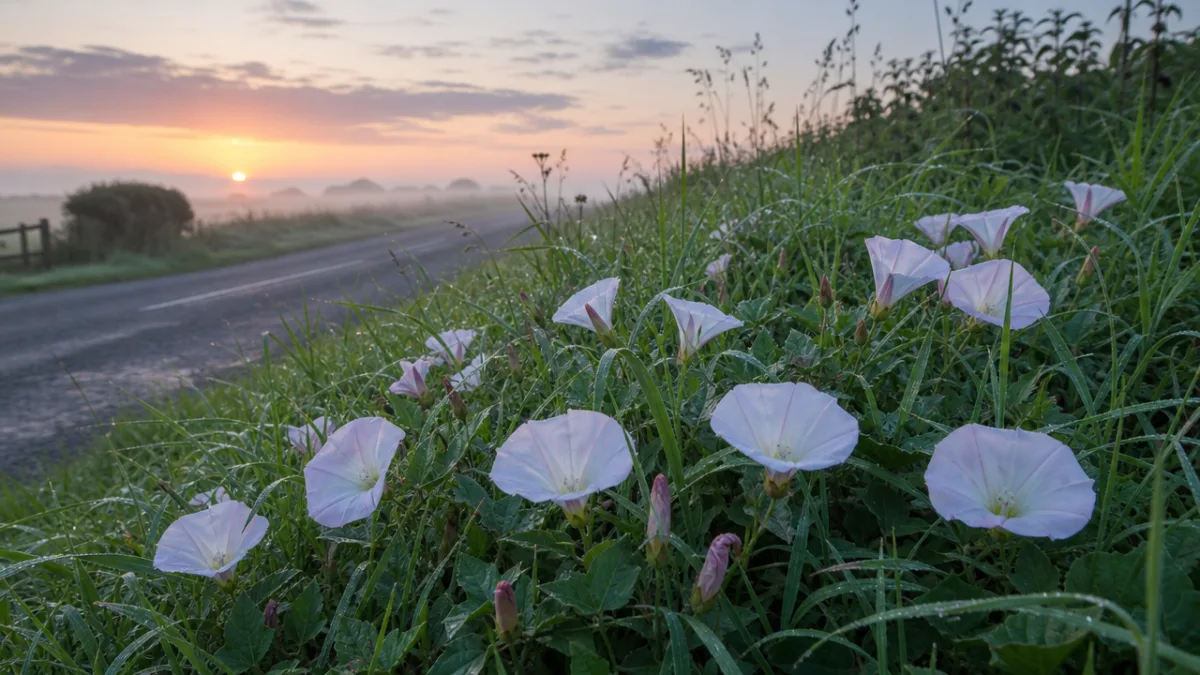
Despite its reputation as a troublesome weed, Convolvulus arvensis possesses a quiet and understated beauty that deserves genuine appreciation. Its flowers, which bloom from late spring through early autumn, open in the morning and gently close as the day progresses, earning the plant a poetic relationship with the rhythms of sunlight. The blossoms range from pure white to soft pink, often displaying elegant pink or rose-colored stripes that radiate from the center, creating a visual effect reminiscent of a candy-striped parasol viewed from above.
Botanical Characteristics and Flower Morphology
The flowers of Convolvulus arvensis are among the most structurally interesting in the plant kingdom, exhibiting what botanists describe as a salverform or funnel-shaped corolla. Each individual bloom is typically between 15 and 25 millimeters in diameter, featuring five fused petals that form a continuous, pleated trumpet. The characteristic striping pattern visible on the outside of the flower corresponds to the mid-veins of each petal lobe, creating a natural decorative element that serves as a nectar guide for visiting pollinators such as bees and hoverflies.
The plant’s foliage is equally distinctive, with arrow-shaped or sagittate leaves that alternate along the twining stems. These leaves range from 2 to 5 centimeters in length and feature two pointed basal lobes that angle backward, giving them a characteristic arrowhead silhouette. The stems themselves are slender, smooth, and capable of twining in a counterclockwise direction around any available support structure, whether that be another plant stem, a fence wire, or even a grass blade. This climbing behavior is driven by thigmotropism, the plant’s growth response to physical contact.
Below the visible portion of the plant lies an extraordinary root system that is central to understanding field bindweed’s persistence and success. The roots can penetrate the soil to depths exceeding three meters, with lateral roots extending horizontally for considerable distances. This extensive underground network serves as both a water and nutrient reservoir and a regenerative organ, capable of producing new shoots from even small root fragments. The root system stores significant quantities of carbohydrates, allowing the plant to regrow vigorously after being cut, mowed, or treated with certain herbicides.
Seed production adds another dimension to the plant’s reproductive strategy. Each plant can produce between 25 and 500 seeds per season, and those seeds are encased in hard seed coats that allow them to remain viable in the soil for decades. Studies have documented germination of field bindweed seeds that were more than 50 years old under laboratory conditions, a statistic that underscores the extraordinary persistence encoded into the plant’s biology.

Ecological Role and Relationships with Pollinators
Field bindweed plays a surprisingly meaningful role in the ecosystems it inhabits, particularly as a forage resource for a broad range of pollinating insects. The flowers produce abundant nectar and pollen, attracting honeybees, bumblebees, solitary bee species, hoverflies, and various butterfly species throughout the growing season. In agricultural landscapes where native wildflower diversity has been significantly reduced, bindweed patches can represent one of the few reliable nectar sources available to struggling pollinator populations during the summer months.
Research conducted across European agricultural systems has highlighted the complexity of the ecological trade-offs associated with field bindweed. While the plant competes aggressively with crops and reduces yields, it simultaneously supports invertebrate communities that provide valuable pest control services to the very farmers it troubles. Parasitic wasps, predatory beetles, and other beneficial insects that rely on bindweed flowers for adult nutrition often predate the caterpillars and aphids that damage crop plants. This paradox has prompted calls among some ecologists for more nuanced approaches to bindweed management that consider its ecological contributions alongside its economic costs.
The relationship between Convolvulus arvensis and certain specialist insects is particularly noteworthy. The bindweed hawk moth, along with several species of tortrix moth, uses field bindweed as a larval food plant, with their caterpillars feeding on the leaves and stems. The convolvulus hawk moth, one of Europe’s most spectacular nocturnal insects with a wingspan approaching 12 centimeters, is strongly associated with Convolvulus species and frequently visits the flowers at dusk to feed on nectar using its extraordinarily long proboscis. These specialist relationships highlight the ecological embeddedness of field bindweed within the communities it inhabits.
Birds also benefit indirectly from field bindweed’s presence. The dense mats of twining vegetation provide cover and nesting habitat for small ground-nesting birds, and the seeds, while hard-coated, are consumed by various seed-eating bird species. Dove species in particular have been observed foraging in areas with substantial bindweed presence, with the seeds forming a small but consistent component of their diet in agricultural edge habitats.
Agricultural Impact and Management Challenges
From an agricultural perspective, Convolvulus arvensis is classified as one of the most economically damaging weeds in temperate farming systems worldwide. The United States Department of Agriculture estimates that field bindweed causes crop yield losses exceeding $350 million annually across American agricultural production, affecting crops ranging from wheat and corn to vegetables, orchards, and vineyards. The plant competes with crops for water, nutrients, and light, while its twining growth habit can cause physical lodging in cereal crops and interfere mechanically with harvesting equipment.
The extraordinary persistence of field bindweed’s root system makes conventional management strategies profoundly challenging. Tillage, the traditional method for weed control, can actually exacerbate infestations by fragmenting the root system and distributing viable root segments throughout the soil profile. Each severed root piece, depending on its size and condition, has the potential to regenerate a new plant, meaning that intensive cultivation can paradoxically increase plant density in subsequent growing seasons. This counterintuitive response to disturbance has long frustrated farmers who rely on mechanical weed control.
Chemical control using systemic herbicides such as glyphosate and certain auxin-mimicking compounds can reduce bindweed populations substantially, but rarely achieves complete eradication. The deep root system means that herbicide translocation must be exceptionally thorough to kill the entire plant, and repeated applications over multiple growing seasons are typically required. Resistance to certain herbicide classes has also been documented in some bindweed populations, adding another layer of complexity to chemical management programs in regions where herbicide pressure has been sustained over many years.
Biological control research has explored the use of specialist insects and pathogens as management tools for field bindweed. The bindweed gall mite, Aceria malherbae, has been approved for release in several countries as a biological control agent, and various rust fungi that specifically infect Convolvulus species have shown promise in experimental settings. While biological control rarely achieves the rapid suppression that chemical methods can deliver, it offers the prospect of long-term, self-sustaining population regulation that integrates well with organic and low-input farming systems.

Ethnobotanical History and Traditional Uses
The long history of human interaction with Convolvulus arvensis extends well beyond its role as an agricultural problem. Across European and Asian cultures, field bindweed has been incorporated into traditional medicine systems, folk practices, and even culinary traditions, reflecting the plant’s broad availability and the resourcefulness of the communities that encountered it. Ancient herbal manuscripts reference the plant under various names, and medieval herbalists attributed a range of medicinal properties to different parts of the plant, particularly the root and the latex contained within it.
Traditional European herbalism made extensive use of bindweed root preparations, which were understood to have purgative and cholagogue properties, meaning they were believed to stimulate bile flow and promote digestive cleansing. These properties are associated with the resinous glycosides present in the root, which do indeed possess pharmacological activity, though their use without careful preparation and dosing carries risks of significant gastrointestinal irritation. Poultices made from the fresh leaves were applied topically in some folk traditions to treat minor skin inflammations and insect bites, a practice that reflects empirical observation of the plant’s mildly soothing properties.
In certain Central Asian cultural traditions, young bindweed shoots were consumed as a spring vegetable, gathered before the leaves reached full size and prepared by boiling or sautéing. The practice of eating young bindweed greens continues in some rural communities today, though it requires knowledge of appropriate preparation methods to mitigate the mild toxicity associated with the plant’s alkaloid and glycoside content. This culinary tradition reflects a broader pattern across human cultures of incorporating locally abundant plants into the diet through accumulated knowledge of safe preparation techniques.
The plant’s flowers have also inspired decorative and artistic traditions across cultures. The elegant simplicity of the funnel-shaped bloom, with its symmetrical form and delicate coloration, has made it a subject for botanical illustrators from the Renaissance onward, appearing in the works of notable plant artists such as Maria Sibylla Merian and in the botanical plates of Linnaeus’s contemporaries who first formally classified the species. The flower’s beauty has been captured in ceramic arts, embroidery patterns, and garden painting traditions across Europe and Asia, suggesting an aesthetic appreciation that runs alongside and independent of the plant’s practical or problematic dimensions.
Conservation Perspective and Rethinking Field Bindweed
Contemporary ecological thinking has begun to challenge some of the firmly negative framing that has characterized scientific and agricultural discourse on Convolvulus arvensis for much of the twentieth century. While the plant’s impacts on agricultural productivity are real and significant, its classification as a universally problematic species obscures a more nuanced reality. In non-agricultural contexts, field bindweed frequently colonizes degraded, disturbed, or contaminated sites where few other plants can survive, performing genuine ecosystem services including soil stabilization, erosion prevention, and the establishment of vegetative cover that facilitates successional processes.
Research into phytoremediation, the use of plants to extract or neutralize soil contaminants, has revealed that Convolvulus arvensis accumulates heavy metals including lead, cadmium, and zinc at rates that make it potentially useful for cleaning contaminated industrial sites. The plant’s deep root system gives it access to contaminants distributed throughout the soil profile, and its rapid growth and high biomass production mean that contaminated plant material can be harvested and removed, progressively reducing soil toxin concentrations. While this application remains largely experimental, it represents a striking reframing of a species long defined primarily by its capacity for harm.
Climate change is already influencing the distribution and behavior of field bindweed in ways that will require updated management and monitoring approaches. Warmer temperatures and altered precipitation patterns in many regions are extending the plant’s growing season, allowing earlier spring emergence and later autumn senescence that give it competitive advantages over both crops and native vegetation. At the same time, the plant’s demonstrated drought tolerance and heat resistance suggest that it may perform increasingly well relative to other species as climate conditions shift in many agricultural regions, making it a potentially more significant management challenge in coming decades.
Ultimately, Convolvulus arvensis embodies the complexity inherent in human relationships with wild plants. It is simultaneously beautiful and troublesome, ecologically valuable and economically damaging, deeply familiar and endlessly surprising. Its funnel-shaped flowers, opening with the morning light and closing as shadows lengthen, represent one of the quiet, recurring spectacles of the temperate landscape, easy to overlook amidst the business of farming or gardening, yet genuinely worthy of the attention that careful observation rewards. Understanding field bindweed fully means holding all of these dimensions in view at once, resisting the simplifications that make plants either heroes or villains, and engaging instead with the rich, tangled reality of a species that has been woven into human life for as long as people have cultivated the land.
Growing Convolvulus Species in the Garden
While Convolvulus arvensis itself is generally discouraged in cultivated garden settings due to its invasive root system, the Convolvulus genus contains several ornamental species that deliver the same exquisite flower form without the management challenges associated with field bindweed. Convolvulus tricolor, commonly known as dwarf morning glory, is an annual species native to the Mediterranean region that produces a continuous succession of striking tricolored flowers combining deep blue, white, and yellow in concentric bands. Unlike its perennial relative, this species has a non-invasive fibrous root system and behaves as a well-mannered garden annual.
Convolvulus sabatius, the ground morning glory or bindweed of Mauritania, is a trailing perennial that has become a beloved plant in Mediterranean-climate gardens and container plantings worldwide. Its lavender-blue flowers, produced prolifically from spring through autumn, cascade beautifully over walls, rockery edges, and container rims, and the plant’s relatively modest root system makes it manageable even in small spaces. In frost-prone climates it is typically grown as an annual or overwintered under glass, though in mild coastal regions it may persist for several years as a reliable, low-maintenance perennial ground cover.
For gardeners who wish to attract the pollinators associated with Convolvulus species without introducing invasive plants to their garden, growing these ornamental relatives represents an excellent compromise. The following considerations are important when selecting and growing ornamental Convolvulus in garden settings:
- Choose well-drained soil in a full sun position, as Convolvulus species originate in open, often sunny habitats and tend to flower poorly in shade or waterlogged conditions.
- Avoid overwatering and heavy fertilization, which can promote leafy growth at the expense of flowers, as these plants generally perform better in lean, open soil with moderate moisture.
- Deadhead spent flowers regularly on annual species to prolong the flowering season and prevent self-seeding in situations where spread is undesirable.
- In containers, use a free-draining potting mix and ensure adequate drainage holes, as root rot in saturated growing media is the most common cause of failure with these plants in cultivation.
- Propagate annual species from seed sown directly in the garden after the last frost, or start them indoors six to eight weeks before the last expected frost date for earlier flowering.
The genus Convolvulus offers gardeners a remarkable range of forms and habits, from the prostrate ground cover of Convolvulus sabatius to the twining annual climbers and the upright bushy habit of Convolvulus tricolor. What unites them all is the characteristic flower form inherited from their wild ancestors, that unmistakable funnel of fused petals that has made field bindweed flowers recognizable to people across the world for generations. By growing their ornamental relatives thoughtfully and responsibly, gardeners can celebrate the genuine beauty of this flower form while contributing positively to the garden ecosystem through the pollinator forage these plants so reliably provide.








What do you think?
It is nice to know your opinion. Leave a comment.