










Clianthus puniceus: The Magnificent Kākābeak of New Zealand
Introduction to Clianthus puniceus
Clianthus puniceus, commonly known as kākābeak or kōwhai ngutu-kākā in Māori, is one of New Zealand’s most spectacular and iconic flowering plants. The name “kākābeak” derives directly from the striking shape of its vivid red flowers, which bear an unmistakable resemblance to the curved beak of the kākā, a native New Zealand parrot. This extraordinary plant belongs to the family Fabaceae, the legume family, and has captivated botanists, gardeners, and nature lovers since it was first formally described by European scientists in the early nineteenth century.
Native exclusively to the North Island of New Zealand, Clianthus puniceus is considered critically endangered in its natural habitat, making it one of the most threatened plant species in the country. Wild populations have declined dramatically due to browsing by introduced mammals such as goats, deer, and possums, combined with habitat destruction and competition from invasive plant species. Despite this precarious status in the wild, the plant has found a second life in cultivation, where it is treasured as an ornamental garden plant both within New Zealand and across temperate regions worldwide.
The plant forms a sprawling or semi-climbing shrub that can reach up to four meters in height when given adequate support. Its pinnate leaves are bright green and finely divided, creating an elegant ferny backdrop that perfectly offsets the dramatic flower clusters. The genus name Clianthus derives from the Greek words “kleios,” meaning glory, and “anthos,” meaning flower — a name that feels entirely justified when the plant is in full bloom. Few garden plants can rival the sheer visual impact of a well-established kākābeak in flower.
Botanical Characteristics and Flower Structure
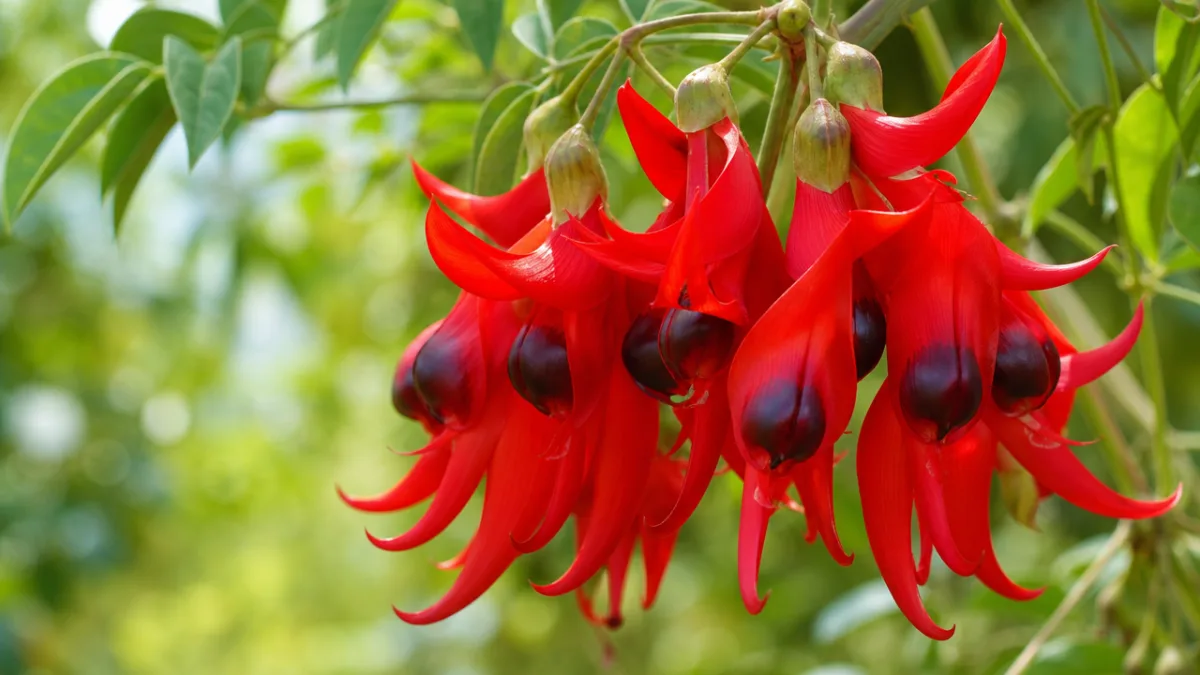
The flowers of Clianthus puniceus are perhaps its most defining feature and certainly its most celebrated attribute. Produced in pendulous racemes of eight to fifteen individual blooms, the flowers hang dramatically from the arching stems in clusters that can span fifteen to twenty centimeters in length. Each individual flower displays the classic pea-flower structure typical of the Fabaceae family, consisting of a large upper petal called the standard, two wing petals at the sides, and a keel formed by two fused lower petals that curve sharply downward in that characteristic beak-like shape that gives the plant its common name.
The most widely known form of Clianthus puniceus produces flowers of an intensely saturated scarlet-crimson color, creating a display of extraordinary brilliance that can be seen from considerable distances. However, the species also occurs naturally in lighter color forms, and selective cultivation has produced several named cultivars spanning a broad color range. White-flowered forms, such as the cultivar ‘Alba,’ offer a more restrained but equally beautiful alternative, while pink-flowered selections like ‘Roseus’ provide a softer, romantic aesthetic that integrates beautifully into pastel-themed garden schemes.
Beyond the flowers, the foliage of Clianthus puniceus contributes significantly to its ornamental appeal. The compound pinnate leaves, each composed of eleven to twenty-five pairs of small oblong leaflets, have a soft, somewhat feathery texture and a bright fresh-green color that remains attractive throughout the year in mild climates. The stems have a slightly woody character at the base but remain flexible enough to be trained against walls, fences, or trellises, making the plant extremely versatile in garden design. Seedpods follow the flowers, forming inflated, papery pods typical of the legume family that contain viable seeds and add a further textural element to the plant’s display.
Natural Habitat and Conservation Status
In its native range, Clianthus puniceus historically grew along rocky coastal cliffs, scrublands, and the margins of forests in the northern and eastern regions of New Zealand’s North Island, particularly in areas such as Hawke’s Bay, Gisborne, and the Coromandel Peninsula. The plant is adapted to well-drained, often poor soils in exposed positions where it receives abundant sunlight and benefits from the moderating influence of the nearby ocean. These harsh, exposed coastal environments actually suit the plant well, as it has evolved to tolerate strong winds, salt spray, and periodic drought.
The conservation situation for wild Clianthus puniceus is genuinely alarming. It is classified as Nationally Critical on the New Zealand Threatened Plant List, the highest category of threat, indicating that it faces an extremely high risk of extinction in the wild in the immediate future. Estimates suggest that fewer than one hundred individuals may remain in truly wild, unmanaged populations, though managed and semi-managed populations on predator-free islands and in conservation reserves add somewhat to this total. The plant’s attractive foliage makes it highly palatable to browsing animals, and even a single goat can destroy a mature plant in a remarkably short time.
Conservation efforts for Clianthus puniceus are ongoing and multifaceted, involving government agencies, iwi (Māori tribal groups), community conservation organizations, and dedicated botanical garden networks. Translocation programs have established new populations on predator-free offshore islands such as Tiritiri Matangi, where the absence of introduced mammals has allowed the plants to grow and reproduce successfully. Seed banking programs ensure that genetic material is preserved even in the event of further losses in wild populations. The cultural significance of the kākābeak to Māori people adds another dimension to conservation motivation, as the plant is deeply embedded in indigenous traditions, stories, and place names across the North Island.
Cultivation and Garden Requirements
Despite its endangered status in the wild, Clianthus puniceus is relatively straightforward to cultivate in appropriate garden conditions, and success with this plant is well within the reach of competent amateur gardeners. The plant performs best in climates that are frost-light or frost-free, as it originates from a maritime environment with mild winters. In regions that experience hard frosts, it can still be grown successfully if positioned against a warm, sheltered wall that provides protection from the coldest temperatures and creates a microclimate several degrees warmer than the open garden. In such positions, even in climates as cool as coastal Britain or the Pacific Northwest of North America, the plant can thrive and flower magnificently.
Soil requirements for Clianthus puniceus favor free drainage above almost all other considerations. The plant will not tolerate waterlogged or constantly wet soil, which promotes root rot and rapid decline. A light, sandy loam with good drainage, ideally slightly alkaline or neutral in pH, suits it perfectly. On heavy clay soils, generous incorporation of horticultural grit or coarse sand into the planting area, combined with raised planting to ensure the crown sits above any water table, can improve drainage sufficiently for the plant to establish and grow. Adding organic matter sparingly is acceptable, but excessively rich soils encourage soft, sappy growth that is more susceptible to cold damage and pest attack.
Sunlight is another non-negotiable requirement for this plant. A position in full sun, ideally facing south (in the northern hemisphere) or north (in the southern hemisphere), will produce the most vigorous growth and the most prolific flowering. Plants grown in shade tend to become leggy and flower poorly, defeating the primary purpose of growing such a visually dramatic species. Wall training is particularly effective, as the reflected warmth from a masonry or brick wall extends the growing season, encourages earlier flowering, and provides the physical support the plant appreciates as it matures and its stems lengthen. Annual pruning after flowering helps maintain a compact, productive framework and prevents the plant from becoming untidy.
- Sunlight: Full sun position, minimum six hours of direct sunlight daily for best flowering performance.
- Soil: Well-drained, light to medium loam; tolerates poor soils but will not survive waterlogging.
- Watering: Moderate watering during the growing season; reduce significantly during winter months in cool climates.
- Frost tolerance: Hardy to approximately minus five degrees Celsius when established and in a sheltered position.
- Pruning: Prune lightly after flowering to maintain shape; harder renovation pruning tolerated if needed.
- Feeding: Light feeding with a balanced fertilizer in spring; avoid high-nitrogen feeds that promote foliage over flowers.
Propagation Methods and Techniques
Clianthus puniceus can be propagated by two main methods: seed sowing and semi-hardwood cuttings. Each method has its advantages and is suited to different circumstances and different levels of gardening experience. Growing from seed is the more accessible option for most gardeners and can produce vigorous, healthy plants relatively quickly, though there will be some natural variation in the resulting plants, particularly in flower color, which can be an advantage or a disadvantage depending on one’s objectives. Cuttings, on the other hand, produce plants genetically identical to the parent and are essential when propagating named cultivars such as the white-flowered ‘Album’ or the pink ‘Roseus.’
Seed propagation of Clianthus puniceus requires a simple but important pre-treatment step before sowing. The seed coat is hard and impermeable, a characteristic common in legumes that evolved to allow seeds to remain dormant in the soil until conditions are favorable for germination. To overcome this dormancy, seeds should be scarified before sowing — either by nicking the seed coat gently with a sharp knife or nail file, or by soaking the seeds in warm water for twenty-four to forty-eight hours until they visibly swell. Once pre-treated, seeds germinate reliably and quickly, typically within one to three weeks at temperatures of fifteen to twenty degrees Celsius, producing sturdy seedlings that grow rapidly and can often be planted out in their first or second year.
Semi-hardwood cuttings taken in mid to late summer offer an effective vegetative propagation method, especially important for preserving specific cultivar characteristics. Cuttings of approximately ten to fifteen centimeters in length, taken from healthy, non-flowering shoots with a heel of older wood if possible, root well when treated with a rooting hormone powder or gel and inserted into a free-draining propagation medium such as perlite mixed with coarse horticultural sand. Bottom heat of around twenty degrees Celsius accelerates rooting significantly. Once rooted, young plants should be potted into individual containers and grown on in a protected environment through their first winter before planting out into their permanent positions the following spring.
Ecological Relationships and Wildlife Value
The relationship between Clianthus puniceus and the native wildlife of New Zealand is one of the most fascinating aspects of this plant’s ecology. The flowers are specifically adapted for pollination by birds rather than insects, a phenomenon known as ornithophily that has evolved independently in many plant lineages around the world. The long, curved keel of the flower is precisely shaped to correspond with the curved bill of the kākā parrot, the bird from which the plant takes its common name. When a kākā inserts its bill into the flower to access the nectar within, the anthers and stigma make contact with the bird’s head, transferring and receiving pollen in a precise and efficient exchange.
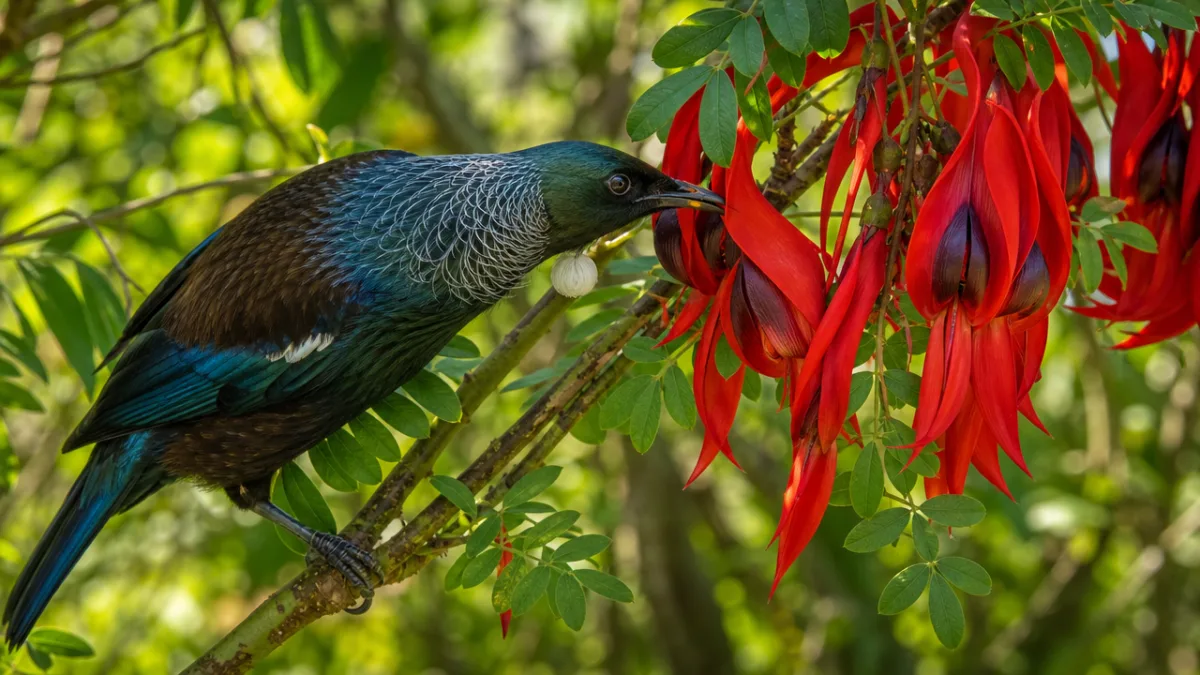
Sadly, the dramatic decline of the kākā as a species across much of the North Island mainland has had direct consequences for the reproduction of wild Clianthus puniceus populations. With fewer kākā visiting flowers, seed set in isolated wild plants is often poor, further compounding the conservation challenges the species faces. Other native birds, particularly tūī and bellbirds, also visit the flowers for nectar and can serve as partial pollinators, though the fit between flower and bill is less precise than with the kākā. This interdependence between an endangered plant and its endangered primary pollinator illustrates the complex cascading effects that can occur when species are lost from ecosystems.
The plant also contributes to the broader garden ecosystem when cultivated outside New Zealand. In British gardens, for example, the flowers attract bumblebees, which are capable of accessing the nectar through a process called nectar robbing, piercing the base of the flower rather than entering legitimately through the front. Long-tongued bumblebee species can also legitimately pollinate the flowers. In gardens where tūī have been reintroduced or naturally occur near conservation reserves in New Zealand, planted kākābeak quickly attracts these charismatic native birds, creating a visible and rewarding wildlife garden element that connects domestic cultivation directly with broader ecological restoration goals.
Cultural Significance and Historical Use
For Māori people, Clianthus puniceus — known as kōwhai ngutu-kākā, meaning kākā-beak kōwhai — holds considerable cultural significance that extends well beyond its ornamental appeal. The plant features in traditional knowledge systems, place names, and oral histories across the regions of the North Island where it naturally occurred. Its vivid red flowers are associated with the color of chiefly status and with the blood of the warrior tradition, and the plant’s beautiful but somewhat precarious nature, growing on exposed clifftops and coastal margins, is reflected in certain proverbs and sayings. The connection between the plant and the kākā bird, itself a deeply significant species in Māori culture, further enriches its symbolic resonance.
European botanists encountered and formally described Clianthus puniceus in the early nineteenth century, and it was introduced into cultivation in Europe remarkably quickly thereafter. By the 1830s, the plant was being grown in botanical gardens in Britain and had attracted considerable attention for its extraordinary flower form and rich color. Victorian plant hunters and gardeners were captivated by its exotic appearance, and it was featured in numerous botanical illustrations of the period, including in Curtis’s Botanical Magazine, one of the most prestigious botanical publications of the era. The plant became something of a status symbol in Victorian gardens, grown against the warmest walls of country houses as a demonstration of horticultural skill and botanical taste.
Today, Clianthus puniceus occupies an interesting dual cultural position. Within New Zealand, it is simultaneously a symbol of national botanical heritage and a reminder of conservation failures and challenges, prompting reflection on the impact of introduced species on the country’s unique natural environment. Internationally, it is prized as an exotic ornamental, valued for precisely the qualities that make it irreplaceable in its homeland. This tension between cultivation and conservation, between the plant as a garden object and as a wild species, is one that resonates increasingly widely as awareness of biodiversity loss grows among gardening communities around the world, many of whom have come to see their own gardens as potential sites of conservation value.
Varieties, Cultivars, and Related Species
The genus Clianthus contains only two species, making it one of the smaller genera within the Fabaceae family. The second species, Clianthus maximus, is sometimes recognized separately from Clianthus puniceus, though the taxonomic boundary between the two is debated among botanists and the species are sometimes treated as varieties of a single taxon. Clianthus maximus produces larger flowers and has a somewhat different growth habit, and some taxonomic authorities consider the two to represent a single variable species across which flower size and plant stature vary continuously rather than forming two distinct and discrete entities.
Within Clianthus puniceus, several cultivars have been selected and named for specific ornamental characteristics, offering gardeners a range of options beyond the classic scarlet form. The cultivar ‘Album’ (sometimes listed as ‘White Heron’ in reference to the kōtuku, the white heron of Māori legend) produces pure white flowers of exceptional elegance against the bright green foliage and is considered by many to be the most refined and beautiful form of the species. ‘Roseus’ and ‘Pink Flamingo’ offer varying shades of pink, from pale shell pink to a deeper rose. ‘Red Cardinal’ is a selection with particularly vivid scarlet flowers, chosen for the intensity of its color, while ‘Kaka King’ was selected for its exceptionally vigorous growth habit.
When considering planting Clianthus puniceus, it is worth noting that the species has some relationship with other ornamental legumes that might serve as companions or alternatives in situations where the climate is too cold for kākābeak to thrive. Sophora species, particularly the well-known kōwhai of New Zealand, share a family relationship and can create harmonious plantings that evoke the character of New Zealand’s indigenous flora. In mild Mediterranean-climate gardens, Clianthus might be combined with other bird-attracting, pea-flowered shrubs from the southern hemisphere such as Sutherlandia frutescens or various Australian Swainsona species to create a planting with a coherent ornamental and ecological theme centered around this extraordinary and underappreciated plant family.








What do you think?
It is nice to know your opinion. Leave a comment.