










Cactus Flowers: Discovering the Remarkable Huernia zebrina (Lifesaver Plant)
Introduction to Huernia zebrina: The Plant with a Thousand Names
Among the most visually striking succulent plants in the world, Huernia zebrina goes by many captivating common names that hint at its extraordinary appearance. Known affectionately as the Lifesaver Plant, Little Owl Eyes, and Carrion Flower, this remarkable succulent from the Apocynaceae family has enchanted plant collectors and botanists alike for centuries. Its unusual five-petaled flowers, marked with a distinctive ring that unmistakably resembles a lifesaver candy, make it one of the most recognizable and sought-after plants among succulent enthusiasts around the globe.
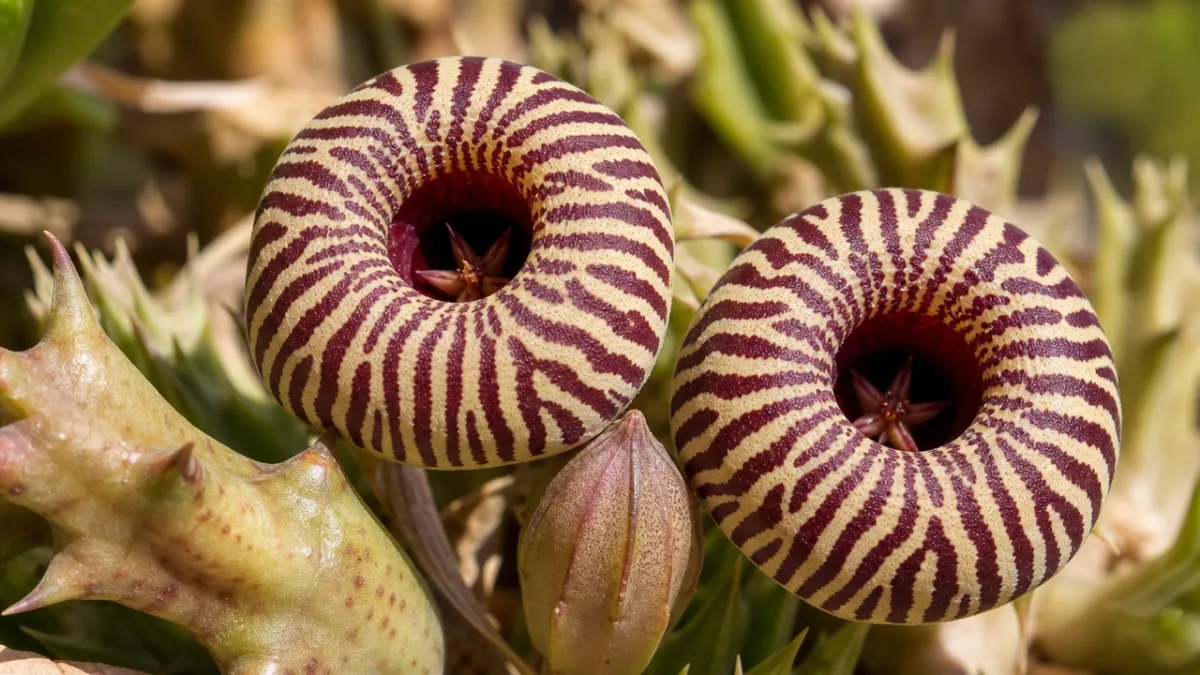
Native to the arid regions of southern Africa, particularly in countries such as South Africa, Namibia, and surrounding territories, Huernia zebrina has evolved over millennia to thrive in harsh, drought-prone environments. The genus Huernia itself encompasses dozens of species, but zebrina stands apart due to its particularly dramatic floral markings. The name “zebrina” is derived from the Latin word for zebra, a direct reference to the bold striped patterning found on its petals, which alternates between creamy yellow and deep maroon or brownish-red bands in a pattern that truly mimics the animal’s famous coat.
The common name “Lifesaver Plant” has become the most widely recognized nickname for Huernia zebrina in horticulture and casual conversation, and it is easy to understand why. The annulus — a raised, fleshy ring located at the center of each flower — looks precisely like the classic ring-shaped candy. This structure plays an important biological role in pollination, attracting specific insects with both its visual cues and its famously pungent scent. For plant lovers, the unusual combination of architectural beauty and biological intrigue makes this species an endlessly fascinating subject of study and cultivation.
Botanical Characteristics and Flower Structure
Huernia zebrina is a low-growing, clump-forming succulent that produces angular, toothed stems typically reaching no more than five to eight centimeters in height. The stems are fleshy and green, often taking on reddish or purplish hues when exposed to bright sunlight or during periods of stress, a common adaptation among succulents that helps reflect intense radiation. These stems lack true leaves, as water and nutrients are stored directly within the stem tissue, a highly efficient strategy for surviving in environments where rainfall is sporadic and unpredictable throughout the year.
The flowers are undoubtedly the plant’s most celebrated feature. Each bloom measures approximately two to four centimeters in diameter and emerges directly from the base of the stems on short peduncles. The star-shaped corolla is divided into five pointed lobes that spread outward in a flattened, almost horizontal plane. The surface of these petals is covered in fine, hair-like cilia that give the flower a slightly fuzzy texture under close inspection, adding yet another layer of visual complexity to an already extraordinary bloom. The zebra-like stripes across the petals range from pale cream to deep burgundy, creating a mesmerizing pattern that draws the eye immediately.
At the very center of the flower lies the annulus, the raised ring structure that gives the plant its beloved Lifesaver nickname. This fleshy, circular collar surrounds the reproductive organs of the flower and is typically a deep purple or maroon color that contrasts sharply with the surrounding petal coloration. The annulus is not merely decorative — it serves as an important guide for pollinators, directing them toward the nectar and pollen at the flower’s center. Understanding this structure helps explain why the plant has such a distinctive appearance compared to most other flowering succulents in the horticultural world.
The Pollination Strategy: Nature’s Clever Deception
One of the most fascinating aspects of Huernia zebrina is its highly specialized and somewhat devious pollination strategy. Like many members of the broader Stapeliad group of plants, Huernia zebrina produces flowers that emit a scent strongly reminiscent of rotting meat or decaying organic matter. This pungent odor is not a flaw or a sign of poor health — it is a precisely evolved mechanism designed to attract specific pollinators, primarily carrion flies and blowflies, that are naturally drawn to the smell of decomposing flesh in search of food or egg-laying sites. The plant essentially tricks these insects into visiting its flowers.
When a carrion fly lands on the flower, attracted by both the smell and the visual cues provided by the striped petals and dark annulus — which can mimic the appearance of animal flesh or fungal growth — it inadvertently picks up or deposits pollen as it investigates the bloom. The textured surface of the petals, including the fine cilia mentioned earlier, helps facilitate pollen transfer by creating surfaces that grip the insect as it moves across the flower. This relationship between Huernia and its fly pollinators is a textbook example of deceptive pollination, where the plant offers no actual reward such as nectar but still achieves successful cross-pollination through elaborate mimicry.
The scent produced by Huernia zebrina is most intense during the warmest part of the day, typically midday when temperatures are highest and fly activity is greatest. Gardeners who keep this plant indoors should be aware that while the smell is not overpowering in most home environments, it can become noticeable when the plant is in full bloom, particularly in enclosed spaces. Outdoors, the scent dissipates quickly and is rarely a concern. The flowers typically remain open for several days to a week, giving pollinators ample opportunity to visit and ensuring the best possible chance of successful seed production in the wild.
Cultivation and Care: Growing Huernia zebrina at Home
Despite its exotic origins and otherworldly appearance, Huernia zebrina is surprisingly easy to cultivate and makes an excellent houseplant for beginners and experienced collectors alike. Like all succulents, its primary requirements revolve around well-draining soil, adequate light, and careful watering practices. The plant is remarkably forgiving of neglect and can tolerate periods of drought with ease, but it will not survive prolonged exposure to waterlogged soil or frost. Understanding these basic needs is the key to keeping Huernia zebrina healthy, vigorous, and, most importantly, blooming reliably year after year.
When it comes to soil, a gritty, fast-draining cactus or succulent mix is ideal. Many growers enhance commercial succulent soil with additional perlite, coarse sand, or fine gravel to improve drainage even further. The roots of Huernia zebrina are relatively shallow, making shallow pots or wide, low containers particularly well-suited to this species. Terra cotta pots are often preferred by experienced growers because their porous nature allows excess moisture to evaporate from the sides of the pot, reducing the risk of root rot — the single most common cause of failure when growing succulents of any kind in a home environment.
Watering should follow the classic succulent approach: water deeply and then allow the soil to dry out completely before watering again. During the active growing season in spring and summer, this might mean watering once every one to two weeks, depending on temperature and humidity levels. In autumn and winter, watering should be reduced significantly, sometimes to once a month or even less. Huernia zebrina is not cold-hardy and should be kept above five degrees Celsius at all times. It thrives in temperatures between fifteen and thirty degrees Celsius and appreciates good air circulation, which helps prevent fungal issues and keeps the stems firm and healthy.
- Light: Bright, indirect sunlight is ideal; direct afternoon sun can scorch the stems, while too little light prevents flowering.
- Watering: Deep watering followed by complete drying out; reduce significantly in winter months to mimic natural dry season conditions.
- Soil: Fast-draining cactus mix enhanced with perlite or coarse grit; never allow roots to sit in water or compacted soil.
- Temperature: Prefers fifteen to thirty degrees Celsius; protect from frost and cold drafts at all times throughout the year.
- Fertilizing: Apply a diluted, low-nitrogen succulent fertilizer once or twice during the growing season to support healthy growth and flower production.
Propagation: Multiplying Your Lifesaver Plant Collection
Propagating Huernia zebrina is one of the most rewarding aspects of growing this plant, and fortunately, it is also one of the simplest processes in the world of succulent gardening. The most reliable and widely practiced method is stem cuttings, which take advantage of the plant’s naturally clumping growth habit. As the plant matures, it produces numerous offsets and new stems around its base, providing a ready supply of propagation material without the need to sacrifice the parent plant. A healthy, established Huernia zebrina can provide dozens of cuttings over the course of several growing seasons.
To take a stem cutting, simply use a clean, sharp blade to sever a stem at its base, ensuring the cutting is at least three to five centimeters long and includes at least one or two of the plant’s characteristic teeth or nodes. Allow the cut end to callous over in a dry, shaded location for anywhere from twenty-four hours to a full week — this critical step prevents bacterial and fungal rot from entering the fresh wound when the cutting is placed in soil. Once callused, the cutting can be placed upright in slightly moistened succulent mix and kept in a warm, bright location. Roots typically develop within two to four weeks.
Seed propagation is also possible for the adventurous grower, though it is considerably more time-consuming and requires successful pollination to produce viable seeds. In the wild, pollinated flowers produce elongated seed pods that eventually split open to release seeds equipped with silky filaments that aid wind dispersal. In cultivation, hand pollination using a fine brush to transfer pollen between flowers of the same or different plants can produce viable seeds. These should be sown in a light, gritty medium, kept moist but not wet, and placed in a warm location. Germination typically occurs within one to three weeks, and seedlings grow slowly, often taking two or more years to reach flowering size.
Huernia zebrina in Culture, Collections, and Conservation
Huernia zebrina has earned a devoted following among plant collectors worldwide, and its popularity has only grown in recent decades alongside the broader succulent collecting boom driven in large part by social media platforms. The plant’s photogenic flowers, with their bold patterning and perfect circular annulus, make it an extremely popular subject for plant photography, and images of its blooms regularly attract widespread attention and admiration on platforms such as Instagram, Pinterest, and gardening forums. This visibility has introduced countless new enthusiasts to the plant and to the broader world of succulent collecting, which is a genuinely positive development for plant appreciation generally.
In the realm of specialized succulent and cacti collections, Huernia zebrina is considered a must-have specimen. Botanical gardens around the world maintain examples of this species in their succulent houses and dry garden displays, where it can be observed flowering reliably and demonstrated to visitors as an example of convergent evolution — the way unrelated plant groups from different continents have independently evolved strikingly similar adaptations to drought and heat. Its inclusion in public collections plays an important educational role, helping visitors understand the incredible diversity of evolutionary strategies that plants have developed to survive in challenging environments.
From a conservation perspective, Huernia zebrina and its relatives face pressures common to many succulent species in southern Africa, including habitat loss due to agricultural expansion, illegal collection from wild populations, and the impacts of climate change on arid ecosystems. While the species is not currently considered critically endangered, responsible horticultural practices — including buying only nursery-propagated plants from reputable sources rather than wild-collected specimens — are important for ensuring that wild populations remain healthy. The thriving trade in legally propagated Huernia zebrina plants actually helps reduce pressure on wild populations by providing collectors with an ethical and sustainable alternative to wild collection.
- Purchase Huernia zebrina only from reputable nurseries that sell nursery-propagated plants, never wild-collected specimens.
- Share cuttings and offsets with fellow collectors to promote ethical, sustainable distribution of this species within the hobby.
- Support botanical gardens and conservation organizations that work to protect native succulent habitats in southern Africa.
- Document and share flowering events and growth observations to contribute to the broader community knowledge base about this fascinating species.
Common Problems, Pests, and Troubleshooting
While Huernia zebrina is generally a robust and trouble-free plant, it is not entirely immune to the problems that affect succulents generally. The most serious threat to this species in cultivation is root rot caused by overwatering or poorly draining soil, which can rapidly destroy a plant that might otherwise live for many years. The first signs of trouble typically appear as softening or yellowing of the stems, which may then turn mushy and collapse. At this stage, the plant can sometimes be saved by removing all affected tissue, allowing the healthy remaining stems to callous, and repotting in fresh, dry soil — but prevention through careful watering practices is always far preferable to treatment.
Pests can also occasionally trouble Huernia zebrina, with mealybugs being the most commonly encountered problem. These small, white, cottony insects congregate at the base of stems and in the crevices between stem segments, where they feed on plant sap and can cause significant damage if left untreated. A cotton swab dipped in rubbing alcohol is an effective tool for removing small infestations, while more severe cases may require treatment with a systemic insecticide or neem oil solution. Scale insects and spider mites are less common but can also occur, particularly on plants kept in overly warm, dry indoor environments with insufficient air circulation throughout the growing season.
Failure to flower is another common concern among Huernia zebrina growers, and it is almost always related to one of a few identifiable factors. Insufficient light is the most frequent culprit — the plant needs genuinely bright light, ideally from a south- or west-facing window, to produce its spectacular blooms. Overly rich soil or excessive fertilizing with high-nitrogen feeds can also encourage lush vegetative growth at the expense of flowers. Finally, skipping the winter rest period — the reduction in watering and cooler temperatures that the plant experiences in its native habitat — can disrupt the natural flowering cycle, so replicating seasonal variation as closely as possible is key to reliable annual blooming.
Why Every Plant Lover Should Grow a Lifesaver Plant
Beyond its obvious visual appeal, Huernia zebrina offers plant enthusiasts something rarer and more valuable: a direct window into the extraordinary ingenuity of the natural world. Few plants so eloquently demonstrate the principle that evolution produces solutions that are simultaneously bizarre, elegant, and perfectly functional. The Lifesaver Plant’s strategy of mimicking rotting flesh to attract pollinators, its ability to survive months without water, its capacity to thrive in a small pot on a sunny windowsill for decades — all of these qualities make it a plant that rewards curiosity and careful observation in equal measure throughout its long and productive life.
For collectors who are just beginning their journey into the world of succulents, Huernia zebrina represents an ideal entry point. It is affordable, widely available from reputable nurseries, easy to care for, relatively fast to reach flowering size from cuttings, and produces blooms that are genuinely spectacular — blooms that never fail to astonish visitors and guests who encounter them for the first time. The plant’s compact size makes it suitable for even the smallest living spaces, and its tolerance for some degree of neglect means it is forgiving of the kind of inconsistent care that beginners inevitably provide as they develop their horticultural skills and instincts over time.
For the experienced collector, Huernia zebrina is the starting point for a deeper exploration of the remarkably diverse Stapeliad group, which includes dozens of genera and hundreds of species displaying equally extraordinary flower forms, scents, and pollination strategies. Growing Huernia zebrina well and understanding it deeply opens the door to appreciating the full breadth of this fascinating plant family, from the towering Stapelia gigantea to the impossibly intricate Orbea variegata. The Lifesaver Plant, in all its zebra-striped, ring-centered, fly-attracting glory, is more than just a curiosity — it is an ambassador for the astonishing complexity and beauty of the plant kingdom at its most inventive and inspiring.








What do you think?
It is nice to know your opinion. Leave a comment.