










Asian Skunk Cabbage (Lysichiton camtschatcensis): A Complete Growing Guide
Introduction to Asian Skunk Cabbage
Asian Skunk Cabbage — or Lysichiton camtschatcensis if you want to impress people at the garden centre — is one of those bog plants that genuinely stops people in their tracks. It comes from the wetlands and stream margins of eastern Asia, from Japan across Siberia to the Kamchatka Peninsula, and it brings that wild, otherworldly energy with it. Plant it somewhere damp and dramatic, and your whole waterside planting will feel like it’s been transformed into something out of a nature documentary.
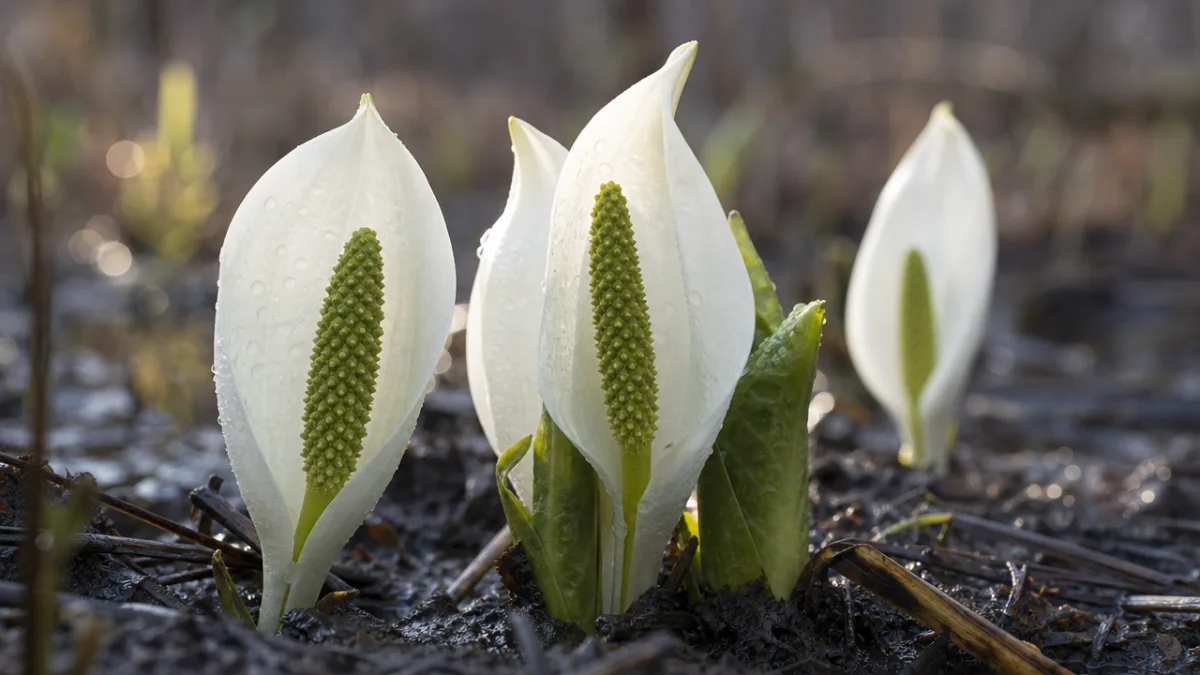
What really sets this one apart from its American cousin Lysichiton americanus is the colour of its flowers. While the American species goes for bold yellow, the Asian version produces pure white spathes that look almost luminescent when they push up through the last of the winter frost. They have this genuinely exotic quality — like a little piece of a Japanese mountain valley has appeared in your garden. Against dark, damp soil in late winter or early spring, the effect is striking in a way that’s hard to put into words until you’ve seen it for yourself.
Yes, it’s called Skunk Cabbage, and yes, the flowers do have a faint smell to them — that’s how they attract early pollinators like beetles and flies. But honestly, you’d have to bury your nose right in the spathe to really notice it, and it’s a very small price to pay for a plant that spends the rest of the growing season producing some of the most impressive foliage you’ll find in a temperate garden. Those enormous, paddle-shaped leaves carry the display right through to autumn, and they never stop being eye-catching.
Characteristics and Growth Habits
Lysichiton camtschatcensis is a herbaceous perennial with a very satisfying annual rhythm once you get to know it. The flowers are the main event, appearing from February through April in the UK and across northern Europe — the exact timing varies depending on where you are and what the winter has been like. What makes this especially dramatic is that the white spathes, which can grow up to 30 centimetres tall, appear before any foliage whatsoever. They emerge straight from bare winter ground, which makes them look all the more extraordinary when everything else in the garden is still firmly dormant.
Once the flowers are done, the leaves take over — and they do not disappoint. We’re talking about individual leaves that can reach 100 to 150 centimetres long and 50 to 60 centimetres wide when the plant is well established and happy. They’re glossy, deep green, and they arch out from the crown in a way that feels genuinely tropical and almost prehistoric. Next to fine-textured plants like grasses, ferns, and sedges, the contrast is spectacular. It’s the kind of bold foliage that makes people stop and ask what it is.
It’s worth being upfront about one thing: this is not a fast grower. Young plants — like the 1-litre specimens you’ll often find for sale — take two to three years to really hit their stride and show you what they’re capable of. That’s worth knowing going in, so you’re not disappointed in year one. The flip side is that once a plant is established, it’s extraordinarily long-lived and gets better every single year. Patience pays off well with this one, and the clumps just keep expanding and improving over the long haul.
Ideal Growing Conditions and Site Selection
Getting the site right is honestly the most important thing you can do for this plant. Everything else is secondary. Asian Skunk Cabbage is a bog and waterside species at heart, and it needs consistently wet or at least reliably moist soil to really perform. The classic spots are pond margins, stream edges, ditches, or a purpose-built bog garden — anywhere the ground stays damp without you having to think too hard about it. In genuinely ideal conditions, it will even tolerate a few centimetres of shallow standing water around its roots without any complaint.
On the question of sun versus shade, it’s pleasantly flexible. Full sun works fine, but it also does beautifully in partial shade, which actually mirrors the conditions it grows in naturally — beneath deciduous woodland canopy, getting good light in spring before the trees leaf out, then enjoying cool dappled shade through summer. If you can plant it under willows, alders, or ornamental maples at the water’s edge, you’re pretty much replicating its natural habitat, and the results tend to be especially lush. This is particularly useful in gardens where summers get warm and dry, as the shade helps protect both the plant and the soil moisture.
Soil matters a lot here. Heavy clay that holds onto water is your friend; free-draining sandy or chalky soil is not. The sweet spot is rich, moisture-retentive ground with a slightly acidic to neutral pH — somewhere between 5.5 and 7.0 — and ideally bulked up with leaf mould, garden compost, or well-rotted manure. If your garden naturally drains too freely, it’s genuinely worth building a dedicated bog garden area. Lining a bed with a butyl rubber pond liner with a few small holes punched in it creates a reliably moist growing environment that this plant will thrive in for decades.
Planting Techniques and Establishment
If you’re planting from 1-litre containers — which is a popular and sensible way to buy these, especially in a pack of three — timing makes a real difference to how well the plants settle in. Early autumn (September to October) or early spring (March to April) are your best windows, when soil temperatures are moderate and rain tends to be reliable. Try to avoid planting in high summer if you can; the combination of heat and water stress is hard on young plants that are still finding their feet in a new spot.
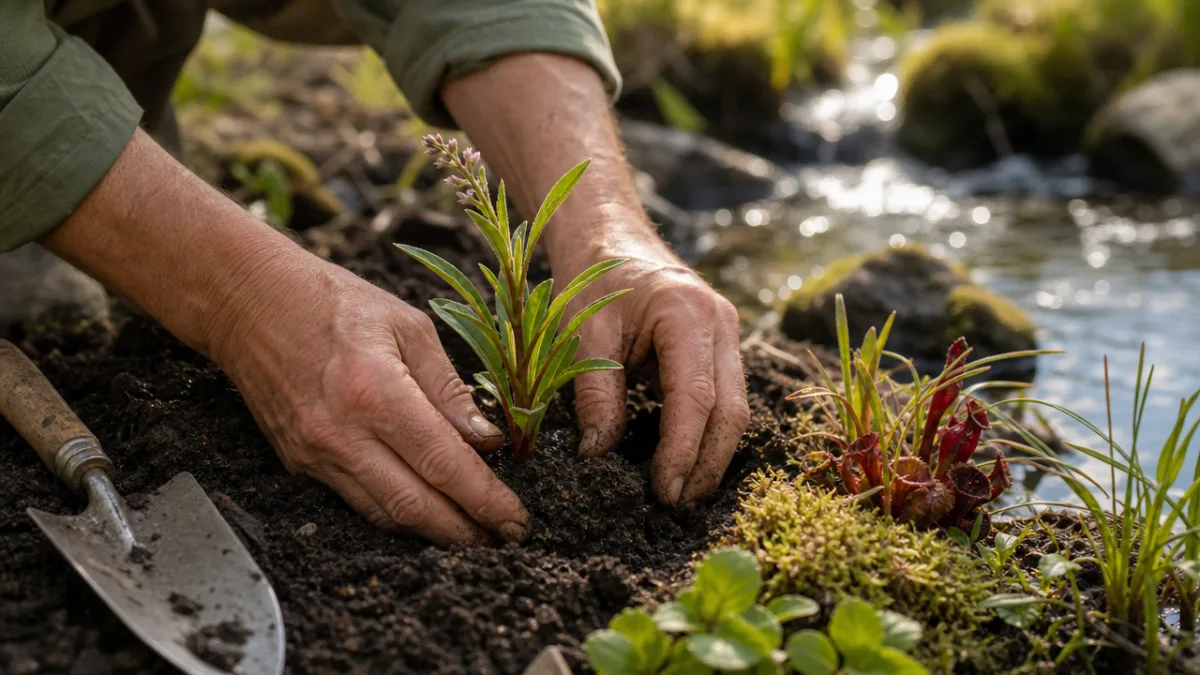
A bit of effort in preparing the planting hole goes a long way. Dig generously — at least twice the width and depth of the root ball — and work plenty of organic matter into the soil you’ve dug out. If you’re planting at a pond or stream edge, position each plant so its crown sits at soil level or just fractionally above it. Planting too deep in waterlogged ground can lead to crown rot, which is worth avoiding. Leave 60 to 90 centimetres between plants so each one has room to develop properly without crowding its neighbours from the start.
For the first growing season, the main job is keeping an eye on moisture. Even in a bog setting, newly planted specimens can struggle if there’s an unusually dry spell, so check in on them and water as needed during that first year. A mulch of organic material around the plant — not sitting on top of the crown itself — will help hold moisture in the soil, keep root temperatures stable, and slowly improve the soil structure over time as it breaks down. After that first season, well-sited plants are remarkably self-sufficient and really don’t need much from you.
One of the nice things about buying a pack of three is that you can create an immediate naturalistic grouping rather than planting a single specimen and waiting for it to look like something. Odd numbers work better than even ones in naturalistic planting, and three plants together will start to read as a small colony from very early on. Try varying the spacing slightly rather than making it perfectly even — put two a bit closer together and set the third a little apart. It sounds like a small thing, but it makes the whole planting feel much more genuinely wild and uncontrived, which is exactly the character you’re after with this plant.
Companion Planting and Landscape Design Applications
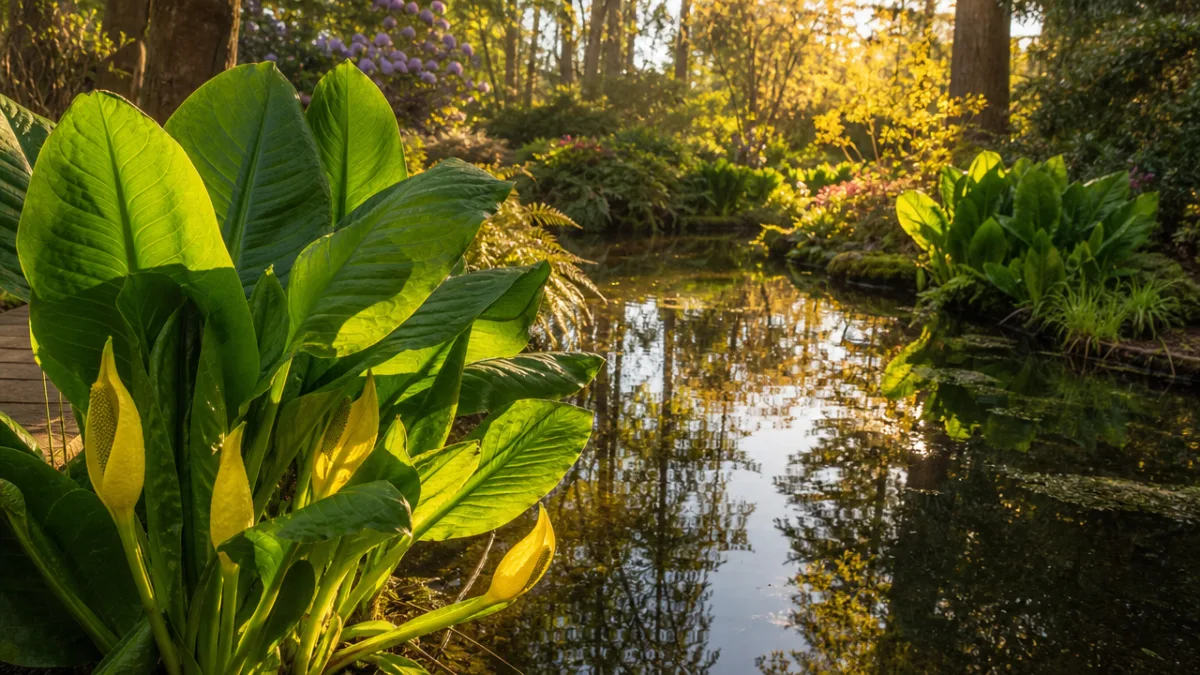
Part of what makes Asian Skunk Cabbage such a gift for waterside planting is how well it plays with others. The key things to think about when choosing companions are contrast in texture and leaf form, a succession of interest through the seasons, and colours that sit comfortably together. Those large, glossy, paddle-shaped leaves give you a powerful visual anchor, and finer-textured plants like Carex pendula, Deschampsia cespitosa, and Osmunda ferns weave around them beautifully, creating a dynamic interplay of scale and texture that carries real interest across the whole growing season.
For spring flowering interest alongside the white spathes of Asian Skunk Cabbage, consider the following companion plants that thrive in similarly moist conditions:
- Caltha palustris (Marsh Marigold) — produces brilliant golden-yellow flowers in March and April, creating a striking colour contrast with the pure white spathes of Lysichiton.
- Primula japonica (Japanese Primrose) — a candelabra primrose that flowers in late spring and thrives in the same boggy conditions, offering tiered whorls of pink, red, or white blooms.
- Iris pseudacorus (Yellow Flag Iris) — a tall, architectural water iris that extends the flowering season into late spring and early summer with bold yellow flowers on upright stems.
- Rodgersia pinnata — shares the preference for moist, partially shaded conditions and contributes dramatic bronze-tinted foliage and fluffy plumes of flowers in summer.
- Gunnera manicata (Giant Rhubarb) — for larger waterside settings, pairs magnificently with Lysichiton in creating a prehistoric, jungle-like atmosphere at the water’s edge.
Beyond the classic bog garden setting, Lysichiton camtschatcensis has also found its way into more contemporary garden design — particularly the kind of naturalistic, ecologically-minded planting that’s been gaining ground in recent years. Its bold silhouette and white spring flowers work well in rain gardens, sustainable drainage systems, and ecological planting schemes that celebrate cool temperate wetland habitats. There’s also a practical ecological side to this plant that goes beyond looks: its spreading root system genuinely helps to stabilise pond and stream margins, so you’re getting real functional value alongside all the visual drama.
Maintenance, Propagation, and Potential Issues
Here’s something refreshing about Asian Skunk Cabbage: once it’s properly established, it really doesn’t ask much of you. There’s no annual division, no staking, no deadheading regime to keep on top of. The main thing you’ll want to do each year is remove the spent flower spathes once they’ve faded and started to look a bit tired — keeping the area around the crown tidy and free of decaying material is sensible and helps avoid any disease issues. Beyond that, a well-sited plant is essentially happy to get on with things without your intervention.
If you want to propagate, you have two options: seed or division. Seed is the slower route — collect it fresh when the spathe has fully faded and the berry-like fruits have developed on the spadix, sow it immediately into moisture-retentive compost, and keep everything consistently damp and cool. Germination can be unpredictable and may take several months, and then you’re looking at another two to three years of growing on before the seedlings are ready to plant out. Division of established clumps is more immediately satisfying, though the thick fleshy rhizomes of a mature plant can make it a workout. Early spring or early autumn are the best times to attempt it.
On the whole, this is a tough, trouble-free plant in the right conditions. Slugs and snails might have a go at young leaves in the first couple of seasons, before the plant has developed enough momentum to shrug off minor pest damage. In very exposed positions, those large leaves can get battered by wind, which looks untidy but doesn’t actually harm the plant long-term. One important note: Asian Skunk Cabbage is on the Schedule 9 list of the Wildlife and Countryside Act in England and Wales, which means you must not plant it in the wild or let it spread into natural watercourses. It can displace native vegetation when it escapes garden settings, so this is something to be genuinely mindful of.
One more thing worth knowing: all parts of Lysichiton camtschatcensis contain calcium oxalate crystals, which can irritate skin, mouth, and the digestive system if you handle the plant a lot without gloves or — obviously — eat it. Wearing gloves when cutting back old foliage or dividing clumps is sensible, particularly for anyone with sensitive skin. In a normal garden setting, though, this isn’t a cause for real concern. It’s perfectly fine to grow in gardens where children and pets spend time, as long as everyone knows not to eat it and sensible precautions are taken when doing any hands-on work with the plant.
Why Choose a Pack of Three and Where to Use Them
Buying Asian Skunk Cabbage as a pack of three 1-litre plants just makes sense on several levels. The economics are straightforward — pack deals almost always work out better value than buying three plants individually, which is welcome when you’re establishing a new planting scheme. The 1-litre pot size gives you young but healthy plants that are well set up to establish and grow on into something genuinely impressive over the next few years.
The design logic for grouping three plants together is well established in garden practice for good reason. A group of three creates visual rhythm and a sense of natural abundance that a single plant, or even a pair, struggles to match on its own. In a bog garden or waterside setting, three Lysichiton camtschatcensis plants will, within three to five years, start to read as a convincing naturalistic colony — the kind of thing that makes you feel like the plant chose that spot itself. In ideal conditions they may even begin to self-seed over time, slowly and organically extending the colony in a way that looks entirely unplanned, which is exactly the aesthetic these plants suit best.
If you have more than one suitable spot in your garden — a formal pond margin on one side and a wilder stream or ditch planting on the other, say — a pack of three also gives you the flexibility to spread the plants across different areas and see how each performs in slightly different conditions. Alternatively, you might plant two together as a bold centrepiece in a bog garden composition and position the third a little further away, suggesting natural colonisation spreading outward from a source point. It’s a classic naturalistic planting trick that creates immediate depth and authenticity, and it works particularly well with a plant that has as much wild character as this one.








What do you think?
It is nice to know your opinion. Leave a comment.