










Apatura Iris: The Purple Emperor Butterfly
Introduction to the Purple Emperor
Among the most magnificent and celebrated of all British and European butterflies, Apatura iris — commonly known as the Purple Emperor — occupies a throne of its own in the natural world. This large, powerful butterfly commands awe and admiration from lepidopterists, naturalists, and casual observers alike. Its regal name is no accident: the males shimmer with an iridescent purple sheen that shifts and flashes in the sunlight like a jewel caught at the perfect angle, making every sighting feel like a rare and privileged encounter with something genuinely extraordinary.
The Purple Emperor is a species steeped in history and folklore. For centuries, British naturalists have pursued this elusive creature through ancient woodland rides, armed with patience, binoculars, and sometimes rather pungent bait designed to lure it down from the forest canopy. It has inspired poetry, obsessive collecting expeditions, and dedicated conservation efforts. Few butterflies have captured the human imagination so completely or inspired such devoted enthusiasm among those who seek them out in the wild.
Despite its grandeur, Apatura iris remains one of the less frequently encountered butterflies across its range, not because it is necessarily rare in absolute numbers, but because of its habits. The males in particular spend much of their time high in the tree canopy, engaged in territorial display and feeding on honeydew secreted by aphids far above the reach of most observers. Understanding this butterfly requires patience, a willingness to crane your neck upward, and a deep appreciation for the hidden worlds that exist at the tops of old oak and sallow woodlands.
Physical Appearance and Sexual Dimorphism
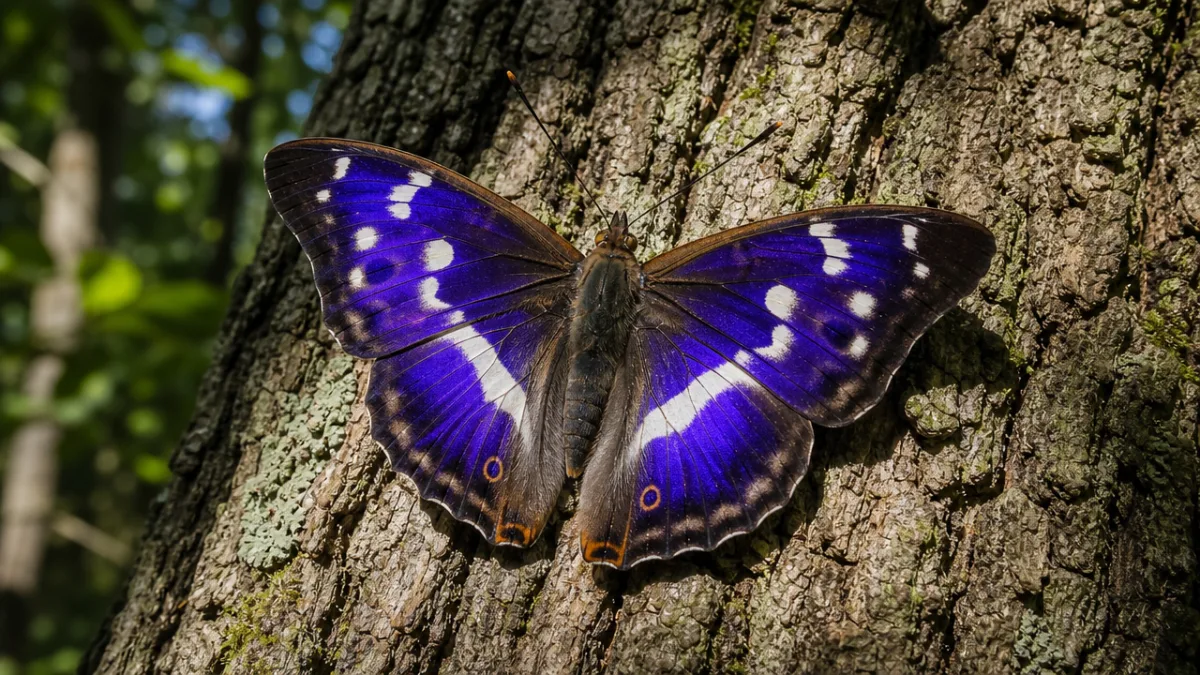
The Purple Emperor is a large and robust butterfly, with a wingspan typically ranging from 70 to 92 millimetres, making it one of the biggest butterflies found in the British Isles and across temperate Europe. Both sexes share a broadly similar pattern of rich dark brown wings marked with distinctive white spots and bands, a pattern that provides excellent camouflage when the butterfly is resting among bark or dappled foliage. On the underside, the wings reveal an intricate and beautiful patterning of orange, white, grey, and black that is quite unlike the upper surface, offering a masterclass in the complexity of butterfly wing design.
The most celebrated feature of this species, and the characteristic that defines its common name, is the stunning iridescent purple sheen displayed by males. This colour is not produced by pigment in the conventional sense but is instead the result of structural coloration — microscopic physical structures on the wing scales that refract and reflect light in specific ways. The purple iridescence is highly angle-dependent, appearing vividly vivid when light hits the wings at certain angles and vanishing entirely when viewed from others. This phenomenon, known as iridescence or structural colour, is what gives the butterfly its otherworldly, almost supernatural visual quality.
Females lack this purple iridescence entirely, which is why sexual dimorphism in this species is so pronounced and immediately apparent to observers. Female Purple Emperors are nevertheless beautiful and impressive insects in their own right, their warm brown tones and bold white markings making them recognisable members of the Apaturinae subfamily. The females are also generally larger than males on average, a common pattern in Lepidoptera known as female-biased sexual size dimorphism, believed to be associated with the energetic demands of egg production and the importance of body size to reproductive success.
Habitat and Distribution
Apatura iris is associated primarily with mature, broadleaved woodland, particularly where ancient sallow (Salix caprea) grows in sufficient abundance to support its caterpillars. In Britain, the species is largely confined to the counties of southern England, with strongholds in the great woodland complexes of Sussex, Hampshire, Wiltshire, Buckinghamshire, and Oxfordshire. Forests such as Knepp Wildland in West Sussex, Fermyn Woods in Northamptonshire, and the New Forest represent important refuges for the species, and these sites attract significant numbers of butterfly enthusiasts each summer during the flight season.
Across continental Europe, the Purple Emperor has a much broader distribution, occurring widely from northern Spain and France through Germany, Poland, and the Baltic states, and extending eastward across temperate Asia into Japan, where a closely related subspecies or sibling species is found. In much of central Europe the butterfly can be locally common in suitable woodland habitats, though like many specialist woodland species it has declined in areas where traditional forestry management has given way to intensive monoculture plantations or where ancient woodland has been cleared entirely for agriculture or development.
The butterfly shows a strong association with woodland edges, wide rides, and areas where sallow grows in the transition zones between dense mature canopy and more open ground. The structural diversity of woodland is therefore critically important: a uniform closed-canopy forest with no internal variation in light levels, tree ages, or shrub layers provides poor habitat, whereas a mosaic of dense canopy, open rides, coppiced areas, and regenerating scrub with abundant sallow can support thriving populations. Conservation management of woodland for this species thus involves maintaining and enhancing this structural complexity through active intervention.
In Britain, the Purple Emperor is considered a priority species under various conservation frameworks, reflecting its relatively restricted distribution and the historical decline of its woodland habitat. Climate change is beginning to influence its range, with records suggesting a northward expansion in Britain as temperatures warm, though this northward spread may also depend on whether suitable sallow-rich woodland habitats exist to receive colonising individuals. The interaction between climate change and habitat availability therefore makes predicting the future distribution of this species a genuinely complex challenge for conservationists.
Life Cycle and Behaviour
The life cycle of Apatura iris follows the typical holometabolous pattern of complete metamorphosis shared by all butterflies: egg, larva, pupa, and adult. Adults are on the wing for a relatively brief period, typically from late June through to early August in Britain, with a peak in July when warm, sunny days provide ideal conditions for flight and territorial activity. The brevity of the adult flight season concentrates the butterfly’s reproductive activity into a short window of time, and observer pressure from enthusiasts tends to peak correspondingly during mid-July in good weather years.
Males emerge slightly before females, a phenomenon known as protandry, which is thought to allow males to establish territories and be ready to mate as soon as females become available. Male Purple Emperors are intensely territorial and will patrol and defend prominent trees — often a single large oak or ash known as a “master tree” — from rivals and even larger insects, birds, and occasionally other intruding objects. This territorial behaviour brings males down to lower perches from time to time and accounts for some of the most exciting and accessible sightings, as competing males spiral upward in dramatic aerial combat above the forest canopy.
Females spend much of their time in the canopy, feeding on honeydew and eventually descending to lay eggs individually on the leaves of sallow bushes, particularly Goat Willow (Salix caprea). The eggs are laid singly on the upper surface of leaves, and the emerging caterpillars feed on sallow leaves through late summer before entering hibernation as young larvae, concealed in the fork of a sallow twig. This overwintering stage as a tiny larva is one of the more vulnerable points in the butterfly’s life cycle and is sensitive to woodland management activities carried out during autumn and winter.
The caterpillar of the Purple Emperor is itself a remarkable creature, beautifully camouflaged in shades of green with yellow lateral stripes and a distinctive pair of pointed horns or “slugs” on the head end. When resting on a sallow leaf it is extraordinarily difficult to detect, blending with almost perfect fidelity into its surroundings. The larva feeds, grows, and eventually pupates in late spring or early summer, forming a flattened green chrysalis attached to a sallow leaf that is again superbly camouflaged against the foliage. The entire pre-adult life of the butterfly is therefore characterised by remarkable cryptic adaptations that render it almost invisible to predators.

Diet and Feeding Habits
One of the more surprising and endlessly fascinating aspects of Purple Emperor natural history is the feeding behaviour of adult butterflies. Unlike many butterflies that visit flowers for nectar, adult Purple Emperors feed primarily on honeydew — the sugary excretions of aphids that colonise the upper canopy of oak, ash, and other woodland trees. This arboreal food source keeps the butterflies high in the canopy for much of their time and contributes significantly to the difficulty of observing them. The preference for honeydew over nectar means that Purple Emperors are not associated with flower-rich habitats in the way that many other butterfly species are.
Males in particular are notorious for their attraction to a wide range of odorous substances encountered on the woodland floor. This behaviour, sometimes described colloquially as “puddling” or more colourfully as an addiction to particularly unpleasant materials, leads males to descend from the canopy to feed on animal dung, carrion, rotting fungi, mineral-rich mud, and even human sweat and excretions. Enthusiasts have exploited this tendency for generations by placing baits of shrimp paste, rotting meat, fox dung, or sickly sweet liquids on rides and paths to attract males down from the canopy to more observable heights, a practice that has yielded some of the most celebrated and widely shared butterfly photographs ever taken in Britain.
The attraction to salt and minerals found in decomposing organic matter is believed to reflect a genuine nutritional need. Males in particular appear to require sodium and other minerals associated with reproductive activity and prolonged flight, and the consumption of these substances from unusual sources may represent an important supplementary nutritional strategy. This is a pattern seen in many Lepidoptera species worldwide, particularly among males, and in the Purple Emperor it reaches a spectacular extreme that has both delighted and puzzled naturalists for generations. The contrast between the butterfly’s regal appearance and its taste for the foulest substances available never fails to raise a wry smile.
- Honeydew from canopy aphids is the primary food source for adults of both sexes, keeping the butterflies at height for much of the day.
- Males actively seek out mineral-rich substances including animal dung, carrion, rotting fungi, and perspiration-soaked clothing.
- Sap from damaged or diseased trees provides another important food source, particularly in woodland with veteran and ancient trees.
- Moisture and dissolved minerals from wet ground, puddles, and mineral-rich soils attract males down to ground level where they can be more readily observed.
- Larvae feed exclusively on the leaves of sallow species, primarily Goat Willow (Salix caprea) and occasionally Grey Willow (Salix cinerea).
Conservation Status and Threats
In Britain, the Purple Emperor is classified as a species of conservation concern, though it is not considered critically endangered. Historical trends showed significant declines associated with changes in woodland management during the twentieth century, particularly the shift away from traditional coppicing and active woodland management toward a more hands-off approach or conversion to conifer plantations. When sallow is shaded out by a closing woodland canopy, as happens in unmanaged woodland over time, the larval food plant becomes scarce and populations decline accordingly. The restoration of active woodland management has therefore been a central strategy in conservation efforts for this species.
The loss and fragmentation of ancient woodland across Britain and Europe represents perhaps the most serious long-term threat to the Purple Emperor and to woodland biodiversity more generally. Once destroyed, ancient woodland cannot simply be recreated on a human timescale; the complex ecological communities, soil fungi, deadwood habitats, and veteran trees that define these places take centuries to develop. The Purple Emperor, as a specialist of mature woodland environments with abundant sallow, is particularly vulnerable to habitat fragmentation because isolated woodland patches may be too small to support self-sustaining populations and are difficult for the butterfly to colonise from adjacent areas.
Deer populations across much of Britain and parts of Europe have reached levels where their browsing has become a serious management problem in woodland habitats. High densities of deer suppress the regeneration of sallow and other shrubs that form the structural diversity necessary for Purple Emperor habitat, effectively creating a woodland with a mature canopy but a suppressed and impoverished understorey. Managing deer to allow natural regeneration of sallow has become an important component of habitat management for this butterfly, and the balance between deer management and woodland conservation is a topic of active discussion among land managers and conservationists.
Climate change presents both opportunities and challenges for Apatura iris. Warmer summers may extend the flight season and improve breeding success in cooler parts of the range, and there is some evidence that the species is expanding northward in Britain. However, climate change also threatens to disrupt the phenological synchrony between the butterfly and its larval food plant, alter woodland structure through increased drought stress or storm damage, and potentially favour the expansion of invasive species or pathogens that could affect sallow or the butterfly directly. Monitoring the responses of Purple Emperor populations to ongoing climate change remains an important area of research and conservation interest.

Cultural Significance and the Legacy of Observation
Few British insects have generated as passionate and devoted a following as the Purple Emperor. The history of butterfly collecting and observation in Britain is inseparable from the pursuit of this species, which was prized above almost all others by Victorian and Edwardian collectors for its size, beauty, and the difficulty of obtaining specimens. The elaborate strategies developed to capture or observe Purple Emperors — from climbing trees to constructing long poles with nets, or from deploying increasingly inventive and malodorous baits — reflect the lengths to which human beings will go in pursuit of a particularly elusive natural spectacle.
The butterfly has attracted devoted chroniclers and enthusiasts whose writings have themselves become part of the cultural heritage associated with Apatura iris. Matthew Oates, a naturalist who has spent decades studying the Purple Emperor, has written extensively and evocatively about his experiences with the species, capturing the obsessive quality of the pursuit and the almost spiritual quality of encounters with a butterfly that seems to exist on a different plane from everyday experience. His writings, and those of other dedicated observers, have helped to build a community of Purple Emperor enthusiasts who share sightings, habitat information, and the peculiar camaraderie of people united by a shared passion for a single magnificent insect.
Apatura iris has also found its way into literature and art, appearing as a symbol of elusiveness, beauty, and the wildness of ancient woodland. The butterfly’s regal common name lends itself naturally to metaphor, and its habit of residing high above the human world, descending only briefly and unpredictably to ground level, has made it a potent symbol of natural wonder that exists largely beyond human reach or control. In an era when much of the natural world is under threat and accessible wild places are increasingly managed and controlled, the Purple Emperor retains an air of genuine wildness that resonates deeply with those who seek it out.
Conservation tourism associated with the Purple Emperor has become economically significant in some areas, with woodland sites attracting visitors from across Britain and beyond during the July flight season. This economic dimension adds a pragmatic argument to the conservation case for protecting and managing woodland habitat for this species, demonstrating that wild nature can generate tangible economic benefits for local communities and landowners. The development of butterfly watching as a form of eco-tourism, inspired in part by charismatic species like the Purple Emperor, represents a genuinely positive development in the relationship between human communities and their natural surroundings.
Looking to the future, the Purple Emperor stands as both an emblem of what remains of ancient woodland Britain and a measure of the success or failure of conservation efforts to protect and restore these habitats. Every thriving population of Apatura iris represents a successful woodland ecosystem, one where sallow grows freely, the canopy is diverse and structurally complex, and the management decisions of those who own and care for the land have favoured biodiversity over short-term commercial gain. In this sense, the Purple Emperor is not merely a beautiful butterfly but an indicator species whose fortunes reflect the health of some of Britain’s most irreplaceable natural habitats.








What do you think?
It is nice to know your opinion. Leave a comment.