










Calochortus venustus: The Butterfly Mariposa Lily in All Its Glory
Introduction to the Butterfly Mariposa Lily
If you’ve ever wandered through the California hills in late spring and stopped dead in your tracks at the sight of an impossibly beautiful flower, there’s a good chance you were looking at Calochortus venustus — the Butterfly Mariposa Lily. It belongs to the genus Calochortus, a wonderfully diverse group within the lily family Liliaceae that has been turning the heads of botanists and wildflower lovers for centuries. The species name venustus comes from the Latin for “charming” or “beautiful,” and honestly, it’s hard to argue with that choice.
The common name “Butterfly Mariposa” is a bit of a delightful redundancy — “mariposa” is already the Spanish word for butterfly. But look at the flower and you’ll understand why someone doubled down. Those cupped petals, painted with intricate markings and vivid color patches, really do look like butterfly wings caught mid-flutter. Come across a whole colony of them spreading across a grassy hillside in early summer and you’ll understand why people go out of their way to find them.
Calochortus venustus holds a special place in California’s wildflower story. It turns up across a surprisingly wide range of habitats — from the Sierra Nevada foothills to the coastal ranges — and its wild variation in color and patterning has made it one of the most studied and celebrated plants in its genus. Whether you stumble on it during a casual hike or drive hours specifically to see it in bloom, this flower has a way of making a lasting impression.
Botanical Description and Identifying Features
Botanically speaking, Calochortus venustus is a perennial herb that comes back each year from a small underground corm — think of it as a sort of compressed bulb that stores energy through the dormant season. The plant usually stands somewhere between 20 and 60 centimeters tall, with a slender stem that branches near the top. The leaves are narrow and grass-like, and the basal leaf often shrivels away by the time the flowers open — a habit shared by many in the Calochortus group. It gives the whole plant a slightly fleeting, here-for-the-show quality, as if it only bothered to exist for the sake of those blooms.
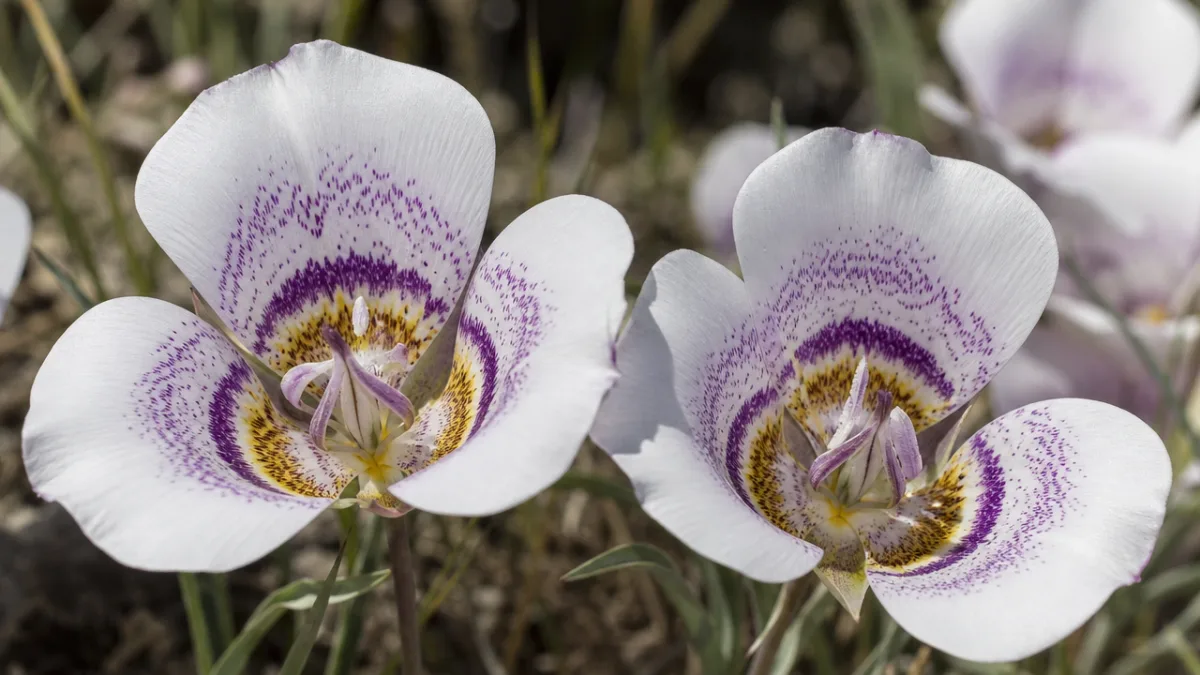
And what blooms they are. Each flower has three petals arranged in a loose cup shape, and they come in a color range that’s almost absurdly generous: white, cream, yellow, pale lilac, deep purple, vivid red. Nearly every petal carries a distinctive blotch near its base — usually dark red, maroon, or brownish — ringed by a contrasting zone of yellow or white. That central marking is one of the best ways to identify the species when you’re out in the field.
There are also three sepals, narrower and greenish with slightly pointed tips. Look closely at the inside of a petal and you’ll spot a patch of specialized hairs near the base called the “gland” — it plays a real role in attracting pollinators, as we’ll get to later. The gland is often framed by a fringe of hairs or a burst of contrasting color that adds yet another layer to the flower’s interior. It rewards a close look — the kind of look most wildflowers don’t quite merit.
Native Habitat and Geographic Distribution
Calochortus venustus is endemic to California — you won’t find it growing wild anywhere else on earth. Within the state, it’s surprisingly adaptable, turning up in grasslands, open woodlands, chaparral, and the grassy slopes of the Sierra Nevada foothills, anywhere from near sea level in coastal counties to well above 2,000 meters in the mountains. That kind of range says a lot about how long this plant has been quietly working out its relationship with California’s varied terrain.
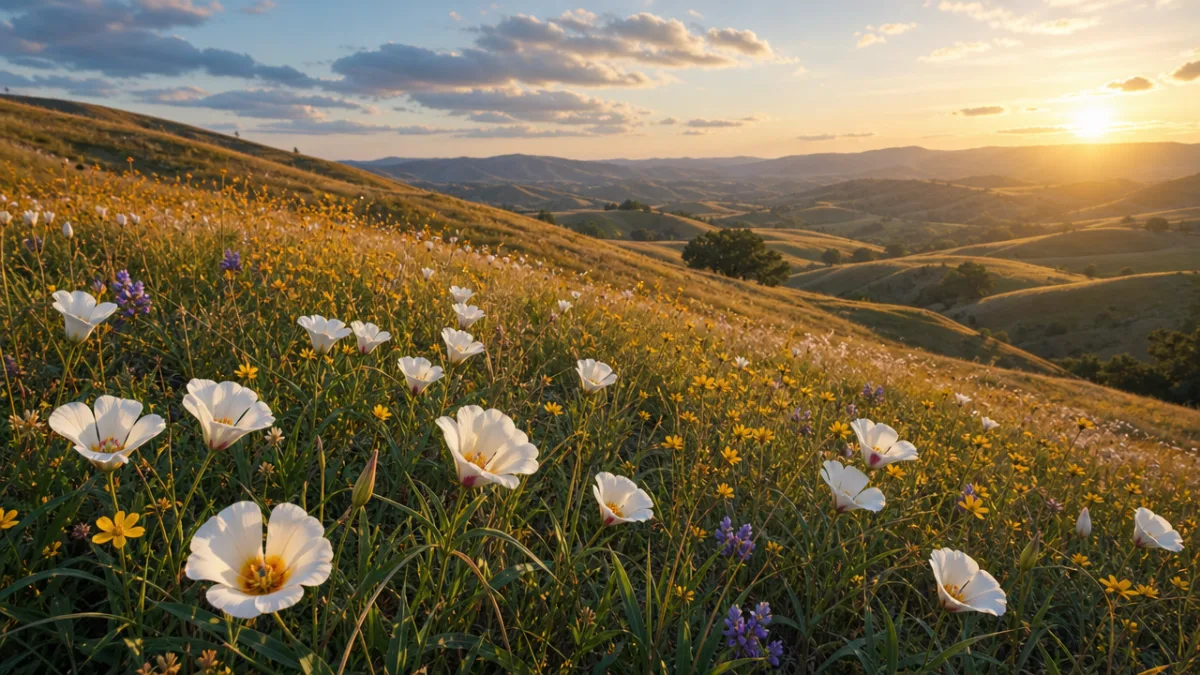
It has a strong preference for well-drained, often rocky or sandy soils, and it’s perfectly suited to California’s Mediterranean climate — those wet winters and punishingly dry summers that many plants struggle with. The corm just hunkers down underground through the dry season, waits out the heat, then comes roaring back when the autumn rains arrive. By late spring, when surrounding vegetation is already starting to crisp up, the Butterfly Mariposa Lily hits its peak and takes center stage.
If you’re hoping to see it in the wild, Tulare, Kern, San Luis Obispo, and Santa Barbara counties are good bets, along with parts of the Central Valley foothills, the Coast Ranges, and scattered Sierra Nevada sites. The species isn’t currently threatened or endangered, but individual populations can be fragile — vulnerable to habitat loss, invasive plants, and changing land use. Protected natural areas are doing a lot of heavy lifting when it comes to making sure this flower is still around for the next generation of wildflower fans.
Ecology and Pollination Biology
The ecological life of Calochortus venustus is every bit as interesting as the way it looks. Like most of its relatives, this lily has built a close working relationship with bees — particularly solitary bees in the families Halictidae and Andrenidae. Those gland structures on the petal interiors produce oils and secretions that bees find irresistible, while the bold markings act as visual landing guides, pointing pollinators straight toward the flower’s reproductive parts.
There’s also a more cunning side to the story. Some researchers have suggested that Calochortus flowers may practice a bit of pollinator deception, putting out visual and scent cues that bring in bees without always delivering a full nutritional reward in return. It’s a strategy more commonly associated with certain orchids, but it seems to play at least some role in how these lilies get pollinated. Whatever the exact mechanics, it works — wild populations set seed and persist across California’s landscapes year after year.
The plant’s ecological generosity doesn’t stop at pollinators. The corms are a food source for gophers, deer, and — historically — Indigenous California peoples who harvested them as a nutritious staple. The flowers also fill an important gap in the spring calendar, offering floral resources at a time when many other food sources are in transition. So while it’s easy to think of Calochortus venustus purely as a beautiful face, it’s doing real ecological work out there.
Cultural and Historical Significance
People have had a relationship with the Mariposa Lily for thousands of years in California. Indigenous peoples including the Paiute, Miwok, and various Sierra Nevada tribes knew the corms as a reliable food source — harvesting them in early spring before flowering, then eating them raw, roasting them in coals, or grinding them into flour. Ethnobotanical records describe them as especially valuable during lean times when other plant foods ran short. It’s a practical history that runs alongside the flower’s more poetic reputation.
When European and American settlers arrived, the Mariposa Lily caught their attention in both ways too. Pioneer accounts are full of admiring descriptions of these flowers encountered on spring journeys through California’s valleys. And for settlers facing food shortages, those corms sometimes proved genuinely lifesaving — there are mid-19th century survival stories that hinge in part on knowledge of the Mariposa Lily. It’s a rare plant that manages to be both a source of wonder and a source of dinner.
More recently, Calochortus venustus has settled into its role as an icon of California’s wildflower heritage. It shows up in botanical illustrations, wildflower guides, and posters, and it’s earned a devoted following among photographers and naturalists. It’s also attracted the interest of horticulturalists keen to grow it as a garden ornamental — though anyone who’s tried knows it asks for quite specific conditions before it’ll perform at its best.
Cultivation, Conservation, and How to Appreciate This Species Responsibly
Growing Calochortus venustus at home is one of those projects that can be genuinely rewarding — but it does demand that you take the plant’s natural preferences seriously. The key is getting as close as possible to the conditions it evolved in. That means providing:
- Excellent drainage, ideally in a raised bed or sloped position to prevent waterlogging of the corms during the dormant summer period.
- A Mediterranean-style watering regime, with regular moisture during the autumn through spring growing season and complete dryness during summer dormancy.
- Full sun exposure, as the plant naturally grows in open, unshaded habitats and requires high light levels to perform well.
- Lean, gritty soil with low organic matter content, mimicking the rocky or sandy substrates of its native range.
- Protection from excessive winter rainfall in regions with wetter climates than California’s, using a cold frame or cloche if necessary.
You can find corms through specialist native plant nurseries and reputable bulb suppliers — and buying from ethical, traceable sources really does matter here. Digging up wild plants is illegal in many areas and causes real damage to populations that can take years to recover. If you’re visiting these flowers in the wild, the best approach is simple: stay on the trails, leave the flowers where they are, and share what you know with other enthusiasts. Citizen science platforms like iNaturalist are a great way to log your sightings and contribute to the broader picture of where these plants are thriving and where they might be struggling.
The bigger conservation picture for Calochortus venustus comes down to habitat. California’s native grasslands and chaparral are among the most threatened ecosystems in North America, squeezed by urban growth, agricultural conversion, invasive annual grasses, and disrupted fire cycles. Supporting land trusts, native plant societies, and habitat restoration organizations is probably the most meaningful thing any individual can do for the long-term future of this flower. The California Native Plant Society, in particular, does important work monitoring native plant populations and pushing for policies that protect wildflower habitat across the state.
The Butterfly Mariposa Lily as Artistic Inspiration
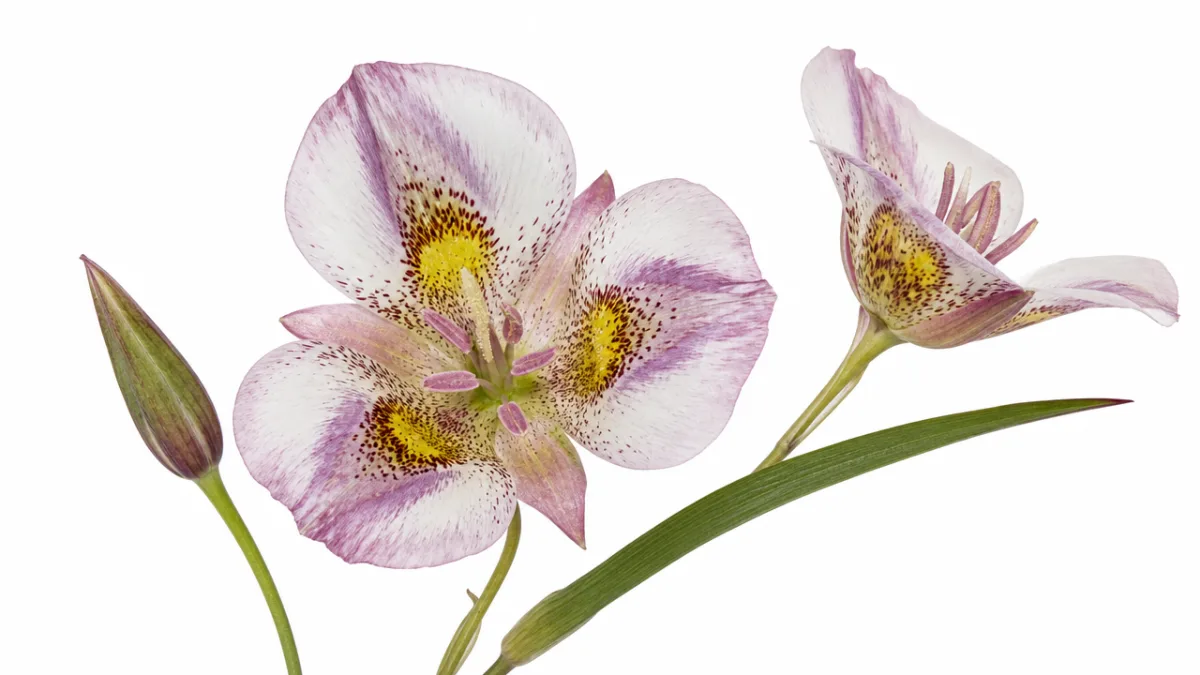
Calochortus venustus has been inspiring artists for a long time, and it’s easy to see why. The color variation alone gives you an enormous range to work with, and those intricate petal markings were practically made for botanical illustration — that demanding art form that asks you to be scientifically accurate and visually beautiful at the same time. Historical Calochortus illustrations from the 19th and early 20th centuries are genuinely stunning, capturing a delicacy and precision that even good photography sometimes can’t quite match.
Contemporary artists are still drawn to it. The flower translates well across media — it works in the luminous detail of watercolor, in the bold simplicity of linocut printmaking, in textiles and photography. There’s also something resonant about the Butterfly Mariposa Lily as a symbol of California’s natural landscape and regional identity, which feels especially meaningful at a time when people are thinking seriously about their connections to place and the natural world. Large-format botanical prints featuring Calochortus venustus have found a real audience among people who want a piece of that California wildflower magic on their walls at home.
Whether you first meet this flower on a sun-warmed California hillside, in the pages of a field guide, growing carefully tended in a specialist garden, or framed as a botanical print on a wall, the Butterfly Mariposa Lily has a way of sticking with you. The combination of visual splendor, ecological depth, cultural history, and botanical fascination makes Calochortus venustus one of California’s genuine treasures — a flower that earns both its Latin name and its poetic common name every single time it blooms.








What do you think?
It is nice to know your opinion. Leave a comment.