










No-Paint Paper Bowl Jellyfish Craft: The Ultimate Easy Ocean Summer Craft for Toddlers & Preschoolers
Why This Paper Bowl Jellyfish Craft Is Perfect for Little Ones
If you’ve ever tried to do a craft with a toddler, you already know the secret formula: keep it simple, make it fun to touch, and end up with something your little one is genuinely proud of. This no-paint paper bowl jellyfish hits all three — and it’s honestly one of my favorite summer activities for that reason. Oh, and there’s a very good chance you already have everything you need sitting in a drawer or your recycling bin right now.
Kids between two and five are at that sweet spot where hands-on crafting does a lot of good — things like tearing, threading, sticking, and decorating are all quietly building the fine motor skills they’ll need for writing down the road. This jellyfish craft was designed with that age range in mind, which means no paintbrushes, no waiting for things to dry, and no cleanup that makes you regret the whole idea before it’s even finished.
Skipping paint wasn’t an accident here. Paint is great for older kids, but for toddlers who haven’t quite figured out brush control yet, it often leads to a lot of brown mush and frustration. Using tissue paper, stickers, markers, or collage materials instead gives you all the color payoff without the chaos. Parents, teachers, and caregivers can actually relax — the table, the clothes, and the walls will all survive this one just fine.
Gathering Your Supplies: Everything You Need for Jellyfish Magic
One of the best things about this craft is how short the supply list is. The star of the show is a plain paper bowl — the kind you’d grab for a backyard cookout. That humble little bowl becomes a beautifully domed jellyfish body, and the three-dimensional shape gives the finished craft a wow factor that flat paper projects just can’t match. Grab a few extra bowls so enthusiastic crafters can make a whole jellyfish family if the mood strikes.
Then there are the tentacles, which — let’s be real — are the most exciting part. You’ve got lots of options depending on what’s already in your craft stash. Crepe paper streamers in ocean colors like blue, purple, teal, and pink are perfect and have that lovely floaty quality that looks just like the real thing. Tissue paper strips, ribbon, curling ribbon, or even colorful cut-up plastic bags all work great too. The mix of textures is part of what makes this such a fun sensory experience for little hands.
Here’s everything you’ll want to gather before you sit down together:
- Paper bowls (one per jellyfish, plus a few extras)
- Crepe paper streamers or tissue paper strips in ocean colors
- Googly eyes in assorted sizes (two per jellyfish)
- Glue stick or child-safe craft glue
- Hole punch or scissors (for adult use only)
- Tape or a stapler for securing the tentacles
- Markers, crayons, or foam stickers for decorating the body
- Optional: glitter glue, sequins, or foam shapes for extra sparkle
- Optional: string or fishing line if you want to hang the finished jellyfish
Getting everything out and ready before you call the kids over makes a huge difference. Toddlers do not wait patiently while you hunt for scissors, and nothing kills the creative momentum faster than having to stop mid-project. Set up your supplies in small bowls or trays so everything is easy to reach, and you’ll be amazed how independently even very young kids can work through this once it’s all laid out in front of them.
Step-by-Step Instructions: Making Your Paper Bowl Jellyfish
The whole process is wonderfully straightforward — here’s how to walk through it so even the youngest crafters can feel involved at every step. Start with the paper bowl, which will be the jellyfish’s big round body. An adult should use a hole punch (or carefully poke holes with scissors) around the rim of the bowl, spaced a few centimeters apart. These holes are what hold the tentacles securely and give that full, flowing look that makes the finished craft so satisfying.
Next up is decorating the bowl, which is where kids really get to do their own thing. Put out some markers, crayons, foam stickers, or small torn pieces of tissue paper that can be glued on. Let your child take the lead on colors and designs — some kids go all-in with rainbow stripes, others want ocean blue all over, and some will cover every inch in polka dots. There is genuinely no wrong answer, and if you’re doing this in a classroom, seeing all the different finished jellyfish displayed together is such a treat.
Once the body is decorated, it’s tentacle time. Thread strips of crepe paper, ribbon, or tissue paper through the holes around the rim and secure each one with a knot or a little piece of tape on the inside. For younger toddlers, an adult can do the threading while the child picks the colors and helps pull them into place. Older preschoolers can often manage much of this themselves, and you can see on their faces exactly how proud that makes them.
The finishing touch that really brings everything to life? Googly eyes. Press or glue two onto the inside curve of the bowl where the face would be, and suddenly the whole thing transforms from a pretty decoration into an actual little character with its own personality. A lot of kids love adding a smile with a marker too, turning their jellyfish into a happy little ocean buddy. If you’re planning to hang the jellyfish, have an adult attach a piece of fishing line or thread through the top of the bowl before decorating begins.
Learning Through Play: The Developmental Benefits of This Craft
Here’s the thing about crafting with young kids — the finished jellyfish is cute, but that’s honestly the least important part of what’s happening. When a toddler tears tissue paper into pieces, they’re building the tiny hand muscles they’ll eventually use to hold a pencil. When a preschooler decides which colors to use for the tentacles, they’re practicing making decisions and figuring out what they like. Every little action in this project is quietly doing something useful, which is why it’s such a genuinely great activity and not just a way to fill an afternoon.
The jellyfish theme also opens the door to some really fun early science conversations. While kids are working, you can chat about what jellyfish actually are, where they live, what they eat, and what makes their tentacles so special. Drop in the fact that jellyfish have been around for over five hundred million years — way before the dinosaurs — or that some species actually glow in the dark, and you will get the most wonderfully dramatic reactions from a room full of preschoolers. It’s science learning that doesn’t feel like learning at all.
Language development gets a big boost from these kinds of guided craft sessions too. Kids naturally pick up new words when they’re hearing them in context — words like tentacle, transparent, dome, ocean, and float can all enter a child’s vocabulary just through natural conversation while you work together. Narrating as you go (“Now we’re threading the purple ribbon through the hole!”) gives kids rich language input without any flashcards or worksheets. Research backs this up pretty strongly: kids who do hands-on activities paired with conversation tend to develop stronger language skills than those who learn primarily from screens.
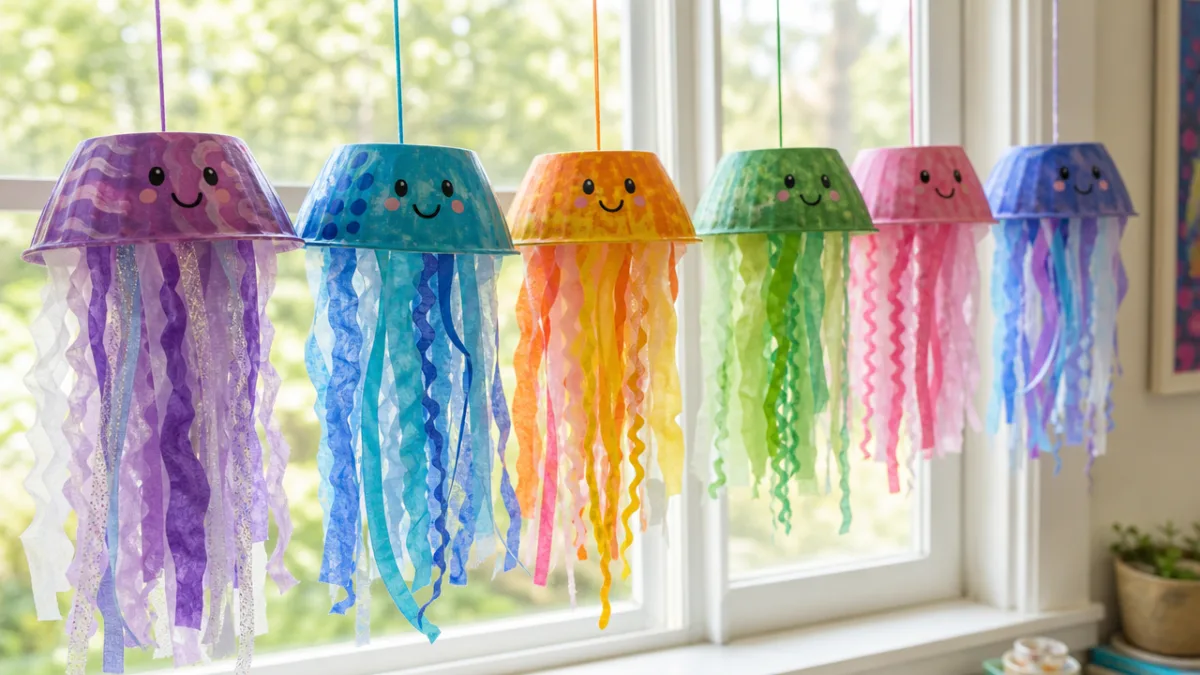
And there’s the social and emotional side of things too. Crafting together teaches patience, builds confidence, and gives kids the deeply satisfying experience of seeing something through from start to finish. When a collection of jellyfish gets hung up in a classroom or across a window at home, each child can point to theirs and feel that little glow of pride and belonging. Those feelings stick around long after the paper bowl has seen better days.
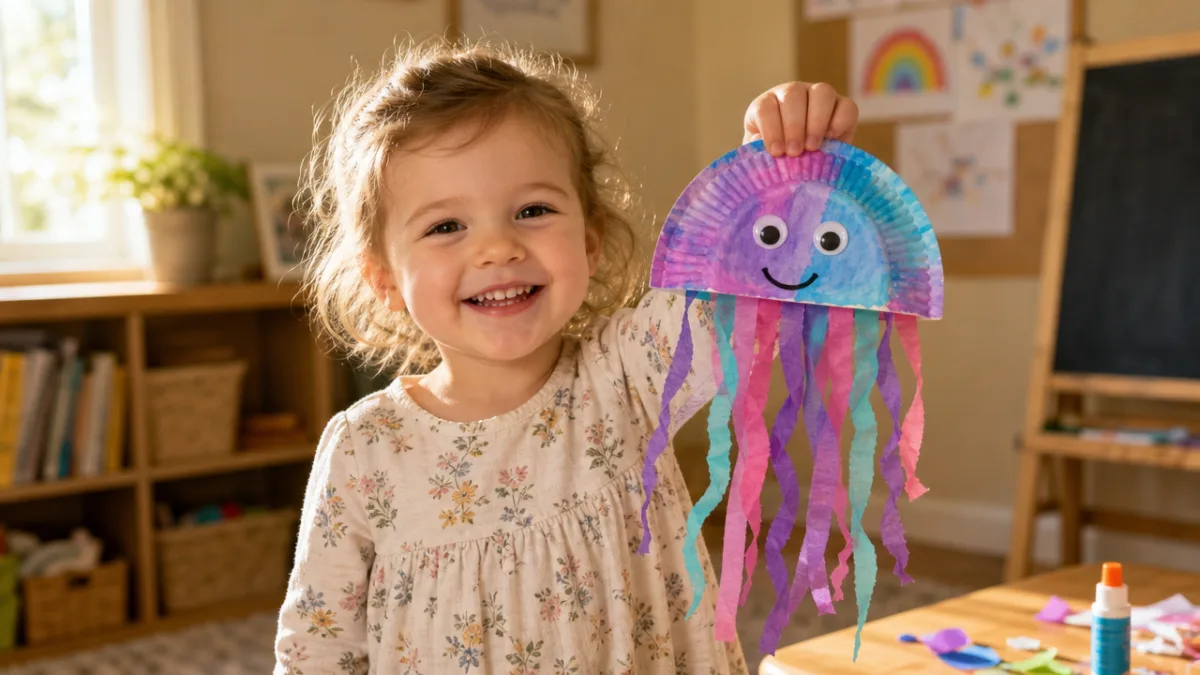
Tips, Variations, and Ways to Extend the Fun
Once you’ve made one round of jellyfish, kids almost always want to make more — and there are so many easy ways to keep the excitement going. Try metallic or holographic crepe paper for tentacles that shimmer in the light and give the whole thing that almost-magical bioluminescent look. Swapping plain white bowls for colored or patterned ones changes the whole vibe of the finished jellyfish and means younger toddlers can skip a lot of the decorating step and still end up with something that looks really cool.
For a full ocean-themed craft day, pair the jellyfish with other quick paper bowl or paper plate projects — fish, starfish, crabs, sea turtles. Then stick everyone’s finished creatures onto a big sheet of blue bulletin board paper on the wall for a collaborative ocean mural that kids can keep adding to. Group projects like that give individual work a bigger context, and kids light up when they can see how their piece fits into the whole picture. It becomes one of those things they stop and look at every time they walk past.
The jellyfish also make a wonderful jumping-off point for imaginative play and storytelling. Once a child has one in their hands, ask them what their jellyfish’s name is, where it lives, and who its friends are — and then just step back and watch the story unfold. That kind of open-ended imaginative play is incredibly valuable for development, and it costs nothing beyond a little encouragement and genuine curiosity about whatever they come up with.
Here are a few more ideas for stretching the fun beyond the craft table:
- Hang a mobile: String several finished jellyfish from a wooden dowel or wire hanger for a beautiful ocean mobile that looks lovely hanging from a bedroom or classroom ceiling.
- Pair with ocean books: Read a picture book about sea creatures before or after crafting to connect the activity to early literacy in a really natural way.
- Create an ocean sensory bin: Fill a plastic tub with blue water beads or water and small toy sea creatures to go along with the jellyfish theme.
- Host a jellyfish parade: Let kids carry their finished jellyfish through the house or classroom in a completely silly, completely joyful parade to show off what they made.
- Photograph and document: Take a photo of each child with their finished jellyfish for a portfolio or to share with family members who’d love to celebrate the achievement.
Making Summer Memories: The Bigger Picture of Crafting with Young Children
Summer with young kids has this particular quality to it — longer days, slower mornings, and a little more room to just sit and make something together without rushing off to the next thing. Screens and structured activities have their place, but there’s really nothing quite like spreading out some colorful supplies on the table and just seeing what happens. This no-paint jellyfish craft fits that summer energy perfectly: it’s low-pressure, it’s joyful, it’s process-focused, and you don’t need any special skills or a craft store budget to pull it off.
Early childhood research is pretty consistent on this: kids who get regular time for hands-on creative play tend to show stronger problem-solving skills, more emotional resilience, and greater self-confidence. When we give young children the time and materials to make things, we’re telling them something important — that their ideas matter, that creating is worthwhile, and that trying something new even when it gets a little messy is always worth it. That’s a lot more valuable than whatever ends up on the refrigerator door.
This jellyfish craft is also a nice reminder that the best kids’ activities don’t need to look Pinterest-perfect or cost very much at all. A paper bowl, some colorful streamers, and a couple of googly eyes are genuinely all it takes to create one of those wonderful little moments. The jellyfish your child makes won’t look like a craft store sample — it’ll look like them, full of personality and happy imperfection, which makes it so much better than anything you could buy.
Whether you’re doing this on a slow summer afternoon at home, weaving it into a preschool ocean unit, or setting it up as a birthday party activity, you’re giving kids something worth keeping — the skills they practice, the pride they feel, and the memory of making something wonderful with you. So grab your paper bowls, cut your streamers, stick on those googly eyes, and dive in. Your little jellyfish artists are more than ready.








What do you think?
It is nice to know your opinion. Leave a comment.