










21 Plants That Thrive Next to Catmint: Your Complete Companion Planting Guide
Understanding Catmint and Why Companion Planting Matters
Catmint (Nepeta spp.) is one of the most rewarding plants you can introduce to a garden. With its silvery-blue foliage, cascading lavender-blue flower spikes, and intoxicating fragrance, it brings beauty, texture, and ecological function all at once. But beyond its individual appeal, catmint truly shines when thoughtfully paired with the right neighboring plants. Understanding why companion planting works — and why catmint is such an exceptional partner — is the first step toward designing a garden that practically takes care of itself.
Companion planting is the practice of growing different plants in close proximity so they mutually benefit one another. The benefits can be physical, such as one plant providing shade or support for another, or they can be biological, such as pest deterrence, pollinator attraction, or improved soil chemistry. Catmint excels in several of these roles simultaneously. Its strong aromatic oils naturally repel aphids, flea beetles, and other soft-bodied pests, creating a protective buffer around vulnerable neighboring plants without the need for chemical intervention.
Catmint also blooms prolifically from late spring through fall, especially when cut back after its first flush. This extended bloom period makes it a powerhouse for attracting bees, butterflies, and beneficial insects that double as natural predators for garden pests. When you place catmint strategically in your beds and borders, you are essentially installing a living pest management and pollination system. The plants you choose to surround it with will either amplify or diminish these effects, which is why knowing the best companions matters so much.
Sun-Loving Perennials That Pair Beautifully With Catmint
Roses are perhaps the most iconic companion for catmint, and the pairing has been celebrated by gardeners for generations. The classic combination of rose bushes underplanted with billowing catmint creates a romantic, cottage-garden aesthetic that is as functional as it is beautiful. Catmint’s pest-repelling fragrance deters aphids — one of the rose’s most persistent enemies — while its sprawling, low growth habit suppresses weeds around the rose’s root zone. The blue and purple tones of catmint flowers provide a cool counterpoint to the warm pinks, reds, and yellows of most rose varieties.
Salvia is another exceptional sun-loving companion for catmint. Both plants belong to the mint family (Lamiaceae), share similar Mediterranean growing preferences, and produce vertical flower spikes that echo each other beautifully in form while differing in color. Pairing deep blue or red salvias with the softer lavender tones of catmint creates layered visual interest from midsummer onward. From a practical standpoint, both plants attract the same beneficial insects, so placing them together creates a concentrated hub of pollinator activity in your garden.
Echinacea, or coneflower, rounds out a trio of sun-loving perennial companions that work exceptionally well with catmint. Their bold, upright daisy-like blooms in shades of purple, pink, orange, and white provide vertical punctuation that contrasts with catmint’s mounding, horizontal growth. Echinacea blooms later in summer, ensuring continuous color in the border even after catmint’s first flush has been trimmed back. Together, they create a long-season display that supports pollinators well into autumn, when other food sources are becoming scarce.
Other sun-loving perennials worth planting alongside catmint include:
- Russian Sage (Perovskia atriplicifolia) — shares similar silvery foliage and airy purple flowers, creating a harmonious, drought-tolerant combination
- Black-eyed Susan (Rudbeckia) — bold golden blooms contrast strikingly against catmint’s cool blue-purple tones
- Agastache (Hyssop) — another aromatic, pollinator-magnet that amplifies catmint’s insect-attracting power
- Yarrow (Achillea) — flat-topped flower clusters provide textural contrast and attract predatory wasps that control pest populations

Ornamental Grasses and Structural Plants as Catmint Partners
Ornamental grasses make surprisingly effective companions for catmint, primarily because they offer everything catmint itself does not: height, vertical structure, and a different textural vocabulary altogether. Feather reed grass (Calamagrostis acutiflora ‘Karl Foerster’), for example, sends up tall, feathery plumes by early summer that remain attractive well into winter. When planted behind a generous drift of catmint, the contrast between the upright, linear grass and the loose, mounding catmint creates a planting composition that looks intentional and sophisticated rather than haphazard.
Blue oat grass (Helictotrichon sempervirens) is a particularly harmonious grass companion because its steel-blue coloration closely mirrors the silvery-blue foliage of catmint. Planting these two together creates a monochromatic cool-toned composition that reads as calm and elegant in the garden. Both plants are drought-tolerant once established and thrive in well-drained soils, meaning they share nearly identical care requirements — a practical consideration that simplifies garden maintenance considerably throughout the growing season.
Lavender deserves special mention as a structural companion that bridges the world between shrubby Mediterranean herbs and ornamental perennials. Its upright, woody form and vertical flower spikes contrast beautifully with catmint’s looser habit, while the two plants share an almost identical cultural profile: full sun, lean well-drained soil, drought tolerance, and a deep attractiveness to bees and butterflies. Lavender and catmint together create a fragrant, silver-and-purple tapestry that requires minimal water, making this combination one of the most sensible pairings for water-wise or xeriscape garden designs.
Alliums — ornamental onions — are another structural choice that complements catmint magnificently. Their spherical purple or white flower heads rise on tall, bare stems in late spring, floating above the emerging catmint foliage like botanical balloons. By the time the allium blooms fade, catmint is in full flowering mode and neatly disguises the allium’s dying foliage — a tidy functional trick that makes both plants look better simultaneously. This kind of temporal and visual synergy is exactly what the best companion planting combinations achieve.
Vegetables and Edibles That Benefit From Catmint Nearby
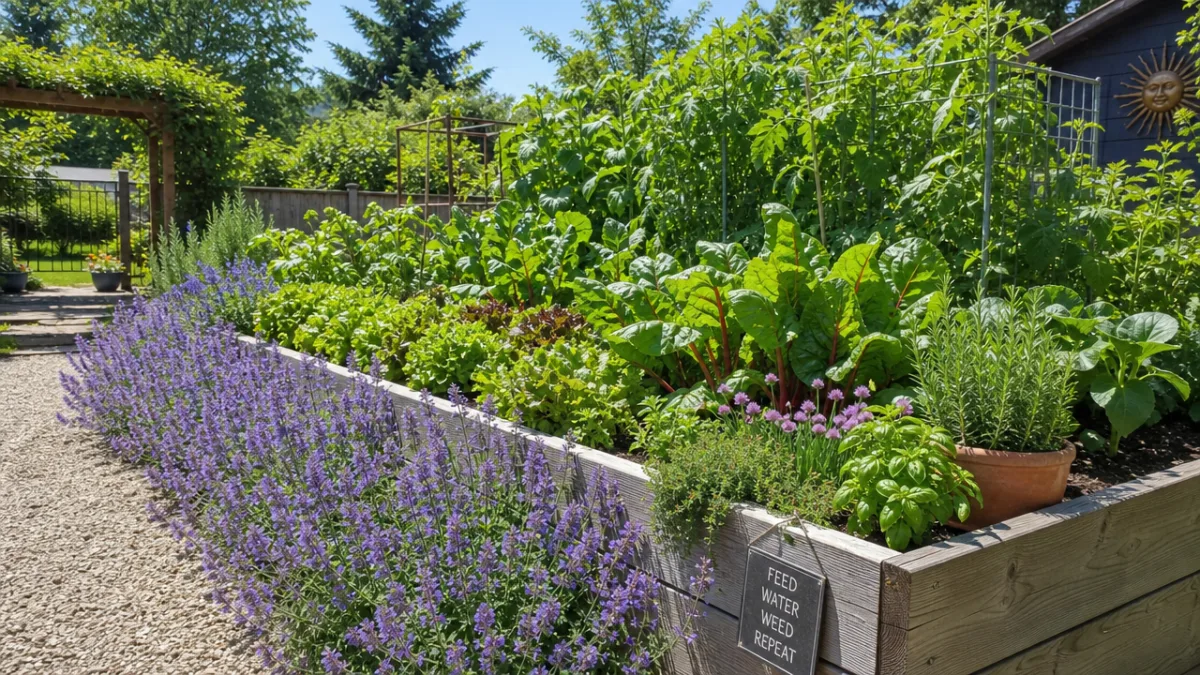
Catmint’s pest-repelling properties make it tremendously valuable in and around the vegetable garden, not just in purely ornamental borders. When planted at the edges of raised beds or along the perimeter of kitchen garden plots, it creates an aromatic barrier that confuses and deters insects that navigate by scent. Squash, cucumbers, and melons — crops that are frequently plagued by aphids, cucumber beetles, and squash bugs — benefit significantly from having catmint growing in close proximity, reducing pest pressure naturally without compromising the organic integrity of your food garden.
Tomatoes and peppers are two more edible crops that respond well to catmint as a neighbor. These crops often attract whiteflies, aphids, and flea beetles, all of which are deterred by catmint’s volatile aromatic compounds. At the same time, the beneficial insects drawn to catmint’s flowers — particularly parasitic wasps and predatory beetles — actively prey on the larvae and eggs of the very pests that would otherwise damage your tomato and pepper plants. This creates a self-regulating ecosystem within your garden that reduces the need for intervention of any kind.
Brassicas such as cabbage, broccoli, kale, and Brussels sprouts face persistent pressure from cabbage white butterflies and their caterpillars. While no single plant provides a complete solution to this challenge, catmint planted nearby has been shown to reduce the incidence of butterfly landing and egg-laying on brassica crops. The fragrance appears to interfere with the butterfly’s ability to locate its preferred host plants. Combining catmint with other deterrent companion plants like nasturtiums and dill creates a layered defense that significantly reduces brassica pest damage over a full growing season.
Herbs also make wonderful edible companions for catmint in the kitchen garden setting:
- Thyme — equally drought-tolerant and aromatic, with small flowers that attract the same beneficial insects
- Oregano — shares Mediterranean growing conditions and deters similar pest species when fragrant oils are released
- Chives — their purple allium flowers echo catmint’s color palette while repelling aphids from nearby crops
- Sage — silvery foliage and upright habit create a textural complement to catmint’s cascading growth
- Fennel — attracts swallowtail butterflies and parasitic wasps when allowed to flower, amplifying catmint’s beneficial insect benefits
Spring Bulbs and Annuals That Work in Seasonal Harmony With Catmint
One of catmint’s most underappreciated qualities in the garden is its role as a camouflage plant for spring bulbs. Tulips, daffodils, and alliums produce gorgeous blooms in spring but leave behind untidy, dying foliage that takes weeks to die back completely before it can be removed. Catmint, which is just beginning to push up fresh new growth in early to mid-spring, naturally grows up and over this dying foliage, hiding it from view and keeping the garden looking clean and intentional. This is a functional partnership with no downsides, making it one of the most reliable bulb-companion combinations available to gardeners.
Geraniums — both the hardy perennial Geranium species and the annual Pelargonium types — are effective and cheerful companions for catmint in mixed borders and container plantings. Hardy geraniums with their fine-textured foliage and delicate flowers in magenta, pink, or white weave attractively through the base of catmint, filling gaps in the planting and providing ground-level interest where catmint’s stems are woodier and less leafy. The two plants together create a dense, weed-suppressing carpet of foliage that is both beautiful and practical throughout the entire growing season.
Verbena bonariensis is a tall, airy annual (or short-lived perennial in mild climates) that makes a stunning seasonal partner for catmint. Its tall, wiry stems carry clusters of tiny violet-purple flowers that hover above other plantings in a cloud-like effect, while its narrow, mostly bare stems allow views through the planting without blocking the catmint beneath. The two plants share a color family that creates cohesion without monotony, and both are irresistible to butterflies. Together, catmint and verbena create one of the most butterfly-friendly planting combinations you can design in a temperate garden.
Shrubs and Woody Plants That Complement Catmint in the Landscape
Spirea is a versatile flowering shrub that pairs exceptionally well with catmint across a wide range of garden styles. The gold-leafed varieties such as Spirea japonica ‘Gold Flame’ or ‘Magic Carpet’ create a vivid color contrast with catmint’s cool blue-purple flowers, while the white-flowering species like Spirea vanhouttei echo the airy, romantic quality of catmint’s clouds of bloom. From a practical standpoint, both plants are hardy, adaptable, and relatively low-maintenance, making this a combination that delivers high visual impact without demanding intensive care from the gardener.
Weigela is another reliable shrub companion, particularly the dark-leafed varieties such as ‘Wine and Roses’ or ‘Midnight Wine,’ whose deep burgundy or purple foliage creates a dramatic backdrop for catmint’s silvery leaves and blue flowers. The contrast of dark against light, coarse shrub foliage against fine catmint texture, and upright structure against mounding habit produces a composition that is visually dynamic and seasonally interesting. Weigela’s spring flowers also attract hummingbirds, adding yet another dimension of ecological value to the planting combination.
Butterfly bush (Buddleja davidii), despite its invasive reputation in some regions (always check local guidance before planting), is where planted appropriately an extraordinarily effective companion for catmint. Both plants are magnets for butterflies and bees, and their combined flowering period covers a significant portion of summer. The tall, arching form of butterfly bush provides height and structure that catmint, as a low mounding plant, simply cannot achieve on its own. Planted together, they create a tiered composition that functions as a high-value wildlife habitat while remaining visually attractive from midsummer through to the first frosts of autumn.
For a comprehensive garden plan incorporating catmint with woody plants, consider these additional shrub companions:
- Caryopteris (Bluebeard) — late-summer blue flowers harmonize perfectly with catmint’s color palette and attract an identical range of pollinators
- Potentilla — compact, long-blooming shrub with yellow or white flowers that contrast warmly against catmint’s cool tones
- Dwarf lilac (Syringa meyeri) — fragrant spring blooms complement catmint’s early season growth before its own flowers emerge
- Rose of Sharon (Hibiscus syriacus) — late-blooming shrub that extends the season well after catmint’s primary display is finished

Designing With Catmint: Putting It All Together
Knowing which plants pair well with catmint is only the beginning — the real art lies in assembling these combinations into cohesive garden designs that work across seasons, not just at a single moment in time. The most successful catmint-centered gardens think in layers, with taller structural plants like ornamental grasses, salvias, and shrubs providing the background, catmint itself occupying the middle ground as a soft, flowing connector, and lower companions like hardy geraniums and thyme filling in at the front edge. This layered approach ensures that there is always something interesting happening at every level of the planting from ground to eye level.
Color repetition is a fundamental design principle that catmint makes surprisingly easy to apply. Because catmint’s blue-purple tone is relatively neutral and sits comfortably alongside warm colors, cool colors, and neutral whites and silvers, it can serve as a visual thread that ties together a border containing many different plant species. By repeating drifts of catmint at intervals along a long border, you create a rhythmic, unified composition even when the plants between each catmint grouping are completely different. This is one of the techniques that professional garden designers use most often, and it is one that catmint facilitates beautifully.
Timing your companion plant selections to cover catmint’s natural ebb and flow through the season is also essential for a border that looks good consistently rather than only sporadically. Catmint blooms heavily in late spring and early summer, then benefits from being cut back hard in midsummer, during which it looks somewhat ragged for a few weeks before rebounding with a fresh flush of growth and flowers in late summer and fall. Choosing companions that look their best precisely during catmint’s midsummer lull — echinacea, rudbeckia, agastache, and tall salvias, for example — ensures that the garden always has something beautiful to show regardless of where catmint happens to be in its natural cycle at any given moment.
Finally, do not underestimate catmint’s value in less formal, naturalistic, or wildlife-focused garden styles. While it is undeniably at home in the structured elegance of a classic rose and perennial border, catmint is equally effective cascading over the edge of a gravel garden, threading through a meadow planting of native grasses and wildflowers, or tumbling over a stone wall in a cottage garden setting. Its adaptability across styles and conditions, combined with the rich ecological relationships it fosters with its companion plants, makes catmint one of the most genuinely useful and versatile plants a gardener of any experience level can choose to grow. The twenty-one plants highlighted throughout this guide represent only a starting point — once you begin experimenting with catmint companions in your own garden, you will quickly discover that the possibilities are as expansive as your imagination and your growing space allow.








What do you think?
It is nice to know your opinion. Leave a comment.