










20+ Favorite Flowering Vines and Climbing Plants for Your Garden
Introduction: The Magic of Vertical Gardening
Flowering vines and climbing plants might just be the most underrated category in gardening. Whether you’re working with a sprawling property or a tiny urban balcony, these plants have a remarkable knack for turning blank vertical spaces into lush, colorful, fragrant walls of life. They want to grow up, and that instinct makes them natural partners for fences, trellises, arbors, pergolas, and even those bare, uninviting walls that you’ve never quite figured out what to do with.
What really sets climbing plants apart isn’t just how gorgeous they can be — it’s how wildly diverse they are. From the delicate, papery blooms of clematis to the bold tropical drama of bougainvillea, there’s a flowering vine for nearly every climate, soil type, and personal style. Gardeners in cold northern zones get to enjoy the fleeting but jaw-dropping displays of wisteria and climbing roses. Those lucky enough to garden in warmer southern climates can have passionflowers and mandevilla putting on a show virtually year-round. No matter where you live, there’s a climbing plant out there waiting to become your new obsession.
And vines aren’t just pretty faces. They pull serious weight in the garden ecosystem too. Dense climbers provide shelter for birds and beneficial insects, help insulate walls (which can actually lower your energy bills), create natural privacy screens, and can even help hold slopes in place. Many produce berries or seed heads that keep wildlife fed through the lean months of fall and winter. Once you start thinking of vines as both ornamental and ecological assets, you’ll make much smarter decisions about which ones to bring into your garden.
Classic Favorites: Timeless Flowering Vines Every Gardener Should Know
There’s a reason climbing roses have been adorning garden walls and trellises for generations, and it has everything to do with the sheer payoff they deliver. Varieties like ‘New Dawn,’ ‘Cecile Brunner,’ and ‘Don Juan’ offer breathtaking flushes of bloom in colors ranging from the purest white to the deepest crimson. The good news is that modern breeding has made climbing roses more disease-resistant and more reliably repeat-blooming than ever before. A well-chosen climber can keep sending out fragrant waves of color from late spring right through the first frosts of autumn — which makes them one of the best investments you can make in your garden.
Clematis is another one that no garden should be without. With hundreds of species and thousands of cultivars, there’s a clematis for every season and every color scheme you can dream up. Large-flowered hybrids like ‘Jackmanii’ and ‘Nelly Moser’ put on a spectacular summer show, while sweet autumn clematis blankets late-season gardens in clouds of tiny, intensely fragrant white flowers. The one thing you really need to nail with clematis is understanding which pruning group your variety belongs to, because wrong-time pruning is the number one reason these otherwise easygoing plants fail to perform. Get that right, and they’ll reward you generously.
Wisteria is one of those plants that stops people in their tracks. Those long, pendulous clusters of lilac, purple, or white flowers arrive in mid-spring just before the leaves come in, creating a cascading waterfall effect that’s genuinely hard to believe is real. Japanese and Chinese wisteria are the most common, but if you have a smaller garden, it’s worth seeking out American or Kentucky wisteria — they’re less aggressive and a lot more manageable. Once wisteria gets settled in, it becomes a true garden heirloom. These plants can live and bloom for well over a century, so you’re really planting something for the ages.
Tropical and Tender Climbers: Bringing Exotic Drama to Your Garden
If you want a plant that absolutely commands attention, bougainvillea is your answer. It can turn an ordinary wall or fence into a blazing spectacle — and interestingly, those vivid “petals” everyone admires are actually bracts, which are modified leaves surrounding the tiny true flowers at the center. Bougainvillea comes in magenta, orange, red, white, pink, coral, and more, and it thrives on a bit of neglect: hot, dry conditions suit it perfectly, and over-watering or over-fertilizing will actually work against you. In frost-free climates it blooms almost nonstop. In colder regions, it makes a fantastic container plant that you can bring inside for the winter.
Mandevilla has really hit its stride in popularity lately, and it’s easy to see why. Those large, trumpet-shaped blooms in rich pink, red, or white are simply gorgeous, and they pop beautifully against the plant’s glossy, deep green foliage. Mandevilla climbs by twining around whatever support it can find and takes off quickly in warm weather, making it a great option when you need something to cover a trellis or obelisk in a hurry. In USDA zones 9 and warmer, treat it as a perennial. Everywhere else, it shines as a summer annual that gives you a lot of tropical drama for the effort.
Passionflower is just extraordinary — there’s really no other word for it. The blooms look almost engineered, with rings of delicate filaments in purple, blue, white, and pink arranged around a central structure that has inspired centuries of spiritual symbolism. But beyond the visual spectacle, passionflowers are the only larval host plant for several butterfly species, including the stunning zebra longwing and Gulf fritillary, which makes them genuinely invaluable in any wildlife-friendly garden. On top of all that, many species produce edible passion fruit. It’s hard to think of another garden plant that delivers so much on so many different levels.
Fast-Growing Vines: Quick Solutions for Privacy and Coverage
When you need coverage fast, annual vines are where it’s at. Morning glories are about as easy and rewarding as fast-growing annuals get — they produce a seemingly endless stream of funnel-shaped flowers in shades of blue, purple, pink, red, and white all through the warm months. You can direct-sow them right in the garden, and under good conditions their twining stems will cover a fence or trellis in just a few weeks. Each flower opens fresh in the morning (it’s right there in the name) and closes by afternoon, creating this lovely daily rhythm that keeps you more connected to the natural world than you might expect from a humble annual vine.
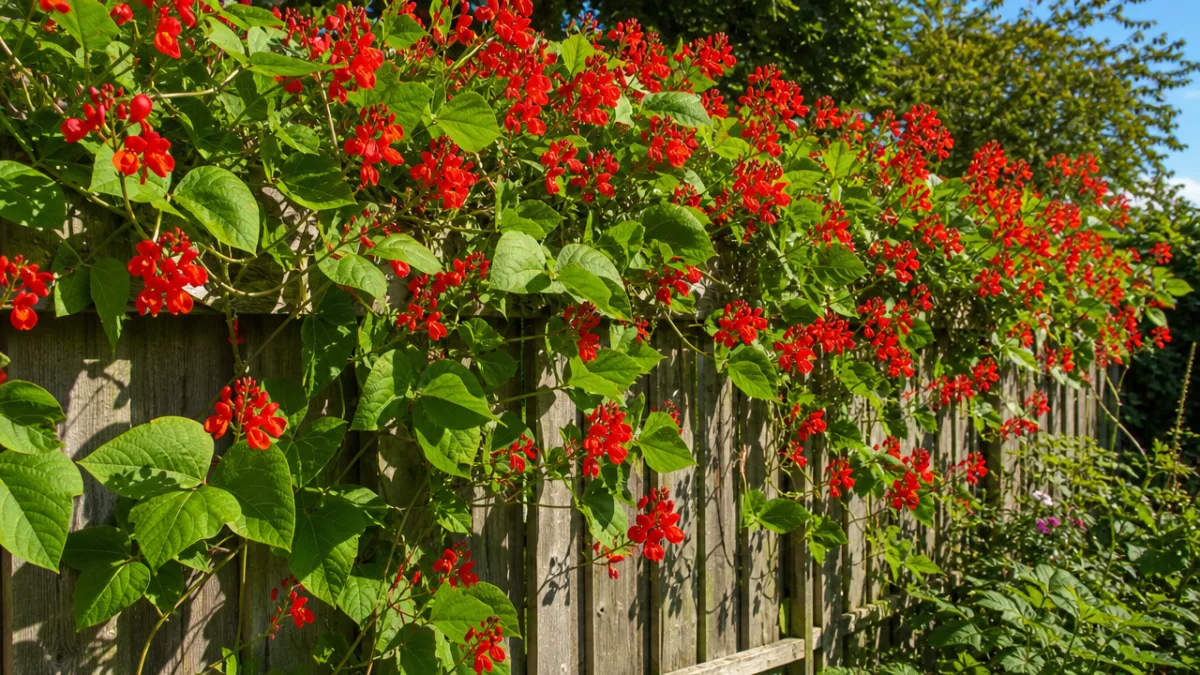
Scarlet runner bean might be the most satisfying plant in this whole list, simply because it refuses to be put in a box. Is it ornamental? Yes — those bright vermillion flowers are hummingbird magnets that cheerfully color your garden all summer long. Is it edible? Also yes — the beans are genuinely delicious when picked young and tender. Few plants offer that combination of beauty, wildlife value, and a harvest you can actually eat. Scarlet runners grow quickly to ten feet or more and fit just as naturally in a vegetable garden as they do woven through an ornamental border. It’s a plant that earns its space every single day.
Hyacinth bean vine, or Lablab purpureus, is one of those plants that more gardeners should know about. It produces rosy-purple flowers followed by glossy, deep purple seed pods so vivid and lustrous they genuinely look fake. Even the foliage carries purple tones, giving the whole plant a rich, jewel-like quality that’s hard to match. It grows with real speed in warm weather and handles heat that would flatten a lot of other ornamentals. Try pairing it with the silvery foliage of dusty miller or the golden blooms of black-eyed Susans — it’s the kind of combination that makes visitors stop and ask what on earth that plant is.
Shade-Tolerant Climbing Plants: Solutions for Challenging Spots
Finding beautiful plants that actually perform well in shade is one of gardening’s perennial headaches, and flowering vines are no exception. But there are some real gems out there for the shadier spots in your garden. Climbing hydrangea is arguably the best of them — it produces large, lacy white flower heads in midsummer against big, bold, heart-shaped leaves, and it clings to walls using aerial rootlets that won’t cause the damage you’d get from English ivy. Fair warning: it’s slow to establish in those first couple of years. But once it gets going, you’ll have a truly magnificent, long-lived plant that just gets better with age.
Honeysuckle is another one that handles partial shade beautifully, and it rewards you with some of the most intensely fragrant flowers you’ll ever grow. Lonicera periclymenum and its cultivars are particularly well-suited to temperate gardens, producing creamy white and yellow tubular flowers that save their sweetest perfume for the evenings, drawing in moths and other nocturnal pollinators. If you’re in North America, the native coral honeysuckle, Lonicera sempervirens, is a particularly smart choice — it delivers all the garden charm while supporting hummingbirds and native bees, and it doesn’t carry the invasive tendencies that make Japanese honeysuckle a problem in many parts of the country.
Virginia creeper and Boston ivy are mostly grown for their fall foliage rather than their flowers, but they absolutely belong in this conversation for the sheer drama of what they do come autumn. These tough, adaptable climbers spend summer looking pleasantly green, then erupt into blazing shades of crimson, scarlet, and burgundy as temperatures drop — it’s one of the most spectacular seasonal transformations in the plant world. They attach to walls using adhesive discs, need almost no maintenance once established, and tolerate a wide range of soils and light levels. If you have a challenging spot and need something that will just get on with it, these are your plants.
Choosing and Caring for Your Climbing Plants: Practical Guidance
Before you fall in love with a vine at the garden center and impulse-buy it, it’s worth doing a little honest homework. Start with your hardiness zone — knowing whether a plant will come back as a perennial or need to be replanted every year makes a real difference to both your budget and how you design your garden long-term. Then take a good look at your planting site: how much light does it actually get, what’s the soil like, and does it drain well? Even the most vigorous vine will struggle if the conditions are fundamentally wrong for it. A few minutes of assessment upfront will save you a lot of frustration down the road.
Support structures are one of the most commonly overlooked parts of growing climbers, and getting this wrong trips up a lot of gardeners. Here’s the thing: different vines climb in completely different ways. Some twine their whole stem around a support, others grab with tendrils, some cling using adhesive rootlets, and climbing roses don’t really climb at all — they scramble, and you have to tie them in by hand. Match your support to how your vine actually climbs, and it’ll establish quickly and take off. Trellises with narrow cross members work great for twiners and tendril-climbers; open lattice gives you better purchase for scramblers you’re tying in manually.
When it comes to ongoing care, feeding and pruning are the two things that will make or break your flowering vines. Most climbers do well with a balanced, slow-release fertilizer applied in spring when growth kicks off, followed by a phosphorus-rich feed during the main flowering period to keep blooms coming. Pruning is where the details really matter — the cardinal rule is to prune spring-blooming vines immediately after they flower (since they bloom on old wood), and to prune summer-blooming vines in late winter or early spring (since they bloom on new growth). Get this timing right and you’ll have spectacular flowers every year. Get it wrong and you’ll keep wondering why your vine isn’t performing.
Last but not least, try to think of growing climbing plants as a long game rather than a quick fix. Some of the very best — wisteria, climbing hydrangea, climbing roses — follow that classic gardener’s saying: sleep, creep, leap. They spend their first year or two looking like they’re doing absolutely nothing while quietly establishing deep, extensive root systems underground. Those roots are the foundation for decades of vigorous growth and flowering. So be patient, keep them watered and fed, prune at the right time, and trust the process. The climbers that make you catch your breath when you walk past a neighbor’s garden? That’s what consistent, patient care looks like after a few years.
- Climbing Roses — Repeat-blooming beauties with incomparable fragrance; choose disease-resistant modern varieties for best results.
- Clematis — Enormous variety across species; research pruning group before planting to ensure correct seasonal care.
- Wisteria — Spectacular in maturity; site carefully as it is long-lived and ultimately very vigorous.
- Bougainvillea — Unrivaled color in warm climates; prefers lean, dry conditions over rich, moist soils.
- Passionflower — Extraordinary blooms with significant wildlife value; several species are hardier than commonly assumed.
- Morning Glory — Fast, easy annual cover; direct sow after last frost for best germination results.
- Climbing Hydrangea — The premier shade-tolerant climber; slow to establish but ultimately magnificent and very long-lived.
- Honeysuckle — Intensely fragrant and excellent for pollinators; choose native or non-invasive species for responsible planting.
- Mandevilla — Tropical glamour for summer containers and warm-climate gardens; bring indoors before frost in colder zones.
- Hyacinth Bean Vine — Underused annual gem with striking purple flowers and pods; thrives in heat and humidity.








What do you think?
It is nice to know your opinion. Leave a comment.