










15 Craft Room Ideas Aesthetic: Inspiration, Tips, and Ideas for Your Creative Sanctuary
Creating a craft room that is both functional and visually inspiring is one of the most rewarding projects a creative person can undertake. Whether you are an avid scrapbooker, a seasoned painter, a passionate sewer, or someone who dabbles in a little bit of everything, your workspace should reflect your personality, support your workflow, and spark joy every time you walk through the door. The aesthetic of your craft room matters just as much as its organization, because a space that feels beautiful to you is a space where you will want to spend time and create freely.
In recent years, aesthetic craft rooms have exploded in popularity on platforms like Pinterest, where thousands of creators share their beautifully curated workspaces. From soft cottagecore vibes to sleek modern minimalism, there is truly no single right way to design a craft room. What matters most is that the space works for your unique creative process while also feeling like an extension of your personal style and values. The 15 ideas compiled here are drawn from the most beloved and widely shared inspirations across the crafting community.
This guide will walk you through everything you need to know, from choosing a color palette and selecting the right furniture to organizing your supplies in ways that are both practical and photogenic. You do not need a large room or an unlimited budget to build a craft space you love. With thoughtful planning and a clear aesthetic vision, even the smallest corner of your home can become a magical creative retreat that fuels your imagination and supports your best work.
1. Defining Your Craft Room Aesthetic
Before you purchase a single shelf or paint a single wall, the most important step is deciding on the overall aesthetic direction for your craft room. Your aesthetic is the visual and emotional mood of the space — the feeling it evokes when you walk in and the impression it creates in photographs. Common craft room aesthetics include bohemian, Scandinavian minimalist, cottagecore, vintage farmhouse, dark academia, pastel kawaii, and industrial chic. Each of these styles carries its own set of color palettes, furniture choices, decor elements, and organizational philosophies.
To identify which aesthetic resonates most with you, spend time collecting images that excite you — not just of craft rooms, but of spaces in general that you find visually appealing. Look for patterns in what you are drawn to. Do you gravitate toward warm, earthy tones with lots of natural texture, or do you prefer crisp whites and clean lines? Are you attracted to maximalist spaces overflowing with color and collections, or do you feel most at peace in a pared-down environment where every object is intentional? Your honest answers to these questions will point you toward an aesthetic that will feel authentic rather than forced.
Once you have identified your preferred aesthetic, use it as a filter for every decision you make in the room. This does not mean you have to follow rigid rules — great design always leaves room for personality and improvisation — but having a guiding vision will prevent the common mistake of accumulating mismatched elements that leave a space feeling chaotic rather than curated. Consider creating a mood board, either digitally on Pinterest or physically with printed images and fabric swatches, to keep your vision anchored as you shop, arrange, and decorate.
2. Choosing the Perfect Color Palette
Color is arguably the most powerful tool in interior design, and in a craft room it serves a double purpose: it shapes the emotional atmosphere of the space and it provides a backdrop against which your supplies, projects, and artwork can either stand out or blend harmoniously. The color palette you choose should align with your overall aesthetic while also considering the practical realities of your space, including the amount of natural light it receives, its size, and the colors of materials you typically work with.
For a soft, feminine craft room aesthetic, pale blush pinks, creamy whites, sage greens, and dusty lavenders work beautifully together. These tones create a calm, nurturing environment that feels both elegant and approachable. For a more dramatic look, consider deep jewel tones like emerald, navy, or burgundy paired with warm gold accents. These colors create a sense of richness and sophistication that is particularly popular in dark academia and maximalist craft room designs. If you prefer a more neutral base, crisp white walls paired with warm wood tones and touches of black create a Scandinavian-inspired space that feels timeless and endlessly versatile.
Do not overlook the impact of color on your actual work. If you do detailed work requiring accurate color perception — such as painting, dyeing fabric, or color-matched embroidery — overly saturated or colored walls can affect how you perceive the colors of your materials. In these cases, a neutral white or off-white wall is not just an aesthetic choice but a practical one. However, you can still introduce color through furniture, rugs, curtains, storage containers, and decorative objects without compromising your color accuracy when working on projects.
3. Maximizing Storage with Style
Storage is the backbone of any functional craft room, and in an aesthetic craft room, storage must do double duty as decor. The goal is to organize your supplies in a way that makes them easy to access while also contributing to the visual appeal of the space. This requires thinking beyond basic plastic bins and cardboard boxes toward storage solutions that are beautiful in their own right — or at minimum, can be made beautiful through labeling, lining, or display.
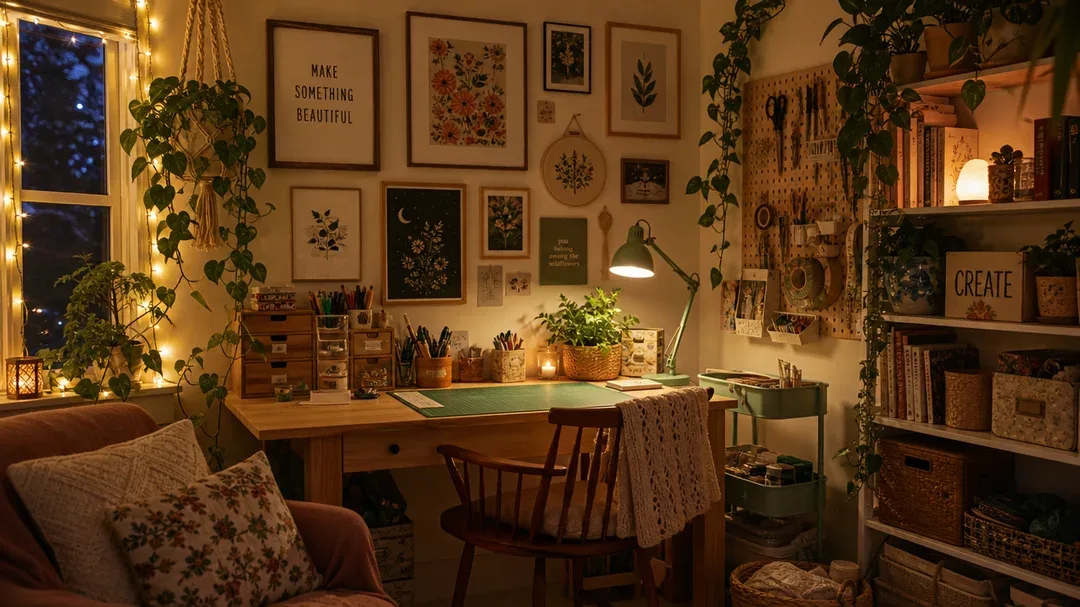
Open shelving is one of the most popular storage choices in aesthetic craft rooms because it allows you to display your supplies as part of the room’s decor. Neatly arranged spools of thread, jars of buttons, stacks of patterned paper, and rows of paint bottles can all function as art when organized thoughtfully. Floating shelves in white or natural wood are endlessly versatile and suit almost every aesthetic from minimalist to bohemian. For a more polished look, use matching containers — glass jars, woven baskets, ceramic pots — to corral smaller items and create visual cohesion across your shelves.
Pegboards are another beloved storage solution in craft rooms and offer incredible flexibility. A large pegboard mounted on the wall can hold an enormous variety of tools, from scissors and rulers to spools of washi tape and ribbon rolls, all while keeping your work surface clear. Pegboards can be painted to match your color palette and outfitted with shelves, hooks, and bins in coordinating colors or materials. For a particularly aesthetic touch, arrange your tools by color on the pegboard so that the storage wall itself becomes a rainbow display that is as pleasing to look at as it is practical to use.
4. Lighting Your Creative Space
Lighting is one of the most underestimated elements in craft room design, and yet it has an enormous impact on both the functionality of your workspace and its overall aesthetic. Poor lighting leads to eye strain, color distortion, and decreased creativity, while beautiful, well-planned lighting transforms an ordinary room into an inspiring sanctuary. In an aesthetic craft room, lighting should be layered — combining natural light, ambient light, task lighting, and decorative accent lighting to create a space that is both practical and visually enchanting.
Natural light is the gold standard for any creative workspace, and if your craft room is fortunate enough to have large windows, make the most of them. Position your main work surface to face or sit adjacent to the window so you benefit from daylight during the hours when natural light is available. Use sheer curtains rather than heavy drapes so that light can filter through while still providing some privacy and softening harsh direct sun. If your room lacks adequate natural light, full-spectrum LED bulbs are an excellent substitute that provide balanced, true-to-life illumination that is kind to both your eyes and your color work.
Beyond functional task lighting, consider the decorative lighting that contributes to the aesthetic mood of your craft room. String lights draped along shelves or around a window create a whimsical, cozy atmosphere that is endlessly charming in photographs and equally lovely in person. A beautiful pendant light or a vintage-inspired chandelier hung above a central work table becomes a focal point that elevates the entire room. Table lamps with interesting bases and warm-toned bulbs add pools of soft light that make the space feel inviting rather than clinical, particularly important if you also use your craft room as a place to journal, plan, or simply enjoy quiet creative thinking.
5. Furniture Selection for Form and Function
The furniture you choose for your craft room will define its layout, determine how comfortably you can work for long periods, and significantly shape its aesthetic character. Because craft rooms tend to accumulate a great deal of visual information through supplies, tools, and works-in-progress, furniture that is clean-lined and purposeful tends to work better than pieces that are overly ornate or visually complex. That said, one or two statement furniture pieces — a beautifully carved vintage desk, an upholstered chair in a bold fabric, a painted dresser used as storage — can add enormous personality to the space.
Your main work surface is the most critical piece of furniture in the craft room, and it deserves careful consideration. Think about the types of crafts you do most often and choose a surface that accommodates them. If you sew, you need a sturdy table at the right height for your machine with room on both sides for fabric. If you do large paper crafts or collage, you want an expansive flat surface. If you do both, an L-shaped desk or a large island-style table gives you versatility. Consider tables with built-in storage, such as drawers or lower shelves, to maximize the utility of your main workspace.
Seating is equally important, since you will likely spend long hours in your craft room and discomfort will cut those sessions short. An ergonomic chair that supports your posture is essential if you do detailed work that requires sustained concentration. However, you do not have to sacrifice style for comfort — many ergonomic chairs come in beautiful colors and finishes, and even a standard office chair can be made more aesthetic with a seat cushion in a complementary fabric. If your craft room is large enough, consider adding a cozy secondary seating area — a small loveseat, a floor cushion, or an armchair — where you can sit with a cup of tea and plan your next project away from your work surface.
6. Incorporating Inspirational Decor and Personal Touches
A craft room that is purely functional but lacks personal warmth and inspiration is one you may not feel emotionally drawn to use. The decorative elements of your craft room — the artwork on the walls, the plants on the windowsill, the collection of vintage finds displayed on a shelf — are what transform it from a workshop into a sanctuary. These are the details that make the space feel distinctly yours and that communicate your personality and passions to anyone who enters. Do not overlook them in your planning, and do not relegate them to an afterthought once the furniture is in place.
Wall art is one of the easiest and most impactful ways to inject personality and aesthetic cohesion into a craft room. A gallery wall of framed prints, photographs, fabric swatches, and inspirational quotes creates a visual focal point and tells the story of who you are as a creative. In a craft room specifically, you have the delightful option of displaying your own work — finished pieces, works in progress, color studies, or experimental samples — alongside art you have purchased or printed. This not only adds visual interest but also serves as a daily reminder of your own creative capability and growth.
Plants are another powerful decorative element that bring life, color, and a calming organic quality to any creative space. Trailing plants like pothos or string of pearls look magical draped along shelves or hanging from macramé hangers. Succulents and air plants require minimal care and can sit on your work surface or windowsill without demanding much attention. Even a single well-chosen plant in a beautiful pot can dramatically improve the energy and aesthetic of a room. Beyond plants, consider other natural elements — a vase of dried flowers, a bowl of pine cones, shells, crystals, or interesting rocks — that connect the room to the natural world and add texture and visual interest without clutter.
- Display finished projects on floating shelves or in frames to celebrate your creative achievements and track your progress over time.
- Use a chalkboard or whiteboard wall section for notes, sketches, and to-do lists that keep your planning visible without creating paper clutter.
- Hang a large mirror to make the space feel larger and brighter while also giving you a tool for evaluating finished pieces.
- Incorporate meaningful objects — inherited tools, vintage finds, souvenirs from travels — that make the space feel rooted in your personal history.
- Rotate your decor seasonally to keep the space feeling fresh and to reflect the changing inspirations of each time of year.
7. Small Space Craft Room Solutions
Not everyone has the luxury of a dedicated room for crafting, and a lack of square footage should never stand in the way of creating an aesthetic, functional creative space. Some of the most inspired craft rooms on Pinterest are compact by necessity but meticulously designed to make every inch count. Whether you are working with a spare bedroom corner, a closet conversion, a hallway nook, or a shared living space, there are clever strategies that can help you carve out a beautiful creative corner that feels intentional rather than makeshift.
Vertical space is your most valuable asset in a small craft room. When floor space is limited, think upward. Tall bookshelves reaching toward the ceiling, stacked pegboards, wall-mounted magnetic strips for tools, and tiered hanging organizers all allow you to store significant quantities of supplies without expanding your footprint. Paint the wall behind your vertical storage in a color that unifies the display and makes it feel like a designed feature rather than a practical necessity. A cohesive, color-coordinated wall of supplies can become genuinely beautiful even — or especially — in a small space.
Furniture that multitasks is essential in small craft spaces. A fold-down wall desk allows you to have a work surface only when you need it, keeping the room or area feeling open the rest of the time. A storage ottoman can hold supplies inside while doubling as seating or a footrest. A bar cart on wheels becomes a mobile supply station that can be rolled to wherever you are working and tucked away when not in use. Nesting tables offer multiple work surfaces when needed and stack neatly when you want to reclaim floor space. With creative thinking and a willingness to embrace multifunctional solutions, even the smallest space can become a surprisingly capable creative studio.
Conclusion: Building the Craft Room of Your Dreams
Creating an aesthetic craft room is a deeply personal and ongoing creative project in itself. It is not something that happens all at once — the most beautiful creative spaces evolve gradually over time as you discover what works for you, add pieces that speak to your evolving taste, and edit away the things that do not serve your needs or bring you joy. Approach the process with patience and curiosity, and give yourself permission to experiment, rearrange, and change direction as often as your creative spirit demands.
The 15 ideas and strategies explored in this article — from defining your aesthetic and choosing a color palette to maximizing storage, perfecting your lighting, selecting meaningful furniture, incorporating personal decor, and adapting small spaces — form a comprehensive foundation for building a craft room that is as functional as it is beautiful. You do not need to implement every idea at once. Choose the ones that resonate most with you right now, begin there, and let the space develop organically over time.
Ultimately, the best craft room is the one that makes you want to create. If you sit down at your workspace and feel a little lift of excitement, a quiet sense of calm, or a spark of inspiration, then you have succeeded — regardless of how much you spent, how large the space is, or how closely it matches any particular aesthetic trend. Your creative sanctuary is yours alone, and its greatest purpose is to support and celebrate the unique creative life you are living every single day.








What do you think?
It is nice to know your opinion. Leave a comment.