










11 Modern Aesthetic Bathroom Decor Trends to Follow
The Rise of the Intentional Bathroom
Not long ago, the bathroom was the most overlooked room in the home — a purely functional space treated as an afterthought in the broader design conversation. That era is definitively over. Today, the bathroom has emerged as one of the most creatively charged spaces in interior design, a place where homeowners invest real thought, real money, and real personal expression. Social media platforms like Pinterest have accelerated this shift dramatically, turning everyday people into visual curators of their own living environments and inspiring a generation of design-conscious renovators who refuse to settle for the ordinary.
The modern aesthetic bathroom is not defined by a single look. It is instead defined by intention — the deliberate choice of materials, colors, lighting, and fixtures that work together to create a cohesive sensory experience. Whether you are drawn to the warm, earthy tones of a Japandi-inspired wet room or the cool, sculptural confidence of minimalist European design, the underlying philosophy is the same: every element in the space should earn its place. Clutter is the enemy. Harmony is the goal. The bathroom, in this vision, becomes a sanctuary rather than a utility closet.
What makes this moment in bathroom design particularly exciting is the democratization of high-end aesthetics. Thanks to accessible tile manufacturers, affordable stone-look materials, and the explosion of boutique fixture brands available online, you no longer need a six-figure renovation budget to achieve a bathroom that looks like it belongs in an architectural digest spread. The trends discussed in this article draw from the cutting edge of global interior design but remain achievable for a wide range of homes and budgets, whether you are doing a full gut renovation or a thoughtful cosmetic refresh.
Why Bathroom Design Matters More Than Ever
The bathroom is one of the few spaces in the home where we are genuinely alone with ourselves. Morning routines and evening wind-downs happen here, and the atmosphere of that space has a measurable effect on mood, focus, and overall wellbeing. Designers and psychologists increasingly agree that environments shape behavior, and a bathroom that feels calming, beautiful, and considered can meaningfully improve the quality of daily life. This is not indulgence — it is a recognition that the spaces we inhabit every day matter more than the spaces we visit occasionally.
Beyond personal wellbeing, bathroom renovations consistently rank among the highest-return home improvement projects. A well-executed bathroom refresh increases property value, improves buyer appeal, and signals to prospective purchasers that the entire home has been maintained with care. Following modern design trends is not simply about keeping up with aesthetics — it is a practical investment in the long-term value of your property. The trends outlined below are not passing fads; they reflect deeper shifts in how people relate to their homes and their daily rituals.
Trend 1 — Warm Neutrals and Nature-Inspired Palettes
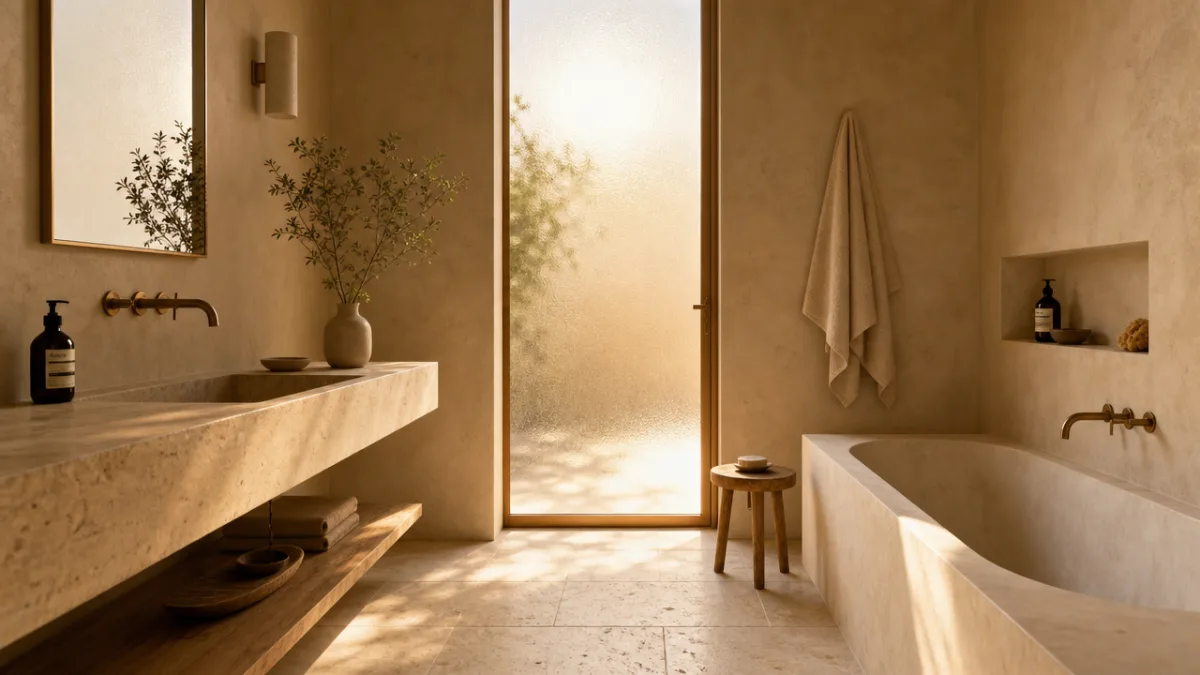
The cool gray bathroom that dominated the 2010s has given way to something far warmer and more organic. Across design studios and renovation projects worldwide, the palette has shifted decisively toward sandy beiges, terracotta blushes, warm whites, and the full spectrum of stone-adjacent neutrals. These colors feel grounded and human in a way that cold gray never quite managed, and they pair beautifully with the natural materials — wood, travertine, linen — that define so much of contemporary interior design. The result is a bathroom that feels connected to the natural world rather than apart from it.
Warm neutrals work particularly well in bathrooms because they respond generously to different lighting conditions. In morning sunlight, a sandy plaster wall glows with an almost golden warmth. Under evening candlelight or warm-toned artificial lighting, the same wall deepens into something richly atmospheric. This responsiveness to light is part of what makes nature-inspired palettes so enduringly satisfying — they are never static. They shift and breathe with the rhythms of the day, making the space feel alive in a way that a flat, uniform color simply cannot replicate.
For homeowners looking to adopt this trend without committing to a full repaint or retile, the quickest route is through textiles and accessories. Switching out bright white towels for thick linen pieces in oat, flax, or warm taupe tones immediately shifts the energy of the space. Adding a rattan basket, a wooden stool, or a terracotta soap dish introduces organic warmth without structural changes. These small moves, guided by a coherent color philosophy, can transform the feeling of a bathroom remarkably quickly and affordably.
Incorporating Stone and Mineral Textures
Stone textures — real or simulated — are among the most powerful tools available to the bathroom designer working within a warm neutral palette. Travertine, with its characteristic pitting and veining, has had an extraordinary resurgence in recent years, appearing on floors, walls, vanity tops, and even shower niches in bathrooms from Copenhagen to Los Angeles. Its warmth, its imperfection, and its unmistakably geological character make it the perfect material for a design philosophy grounded in nature. Where budget does not allow for real travertine, the quality of large-format porcelain lookalikes has improved to a genuinely impressive degree.
Limestone, slate, and onyx are also seeing renewed interest, each bringing its own personality to the space. Limestone offers softness and a matte finish that absorbs light gracefully. Slate brings a cooler, more dramatic edge that works beautifully in more moody, contemplative bathroom schemes. Onyx, used sparingly as an accent — perhaps a single feature wall behind a freestanding bath — introduces a level of luxury and visual drama that few other materials can rival. The key with all stone materials is restraint: letting one or two statements breathe rather than overwhelming the space with competing textures.
Trend 2 — Sculptural Fixtures as Focal Points
The fixtures in a modern aesthetic bathroom are no longer merely functional objects — they are sculptural statements that anchor the entire design. Freestanding bathtubs have been central to this conversation for years, but the category has matured and diversified dramatically. Where once the freestanding tub meant a simple oval soaker, today’s options include architecturally confident forms: asymmetric oval designs, deep Japanese soaking tubs with crisp geometric profiles, curved concrete forms that look more like art installations than bathing vessels. The tub, when chosen thoughtfully, becomes the single most powerful design element in the room.
Basin design has undergone an equally radical evolution. Above-counter basins with bold, organic shapes — irregular forms that suggest hand-thrown pottery or river-worn stone — have replaced the recessed under-mount basins that defined the previous decade. These vessels demand attention and elevation: a beautiful basin on a simple floating shelf can become a complete design moment without any additional decoration. Paired with a wall-mounted spout or an architectural column-style faucet in matte black, brushed gold, or unlacquered brass, the result feels genuinely gallery-worthy.
Faucets and hardware deserve particular attention in this context. The shift from chrome to matte and unlacquered finishes has opened up an enormous range of expressive possibilities. Matte black remains a strong choice for clean, contemporary schemes. Brushed nickel and satin brass offer warmth without the ostentation of polished gold. Unlacquered brass, which develops a natural patina over time, appeals to those who appreciate materials that age and change rather than maintain a static, factory-fresh appearance. Mixing metals — once considered a design error — is now widely embraced, provided the palette is limited to two complementary finishes used consistently throughout the space.
The Statement Mirror Moment
Mirrors have quietly become one of the most creatively exploited elements in modern bathroom design. Gone are the standard rectangular medicine cabinet mirrors that simply reflected what was in front of them. Their replacements are confident, often oversized, and frequently unconventional in shape. Arch-topped mirrors, irregular organic forms, multi-panel vintage-inspired frameless designs, and backlit LED mirrors with adjustable color temperature all appear prominently in today’s most-shared bathroom inspiration boards. The mirror is understood now as a design object in its own right, not merely a reflective surface.
Oversized mirrors serve a particular practical purpose beyond aesthetics: they amplify light and make spaces feel significantly larger than they are. In small bathrooms — the reality for many urban dwellers — a full-height or near-full-width mirror can be genuinely transformative, effectively doubling the perceived volume of the space. This practical benefit combined with the strong visual statement makes the oversized mirror one of the highest-value single additions you can make to a bathroom renovation or refresh. The format is versatile enough to work across styles from minimalist to maximalist, from traditional to futuristic.
Trend 3 — Wet Room and Open Shower Concepts
The wet room — a fully waterproofed bathroom space with a floor-level shower area separated by glass or simply by a slope in the floor — has moved decisively from the high-end hotel aesthetic into residential design. Its appeal is both practical and visual. Practically, the absence of a shower tray or enclosure frame makes the space dramatically easier to clean, removes a tripping hazard, and creates a continuous visual flow across the floor that makes even compact bathrooms feel more expansive. Visually, the open, uninterrupted floor plane creates a sense of luxury and spaciousness that traditional shower enclosures simply cannot replicate.
The frameless glass panel — either a single fixed screen or a hinged door — has become the preferred way to manage water containment in wet room schemes while maintaining the open visual aesthetic. Where even the glass panel feels like too much interruption, some designers are working with carefully calibrated floor gradients and linear drainage channels positioned to contain water within the shower zone without any glass at all. This fully open approach requires precision in both design and construction but delivers an extraordinarily serene, uncluttered visual result that photographs and lives beautifully.
Rainfall showerheads, both ceiling-flush and ceiling-mounted on exposed arms, are the natural companion to the wet room concept. Their wide, gentle distribution of water is perfectly suited to the relaxed, immersive experience that the open shower format invites. Increasingly, homeowners are pairing ceiling rainfall heads with wall-mounted body jets or handheld attachments, creating a spa-like multi-directional shower experience that transforms the daily routine into something genuinely restorative. The investment in quality shower hardware pays dividends in daily satisfaction that is difficult to overstate.
Tile Choices That Define the Space
In a wet room or open shower design, the tile selection is perhaps the single most consequential aesthetic decision. Large format tiles — anything from 60x60cm upward, with 120x60cm and even 120x120cm formats now commercially available — create a sense of visual calm by minimizing grout lines and allowing the material itself to speak without interruption. Zellige tiles, the handmade Moroccan ceramic tiles with their characteristically varied glaze and slightly irregular surface, offer something entirely different: a rich, textural, artisanal warmth that has captivated designers and homeowners across the globe and shows no sign of fading.
Fluted or ribbed tiles represent another major trend with extraordinary staying power. The three-dimensional surface of a fluted tile catches light differently at different times of day and from different angles, giving the wall a quality of aliveness that flat tiles cannot achieve. Available in ceramic, terracotta, and glass, fluted tiles work beautifully as shower wall accents, half-height wainscoting, or full-wall treatments. Paired with a simple large format floor tile in a complementary tone, a fluted feature wall can single-handedly elevate an otherwise simple bathroom into something genuinely distinctive and memorable.
Trend 4 — Integrated Storage and Minimalist Organization
The modern aesthetic bathroom is defined as much by what it does not show as by what it does. Cluttered countertops, exposed pipes, and generic wire shelving are the enemies of the serene, considered aesthetic that defines contemporary bathroom design. In their place, designers are working with recessed niches, custom joinery, and floating cabinetry to create storage solutions that are invisible until needed. The result is a surface plane — countertop, floor, wall — that remains unbroken and calm, allowing the materials and fixtures to read as clearly as possible without visual competition from bottles, appliances, and accessories.
Recessed shower niches are one of the most impactful and relatively affordable ways to introduce this philosophy of integrated storage. A well-positioned niche, tiled to match the surrounding wall or finished in a complementary accent material, eliminates the need for corner caddies and hanging organizers that compromise both safety and aesthetics. Multiple niches at different heights can accommodate different user needs — shampoo bottles, soap bars, razors — while contributing to rather than detracting from the overall design composition. The niche is, in a sense, a small act of architecture within a larger architectural gesture.
Floating vanities and wall-hung toilets are the other major weapons in the integrated storage arsenal. The floor plane kept clear and uninterrupted by cabinetry or toilet bases creates a visual lightness that makes the space feel larger and easier to maintain. Below a floating vanity, the visible floor space invites the use of a single carefully chosen object — a low stool, a basket, a sculptural plant — rather than a cluttered accumulation. This restraint, repeated across the entire space, is what separates a truly modern aesthetic bathroom from one that has simply bought modern-looking individual components without committing to the underlying design philosophy.
Smart Lighting as a Design and Functional Tool
Lighting in the modern bathroom operates on at least two registers simultaneously: functional and atmospheric. Task lighting — the bright, even, shadow-free illumination needed for skincare, grooming, and makeup — must be positioned carefully, typically at face level on either side of the mirror rather than overhead, where it creates unflattering downward shadows. Backlit mirrors or integrated LED strips within mirror frames provide this face-level illumination elegantly while also serving as a design feature in their own right, giving the mirror a luminous, floating quality that photographs extraordinarily well.
Atmospheric lighting is the other half of the equation. Dimmable overhead fixtures — recessed ceiling lights with warm color temperatures, pendant lights in matte or textured finishes positioned over the bath, or LED strip lighting hidden behind floating shelves or beneath the vanity — allow the bathroom to shift from a bright, functional morning environment to a warm, intimate evening retreat with the simple adjustment of a dimmer. This flexibility is, for many homeowners, one of the most transformative upgrades available, and it is far less expensive and disruptive than a material or fixture change.
Trend 5 — Biophilic Elements and Living Greenery
Biophilic design — the deliberate integration of natural elements and living organisms into the built environment — has moved from a fringe architectural concept to a mainstream design priority, and the bathroom is one of its most natural homes. The combination of humidity, warmth, and often available natural light makes the bathroom a surprisingly hospitable environment for a carefully chosen selection of plants. More importantly, the presence of living greenery in a bathroom creates a shift in atmosphere that is genuinely profound: the space begins to feel less constructed and more organic, less institutional and more alive.
The most successful bathroom plants are those that genuinely thrive in humid, low-to-medium light conditions. Pothos and heartleaf philodendron trail beautifully from shelves or hanging positions, their rich green leaves bringing a cascading natural energy to the space. Bird of paradise plants, where ceiling height allows, make extraordinary architectural statements in bathroom corners. Ferns — Boston ferns, maidenhair ferns, and the dramatic staghorn fern mounted on a piece of timber — all love the humidity that bathrooms naturally generate and require far less watering as a result. The humble snake plant tolerates almost any condition and provides clean vertical geometry that complements minimalist design schemes beautifully.
Beyond potted plants, biophilic thinking in bathroom design extends to materials and textures. The choice of travertine over porcelain, timber over MDF, linen over synthetic textiles — each of these decisions introduces a piece of the natural world into the space and contributes to the larger biophilic vision. Woven baskets, natural fiber bath mats, wooden bath trays, and stone soap dishes all play a role in this material storytelling. The bathroom that feels most genuinely modern is, paradoxically, the one most connected to ancient, natural materials and rhythms — a space where the human need for beauty and the human need for nature are recognized as one and the same impulse.
Bringing It All Together: The Cohesive Vision
The most important lesson from all eleven of these trends — warm palettes, sculptural fixtures, wet room concepts, integrated storage, and biophilic elements among them — is that individual trends are far less powerful than a coherent design vision that synthesizes the right elements for a specific space and a specific person. The mistake that produces disappointing results is treating each trend as a separate purchase rather than a contributing element in a unified whole. A beautiful freestanding tub in a bathroom with cold lighting and generic white tiles will never achieve the sanctuary-like effect that the same tub would achieve in a space where every other decision supports and amplifies its presence.
Begin any bathroom project by defining the emotional quality you want the finished space to deliver. Calm and restorative? Energizing and clean? Warm and sensory? Dramatic and bold? This emotional brief, articulated clearly before any material selections are made, becomes the filter through which every subsequent decision — tile color, fixture finish, lighting temperature, plant selection — is evaluated. When every element passes through the same filter, the result is coherence: that ineffable quality that separates a professionally designed space from a space that simply contains nice individual objects.
The modern aesthetic bathroom, at its best, is not a collection of trends. It is a considered act of self-expression — an environment shaped by genuine attention to beauty, comfort, and daily life. Whether you adopt one idea from this list or all eleven, the underlying invitation is the same: to take seriously the spaces where you begin and end each day, and to make them worthy of the life you are living in them. The bathroom, once the room most likely to be ignored, has become one of the most powerful canvases available to the thoughtful homeowner. Use it well.








What do you think?
It is nice to know your opinion. Leave a comment.