










15 Flowers That Grow in Shade: A Complete Guide to Beautiful Low-Light Gardens
Understanding Shade Gardening and Why It Matters
Many gardeners look at shaded corners of their yards and feel a sense of defeat, assuming that darker areas are simply unsuitable for growing anything beautiful. This is one of the most common misconceptions in home gardening. In reality, shade gardens can be among the most lush, serene, and visually captivating spaces on your entire property, provided you choose the right plants and understand how to work with the conditions you have rather than against them.
Shade gardening requires a fundamental shift in perspective. Instead of fighting the tree canopy overhead or the shadow cast by a fence or building, experienced gardeners learn to embrace these conditions as opportunities. Many of the world’s most elegant and sought-after flowering plants actually prefer to be out of the harsh midday sun. Hostas, astilbes, and bleeding hearts, for example, thrive in exactly the dappled or full shade that would scorch other species beyond recovery.
Before selecting your plants, it is important to understand the difference between the types of shade your garden may experience. Full shade means less than three hours of direct sunlight per day. Partial shade typically means three to six hours of sun, often during the cooler morning hours. Dappled shade refers to the shifting, filtered light that comes through a tree canopy. Each of these conditions suits different plant species, and knowing which type you are working with will make all the difference in your garden’s long-term success and beauty.
Spring Bloomers That Love the Shade
Spring is a magical time in the shade garden, as many flowering plants native to woodland environments have evolved specifically to bloom early, taking advantage of the light that filters through bare tree branches before the canopy fills in. These plants have developed an elegant biological strategy: they flower, set seed, and sometimes go dormant before their overhead competitors fully leaf out. This makes them invaluable for gardeners who want color during the often-overlooked early growing season.
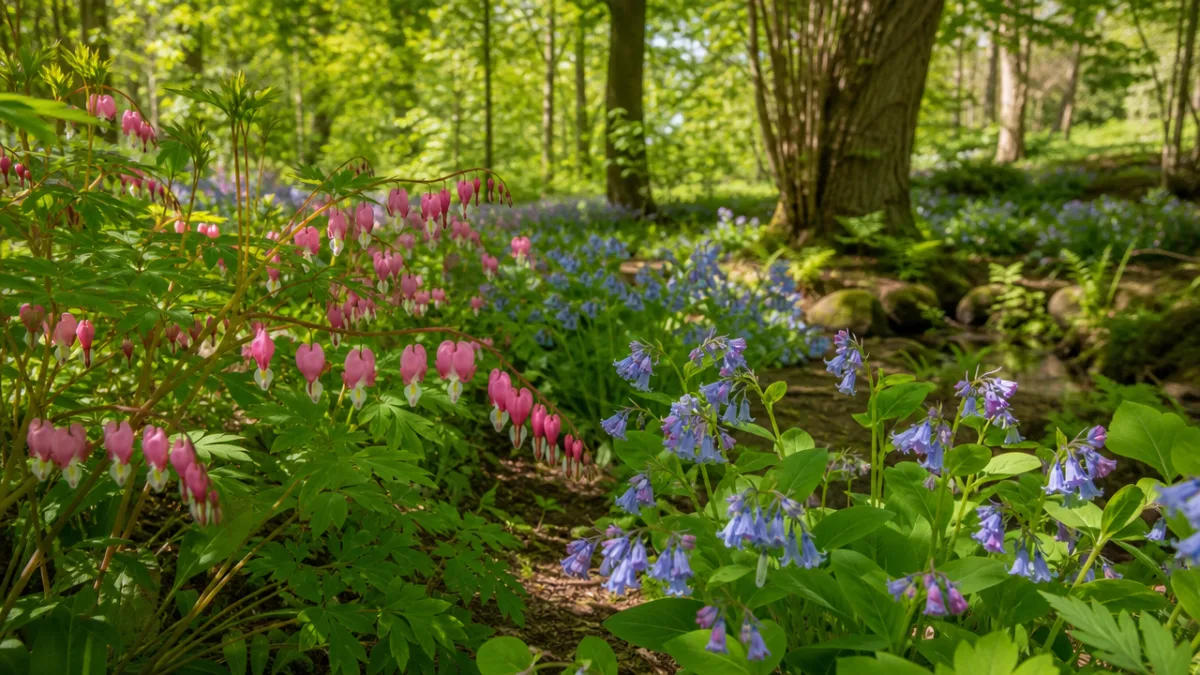
Bleeding heart, known botanically as Lamprocapnos spectabilis, is one of the most iconic shade-loving spring flowers. Its arching stems carry rows of perfectly heart-shaped blossoms in shades of pink, red, and white, dangling delicately like tiny lockets. The plant thrives in moist, humus-rich soil and partial to full shade, and it can create a breathtaking display in April and May. Once temperatures rise in summer, the foliage dies back gracefully, leaving room for later-blooming companions to fill the space.
Virginia bluebells are another extraordinary spring shade bloomer, producing clusters of tubular, sky-blue flowers in early to mid-spring. They are native to North American woodlands and are perfectly adapted to the conditions found beneath deciduous trees. Like bleeding heart, they are ephemeral, meaning their above-ground growth disappears after blooming. Trilliums, with their striking three-petaled blooms in white, pink, or deep burgundy, round out the spring shade palette beautifully, though they require patience as they are slow to establish and should never be collected from the wild.
Summer Shade Flowers for Sustained Color
Keeping a shade garden vibrant through the long summer months takes thoughtful plant selection, but the options available are far more varied and colorful than most people realize. Summer-blooming shade plants tend to prefer consistently moist soil and good organic matter, as they are often competing with tree roots for nutrients and water. Mulching generously around these plants helps retain soil moisture and keeps root temperatures stable during heat waves.
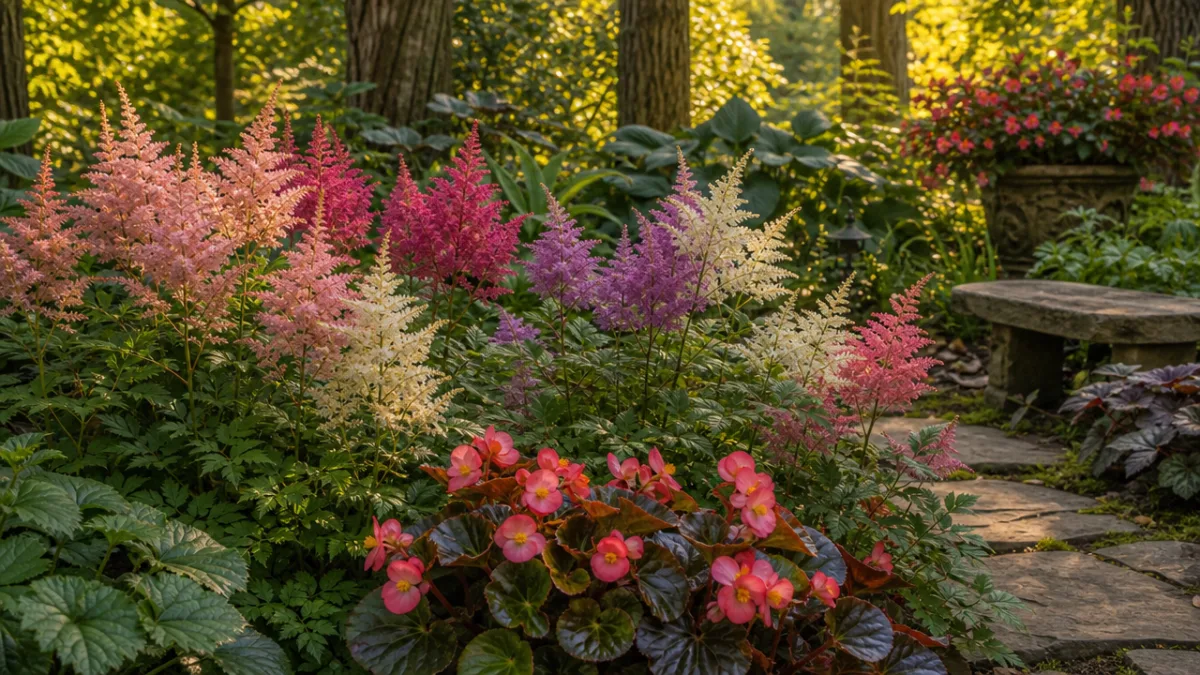
Astilbe is perhaps the undisputed queen of the summer shade garden. These feathery, plume-like flowers rise above deeply cut, fern-like foliage in colors ranging from white and soft lavender to vivid coral and deep crimson. They bloom from early to late summer depending on the variety, and planting a mix of early, mid, and late-season cultivars ensures you have color for months. Astilbes are also remarkably low-maintenance once established, requiring little more than consistent moisture and an annual top dressing of compost to perform at their best.
Impatiens have long been the go-to annual for shade gardens, and while their popularity waned following outbreaks of impatiens downy mildew, newer disease-resistant varieties and the charming native alternative, jewelweed, have revived interest in this category. New Guinea impatiens, in particular, are more sun-tolerant than common impatiens and produce enormous blooms in brilliant oranges, pinks, and reds that light up shaded borders like living lanterns. For a more delicate, airy look, begonias offer another superb summer option, with wax begonias producing nonstop blooms from planting until frost in almost any shade condition.
Foxglove deserves special mention as a biennial or short-lived perennial that produces some of the most dramatically beautiful flower spikes in any garden setting. Growing two to five feet tall, foxglove’s tubular flowers in purple, pink, white, and cream are beloved by bumblebees and hummingbirds alike. They thrive in partial shade and add vertical interest that few other shade plants can match. Because they self-seed prolifically, a single planting often establishes a self-sustaining colony that returns reliably year after year.
Perennial Shade Flowers That Return Year After Year
One of the great rewards of gardening with shade-loving perennials is the investment that pays off more richly with each passing season. Unlike annuals, which must be replanted each year, perennials establish deeper root systems over time, becoming more drought-tolerant, more floriferous, and more structurally impressive as they mature. A shade garden anchored by well-chosen perennials becomes genuinely easier to manage as the years go by, even as it becomes more beautiful.
Hellebores, sometimes called Lenten roses, are among the most treasured perennials in the shade gardener’s repertoire. They bloom from late winter through early spring, often pushing up nodding flowers through snow and frozen ground when nothing else is stirring. Their flowers come in an astonishing range of colors — white, cream, blush pink, deep plum, slate gray, and nearly black — and many modern varieties feature double blooms, picotee edges, or striking spotted interiors. Hellebores are also exceptionally long-lived and deer-resistant, making them a practical as well as gorgeous choice.
Hostas, while primarily grown for their spectacular foliage, do produce flowers, and some varieties offer pleasantly fragrant blooms in lavender or white on tall scapes in mid to late summer. More importantly, their textural and color diversity — from tiny mouse-ear varieties to giant plants with leaves the size of dinner plates, in shades from chartreuse to deep blue-green to creamy white — makes them indispensable as companions for flowering shade plants. Pulmonaria, or lungwort, offers both attractive silver-spotted foliage and early spring flowers that open pink and mature to blue, a combination rarely seen in any other plant.
Coral bells, or Heuchera, represent one of the most exciting breeding success stories in recent shade gardening history. Once valued mainly for their small, bell-shaped flowers held on wiry stems above a modest mound of foliage, modern coral bell varieties have been developed for extraordinary leaf color: deep burgundy, bright caramel, silvery pewter, lime green, and multicolored combinations. They bloom reliably in partial shade and attract hummingbirds while also serving as spectacular foliage plants throughout the growing season. Hardy in most temperate climates, they are virtually indispensable for the four-season shade garden.
Native Shade Flowers and Their Ecological Benefits
Growing native shade-loving flowers is not simply a trend or an aesthetic choice — it is one of the most meaningful contributions a home gardener can make to local ecosystems. Native plants have co-evolved with local insects, birds, and other wildlife over thousands of years, forming intricate ecological relationships that imported ornamentals simply cannot replicate. A shade garden planted with native species becomes a functioning habitat, supporting pollinators, providing food sources for birds, and contributing to the broader health of your regional environment.
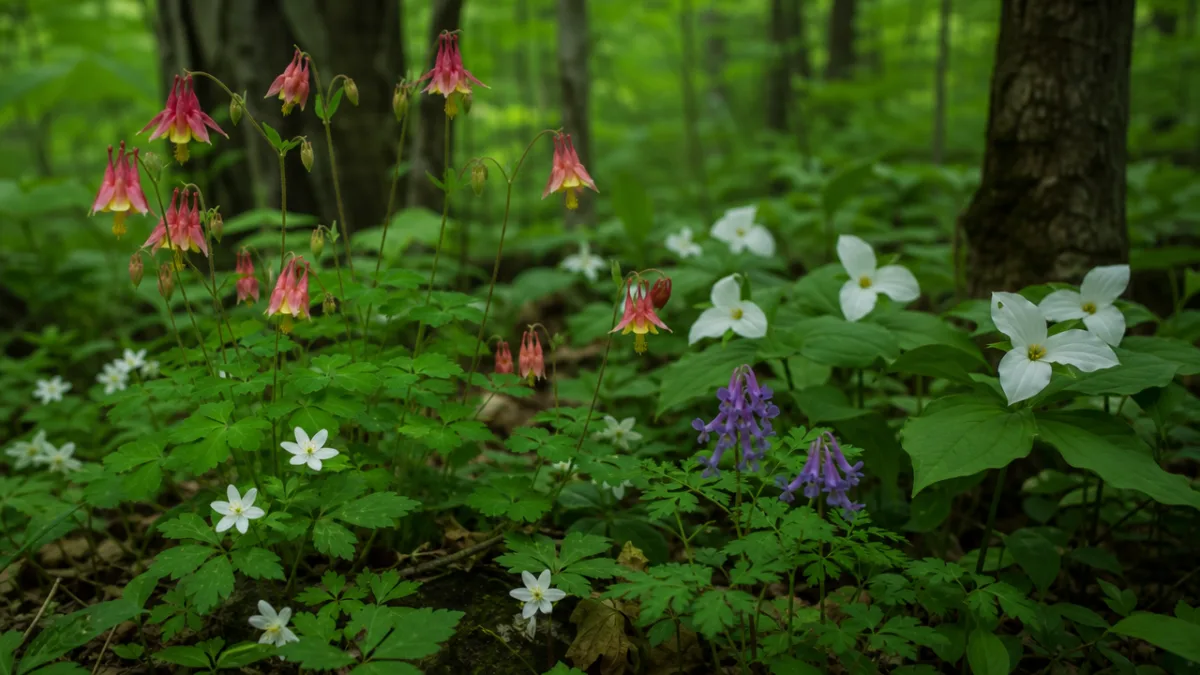
Wild columbine, Aquilegia canadensis, is a native perennial perfectly suited to partially shaded woodland edges, producing nodding red and yellow spurred flowers from spring into early summer. It is a critical early nectar source for hummingbirds returning from their winter migration and is also beloved by native bees. Jacob’s ladder, Polemonium reptans, offers clusters of delicate bell-shaped blue-violet flowers in spring and thrives in moist, shaded conditions, making it ideal for planting beneath deciduous trees where spring light is available but summer shade is deep.
Wild ginger, Asarum canadense, is technically grown more for its attractive, heart-shaped ground-covering foliage than for its small, inconspicuous spring flowers, but it deserves inclusion here as a native that performs ecological functions few other plants can match. It spreads slowly to form a dense, weed-suppressing carpet in deep shade and provides important habitat for ground-dwelling insects. Mayapple, Podophyllum peltatum, offers bold, umbrella-like foliage and charming white flowers hidden beneath its leaves in spring, adding a prehistoric, architectural quality to naturalistic shade gardens.
Planting native shade flowers also significantly reduces the garden’s maintenance burden over time. Because these plants are adapted to local rainfall patterns, soil types, and temperature ranges, they typically require far less watering, fertilizing, and pest management than exotic ornamentals. They are also naturally resistant to many of the diseases and pests common in your region, having developed those defenses through long evolutionary exposure. This makes native shade gardens not only ecologically responsible but also genuinely practical for busy gardeners who want beauty without constant intervention.
Tips for Designing and Maintaining a Shade Flower Garden
Designing a shade garden that looks intentional, balanced, and visually exciting throughout multiple seasons requires thinking carefully about layering, texture, color, and bloom time. Unlike sunny borders where bold color contrasts often succeed, shade gardens tend to reward subtlety and a more restrained palette. Light colors — whites, pale yellows, soft pinks, and lavenders — show up beautifully in low-light conditions and can make a shaded area feel luminous and inviting rather than dark and oppressive.
Layering is the structural principle that makes shade gardens feel rich and dimensional rather than flat. Think in three tiers: a canopy layer consisting of existing trees or large shrubs, a middle layer of taller perennials such as astilbe, foxglove, and ferns, and a ground layer of low-growing plants like hellebores, coral bells, and creeping phlox. This vertical diversity not only looks beautiful but also mimics the structure of natural woodland ecosystems, which tends to produce naturally stable, self-reinforcing plant communities that require less ongoing intervention.
Soil preparation is the single most important factor in shade garden success and one that many beginning gardeners underestimate. Soil beneath trees is often dry, compacted, and depleted of nutrients due to competition from tree roots. Before planting, work generous amounts of compost, aged bark, and other organic matter deeply into the soil to improve drainage, moisture retention, and fertility simultaneously. Repeat this amendment annually by top-dressing with compost each spring, and your shade garden will reward you with increasingly vigorous and floriferous plants year after year.
Watering strategies in shade gardens differ importantly from those in sunny beds. While shaded soil dries out more slowly than sun-exposed ground, the large root systems of nearby trees can absorb tremendous amounts of moisture, leaving your flowering plants stressed during dry spells. Installing soaker hoses or drip irrigation beneath mulch is one of the most effective ways to deliver consistent moisture directly to the root zone without promoting the fungal diseases that overhead watering can encourage in humid, low-airflow shaded environments.
Finally, embrace the concept of the “no-fail” shade plant list as your garden’s backbone, then experiment with more adventurous additions once the fundamentals are in place. A core collection might include hostas for foliage, astilbe for summer color, hellebores for winter interest, impatiens for continuous annual color, and ferns for texture — all of which are nearly impossible to kill in appropriate shade conditions. Around this reliable foundation, you can trial more unusual species, knowing that even if some experiments fail, your garden will remain beautiful and well-structured throughout the process of discovery and refinement.
- Bleeding Heart — Elegant arching stems with heart-shaped flowers in pink, red, or white; prefers moist, humus-rich soil in partial to full shade and goes dormant in summer heat.
- Astilbe — Feathery plumes in white, lavender, coral, and red; blooms mid to late summer and thrives in consistently moist, organically rich shaded borders.
- Hellebore (Lenten Rose) — Late winter to early spring bloomer in an extraordinary range of colors; deer-resistant, exceptionally long-lived, and highly tolerant of deep shade.
- Impatiens — Reliable annual producing nonstop color from late spring to frost; newer disease-resistant varieties have revived this classic shade garden staple.
- Foxglove — Tall, dramatic flower spikes in purple, pink, and white; attracts hummingbirds and self-seeds to create a lasting garden presence.
- Coral Bells (Heuchera) — Grown for spectacular leaf color as much as flowers; available in burgundy, caramel, silver, and lime green foliage with bell-shaped summer blooms.
- Virginia Bluebells — Native spring ephemeral with sky-blue tubular flowers; ideal beneath deciduous trees where it completes its life cycle before canopy shade deepens.
- Wild Columbine — Native perennial with red and yellow spurred flowers; critical hummingbird nectar source and thrives in lightly shaded woodland edges.
- Pulmonaria (Lungwort) — Silver-spotted foliage and bicolor flowers that open pink and mature to blue; one of the earliest perennials to bloom in spring shade.
- Begonia — Wax and tuberous begonias both thrive in shade, producing bold blooms in orange, red, pink, and white from planting until the first frost of autumn.
- Trillium — Iconic native woodland wildflower in white, pink, or burgundy; slow to establish but forms stunning colonies in undisturbed shaded conditions.
- Jacob’s Ladder — Bell-shaped blue-violet flowers on ferny foliage; thrives in moist shade and blooms reliably in mid-spring beneath deciduous tree canopies.
- New Guinea Impatiens — More sun-tolerant than common impatiens with larger, bolder blooms; produces brilliant color in dappled shade throughout the growing season.
- Wild Ginger — Native ground cover with heart-shaped foliage and small spring flowers; forms a dense, weed-suppressing carpet in even the deepest shade conditions.
- Creeping Phlox — Low-growing perennial with a profusion of small flowers in pink, white, or lavender; excellent for edging shaded paths and naturalizing beneath shrubs.








What do you think?
It is nice to know your opinion. Leave a comment.