










Portraits in Crochet: The Remarkable Fiber Art of Mary Dunn
The Intersection of Traditional Craft and Fine Art Portraiture
When most people picture crochet, they think of cozy blankets, maybe a few doilies, or a chunky winter scarf. Mary Dunn has turned all of that on its head. In her hands, a simple hook and some yarn become tools capable of capturing something as intimate and complex as the human face. Her portrait work sits in a genuinely unusual place in today’s art world — somewhere between the slow, meditative patience of traditional fiber craft and the exacting demands of representational portraiture. The results tend to stop people mid-step and make them rethink everything they thought they knew about what crochet could be.
Textile portraiture has a long history — think of woven tapestries showing medieval royalty, or the detailed needlework samplers that colonists stitched in early America. But crochet portraiture, as a serious and technically sophisticated practice in its own right, is still remarkably rare. The crochet stitch has a structural quality to it — those interlocked loops create a fabric that’s inherently textured and dimensional — and that actually makes things harder, not easier. Getting smooth gradations of skin tone, nailing the geometry of facial features, and suggesting the way light moves across a face using nothing but yarn and a hook takes an unusual mix of artistic vision, technical skill, and a fair amount of sheer stubbornness.
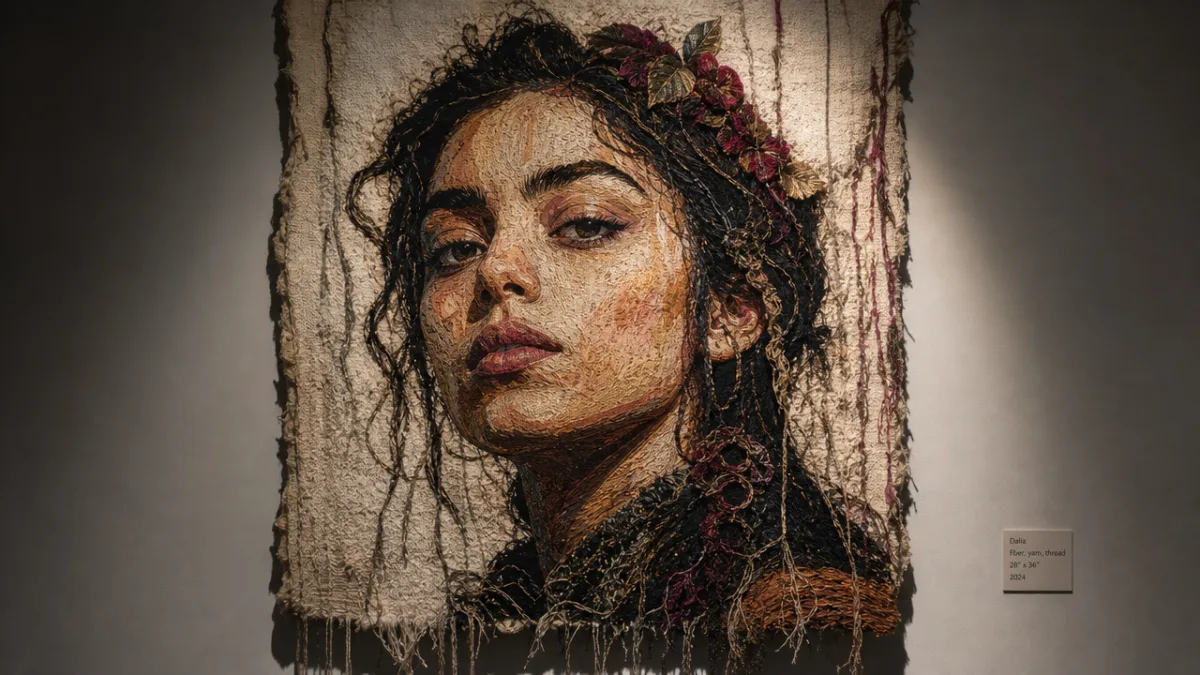
Mary Dunn has spent years building a personal approach that meets those challenges directly. Rather than fighting the textural nature of crochet, she’s learned to lean into it — using the raised surfaces and shadow-catching qualities of different stitch combinations to create depth and dimension that flat mediums simply can’t replicate. Her portraits have a quality that’s genuinely hard to convey in photographs: a physical, tangible presence that draws your eye not just to the image but into the fabric itself, inviting you to look closer at the thousands of tiny individual choices that together add up to a recognizable human face.
Technique and Materials: Building a Face Stitch by Stitch
The technical groundwork for one of Mary Dunn’s portraits begins long before the first stitch is made. She spends considerable time studying her reference photograph or subject — not just the obvious features, but the underlying structure beneath them. The way the skull shapes the forehead. How light falls differently across the planes of the nose and cheekbones. The precise tonal relationship between shadow and highlight that gives a face its sense of depth. This analytical phase matters as much as the actual making, because the decisions made upfront determine whether the finished piece reads as a genuine likeness or just a decorative impression of a human face.
Her material choices come from a deep familiarity with how different yarn weights and fiber types interact with light and build visual texture. Finer yarns open up more possibilities for detail and smoother color transitions, while thicker fibers create bolder textural effects that can feel more expressive and painterly. Dunn moves between yarn weights depending on the scale and mood of each piece, and she keeps an extensive palette of both hand-dyed and commercial yarns so she always has access to exactly the tonal values she needs. Color selection alone can take a significant amount of time — matching the complex, shifting hues of human skin means layering multiple subtle shades rather than reaching for a single “skin tone” yarn.
Her specific techniques include tapestry crochet, intarsia methods borrowed from knitting, and hybrid approaches she’s developed herself, all of which allow her to move between colors with a precision that standard striping methods couldn’t achieve. She also adds surface embroidery to the finished base fabric, using needle and thread to sharpen the details that fall below what the crochet stitch alone can resolve — the catchlight in an eye, the clean edge of a lip, the fine individual hairs of an eyebrow. This combination of crocheted structure and hand-embroidered detail lets her work at two scales of precision at once: building the broad tonal architecture in yarn, then coming back in with needle and thread for the finest finishing touches.

Artistic Influences and the Language of Likeness
Mary Dunn draws from a wider range of artistic traditions than you might expect. Her understanding of how to construct a likeness owes a real debt to the classical portrait painters — Rembrandt, Vermeer, later John Singer Sargent — artists who each developed systematic ways of representing the human face using the fundamentally abstract language of paint. Just as those masters learned to translate the optical reality of a face into strategic marks of pigment, Dunn has developed her own vocabulary for translating that same visual reality into fiber. The underlying artistic intelligence turns out to be remarkably similar, even when the materials and processes are completely different.
Contemporary fiber art has also shaped how she thinks about her work. The broader movement to take craft practices seriously as fine art — one with roots in feminist art of the 1970s and carried forward by artists like Faith Ringgold, Sheila Hicks, and Joana Vasconcelos — gives Dunn’s work an important intellectual context. Her portraits aren’t just technically impressive objects; they’re also quiet arguments about the artistic seriousness of crochet as a medium, and about how craft practices historically associated with women’s domestic labor have been culturally undervalued. Choosing a medium so thoroughly associated with the everyday and functional, and using it to engage directly with one of the most prestigious genres in Western art history, is itself a statement — as conceptual as it is aesthetic.
Photography plays a significant practical role in her process too, both as reference material and as a source of productive tension. Working from photographic references means making constant interpretive decisions — which details to render faithfully, which to simplify, where to let the inherent texture of the crochet fabric serve the image and where to work against it. She’s talked about how the slow, meditative pace of crochet creates a fundamentally different relationship with an image than any faster medium would allow. You spend hours and hours in sustained attention with a single face, and that extended looking gradually deepens your understanding of it in ways that neither the original photograph nor a quick sketch ever could.
The Subjects: Who Gets Portrayed and Why
In portrait art, the choice of who to depict is never incidental, and Mary Dunn’s selection of subjects says a lot about her broader intentions. She has worked from portraits of historical figures, from photographs of family members, from images of strangers whose faces caught her attention, and from commissioned work where the subject is chosen by a patron. Each of these contexts creates a different kind of engagement with the work. Dunn has talked thoughtfully about how the nature of her relationship to a subject shapes the process of making their portrait — a face she knows intimately presents completely different challenges and opportunities than the face of a historical figure she can only access through layers of existing representation.
One consistent thread in her subject choices is an interest in faces that carry visible histories — faces marked by age, experience, and the accumulated weight of a life fully lived. Young, unlined faces present their own technical challenges, but she has spoken about finding particular richness in faces where time has inscribed itself in lines, textures, and asymmetries. These are faces that seem to reward exactly the kind of slow, patient attention her medium demands, offering layers of detail and meaning that reveal themselves gradually over long hours of work. There’s something fitting about that — a labor-intensive medium and subjects whose own lives have been shaped by sustained effort and accumulated experience.
When Dunn portrays historical or public figures, her work enters into implicit conversation with the existing iconic images of those people. To crochet someone who has already been extensively photographed, painted, or sculpted is to offer a new interpretation — one filtered through a specific medium and a specific artistic sensibility. And the choice of crochet as that vehicle is never neutral. It inevitably raises questions about value, labor, and the hierarchies that separate fine art from craft. In that sense, her most ambitious portrait subjects become occasions for a kind of material argument conducted entirely through fiber and stitch.
The Process: Time, Labor, and Meditative Making
One of the most striking things about Mary Dunn’s portrait work is simply how long each piece takes. A single portrait can represent hundreds of hours of concentrated work — not the kind of frenzied, high-intensity energy associated with some artistic practices, but the steady, rhythmic, repetitive motion that defines crochet. Hook enters loop, yarn wraps, new loop forms, and that fundamental action repeated tens of thousands of times gradually accumulates into an image. This relationship between time, repetition, and the slow emergence of meaning is something Dunn talks about often, and it sets her work apart from faster mediums in ways that go well beyond the practical.
The meditative quality of the making process directly influences the character of the finished work. Extended periods of focused, repetitive activity produce a particular quality of attention — sustained, unhurried, and open to constant micro-adjustments and reconsiderations. Unlike painting, where a single brushstroke can cover or modify a large area, crochet moves at a pace set by the size of the stitch. There are essentially no shortcuts. Every square centimeter of a crocheted portrait has been individually and intentionally worked, and the cumulative effect of that complete attention is palpable in the finished pieces in a way that’s hard to put into words but immediately felt by anyone who stands in front of them.
Dunn has also written and spoken honestly about the physical cost of this labor — the strain it places on her hands, wrists, neck, and eyes over the course of a major work. The body keeps a very literal record of these projects, and there’s an ethical complexity to art made at that physical price that she doesn’t shy away from. When viewers encounter a finished portrait, they’re encountering not just a visual image but the material residue of a sustained bodily commitment. She believes that embodied quality — invisible to casual inspection though it may be — contributes something essential and irreplaceable to the meaning of the work.
Reception, Legacy, and the Future of Crochet Portraiture
The response to Mary Dunn’s portrait work — from both the craft community and the broader art world — has revealed some interesting tensions in how we categorize and value creative work. Within the fiber arts community, her technically demanding and conceptually ambitious portraits have been celebrated as proof of what the medium is really capable of, inspiring other makers to push past the limits of conventional crochet applications. Her work circulates widely on platforms like Pinterest, reaching audiences well beyond the specialized world of fiber arts and consistently drawing reactions of surprise and genuine admiration from people encountering serious crochet portraiture for the first time.
The question of institutional recognition — being shown in fine art galleries and museums rather than craft shows and textile exhibitions — remains complicated. The line between fine art and craft has become considerably more porous in recent decades, but it hasn’t disappeared, and artists working in traditionally craft-based mediums often find themselves navigating uncertain territory between contexts that value their work in different ways and for different reasons. Dunn’s portraits push viewers to examine their own assumptions about where that line should fall — or whether it should exist at all — and that challenge is part of what makes her work culturally interesting beyond its considerable technical and aesthetic achievements.
Looking ahead, artists like Mary Dunn seem likely to have a real influence on the next generation of fiber workers. Online communities dedicated to crochet and textile arts have grown enormously in recent years, and the visibility that platforms like Pinterest, Instagram, and YouTube give to ambitious work in these mediums has opened up new possibilities for artists whose practice might once have remained largely invisible outside specialized circles. The technical knowledge required for portrait crochet — once accessible mainly through direct mentorship or long individual experimentation — is increasingly being shared through online tutorials, pattern books, and community forums, making it more accessible to a wider population of makers who might want to attempt work at this level of ambition and complexity.
- The growing online fiber arts community has dramatically expanded the audience for technically sophisticated crochet work, connecting artists with viewers and collectors around the world who would previously have had little or no access to their output.
- Workshop and teaching opportunities allow artists like Dunn to share their methods directly with other makers, helping to accelerate the development of portrait crochet as a recognized and technically developed genre within the broader fiber arts tradition.
- Major museums have increasingly collected fiber art over recent decades, suggesting that the cultural infrastructure for valuing and preserving ambitious textile work is slowly maturing alongside the art itself.
- The combination of traditional craft knowledge with contemporary artistic concepts positions portrait crochet at a productive intersection that continues to attract makers interested in both technical mastery and conceptual depth.
Ultimately, Mary Dunn’s contribution to the art of portraiture goes well beyond the impressive technical achievement of any single piece. She’s shown, with patience and consistency, that the expressive range of crochet is far wider than its cultural reputation has ever suggested — that a medium so thoroughly associated with domestic comfort and practical utility is equally capable of the demanding, precise, and emotionally resonant work of capturing a human face. In doing so, she’s expanded what anyone working in this medium understands to be possible, and added something meaningful to the long, rich, and still-unfolding history of portrait art in all its forms.








What do you think?
It is nice to know your opinion. Leave a comment.