










“`html
The Extraordinary World of Trevor Smith’s Crochet Sculptures
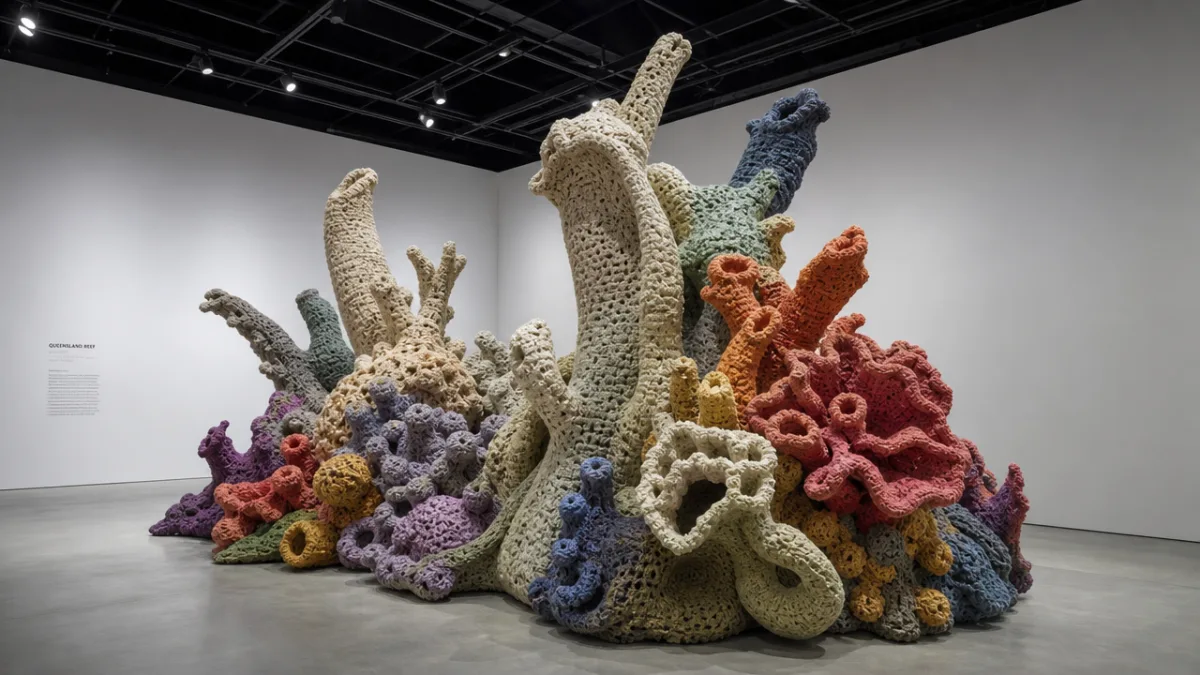
In the wide world of contemporary fiber arts, Trevor Smith is doing something genuinely different. His crochet sculptures stand apart from almost everything else in the medium right now — they’re ambitious, weird, technically demanding, and buzzing with a handmade energy that feels both ancient and completely of the moment. Seeing one in person is a little disorienting, honestly, in the best way. Your brain knows it’s looking at soft yarn, and yet the thing in front of you refuses to behave like soft yarn should, twisting and curling into forms that seem to defy what crochet is even supposed to be capable of.
Smith works right at the crossing point between craft tradition and fine art ambition — territory that’s been historically contested and undervalued, but is increasingly recognized as one of the most interesting places in contemporary art to be. His sculptures pull from biology, architecture, surrealism, and folk tradition all at once, and the result is objects that are genuinely hard to categorize. They’re too large and too conceptually serious to be called decorative, but they’re also too warm, too tactile, too quietly funny to feel cold or academic. They occupy their own category, one that Smith has essentially invented through years of obsessive, dedicated work.
The excitement that follows his work online — especially on Pinterest, where images of his pieces get shared and reshared across communities of makers, artists, and plain old curious people — reflects something real about what these sculptures do visually. A photo of a Smith piece stops you mid-scroll. The colors are unexpected, the forms look impossible, and the craft is undeniable. If you’ve ever held a crochet hook yourself, there’s an extra layer of astonishment on top of all that: you know just enough to understand that what you’re looking at shouldn’t exist, and yet there it is.
Technique and Process: How the Work Gets Made
Getting a sense of how Smith actually makes his work goes a long way toward explaining why the sculptures look and feel the way they do. At its core, crochet is about creating interlocked loops from a single continuous strand of yarn using a hooked needle. Unlike knitting, which keeps multiple live stitches going at once, crochet works one stitch at a time — slower, but more structurally stable and much easier to work in three dimensions. That dimensional capacity is exactly what Smith pushes to its limit, building his sculptures stitch by stitch into forms that extend, curve, spiral, and branch in ways that seem to defy the material’s own logic.
A key part of how he pulls this off is through armatures — internal frameworks built from wire, foam, or found objects — that give the sculptures their structural integrity and let them hold positions that soft fiber simply couldn’t maintain on its own. Sometimes the crochet is worked directly over the armature; other times the crocheted form is made separately and assembled around it. Either way, you end up with a sculpture that looks fully textile on the outside while holding the rigidity and drama of something made in a more traditional sculptural medium. It’s a hybrid approach that puts his work in conversation with both soft sculpture history and mixed-media art more broadly.
His yarn choices matter just as much. Smith works across a range of fiber weights and textures — sometimes within a single piece — creating surfaces that shift from dense and smooth to open and lacy to shaggy and wild. He uses color like a painter: saturated hues in unexpected combinations, gradients that move across a surface like weather rolling in, tonal contrasts that pull your eye through the work and keep revealing new things. The more time you spend with one of his sculptures, the more you notice. That’s not an accident.

Themes and Imagery: What the Sculptures Are About
Smith’s sculptures are rarely about just one thing. Like the best work in any medium, they operate on several levels at once, generating meaning through the interplay of form, material, scale, and cultural context rather than through any single clear message. That said, certain preoccupations show up across his body of work consistently enough to call them real themes. Bodies and body parts appear a lot — hands, heads, limbs, organs — rendered at unexpected scales and in states of transformation or exaggeration that push them from representation toward something more archetypal and strange. These bodily forms carry real emotional weight: vulnerability, humor, desire, and mortality all turn up, sometimes within the same piece.
Natural forms are another recurring thread. Fungi, coral, flowers, roots, and other organic structures lend themselves naturally to crochet’s loop-based logic, and Smith pursues them with obvious fascination. His mushroom sculptures in particular have gotten a lot of attention — large-scale crocheted fungi that blend botanical accuracy with hallucinatory color and scale. They tap into the current cultural obsession with mycology, but they outlast trend because of their formal seriousness and the clear depth of engagement with the subject. You get the sense that Smith has spent real time actually looking at fungi, not just using them as a convenient motif.
There’s also a strong vein of humor and play running through the work that keeps it from getting too earnest or self-serious. Smith has a real gift for the absurd juxtaposition — putting familiar elements together in unfamiliar ways so that something recognizable quickly becomes strange, or something strange suddenly reveals an unexpectedly familiar detail. That quality of perceptual surprise is a big part of what makes encountering his work so compelling. You’re never quite sure what you’re looking at, and somehow that uncertainty feels like a pleasure rather than a frustration.
The Fiber Arts Renaissance and Smith’s Place in It
Smith’s rise has coincided with — and in some ways helped drive — a broader renaissance in fiber arts that’s been building for roughly the past two decades. Several things converged to make it happen: a general reevaluation of craft as a legitimate artistic medium, the influence of feminist art history in recovering and revaluing traditionally female-coded practices, the social upheavals that have made handmaking feel meaningful and grounding, and the visual culture of social media, which has given fiber artists access to global audiences who might never set foot in a gallery.
The history of textile arts being dismissed as “mere craft” rather than fine art is long and tangled, tied up with gender dynamics that devalued work historically done by women, the class associations of domestic labor, and modernism’s preference for concept over material. Artists and critics working since the 1960s have steadily chipped away at those hierarchies, and figures like Magdalena Abakanowicz, Sheila Hicks, and later Joanna Vasconcelos made it definitively clear that fiber could carry work of major ambition and power. Smith builds on that lineage while also responding to a more recent wave of makers who have used crochet and knitting specifically as vehicles for radical, political, and conceptually serious art.
What sets Smith apart within this contemporary fiber arts landscape is a combination of technical virtuosity, formal ambition, and a personal vision that’s immediately recognizable. Plenty of artists working in crochet today produce beautiful, skilled work — far fewer produce work with the kind of visual authority and conceptual depth that Smith consistently hits. His sculptures have that quality of feeling inevitable, the way only the best art does: as if no one else could have made them, as if they emerged from a sensibility so particular and fully developed that they couldn’t have taken any other form. That sense of necessity is one of the marks of an artist working at the height of their powers.
Influence, Community, and the Spread of Smith’s Work Online
One of the most interesting things about Smith’s cultural footprint is how his work moves through online maker communities, especially on platforms like Pinterest, Instagram, and YouTube. These communities are enormous — fiber arts spaces online draw millions of active participants worldwide — and they function as sophisticated, self-organized networks for sharing inspiration, technique, and cultural reference. When a Smith sculpture surfaces in these spaces, it doesn’t just generate passive admiration. It sparks active creative response: makers analyzing his techniques, speculating about his process, trying to fold elements of his approach into their own work.
That kind of generative influence is significant, and it points to Smith’s unusual position as an artist who genuinely bridges the fine art world and the popular craft world. Most gallery-represented contemporary artists have pretty limited direct influence on everyday practitioners in their medium — the gap between fine art and craft communities, while narrowing, is still real. Smith operates differently, maintaining a presence in both worlds and producing work that speaks meaningfully to both audiences. For the fiber arts community, he’s proof of what the medium can do at the highest level of ambition. For the fine art world, he represents the vitalizing force that craft traditions can bring to contemporary practice.
The spread of his imagery across platforms like Pinterest also raises some interesting questions about visual culture, artistic reputation, and the nature of influence in the social media era. Smith’s work photographs remarkably well — the colors are vivid, the forms are dramatic, and the textural complexity reads clearly even in a thumbnail. That visual legibility is partly a function of his formal intelligence as an artist, but it also means his work is especially well-suited to the fast, image-driven consumption of digital platforms. In an era when an artist’s reach is partly determined by how their work translates to a screen, Smith’s sculptures are ideally built to travel.
Key Elements That Make Smith’s Work Share-Worthy
- Immediate visual impact: His saturated, unexpected color combinations make a strong first impression that stops viewers mid-scroll and pulls them into looking more closely at what’s actually going on structurally.
- Recognizable yet strange subject matter: Familiar forms — bodies, fungi, plants, everyday objects — rendered in unfamiliar ways create the productive disorientation that drives social sharing and comment.
- Technical legibility: Even viewers who have never crocheted can sense that something remarkable has been accomplished; experienced makers understand the depth of skill involved and share accordingly.
- Emotional range: The work moves between humor, warmth, uncanniness, and a kind of tender strangeness that generates genuine emotional response rather than mere aesthetic appreciation.
- Scale and ambition: The sheer size of many of his sculptures — works that fill rooms or dwarf human figures — communicates seriousness and intention in a way that smaller work simply can’t.
What Smith’s Work Tells Us About the Future of Craft
Spending time with Trevor Smith’s crochet sculptures naturally leads you to think about not just his individual achievement, but what his work suggests about where craft-based art is headed. And honestly, the picture looks pretty good. The conditions that once kept craft in a secondary position in the art world — institutional prejudice, market indifference, critical neglect — haven’t vanished entirely, but they’ve weakened considerably. Major museums now collect and exhibit ambitious fiber work without apology; prestigious art fairs include craft-based artists alongside painters and sculptors; critics take the medium seriously. Smith’s career is both a product of that shift and one of the things pushing it further along.
More broadly, his work suggests that some of the most generative artistic territory in the near future might lie precisely at the intersections between disciplines that have historically been kept separate. The boundary between fine art and craft, between sculpture and textile, between gallery practice and community making, between conceptual ambition and material pleasure — these are the zones where Smith operates most freely, and where his work achieves its most interesting effects. Artists who can move fluently across those boundaries, drawing on the resources of multiple traditions at once, are set up to produce work of real richness and resonance.
For the many thousands of people who first encountered Smith’s work through a Pinterest image — a shared pin, a recommended post, one click leading to another — the encounter is a reminder of why visual culture matters and why handmaking endures. In a world saturated with mass-produced objects and digital images, there’s something genuinely countercultural about a sculpture built stitch by stitch from yarn, assembled over months of focused human attention and physical labor. Smith’s work makes that labor visible and meaningful, which is itself a kind of argument about what art is for and what craft can do when it’s given the full resources of a serious artistic mind.
Why Fiber Arts Continue to Captivate Contemporary Audiences
- Tactile presence in a digital world: As more of daily life migrates to screens, the physical reality of handmade objects becomes more valuable and more noticed, not less. Fiber works carry an embodied quality that digital images can gesture toward but never quite replace.
- Accessible entry points: Crochet and knitting are skills that millions of people have at some level, which creates a built-in audience that brings personal knowledge and genuine investment to the viewing experience.
- Political and cultural resonance: Reclaiming historically marginalized craft traditions carries real political meaning in a moment when questions about whose labor and whose knowledge counts are very much alive.
- Environmental consciousness: Handmaking and fiber arts fit naturally into broader conversations about sustainability, slow production, and alternatives to fast-fashion and mass-manufacturing culture.

Trevor Smith’s crochet sculptures are, when you get down to it, an argument made in yarn and time and color: an argument that the things we make with our hands carry meaning that other kinds of making can’t replicate, and that the craft traditions we’ve inherited from generations of makers aren’t quaint relics but living resources for some of the most vital art being made today. To be hooked on his work, as so many people clearly are, is to be reminded of that truth in a form that is simultaneously beautiful, strange, funny, and stubbornly, persistently alive.
“`








What do you think?
It is nice to know your opinion. Leave a comment.