










The Charm of Mason Jar Crochet Cozies: A Timeless DIY Trend
It’s hard to explain exactly why mason jar crochet cozies have such a hold on the crafting world — but spend five minutes browsing any handmade marketplace or craft blog and you’ll start to get it. There’s something genuinely satisfying about taking a plain glass jar and wrapping it in a little textile creation that makes it feel like it belongs in a magazine spread. And the best part? Whether you’ve been crocheting for years or you literally just bought your first hook, these projects are approachable enough to actually finish and good-looking enough to be proud of.
Beyond the looks, though, cozies actually do something useful. That textile wrap gives you a little insulation when your jar is full of hot tea or cocoa, and it saves your table from those inevitable condensation rings when you’re using jars as glasses for cold drinks. So you get something that’s both practical and pretty — which is a rare combination and honestly explains why people keep making these things year after year.
What really seals the deal is how adaptable they are. A chunky neutral tweed yarn stitched up in simple single crochet feels completely at home in a rustic cabin kitchen. A delicate lace-weight yarn worked into an intricate shell pattern could easily live on a bedside table in a romantic cottage bedroom. The yarn, the stitch, the embellishments — all of those choices add up to something that can fit almost any room and any style. That kind of flexibility is rare in a craft project this small, and it’s a big reason people get genuinely hooked on making them.
Choosing the Right Yarn and Materials for Your Cozy
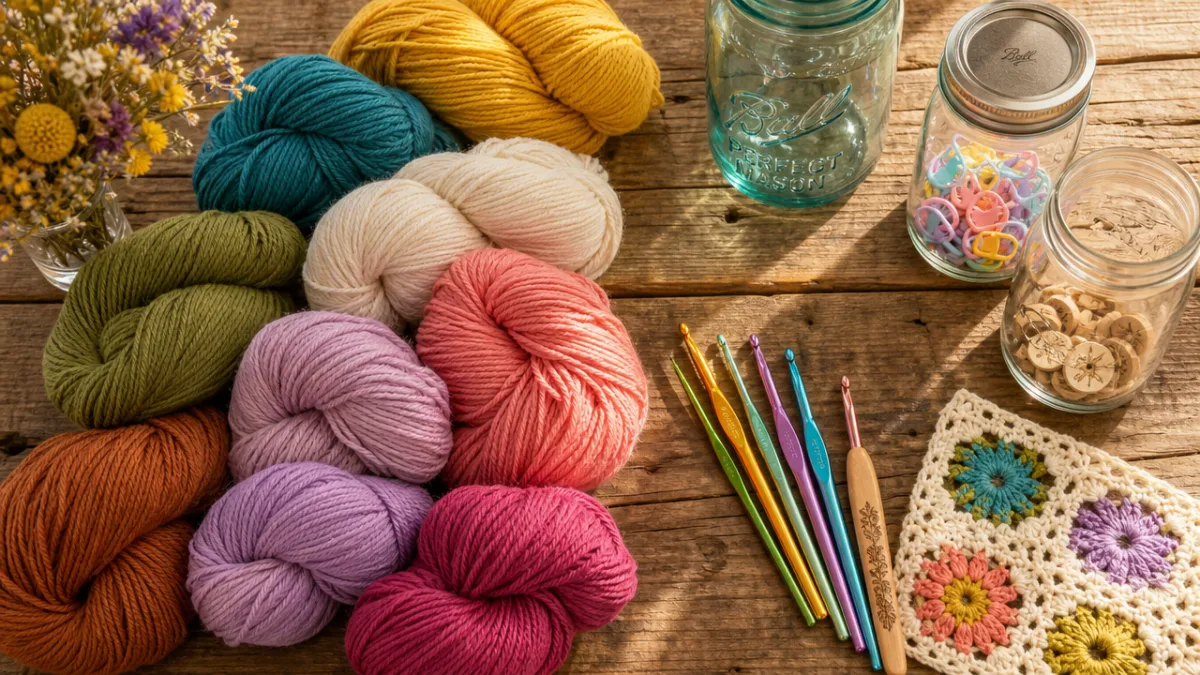
Of all the decisions you’ll make on a mason jar cozy project, picking your yarn might matter most. Cotton is the go-to choice for good reason — it’s absorbent, durable, easy to work with, and it shows off stitch detail really well. You won’t end up with beautiful shell stitches disappearing into a halo of fuzz. Cotton also tends to hold its color and can usually go right in the washing machine, which matters a lot when your cozy is regularly sitting next to someone’s morning coffee.
That said, other fibers absolutely have their place here. Acrylic is budget-friendly and comes in practically every color imaginable, which makes it a solid choice for purely decorative cozies that won’t see heavy use. Wool and wool blends bring a gorgeous texture and that cozy, handcrafted feel that’s perfect for anything autumn or winter-themed. And if you want to make something a little more special — a gift, maybe, or a piece you’re particularly proud of — silk blends or bamboo yarn add a subtle sheen that photographs beautifully and feels lovely to hold.
For everything else you’ll need: a hook sized to match your yarn weight (many crafters go up one size from the label recommendation to keep the fabric from coming out too stiff), a yarn needle for weaving in ends, scissors, and whatever embellishments you’re thinking about — buttons, beads, a bit of ribbon. It also helps to have a few different jar sizes nearby while you work so you can check the fit as you go. A cozy that’s stretched painfully tight or slipping around loosely isn’t doing anyone any favors.
- Worsted weight cotton is the sweet spot for beginners — it’s forgiving, works up at a good pace, and produces clean, well-defined stitches.
- Fingering or lace weight yarns give you something more delicate and elegant, which is great if the cozy is purely decorative.
- Bulky or super bulky yarns work up fast and give you that satisfying chunky texture — perfect when you want something bold and cozy-looking.
- Always swatch and check the fit on your actual jar before you commit to the full project. It takes five minutes and saves a lot of frustration.
- If the cozy will be holding beverages regularly, stick with natural fibers like cotton or bamboo — they handle the moisture and washing much better.
Popular Stitch Patterns and Design Styles
The stitch you choose does a lot of the heavy lifting when it comes to the personality of your finished cozy, so it’s worth poking around a bit before you just dive in. If you’re newer to crochet, single crochet is genuinely a great place to start — it makes a dense, tidy fabric that looks polished and intentional, and when you pair it with a variegated yarn, you get loads of visual interest without doing anything complicated. These work up fast, and they’re easy to customize just by changing your color, which makes them great for gift-making.
Once you’re comfortable with the basics, stitches like the shell stitch, the puff stitch, or the herringbone half double crochet start to get really fun. The shell stitch looks far more impressive than it actually is — once you get the repeat down, it clicks quickly and produces those lovely fan shapes that people always compliment. Puff stitches add actual dimension to the fabric, a kind of pillowy, three-dimensional texture that makes a jar feel genuinely warm and inviting in your hands. The herringbone half double crochet sits somewhere between casual and refined, with a woven look that photographs beautifully.
If you’re an experienced crocheter looking for a real challenge, tapestry crochet is where things get exciting. Working with two or more colors at once lets you build geometric patterns, motifs, or even lettering directly into the surface of the cozy — monogrammed initials, snowflakes, little hearts, autumn leaves. Fair isle-inspired colorwork is another direction worth exploring, especially in high-contrast combinations where the pattern really pops against the glass beneath. These take more time and concentration, but the results are the kind of thing people ask to buy.
Mason Jar Crochet Cozies for Every Decor Style
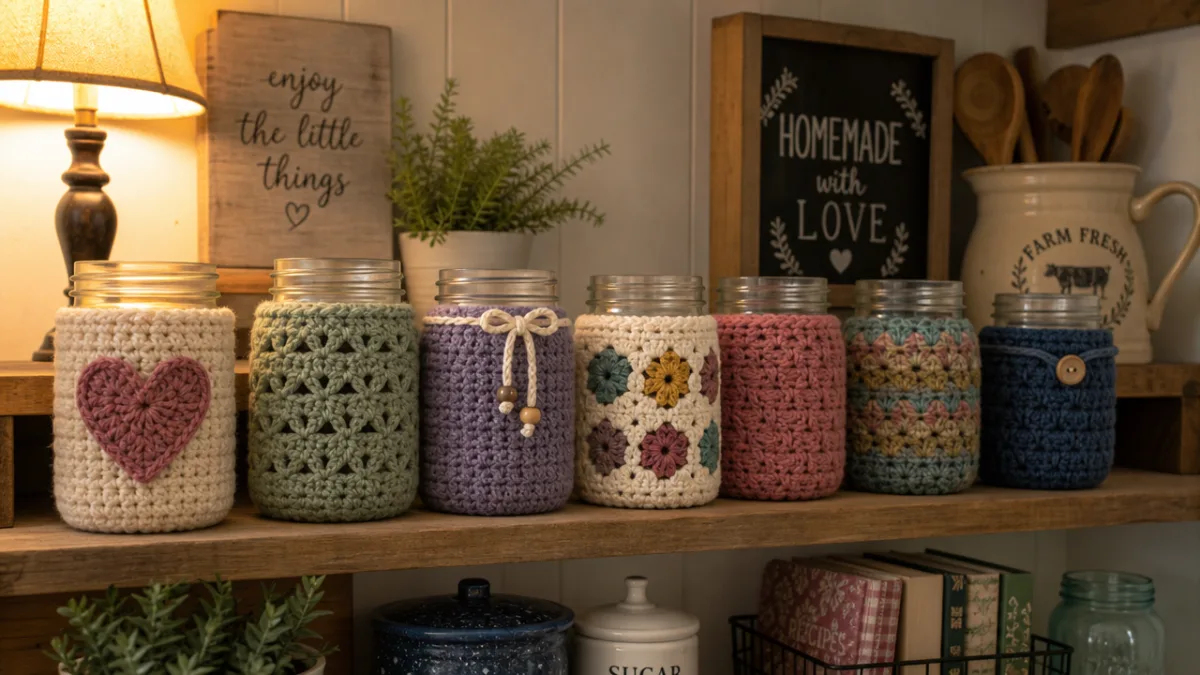
One of the things that makes mason jar cozies so endlessly useful as a decorating tool is how well they adapt to different aesthetics. If your home leans farmhouse or cottagecore, natural undyed cotton or linen-blend yarn in cream, ecru, and warm brown tones will produce cozies that look like they’ve always lived on your kitchen windowsill. Add a simple button closure, tuck in a sprig of dried lavender, wrap on a strip of burlap ribbon — suddenly you have something that feels genuinely artisanal, like it came from a small shop in a very charming town.
Boho and eclectic spaces call for something looser and more layered. Terracotta, burnt sienna, mustard yellow, sage green — these earthy tones immediately evoke the warmth of southwestern textiles and look great paired with dried pampas grass and woven baskets. Fringe is a natural fit here, whether knotted along the bottom edge or looped through granny square motifs that join together to form the body of the cozy. Thread some beads onto the fringe strands and you’ve got movement, handmade texture, and that kind of lived-in, well-traveled quality that bohemian decorating does so well.
For a more contemporary minimalist or Scandinavian-influenced space, the whole game changes — restraint is the point. Pick one color in a muted, sophisticated shade (slate blue, warm gray, soft sage, dusty rose all work beautifully), work it in a clean, repetitive stitch, and let the texture of the yarn speak for itself. Skip the embellishments, or add just one matte ceramic button as a closure and nothing else. Grouped in odd numbers on open shelving, styled next to a candle and a small plant, these understated cozies look curated and considered rather than crafty in a way that can actually elevate a whole corner of a room.
- Farmhouse Style: Cream cotton, twine accents, button closures, and simple stitch patterns in neutral tones.
- Bohemian Style: Earthy colors, fringe details, granny square construction, and beaded embellishments.
- Minimalist Style: Single muted colors, clean stitches, no embellishment, or a single refined button closure.
- Romantic Cottage Style: Pastel colors, lace-weight yarn, shell or picot edging, and ribbon ties.
- Rustic or Cabin Style: Chunky wool or wool-blend yarns, tweed textures, and deep jewel tones or forest hues.
Creative Uses for Finished Mason Jar Cozies Beyond the Kitchen
Most people’s first instinct is to put cozied jars in the kitchen, and that makes total sense — but once you start thinking about it, these things are useful all over the house. In the bathroom, a few jars in coordinating cozies can hold cotton balls, cotton swabs, bath salts, or small rolled hand towels. Line up three of them on a bathroom counter or shelf and you’ve created something that looks like it belongs in a spa, while also actually keeping your supplies organized. Match the yarn colors to your existing palette and it looks like the whole thing was planned from the start.
In a home office or craft room, cozied jars make surprisingly good desk organizers. Pens, pencils, scissors, paintbrushes, crochet hooks — they all work. And unlike a generic plastic organizer, these have actual warmth and personality. There’s something about having handmade things on a desk that makes the space feel more like yours and less like a cubicle. A set of office-supply-filled cozied jars also makes a really thoughtful gift for a teacher or creative friend — the kind of thing that shows you actually thought about the person rather than just grabbed something off a shelf.
Seasonal decorating is another place where cozies really earn their keep. Swap in red and green ones at Christmas to make a quick candlelit centerpiece, pull out orange and black with a spider web stitch pattern for Halloween, go soft and pastel for spring, warm and golden for autumn. Your plain mason jars stay the same year-round — only the cozies change. It’s one of the most low-effort ways to make your home feel seasonally fresh, and once you have a small collection built up, the whole thing takes about five minutes to swap out.
Tips for Gifting and Selling Your Mason Jar Cozies
Handmade cozies are one of those gifts that people genuinely appreciate, and with a small amount of thoughtful packaging, they can feel really special. The trick is to think of the jar itself as part of the gift. Fill a kitchen-themed cozy with layers of hot cocoa mix, or tuck in a few specialty tea bags. A bathroom cozy could hold Epsom salts, a bath bomb, or some homemade sugar scrub. Suddenly the cozy is doing double duty as both the decoration and the wrapping — and the whole thing feels twice as generous without costing much more.
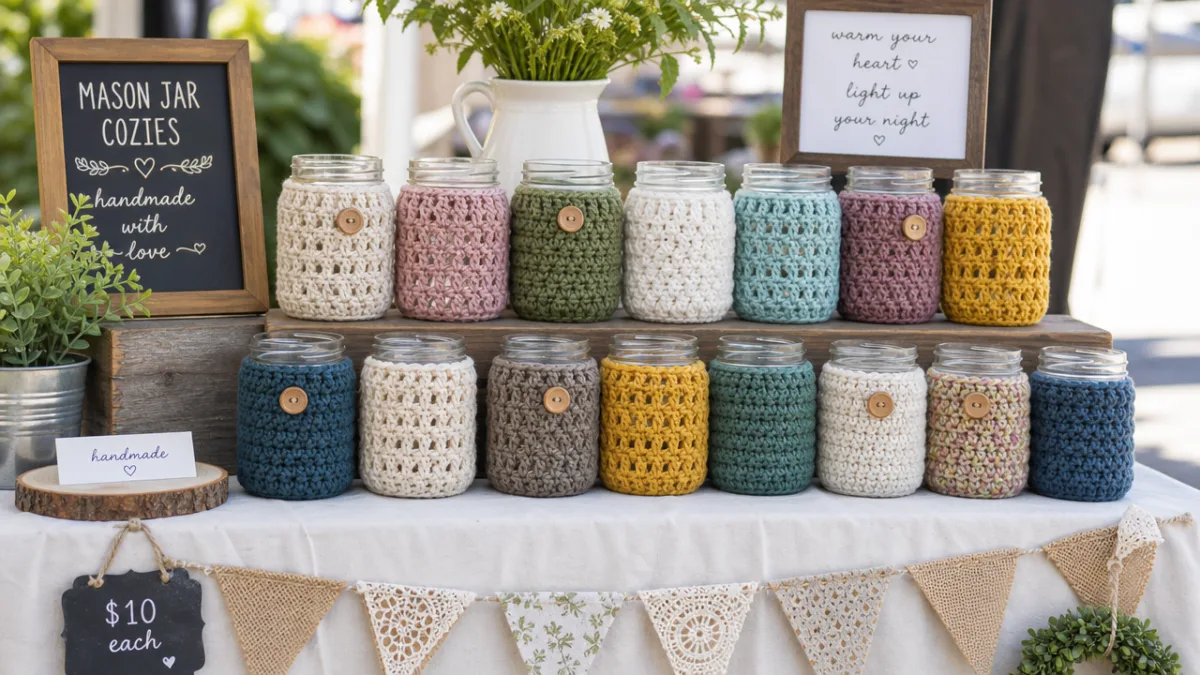
If you’re thinking about selling your cozies — at craft fairs, on Etsy, or through a local boutique — the most important thing to get right is pricing. It’s a real challenge in the handmade world because the temptation to underprice is strong, especially when you’re just starting out. But make sure you’re accounting for yarn costs, your actual time, overhead, and a real profit margin. Look at what similar listings are charging and use that as a baseline. The buyers who genuinely appreciate handmade work will pay a fair price for it, and those are the customers worth having.
Photography matters enormously when you’re selling online, since people can’t pick the cozy up and feel it. Clean, well-lit shots that show the cozy actually on a jar — styled in a way that reflects the vibe you’re going for — do a lot of the selling for you. Get some close-ups that show the stitch texture clearly, because that detail is often what convinces someone to click buy. It’s also worth considering offering cozies in sets of two or three at a bundled price. Customers tend to prefer buying a cohesive little grouping over a single cozy, and it naturally nudges the average order value up without requiring any hard sell.
Getting Started: A Simple Beginner-Friendly Cozy Pattern Overview
If you’re ready to make your first cozy but not sure where to begin, start with the rectangle method — it’s the most beginner-friendly approach by a wide margin. The idea is simple: crochet a flat rectangle long enough to wrap around the circumference of your jar with a small overlap, and tall enough to run from the base up to just below the neck. Seam the short ends together to form a tube, then use your starting yarn tail to work a few gather stitches along the bottom edge and pull it closed. It really is as straightforward as it sounds.
To figure out your dimensions, measure the height of the jar from base to shoulder with a flexible tape measure, then measure around the widest part for the circumference. Add about an inch to that circumference number to leave room for the seam and a fit that slides on and off comfortably without straining the fabric. And please — do a gauge swatch. It sounds like the boring part, but even small differences in tension can mean the difference between a cozy that fits perfectly and one that either won’t go on the jar at all or slides around uselessly once it does.
Once you’ve got the rectangle method down, a whole lot of possibilities open up. You can switch to working in the round and skip the seam entirely for a cleaner finish. You can add ribbed sections at the top and bottom to help the cozy grip the jar instead of sliding. You can work in stitch pattern changes to create textural bands or stripes. You can add a little loop or handle so the cozy can hang from a hook or be carried easily. And gradually, as you try more things, you’ll start to develop your own eye for what works — what combinations of color and stitch and embellishment feel like you. That’s when making these little projects stops being just a craft and starts feeling like actual creative expression.








What do you think?
It is nice to know your opinion. Leave a comment.