










Ultimate Craft Room Inspo: Dreamy, Organized & Aesthetic Creative Space You’ll Want Immediately
Why Your Craft Room Environment Matters More Than You Think
Most crafters spend years collecting supplies, tools, and materials before they ever really stop to think about the space those things actually live in. But here’s the thing — your craft room isn’t just a backdrop to your creative work. It’s an active part of it. When your space feels chaotic, cluttered, or just kind of blah, your brain picks up on that stress before you’ve even grabbed a pair of scissors. Environmental psychology research consistently shows that our physical surroundings have a real, measurable effect on our mood, focus, and creativity — which means that putting thought and effort into your craft room is genuinely an investment in your art.
Think back to the last time you sat down to work somewhere that felt truly beautiful and organized. There’s this specific kind of calm that settles over you when everything has a place, the light feels right, and the whole vibe matches your personality. That feeling isn’t accidental or shallow — it’s your nervous system responding to order, beauty, and intentionality. A well-designed craft room tells your brain that this is a dedicated space for making and thinking and exploring, which makes it so much easier to slip into a creative flow and stay there for hours.
The good news is that you don’t need a huge budget or a room the size of a ballroom to pull this off. Some of the most stunning creative studios I’ve ever seen are carved out of spare bedrooms, basement corners, or even large closets. What matters way more than square footage is thoughtfulness — the intentional combination of storage, color, lighting, and personal details that turns any space into somewhere you genuinely can’t wait to spend time. This article walks you through every element worth considering so you can build the craft room you’ve always dreamed about.
Designing the Aesthetic: Color, Mood, and Visual Cohesion
Before you buy a single shelf or sort a single drawer, you need to figure out the visual identity of your craft room. This is where so many people go sideways — they pick up furniture and storage pieces one at a time, with no real unifying vision, and end up with a space that feels cluttered and disjointed even when it’s technically organized. Start by pulling together inspiration images from Pinterest, design magazines, or home tours, and look for the threads that connect what you keep saving. Do you keep gravitating toward soft, muted Scandinavian tones? Bold, maximalist color? Earthy cottagecore warmth? Locking down your aesthetic first makes every decision after it so much easier and more coherent.
Color is honestly the most powerful tool you have. Lighter, neutral tones — warm whites, soft creams, sage greens, dusty blush — tend to make spaces feel bigger, calmer, and more luminous, which a lot of crafters love for detail-heavy work. Bolder colors, on the other hand, can energize a space and express your personality in ways that feel genuinely joyful. The key is to pick a palette of no more than three or four coordinating colors and use them consistently across your walls, furniture, storage containers, and accessories. When everything speaks the same visual language, the result feels intentional and magazine-worthy instead of thrown together.
Visual cohesion goes beyond color into texture, pattern, and materials too. A room where everything is the same material — all plastic, all metal, all wood — tends to fall a little flat. The most beautiful craft spaces layer different textures: a whitewashed wooden pegboard alongside wicker baskets, ceramic jars next to clear acrylic drawers, a soft textile rug grounding a hard-floored workspace. Those layered textures create warmth and visual interest that make a room feel lived-in and loved rather than sterile. Think of your craft room as a curated installation, not just a storage solution.
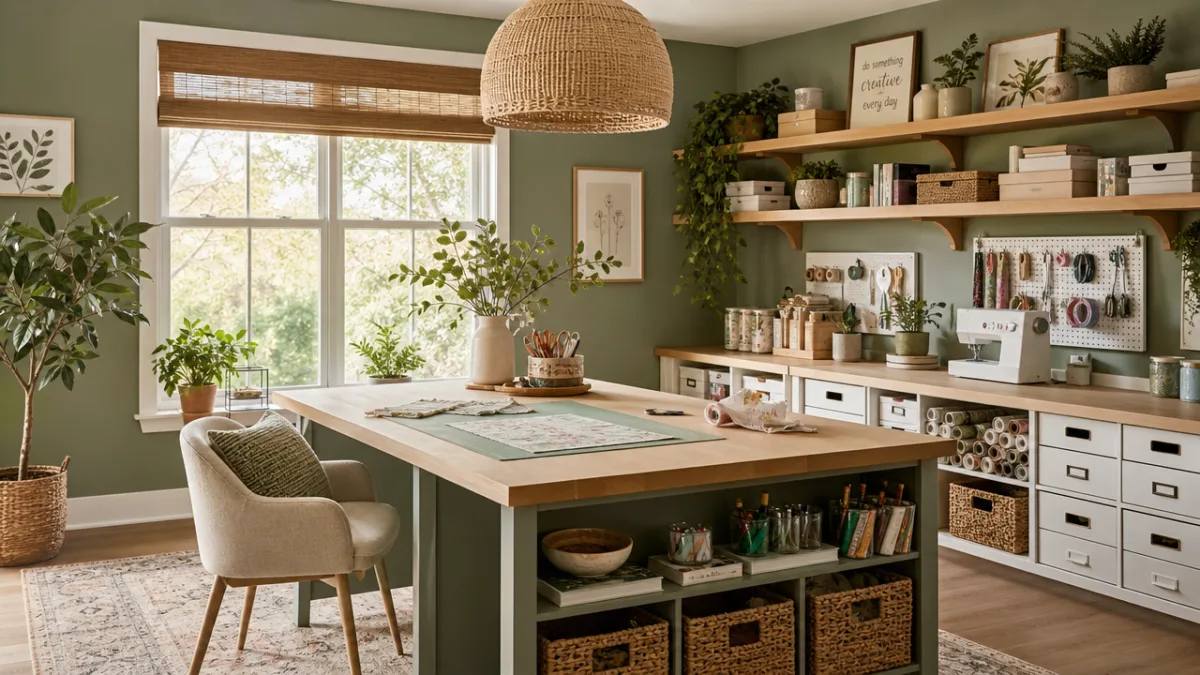
Smart Storage Solutions That Are Beautiful AND Functional
Storage is probably the trickiest part of designing a craft room, because the organizational demands of a creative space are genuinely complex. Crafters work with materials across a wildly diverse range of sizes, shapes, and textures — from tiny seed beads and delicate ribbon spools to large bolts of fabric and awkward rolls of wrapping paper. No single storage solution covers all of that, which is why the most effective craft rooms take a layered, modular approach, combining multiple storage types that work together to handle the full range of your supplies.
Wall-mounted storage is your best friend in a craft room, and pegboards in particular have had a very well-deserved comeback. A large pegboard — especially one painted to match your color palette — gives you infinitely customizable, visible storage that keeps your most-used tools within arm’s reach without eating up desk or floor space. Hooks, shelves, bins, and holders can be rearranged whenever your needs change, and because everything is visible, you actually use and appreciate your tools instead of forgetting about them in the back of a drawer. Pair your pegboard with floating shelves for bulkier items and open shelving units for labeled bins and boxes.
For smaller supplies, the combination of clear containers and consistent labeling is genuinely transformative. When you can see exactly what you have and grab it in seconds, crafting sessions start faster, run more smoothly, and end more cleanly. Using uniform containers in the same size family — matching glass jars for thread and embellishments, matching acrylic drawers for paper supplies, identical wicker baskets for fabric scraps — means your storage itself becomes part of the aesthetic. And your labels don’t have to be purely utilitarian either; hand-lettered tags, printed labels with coordinating fonts, or chalkboard labels all add a polished, intentional look to the whole system.
Here are some particularly effective storage categories to address in any well-organized craft room:
- Vertical wall storage — Pegboards, grid panels, and floating shelves use wall space efficiently and keep your surfaces clear for actual work.
- Drawer towers and rolling carts — Modular units that can be repositioned as needed and provide hidden storage for supplies you don’t want on display all the time.
- Clear stackable bins and jars — Perfect for small embellishments, tools, and materials where visibility prevents duplicate purchasing and saves you from endless hunting.
- Fabric and paper organization — Dedicated systems for large flat materials, like vertical file organizers for paper pads or dowel rods for fabric bolts, prevent damage and keep things actually accessible.
- Seasonal or project-based bins — Clearly labeled totes for holiday crafts, works-in-progress, or specific project types that can come out when you need them and get tucked away when you don’t.
Lighting: The Underestimated Game-Changer
If there’s one single upgrade that will transform your craft room more than anything else, it’s lighting. And that’s not an exaggeration. Poor or poorly planned lighting is one of the most common reasons crafters deal with eye strain, fatigue, headaches, and diminished precision. When you can’t see clearly — when colors look different under artificial light than they do in natural conditions, or when shadows fall across your work at annoying angles — the quality and enjoyment of your crafting suffers in very real, very noticeable ways. Getting your lighting right isn’t a luxury; it’s a foundational necessity for anyone who spends serious time creating.
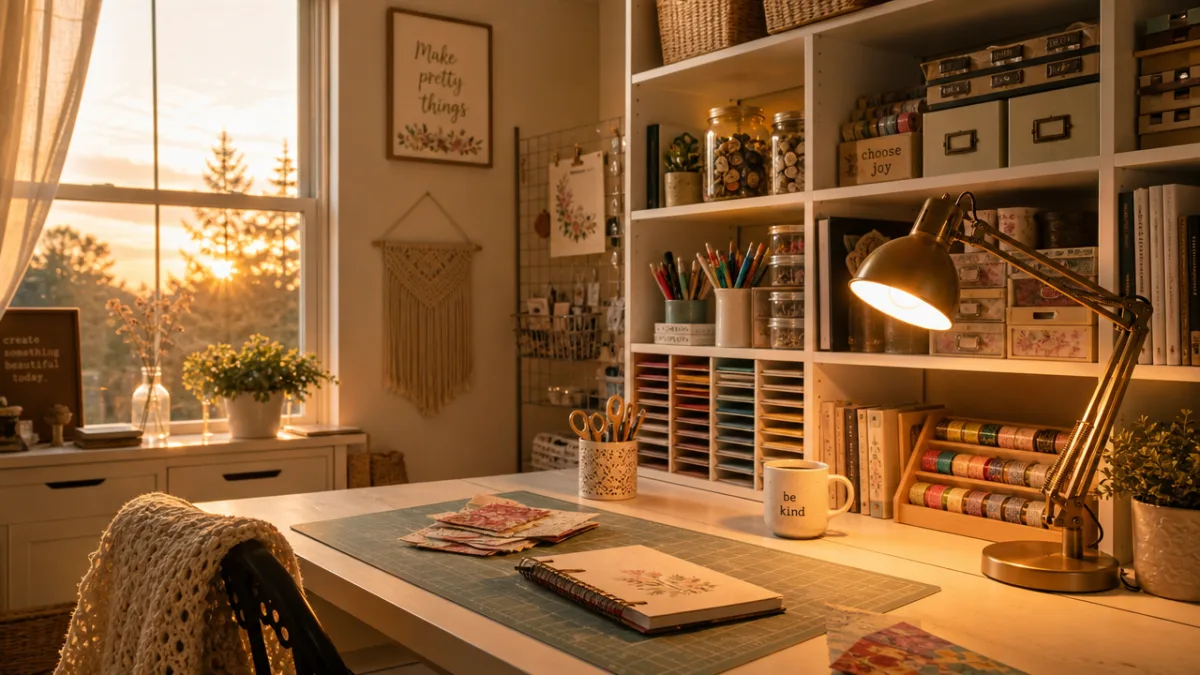
The gold standard is abundant natural light, and if you can position your workspace near a large window or skylight, you absolutely should. Natural daylight gives you true-color rendering that no artificial bulb can fully replicate, which matters enormously when you’re working with color-sensitive materials like fabric, paint, or yarn. That said, natural light alone is rarely enough, especially early mornings, evenings, or during winter months. That’s why a layered artificial lighting setup is so important: overhead ambient lighting to brighten the whole room, task lighting aimed directly at your work surface, and accent lighting to add warmth and atmosphere to the space.
For task lighting, look for LED daylight bulbs with a color temperature between 5000K and 6500K — this range most closely mimics natural daylight and gives you accurate color perception. Adjustable desk lamps, under-shelf strip lights, and mounted spotlights all do the job well for directing focused light exactly where you need it. For ambient and accent lighting, warmer tones in the 2700K to 3000K range create that cozy, inviting glow that makes your craft room feel like a sanctuary rather than a hospital. Using both — bright and cool for working, warm and soft for the overall vibe — gives you a room that’s highly functional and genuinely lovely to be in.
The Ergonomic Workspace: Setting Up Your Creative Command Center
Your primary workspace — the desk, table, or counter where you actually sit down and make things — deserves more thought than almost anything else in your craft room. Crafters are notorious for spending long, immersive hours at their workstations, and doing that in a poorly set-up space is a direct path to back pain, wrist strain, and the kind of physical discomfort that cuts creative sessions short right when inspiration is hitting its stride. Ergonomics might sound like a corporate office concept, but the principles apply just as much to any space where focused, sustained work happens, and a thoughtfully arranged craft desk can genuinely change how long and comfortably you’re able to create.
Start with surface height. Your work surface should let you sit with your elbows at roughly ninety degrees and your forearms resting comfortably on the table without hunching your shoulders or lifting your arms. Most standard desks are designed for computer use and sit at around seventy centimeters, which works well for average-height people in a standard office chair. But if you do a lot of standing work — cutting fabric, working with large sheets of paper, or using tools that need downward pressure — a higher table or an adjustable-height desk can make a huge difference. Some dedicated crafters go for a dual-surface setup: a seated desk for detailed work and a standing-height table for bigger projects.
Your chair matters just as much and is equally worth investing in. A chair with adjustable height, lumbar support, and decent seat padding will serve you far better over time than a decorative chair chosen purely for looks, even if that trade-off feels frustrating at first. The good news is that ergonomic chairs have gotten considerably more stylish in recent years, and plenty of them come in colors and styles that fit beautifully into a thoughtfully designed craft room. Beyond the chair and desk, think carefully about where your most-used tools live — they should be within arm’s reach of your seated position so you’re not constantly twisting, reaching over, or getting up mid-project to grab something you use every single session.
Personal Touches and Inspiration: Making It Unmistakably Yours
A craft room becomes truly special — not just organized and functional, but genuinely inspiring — when it reflects the specific personality, taste, and creative passions of the person who uses it. This is the element that takes a space from looking like a beautifully staged Pinterest photo to actually feeling like it belongs to you and supports your unique creative vision. Personal touches don’t need to be grand gestures; often the most meaningful ones are small and specific: a framed print that makes you smile every morning, a collection of vintage spools displayed on a shelf, a gallery wall of your own finished projects, or a small plant that brings a little living green into the room.
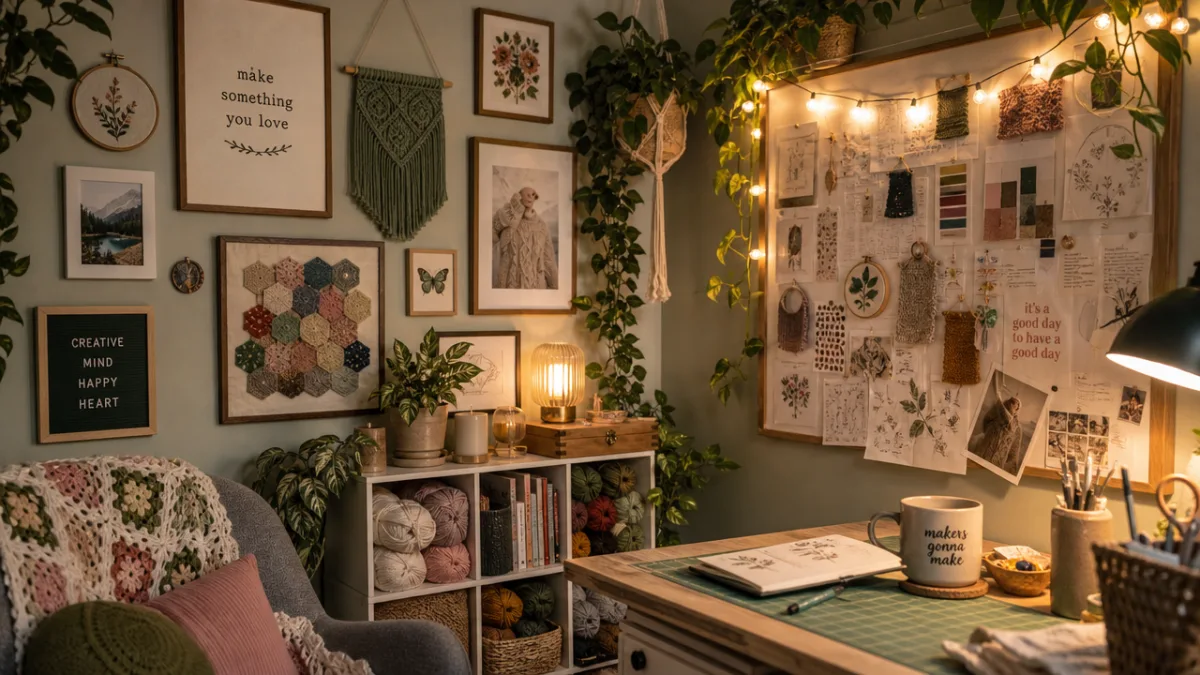
Inspiration boards are one of the most genuinely useful personal additions to any creative space, and they pull double duty by being both aesthetic and functional. Whether you prefer a traditional corkboard pinned with swatches, photos, and clippings, a magnetic board covered in color references and project sketches, or a big chalkboard wall where ideas can be written, erased, and rewritten freely, having a dedicated surface for visual inspiration keeps your creative motivation right in front of you. When you’re stuck mid-project or searching for a new direction, a quick glance at your inspiration board can give you exactly the spark you need without ever having to leave your workspace or fall down a browser rabbit hole.
And don’t underestimate the power of small sensory details in making your craft room a place you genuinely want to be. A candle or diffuser with a scent you associate with creativity and calm, a small Bluetooth speaker on a shelf for the playlist that gets you into a making mood, a favorite mug stationed near your desk for the inevitable cup of tea or coffee — these tiny things signal to your brain that this space is set apart from the rest of daily life, a dedicated zone for the kind of focused, joyful making that actually feeds your soul. The most dreamy craft rooms aren’t just beautiful to look at; they’re beautiful to be inside, designed with the full sensory experience of creating in mind.
As you build and refine your craft room over time, remember that the goal isn’t perfection achieved all at once. The most inspiring creative spaces evolve gradually, picking up layers of personality, function, and beauty season by season. Start with the fundamentals — good storage, good lighting, a comfortable workspace — and let the rest develop naturally as you figure out how you actually use the space and what genuinely serves your creative practice. Your dream craft room isn’t a fixed destination you arrive at; it’s an ongoing, joyful work in progress, just like the best creative work always is.








What do you think?
It is nice to know your opinion. Leave a comment.