










How a Hobby Room Can Become Your Personal Sanctuary
The Power of Having a Space That Is Truly Yours
We live in a world that’s constantly pulling at us — our attention, our energy, our emotional reserves. So the idea of having a space that’s genuinely, completely yours has never felt more important. A hobby room isn’t just somewhere to stash your craft supplies or keep your guitar. It’s a place where the noise of daily life goes quiet and something more personal takes over. When you set it up with real intention, it can become one of the most meaningful corners of your home — the kind of place that actually restores you after a hard day.
Most of us don’t realize how much our surroundings affect how we feel. But research in environmental psychology is pretty clear on this: the spaces we spend time in shape our mood, our creativity, and even our sense of who we are. A hobby room gives you something rare — permission to design a space entirely around your own needs and pleasures, without the compromises that come with shared rooms. That freedom alone can feel surprisingly healing.
Whether you’re into painting, woodworking, reading, music, model building, or yoga, the idea is the same: a room devoted to what you love sends a quiet but powerful message to yourself. It says your interests matter. Your time matters. Your inner life is worth protecting. This article walks you through how to build, organize, and actually inhabit a hobby room that works as your personal sanctuary — not just as a nice concept, but as something you use and come back to every day.
Choosing the Right Space in Your Home
Before anything else, you need to pick the right spot. Not every room works equally well for every hobby, and choosing poorly can quietly undermine the peaceful atmosphere you’re going for. Think about natural light, how much sound travels, how close the room is to the busiest parts of the house, and whether the ventilation is decent. A painter has very different needs than a drummer or someone who does calligraphy, and those differences should guide your choice from the start.
A lot of people naturally gravitate toward a spare bedroom, the basement, or the garage — and honestly, any of these can work really well. Basements tend to have good sound insulation and a naturally cocooning feel that some people find deeply comforting. Spare bedrooms usually have windows and familiar proportions, making them great for hobbies that depend on good light. Garages, once you add some insulation and heating, can handle bigger projects or anything that generates noise, dust, or fumes that would be a problem inside the house.
If you don’t have a whole room to give over, don’t abandon the idea. A well-defined corner of a larger room, a garden shed, a screened porch, or even a deep closet turned into a focused nook can do the same psychological work as a full room — as long as the boundaries are clear and you treat the space with the same care and intention. What matters isn’t square footage. It’s the feeling that this territory belongs to you and your hobby, reliably and without apology.
Designing for Comfort, Focus, and Creative Flow
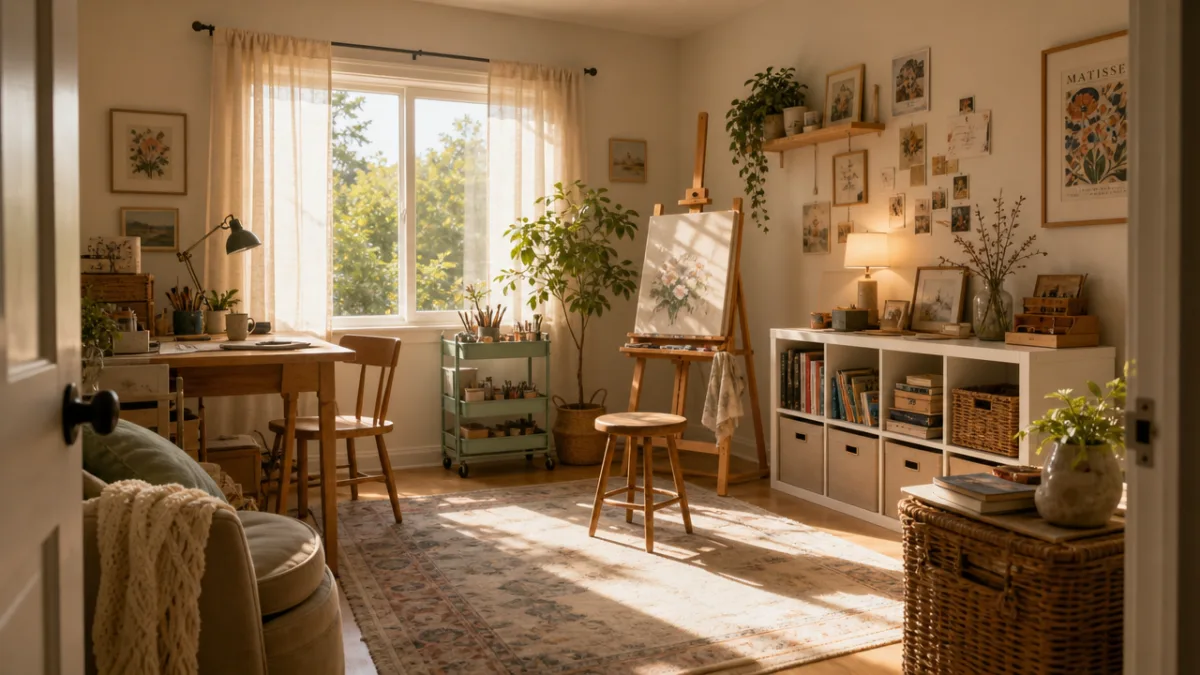
Once you’ve picked your space, the design part begins — and this is where things get really personal. Start by thinking about how you want the room to feel the moment you walk in. Energized and focused? Calm and unhurried? Playfully inspired? Every decision you make — paint color, flooring, the height of your work surface — either supports or works against that feeling. It’s worth getting clear on this before you start spending money on furniture or decor.
Color psychology is a genuinely useful starting point here. Cool blues and greens tend to slow things down in a good way, supporting sustained focus — they work well for reading rooms, writing spaces, or anywhere you meditate. Warmer tones like terracotta, golden yellow, or deep rust tend to feel more energizing and socially warm, which suits a craft room or art studio nicely. Neutral palettes with a few well-chosen accent colors give you the most flexibility, letting you shift the mood through smaller updates as your tastes change over time.
Don’t let ergonomics be an afterthought. The furniture and equipment you’re using for hours at a stretch has to actually support your body, or the room will start to feel like a source of discomfort rather than pleasure. Get a genuinely comfortable chair, make sure your work surface is at the right height, and think carefully about where your light falls relative to your dominant hand. A room that feels good physically is a room you’ll actually want to be in — and that’s the whole point.
Key Design Elements to Consider
- Lighting: Layer natural light, ambient overhead light, and focused task lighting to accommodate different times of day and types of work.
- Storage: Visible, organized storage reduces mental clutter and makes it easier to begin a session without spending ten minutes searching for supplies.
- Acoustic treatment: Even simple measures like rugs, curtains, and upholstered furniture can significantly reduce echo and outside noise intrusion.
- Temperature control: A space that is too hot, too cold, or poorly ventilated will shorten your sessions regardless of how beautifully it is decorated.
- Personal objects: Meaningful art, plants, photographs, or objects that carry personal significance reinforce the sense that this is your sanctuary and no one else’s.
Organizing Your Hobby Room for Maximum Creativity
Organization in a hobby room is a different thing than organization elsewhere in the house. The goal isn’t necessarily to minimize what’s visible or chase some minimalist ideal — for a lot of creative hobbies, having your materials out and accessible is actually part of how the creative process works. The real goal is to reduce friction between having an idea and acting on it. When inspiration strikes, everything should be within reach, clearly sorted, and logically arranged so that the act of getting started never kills the momentum that brought you to the room.
Breaking the room into dedicated zones helps a lot, especially if your hobby has multiple distinct phases. A painter might want separate areas for mixing colors, working on active pieces, storing finished canvases, and cleaning up. A musician might separate a practice area from a recording setup and a place for sheet music. Even in a small room, clearly defined areas cut down on decision fatigue and make it easier to move between different parts of your hobby without losing your flow.
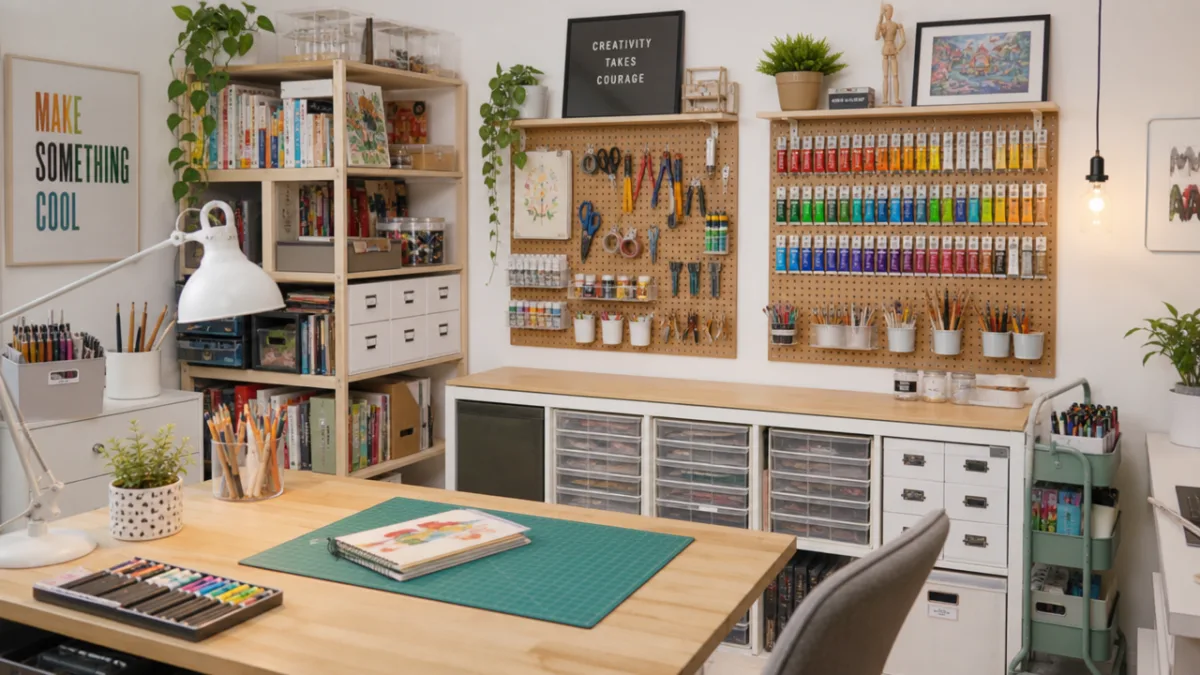
The research on cluttered workspaces is pretty consistent — visual chaos raises stress levels and makes it harder to concentrate. But the answer isn’t necessarily to hide everything away. Open shelving with well-sorted bins, pegboards with hooks for tools, glass jars for small supplies — these let you see what you have without creating visual noise. The real key is consistency: a simple system you can actually maintain is worth far more than a perfect system that takes real effort to restore after every session.
Storage Solutions Worth Investing In
- Modular shelving units that can be reconfigured as your hobby or collection grows.
- Rolling carts that allow you to bring supplies to your work area and then tuck them away without disrupting the room’s layout.
- Clear acrylic bins or drawers for small items so you can identify contents at a glance.
- Pegboards or wall-mounted tool rails to keep frequently used items off the work surface but immediately accessible.
- A dedicated inbox or project tray to corral works-in-progress without allowing them to spread across the entire room.
Creating Rituals That Make the Space Feel Sacred
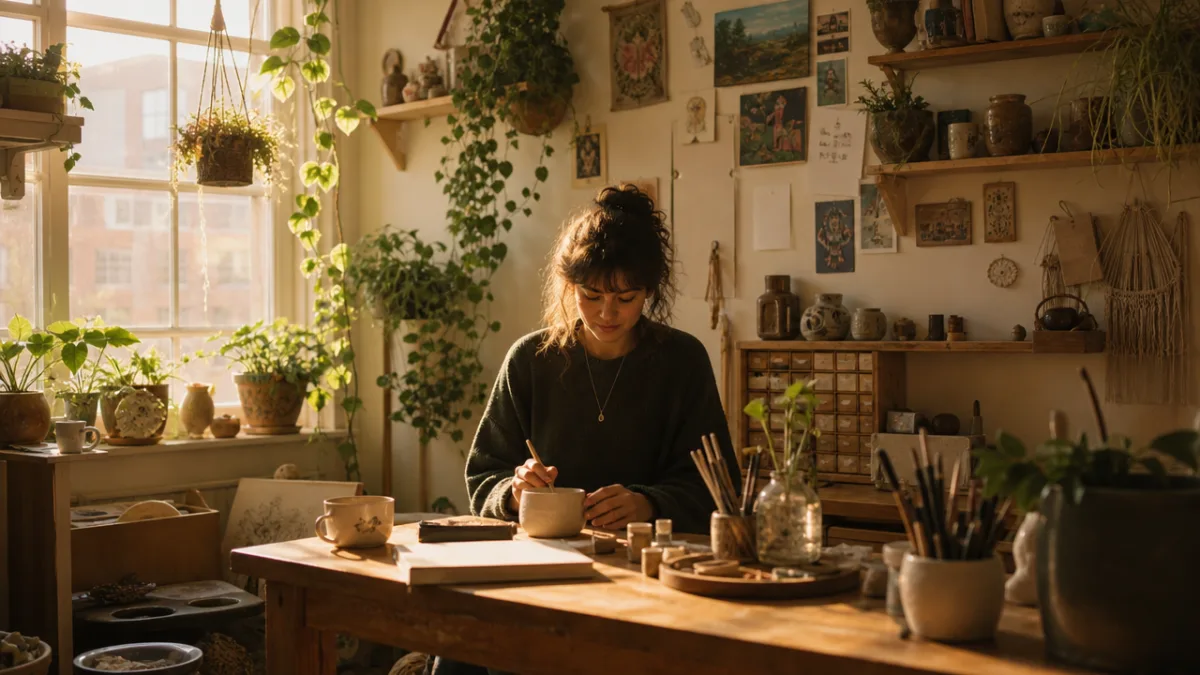
A room becomes a sanctuary through more than just its physical setup — it’s also about the habits and rituals you bring to it. Rituals work because they’re predictable. They signal to your nervous system that something is shifting, that you’re moving into a different mode than the one you were just in. People who use their hobby rooms most consistently tend to have small, reliable rituals that mark the beginning and end of their time there. It might be as simple as making a specific type of tea, lighting a candle, or putting on a particular playlist before they get started.
The closing ritual matters just as much as the opening one. Taking a few minutes to tidy your work area, put your tools away, and maybe jot down a quick note about where you left off creates a satisfying sense of closure — and it makes the next session much easier to step into. It also reinforces your relationship with the space. You’re not just using the room and walking away; you’re caring for it, which mirrors the care it gives back to you. That reciprocal feeling is a big part of what turns a functional room into a real sanctuary.
Some designers and therapists talk about what they call a threshold ritual — a specific small action you take every time you enter your hobby room. It could be removing your shoes, taking three slow breaths, or simply pausing with your hand on the doorframe before you step inside. These actions might seem almost too small to matter, but they create a consistent psychological cue that helps your mind shift out of task-driven, obligation-mode thinking and into the more open, exploratory state where creative hobbies really come alive. Over time, the ritual itself becomes meaningful, and just doing it starts to produce the mental shift you’re looking for.
The Emotional Benefits of a Dedicated Hobby Space
The benefits of having a dedicated hobby room go well beyond the pleasure of the hobby itself. Research in positive psychology has consistently found that regular, freely chosen leisure activities are among the most reliable predictors of long-term happiness and emotional resilience. When that activity has a physical home — a space that signals its own importance just by existing — those benefits get amplified. The room becomes a standing commitment to your own wellbeing, a daily reminder that rest, creativity, and personal joy aren’t luxuries. They’re necessities.
People who spend regular time in a personal creative space often notice real reductions in anxiety and depression, a greater ability to handle stress, and a stronger sense of who they are outside of their professional roles or family responsibilities. This matters especially for caregivers, people in high-pressure jobs, and anyone who regularly puts their own needs last. The hobby room acts as a counterweight — a place where you’re not defined by what you produce for others, but by what you choose to explore for yourself.
There’s also a quieter benefit that many people only notice after spending real, consistent time in their sanctuary: a renewed relationship with patience. Hobbies unfold slowly by nature. They require repetition. They resist the instant gratification that dominates so much of daily life. A room devoted to that kind of practice creates a protected space for slowness, for the satisfaction of incremental progress, for the pleasure of process over outcome. In that sense, your hobby room isn’t just a room — it’s a way of living made physical. A daily argument for the value of attention, craft, and the unhurried self.
Growing with Your Space Over Time
A hobby room isn’t something you finish once and leave alone. It’s a living space that should shift alongside you. Your interests will deepen, change, or branch out in new directions. Your skills will grow, bringing different equipment and new organizational needs. Your emotional needs will evolve through different seasons of life, and your room should be able to respond to that rather than staying locked into a configuration that made sense years ago but no longer fits. Building in flexibility from the beginning — through modular furniture, multipurpose surfaces, and storage that can be rearranged — means the room grows with you instead of holding you back.
It’s worth taking time once or twice a year to honestly reassess whether the space is still working for you. Is there equipment taking up significant room that you haven’t touched in months? Are new supplies crowding your work surface without a real home to go to? Does the overall feel of the room still match how you want to feel when you’re in it? These check-ins keep the room from slowly drifting into a cluttered storage area, and they reinforce your ongoing commitment to treating it as a sanctuary rather than just a room.
Finally, don’t underestimate what it can mean to share your hobby room with someone else — selectively and on your own terms. Inviting a trusted friend to see your space, work on something together, or simply sit quietly while you do your thing can deepen the meaning the room holds for you. A sanctuary doesn’t have to be solitary to feel sacred. What makes it yours isn’t exclusivity — it’s intentionality. The clear, consistent choice to treat this space, and the time you spend in it, as something worth protecting, nurturing, and returning to, for the long and creative life ahead.








What do you think?
It is nice to know your opinion. Leave a comment.