










Hands-On Camping Crafts for Kids of All Ages: The Ultimate Guide to Creative Outdoor Fun
Why Camping Crafts Matter for Kids’ Development
A camping trip is already pretty great on its own — fresh air, campfires, s’mores. But throw some crafting into the mix and you’ve got something that goes way beyond a typical vacation. Making things together out in nature gives kids a hands-on connection to the outdoors that no classroom activity can really replicate. They start actually looking at what’s around them: noticing the shape of a leaf, picking up a cool piece of bark, wondering what lives under that log. That kind of curiosity is genuinely valuable.
From a development standpoint, camping crafts are doing a lot of good things at once. When a kid weaves a grass bracelet or turns a pinecone into a little woodland critter, they’re working on fine motor skills, creative thinking, and problem-solving all at the same time. Research backs this up, too — kids who spend time doing nature-based crafts tend to show better focus and less anxiety, and they come away with a real sense of “I made that” that screen time just doesn’t give them.
There’s also something special about what crafting does for the whole family. Sitting around a picnic table making stuff together — laughing when something falls apart, helping a younger sibling figure out a knot, hearing grandpa explain how he used to whittle as a kid — that’s the stuff that actually becomes a family story. Older kids get to be the experts for once, parents discover they’re not as crafty as they thought, and somehow it all works out into one of the better afternoons of the trip.
Nature-Inspired Crafts Using Materials from the Campsite
Here’s one of the best things about camping crafts: you don’t need to haul a ton of supplies from home, because the campsite itself basically is the craft store. Before you pull out a single thing from your kit, send the kids on a slow walk around the area to see what they can find. Fallen leaves, smooth river stones, twigs, pinecones, acorns, seed pods, interesting bits of bark — all of it becomes raw material. And the foraging itself is part of the lesson, teaching kids to look closely at their surroundings and to take only what’s already on the ground.
Leaf rubbings are one of those crafts that have been around forever for good reason — they’re simple, they’re beautiful, and they work for pretty much every age. You just place a leaf vein-side up under a thin piece of paper and rub a crayon across the surface. What comes through is this surprisingly intricate map of the leaf’s veins, and kids are almost always a little amazed by it. Little ones can do this easily, while older kids can get into layering multiple leaves or hunting for the most unusual shapes. The finished rubbings make great bookmarks, journal covers, or just something to tape inside a nature notebook.
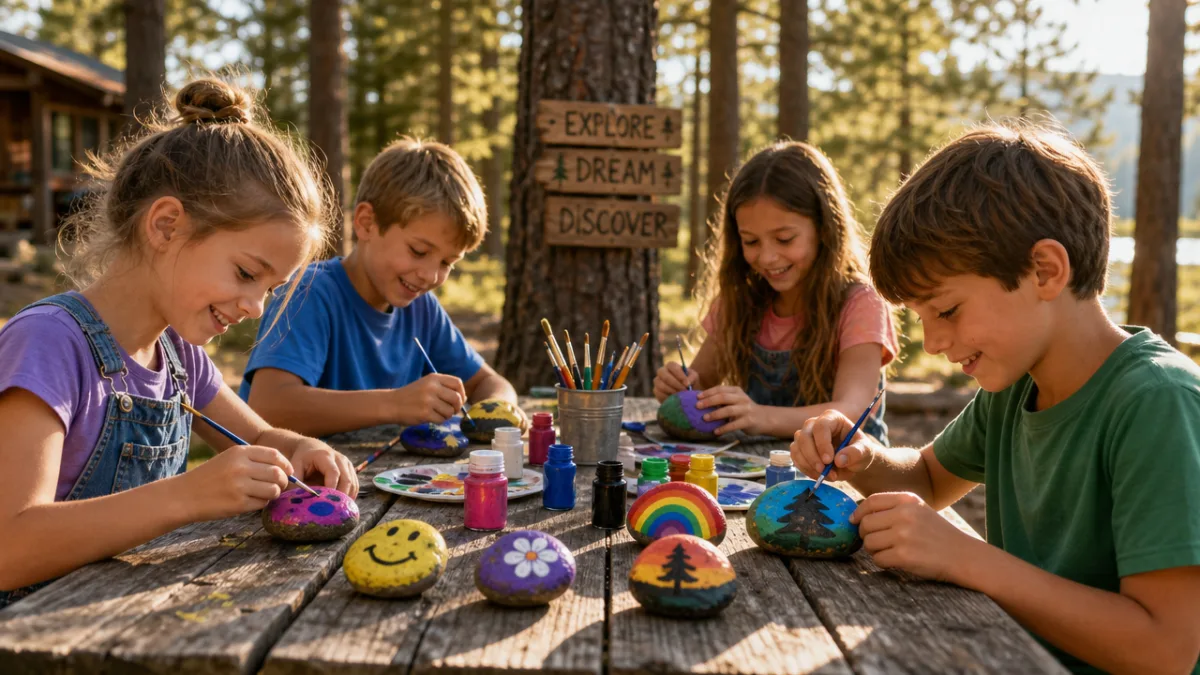
Rock painting has had a real moment in recent years, and it’s easy to see why. You need minimal supplies, it’s satisfying pretty quickly, and there’s no wrong way to do it. Pack along some acrylic paint pens or a small set of basic acrylics and let kids go to town on smooth stones — ladybugs, owls, tiny landscapes, wild abstract patterns, whatever they’re into. Some families get into the “kindness rocks” movement, where you paint something cheerful or write an encouraging message and leave the rock on a trail for a stranger to find. It’s a small thing, but kids love the idea that someone they’ll never meet might smile because of something they made.
Classic Camp Crafts That Never Go Out of Style
Friendship bracelets have been a camp staple for generations, and they’re still one of the most satisfying portable crafts out there. All you really need is some embroidery floss, a safety pin to anchor your work, and a little patience. Kids around six or so can usually get the hang of the basic knotting pattern with a bit of help, and by the time you’re looking at chevron or diamond patterns, even adults are fully absorbed and wondering where the last hour went. The bracelets end up as little wearable souvenirs — kept, traded, or tucked into an envelope to mail to a friend back home.
Dreamcatchers translate really well to a camping setting, though they’re worth approaching with some care and context. A quick, honest conversation about their roots in Anishinaabe traditions makes the activity much richer than just a cool craft. Using hoops, yarn, and whatever feathers or beads you’ve brought along, kids can create their own decorative versions while actually learning something about storytelling and symbolism. The weaving part — building up that web in the center — is also surprisingly meditative, which makes this a great choice for winding down after a big day on the trails.
Stick and twig crafts are endlessly open-ended, which is a big part of what makes them so great. Kids can build tiny log cabins, fairy houses, rustic picture frames, or elaborate little suspension bridges using sticks they’ve collected and bound with twine. If you have a portable battery-powered glue gun, that opens up even more possibilities. The process of figuring out which sticks work, how to keep things from collapsing, and why the first attempt didn’t quite hold together is genuinely good engineering practice — it just doesn’t feel like it because it’s so fun. Some families have turned this into a camping tradition, adding to a twig fairy village a little more each year they return to the same site.
Crafts That Teach Survival and Outdoor Skills
Some of the best camping crafts are the ones where kids walk away with an actual skill. Cordage making is a perfect example. Using long grasses, strips of bark, or even cut-up strips from an old t-shirt, kids can learn to twist plant fibers into simple rope using a technique that humans have been using for tens of thousands of years. It takes a little practice to get the two-ply twist consistent, but once it clicks, kids are genuinely thrilled — and the cordage they make can actually be used to hang a food bag or lash sticks together. That sense of real-world usefulness is hard to beat.
Natural dye tie-dye sounds complicated but is actually very doable at a campsite, and the chemistry lesson baked into it is legitimately cool. Different plants and materials produce different colors: walnut hulls make rich browns, blackberries give soft purples, onion skins yield warm yellows, and some clay-rich soils produce lovely terra-cotta tones. With an adult helping with the boiling or grinding, kids can extract color from things they find or bring along, then use basic binding techniques to create patterns on white cotton bandanas or t-shirts. Wearing something home that you essentially dyed with berries and dirt is a pretty great feeling.
Whittling deserves a real comeback in family camping. Yes, it involves a knife — but with the right supervision, age-appropriate tools made for young woodworkers, and clear safety instruction, kids as young as eight or nine can absolutely learn to carve simple shapes from soft wood like basswood or pine. A little spatula, a pointed marshmallow stick, a rough animal shape — these small accomplishments mean a lot to kids. The focus and patience it takes to whittle something builds concentration in a way that’s hard to find elsewhere, and the pride of holding something you carved out of raw wood with your own hands is genuinely something special.
Rainy Day Camping Crafts for Shelter and Screen-Free Fun
Every camping family has been there: it’s raining, the fire won’t cooperate, and the kids are starting to look at you expectantly. Having a few good shelter-friendly crafts ready to pull out turns that potential frustration into some surprisingly great memories. Nature journaling is one of the best options because all it really needs is paper, something to draw with, and the fact that you’ve just spent time outside noticing things. Kids sketch the birds they saw, tape in a leaf they found, write about something funny that happened, or try to paint the view from the tent door in watercolor. It becomes a record of the trip that’s entirely theirs.
Paracord crafting is basically made for rainy days — no mess, no water needed, and the supplies take up almost no space. That bright, tough nylon rope can be braided and knotted into bracelets, keychains, zipper pulls, and survival bracelets that pack several feet of usable cordage into something that fits on your wrist. Bring a pattern card or download a few instructional sheets before the trip and kids can largely work independently. The range of colors and pattern difficulty levels means everyone from a seven-year-old to a grandparent can find something that holds their attention.
Collage and mixed-media work under the awning or in a big tent is another rainy-day winner. Kids arrange their collected natural treasures — pressed leaves, small feathers, bits of interesting bark, dried petals — on cardstock or cardboard, gluing them into little landscapes or abstract compositions. Adding a watercolor wash or some pen-and-ink details takes these pieces from “cool camp project” to genuinely frameable art. If you keep the finished pieces flat in a folder, you’ll get home with a stack of nature collages that are actually beautiful, and that tell the story of the trip in a way photos can’t quite capture.
Tips for Organizing and Packing a Camping Craft Kit
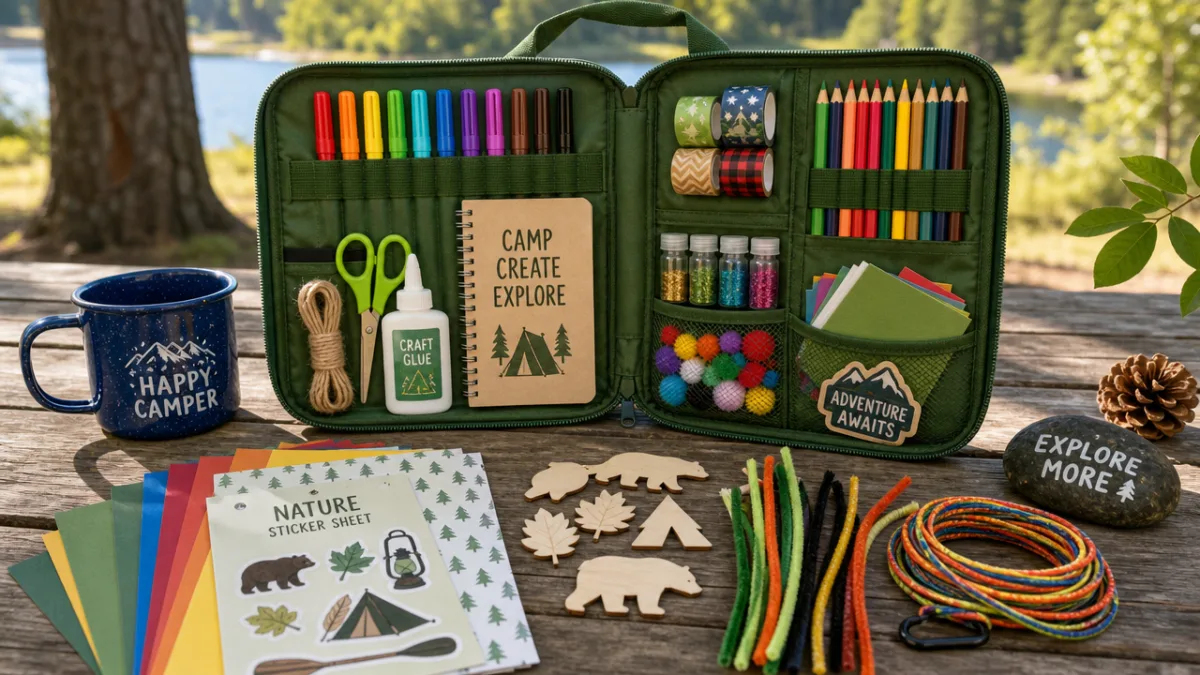
A well-packed craft kit is honestly half the battle. If supplies are jumbled together, damp, or impossible to find quickly when kids are ready to make something, the whole thing falls apart fast. You want a container that’s lightweight, reasonably compact, and has some kind of organization to it — a large zip-closure bag, a divided tackle box, or a small zippered canvas pouch all work well depending on how much you’re bringing and how many kids you’re packing for.
When you’re deciding what to include, think versatility first. Every item in that kit should be able to pull double or triple duty across different projects rather than being a one-trick-pony. Here’s a solid list of supplies that genuinely earn their place:
- Embroidery floss in at least six colors — useful for friendship bracelets, twig lashing, simple weaving, and natural dye projects
- A small set of acrylic paint pens or basic acrylic paints in primary colors plus black and white, which you can mix into pretty much anything
- A compact watercolor palette, perfect for nature journaling, painting on bark or stone, and adding color to collages
- A roll of masking tape and a roll of twine — both endlessly useful for twig structures, securing work in progress, and whatever else comes up
- Blank watercolor paper or heavy cardstock, pre-cut to a manageable size and stored flat inside a rigid folder so it doesn’t wrinkle
- A small pair of child-safe scissors and one pair of adult craft scissors for anything that needs more precision
- A basic set of colored pencils — more durable and much less messy than markers when you’re working outside
- White glue or a glue stick for collage and nature art
One last thing worth doing: build craft time into the day on purpose rather than waiting until someone says they’re bored. A loose “craft hour” after lunch or during the slow heat of mid-afternoon gives the whole day a nice rhythm, and kids actually look forward to it when they know it’s coming. If each kid keeps their finished pieces in their own small folder or portfolio bag throughout the trip, they’ll end up going home with a real collection — a little handmade record of the adventure that’s way more personal than a photo album.








What do you think?
It is nice to know your opinion. Leave a comment.