










Yule Star Ornament with Dried Orange: A Guide to Witchy Winter Decor
The Magic of Yule and Its Ancient Roots
Yule is one of the oldest winter celebrations we know of, observed by ancient Germanic and Norse peoples as a festival marking the winter solstice. It falls around December 21st — the longest night of the year — and celebrates the symbolic rebirth of the sun. Long before the holiday traditions most of us grew up with ever took hold, communities were gathering around fires, hanging evergreen boughs, and making ornaments by hand that carried real meaning and intention. That’s the spirit of Yule: warmth, hope, and a kind of quiet magic that feels native to the darkest time of year.
For modern witches, pagans, and anyone drawn to earth-centered spirituality, Yule is a deeply sacred time. It marks the turning of the wheel — that pivotal moment when the darkness stops deepening and light begins, slowly, to return. Decorating for Yule isn’t just about making things look pretty. It’s a ritualistic act. Every object placed on an altar or hung from a branch carries symbolic weight, tying the practitioner to natural cycles that have shaped human life for thousands of years. The materials you choose, the colors, the symbols — all of it is deliberate, and deeply personal.
The recent surge of interest in witchy winter decor reflects something a lot of people are feeling: a real hunger for meaning and connection. More and more of us are turning back toward handmade, nature-based traditions as an antidote to the commercial frenzy that the modern holiday season has become. Yule ornaments made from dried botanicals, natural fibers, and hand-carved wood tap into something primal — an instinct to honor the seasons, to make beauty from simple things, to fill our homes with objects that carry story and soul rather than just mass-produced sparkle.
Symbolism of the Star in Pagan Winter Traditions
The star might be the most universally resonant symbol across winter traditions worldwide. In witchcraft and pagan practice, the five-pointed star — the pentagram — is a powerful symbol of protection, the five elements (earth, air, fire, water, and spirit), and the way all living things are connected. When you craft one as a Yule ornament, it becomes something more than decoration. It’s a talisman, a small beacon of light hung with intention during the longest nights of the year. Its five points radiate outward like the arms of the sun, which makes it a perfect emblem for the solar return that Yule celebrates.
Six-pointed and eight-pointed stars also show up in Yule crafting traditions, each with its own resonance. The eight-pointed star is particularly associated with the Wheel of the Year, with each point representing one of the eight sabbats that many modern witches and pagans observe. Hanging one of these during the winter solstice is a way of honoring the full cycle of seasons even while you’re standing at its darkest point — an acknowledgment that this stillness and cold isn’t an ending, but a necessary pause before everything begins again.
In folk magic traditions across Northern Europe, star ornaments were commonly made from straw, wood shavings, or dried plant materials and hung near windows and doorways to attract good fortune and keep negative energies out. The Scandinavian tradition of Advent stars in windows echoes these older, pre-Christian practices. When modern witchy crafters recreate these forms using natural materials, they’re participating in an unbroken thread of folk magic stretching back centuries — adding their own intentions to something ancient and very much alive.
Dried Orange Slices: Scent, Symbolism, and Preservation
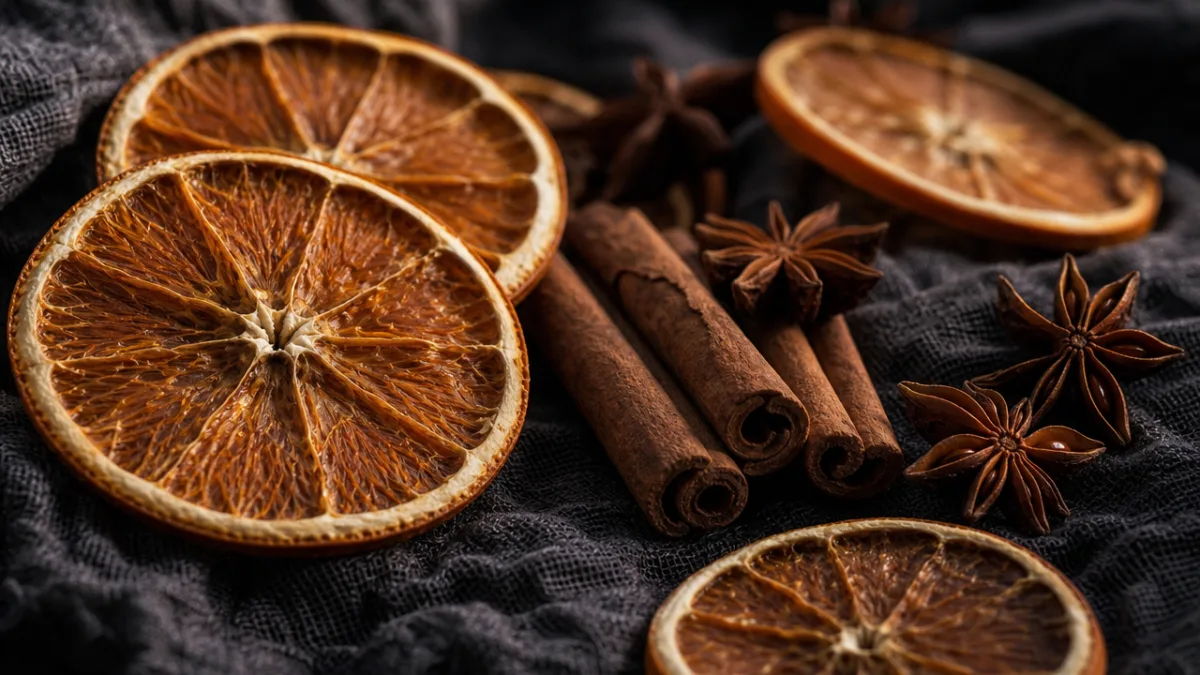
Dried orange slices have become one of the most beloved elements of natural winter decor, and honestly, it makes complete sense. The orange is a fruit deeply associated with the sun — its warm color, round shape, and radiant fragrance make it a natural symbol of solar energy and vitality. In the context of Yule, where the whole celebration centers on the return of the sun’s light, weaving dried oranges into your decorations is a genuinely powerful symbolic choice. The fruit speaks to abundance, warmth, joy, and the promise that even in the depths of winter, the light is coming back.
Drying the oranges is itself a meditative, almost magical process. Slicing the fruit thinly and letting it dry slowly in a low oven fills your home with a warm, spiced fragrance that feels grounding in a way that’s hard to describe. Many practitioners dry their oranges with intention — focusing their thoughts on what they want to call into their lives in the coming year, whether that’s abundance, health, creativity, or love. That slow transformation from fresh fruit to something preserved and beautiful mirrors the Yule themes of death and rebirth, of something yielding to time and becoming more enduringly lovely in the process.
Practically speaking, dried orange slices are wonderfully versatile. Their translucent, almost jewel-like quality when held up to light makes them stunning in wreaths, garlands, and ornaments. You can string them on twine, tuck them into evergreen arrangements, layer them into potpourri, or tie them onto packages as natural gift tags. Pair them with cinnamon sticks, star anise, cloves, and dried rosemary, and you’ve got something that engages every sense in the room. Their scent lingers gently through the whole season in a way that no synthetic air freshener ever quite manages.
- To dry orange slices for ornaments, aim for about 5mm thickness — thin enough to dry evenly without excessive shrinkage or browning at the edges.
- Dry them at 93°C (200°F) for 4–6 hours, flipping every hour, or use a food dehydrator for more consistent, even results.
- Let the slices cool completely before handling — they’ll firm up and crisp further as they come to room temperature.
- To make them last longer, seal dried slices with a light coat of decoupage medium or beeswax to protect against moisture reabsorption.
- Store any unused slices in an airtight container with silica gel packets to keep them crisp between seasons.
Crafting Your Yule Star Ornament: Materials and Method
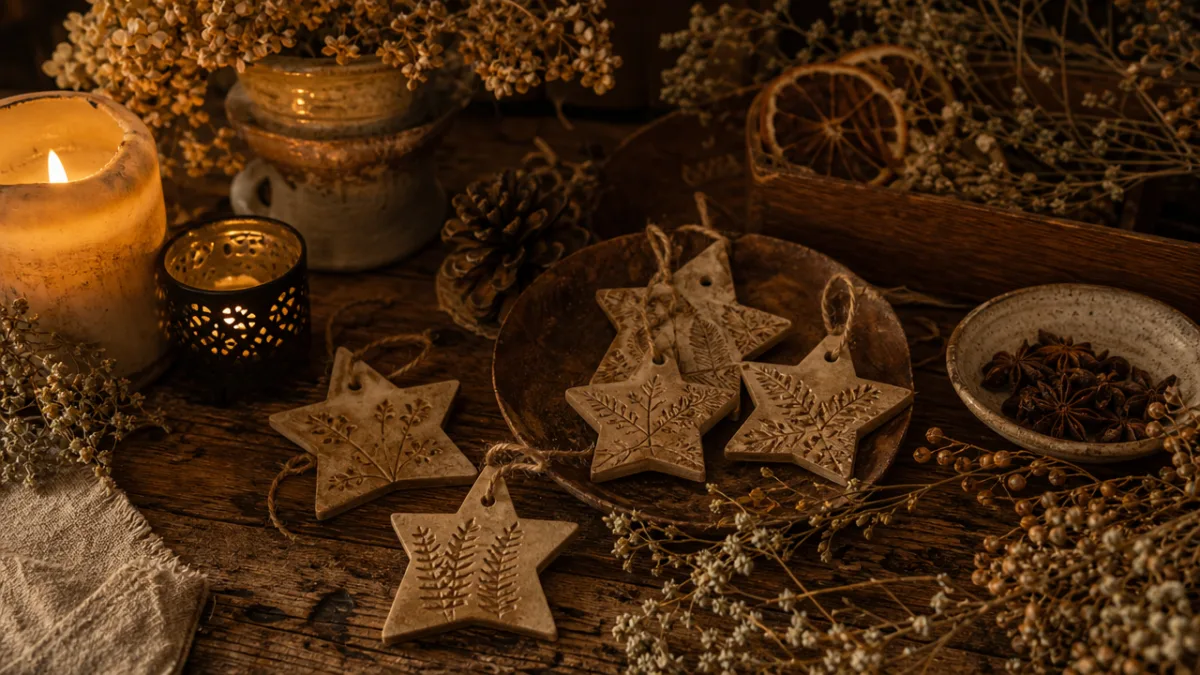
Making a Yule star ornament with dried orange and natural witchy elements is a genuinely satisfying project that only needs a handful of materials and a few hours of your time. The foundation is a star form, which you can buy as a pre-cut wooden shape, bend from floral wire, or weave from natural materials like willow, grapevine, or bundled straw. Your choice of base shapes the whole feel of the finished piece — wood gives it a solid, grounded quality; wire keeps it open and delicate; woven plant materials connect most directly to folk and earth-based traditions.
Once your star form is ready, you start building up the layers of natural elements. Dried orange slices are often secured at the center or at each point of the star, becoming the visual anchor around which everything else is arranged. From there, you might add sprigs of dried rosemary (associated with remembrance and protection), cinnamon sticks (warmth and prosperity), dried cranberries (symbolizing life persisting through winter), star anise (protection and psychic opening), and small pine cones (fertility and resilience), all wired or carefully glued into place. The result is a layered, aromatic, visually rich ornament that tells a story through everything it’s made of.
The finishing touches are where you can really make the ornament your own. Natural twine, black velvet ribbon, or red and gold cord can both bind the elements together and form a hanging loop. Dried flowers like lavender, chamomile, or rose petals add color and their own magical correspondences. Some crafters tuck in small crystals among the botanicals — a chip of clear quartz for amplification, black tourmaline for protection, or citrine for abundance. A final spray of homemade herbal mist or a gentle pass through incense smoke can cleanse and consecrate the piece before you hang it up.
- Gather your star base, dried botanicals, natural cord, a hot glue gun or fine floral wire, and any crystals or additional elements you want to include.
- Start with your largest elements — the dried orange slice and any cinnamon sticks — and position them on the star before securing anything, so you can work out the overall composition first.
- Build outward from the center, layering in the smaller botanical elements, filling gaps, and making sure the ornament feels balanced both visually and symbolically.
- Attach your hanging loop, tying it with three knots while focusing on your intentions for the season — protection, abundance, the returning light.
- Consecrate the finished ornament in whatever way feels right to you: pass it through incense smoke, sprinkle it with salt water, or simply hold it in your hands and speak your intentions aloud before hanging it.
Creating a Witchy Winter Altar and Decorative Scheme
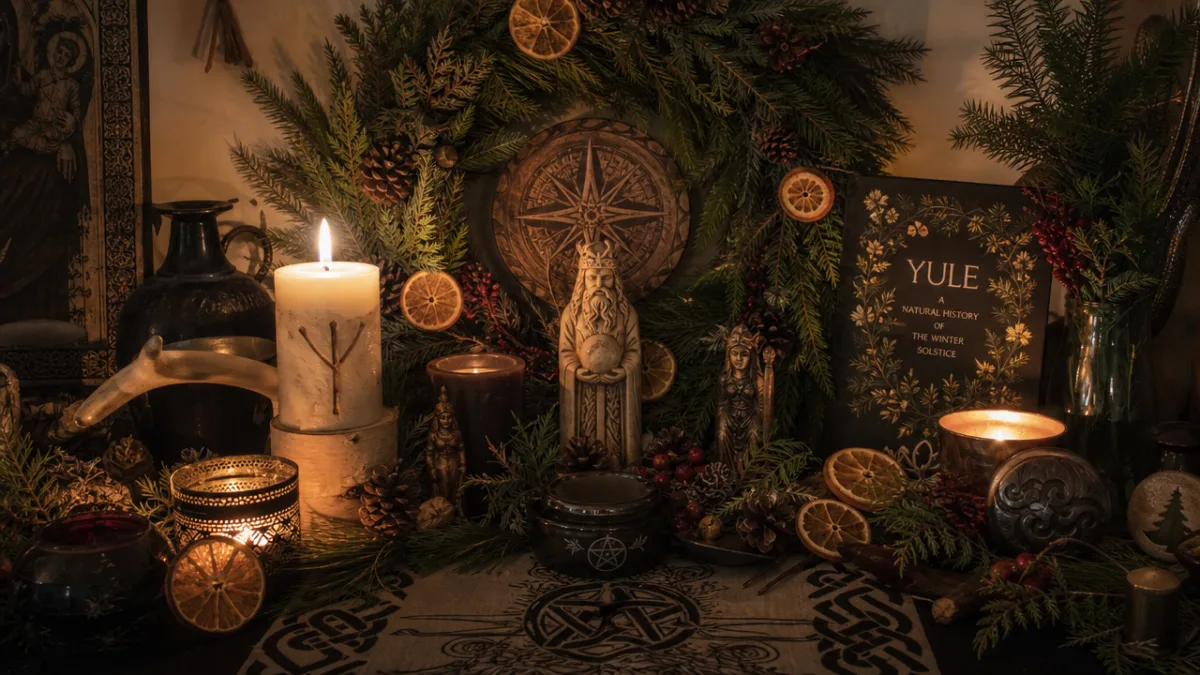
A Yule star ornament feels most alive when it exists within a broader decorative and spiritual context. Building out a witchy winter altar or decorating your home with intention means thinking about color, texture, scent, and symbolic resonance all together. The traditional Yule palette draws straight from nature: deep forest greens, warm golds, rich reds and burgundies, the white of snow and the black of long nights. Against all of that, the warm amber of dried orange and the deep brown of cinnamon and spices feel completely at home — as if the decorations simply grew out of the season itself.
A Yule altar might center on a white or gold candle to represent the returning sun, surrounded by evergreen cuttings of holly, ivy, pine, and cedar. Pinecones, nuts, and dried berries speak to the abundance the earth stores up for the dark months. A bowl of oranges studded with cloves — traditional pomanders with roots in medieval folk magic — releases a slow, warming fragrance that drifts through the whole room. The Yule star ornament can hang above the altar or sit at its center as the primary ritual object, drawing the symbolic energies of all the surrounding elements into its star form.
Beyond the altar, witchy winter decor can be woven through your entire home. Garlands of dried orange, bay leaf, and rosemary draped across mantlepieces and doorframes look beautiful and serve the traditional magical purpose of blessing and protecting the space. Bundles of cinnamon sticks tied with red twine near the front door invite prosperity across the threshold. Dried botanical wreaths on doors and windows echo old practices of marking sacred boundaries and welcoming beneficial spirits. Every one of these things can be made by hand and imbued with intention, turning the whole act of decorating into a season-long magical practice.
The Mindful Practice of Seasonal Crafting
One of the most meaningful things about making Yule ornaments and witchy winter decor is the practice itself — the slow, intentional work of the hands that stands in real contrast to the rushing, consuming energy of the mainstream holiday season. Working with natural materials asks for patience. Oranges have to be dried slowly. Botanicals have to be gathered and prepared. Every element has to be considered and placed with care. That pace is a spiritual practice in its own right, a way of reclaiming December as a time of quiet and inner work rather than frenzy.
Many practitioners find that seasonal crafting works as a powerful form of meditation and grounding. The repetitive motions of wiring botanicals, arranging dried flowers, or knotting cord keep the hands busy while the mind softens into a more reflective state. There’s a reason that crafts like knitting, weaving, and braiding have been associated with magic across so many cultures — making things with your hands, slowly and deliberately, creates a kind of focused awareness that’s deeply conducive to intention-setting and inner work. The finished ornament becomes not just an object but a record of that meditative state, carrying its energy forward through the whole season.
Crafting for Yule also gives you a chance to engage with the natural world in a direct, tactile way. Sourcing your materials thoughtfully — foraging where it’s permitted, buying from ethical small producers, or growing your own herbs and drying them yourself — deepens your relationship with the earth. It builds genuine knowledge of plants: their seasons, their scents, their traditional uses. Over time, that knowledge accumulates into a kind of embodied botanical wisdom that enriches both your craft and your magical practice. Simply learning which herbs dry well, which hold their color, and which release their fragrance most beautifully when dried is a form of earth-based learning that has sustained human communities for millennia.
Sharing these crafts and the knowledge behind them is a gift as meaningful as anything you could buy. Teaching a child, a friend, or a neighbor how to make a Yule star ornament passes on more than a craft skill — it passes on a whole way of relating to the world, one rooted in seasonality, intentionality, and a real reverence for natural beauty. Gathering together to make these things, sharing warm drinks and stories while your hands stay busy with botanicals and ribbon, is itself a Yule practice as old as the festival. Every star ornament hung in a window is a small act of cultural memory, a thread stitched into the long fabric of human celebration of the winter solstice, connecting the maker to everyone who has ever held something handmade up to the darkening sky and said: here is light, here is beauty, here is my hope for the season’s turning.








What do you think?
It is nice to know your opinion. Leave a comment.