










Make it a Party: The Ultimate Guide to Throwing Celebrations Worth Remembering
The Art of Setting the Mood
Every great party begins long before the first guest arrives. It starts with an intention, a feeling you want to create in the room, and the deliberate choices that build toward that feeling. Whether you’re hosting an intimate dinner for twelve or a backyard blowout for a hundred, the mood is the invisible architecture that holds everything together. Think of it as the emotional blueprint your guests will inhabit the moment they walk through your door.
Lighting is arguably the single most transformative element in any space, and yet it is chronically underestimated by hosts who spend hours on food and minutes on ambiance. Warm, low-wattage bulbs, clusters of Candles at varying heights, and strategically placed string lights can turn even the most ordinary living room into something that feels cinematic. Dimmer switches are one of the best investments a host can make, giving you the flexibility to shift from bright and energetic early in the evening to soft and intimate as the night unfolds.
Scent is another powerful and often overlooked dimension of atmosphere. Research in sensory psychology consistently shows that smell is the sense most directly tied to memory and emotion. A home that smells like fresh citrus, warm vanilla, or cedar and sandalwood creates a subconscious sense of welcome that no amount of decorative bunting can replicate. Light a candle an hour before guests arrive, simmer a pot of mulled spices on the stove, or scatter eucalyptus branches around the space to give the air a subtle, grounding fragrance that sets the stage beautifully.
Color and Decor That Speaks
Color psychology plays a meaningful role in how your guests feel during your event. Warm tones like terracotta, rust, gold, and deep red tend to stimulate conversation and appetite, making them excellent choices for dinner parties and festive gatherings. Cooler palettes of sage, dusty blue, and soft lavender encourage calm and creativity, lending themselves beautifully to afternoon showers, garden parties, and artsy soirées. Choose your palette intentionally, and carry it through your table linens, florals, balloons, and even your serving ware.
Tablescapes deserve far more attention than most hosts give them. The table is the centerpiece of any gathering, the visual anchor that guests return to again and again throughout the evening. A thoughtfully composed tablescape doesn’t require a florist’s budget; it requires an eye for layering. Start with a Textured runner or interesting cloth, build height with candle pillars or a single dramatic floral arrangement, and add personality with unexpected elements like vintage books, gathered herbs, or seasonal fruits tucked among the place settings.
Don’t neglect the entry and transitional spaces in your home or venue. The front door, the hallway, the space between indoors and outdoors — these are the moments of first impression and emotional transition. A balloon arch, a wreath of fresh greenery, a welcome sign in a style that matches your theme, or even just a cluster of potted plants on either side of the door signals that something special is happening here, that someone cared enough to make this beautiful.

Food and Drink: The Heart of Any Celebration
No matter how spectacular your decorations, it is the food and drink at a party that people talk about afterward. A great spread doesn’t have to be complicated or expensive, but it does have to be intentional. The most successful party menus are built around a central concept — a cuisine, a season, a flavor profile — and every dish flows from that center outward. When guests can sense a through-line in what they’re eating, the experience feels curated rather than assembled.
The grazing table has become one of the most beloved and enduring party food formats for excellent reasons. A beautifully arranged charcuterie and snack spread allows guests to eat at their own pace, encourages mingling as people reach around one another, and can be composed of ingredients at nearly any price point. The key to a truly impressive grazing table is abundance and variety in texture and color: creamy cheeses alongside crisp crackers, cured meats next to bright pickled vegetables, dark chocolate near pale almonds, and always at least one element that surprises.
Signature cocktails and mocktails have become essential to the modern party experience, and for good reason. A drink created specifically for an event, given a name that ties to the theme, and presented beautifully in the right glassware with a considered garnish, does something no store-bought beverage can do: it tells a story. It says that the host thought deeply about every element of the guest’s experience. Offering a non-alcoholic version of your signature drink ensures that every guest, regardless of their relationship with alcohol, feels equally celebrated and considered.
Building a Menu for Every Guest
Dietary inclusivity is no longer a courtesy — it is a baseline expectation for any host who cares about their guests’ comfort. This doesn’t mean you need to prepare five separate menus; it means designing a spread where the majority of items are accessible to the majority of people. Labeling dishes clearly with common allergens, offering at least two substantial vegetarian options, and ensuring your dessert table includes at least one dairy-free and one gluten-free option goes a long way toward making every guest feel welcome and well fed.
Presentation elevates even the simplest food to something festive. Transferring chips and dips into beautiful bowls, slicing fruit into geometric shapes rather than rough chunks, layering dips in clear glasses so the colors show, and using serving ware with interesting texture or pattern — these small decisions accumulate into a spread that looks like it required far more effort than it did. Fresh herbs scattered over dishes, edible flowers on top of cakes, and a dusting of flaky salt over anything savory all add polish with minimal effort.
Timing your food service thoughtfully is one of the less glamorous but deeply important aspects of hosting. A staggered approach, where lighter bites are available at arrival, a more substantial spread opens mid-party, and sweets emerge in the final act, keeps energy levels consistent and gives guests a sense of event arc. Nothing deflates a party faster than guests who are hungry and waiting, or conversely, a table that’s been picked over and sad for the last two hours of the event. Plan your quantities generously and your timing deliberately.
Music: The Invisible Guest
Music is the most democratic of all party elements because every single person in the room experiences it simultaneously. It shapes the tempo of conversation, the speed at which people move through the space, whether the energy rises or settles, and even how long guests stay. A well-curated playlist is not just background noise — it is an active participant in the social dynamics of your gathering. Treat it with the same care you’d give your menu or your decorations, and your party will feel effortlessly alive in a way that is hard to articulate but impossible to miss.
The most effective party playlists follow a deliberate arc. In the early hours when guests are arriving and conversations are still tentative, the music should be familiar and warm without demanding too much attention — think classic soul, light jazz, acoustic covers of beloved songs. As the room fills and the energy builds, the tempo and volume can increase incrementally. By the peak of the evening, the playlist should be delivering the tracks that make people want to move, sing along, or at least feel a little electric in their seats. Planning this arc in advance prevents the jarring tonal shifts that can accidentally interrupt the flow of a great night.
Volume calibration is a skill that separates good hosts from great ones. Music that is too quiet becomes a barely noticed undertone that does nothing to lift the atmosphere. Music that is too loud forces every conversation into shouting and creates fatigue and frustration surprisingly quickly. The sweet spot is music that can be heard and felt without requiring guests to raise their voices above a comfortable indoor speaking level. Check the volume from different points in the room, and be prepared to make adjustments as the crowd density changes — a full room of people absorbs sound very differently than an empty one.
Live Music and Interactive Sound
If your budget and space allow, live music transforms a party from lovely to legendary. You don’t need a full band to achieve this effect. A single guitarist playing during cocktail hour, a pianist in the corner of a dining room, a DJ who can read the room and respond to it in real time — any of these introduces a human element to the sonic experience that recorded music simply cannot replicate. Guests tend to linger longer, engage more openly, and remember the event more vividly when live performance is part of the experience.
Interactive musical elements can add extraordinary energy to the right kind of party. A karaoke setup encourages even shy guests to participate in something memorable and often hilarious. A drum circle or percussion jam requires no musical knowledge and creates instant community. Even a simple “request board” where guests can write song requests that you’ll actually honor creates a sense of participation and personalization that guests deeply appreciate. When people feel involved rather than entertained at, they invest more of themselves in the experience.
Sound spatialization is worth considering for parties that span multiple rooms or indoor-outdoor spaces. Rather than blasting a single speaker into every corner, consider using smaller speakers thoughtfully placed so that the music maintains its presence without dominating. Outdoor areas benefit from weatherproof speakers nestled in planters or mounted discreetly on fencing. If you want guests to flow naturally between spaces, making each zone feel equally alive acoustically encourages that movement rather than creating a sound gradient that pulls everyone toward one corner.
Activities and Entertainment That Create Memories
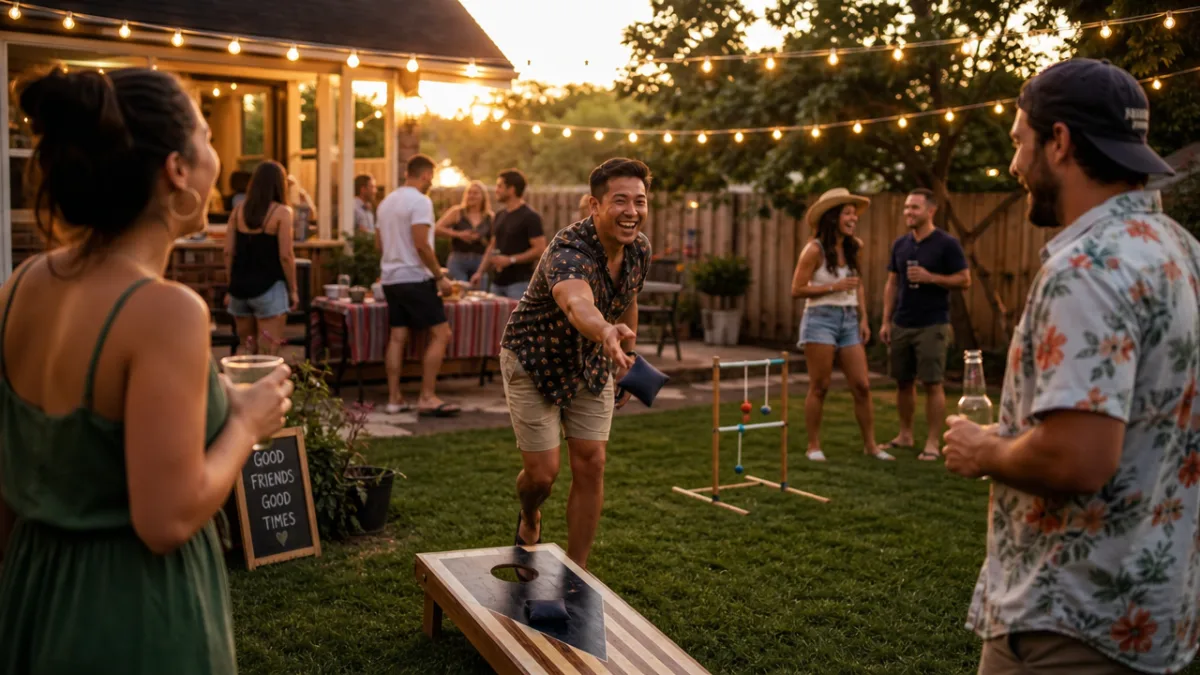
The most unforgettable parties are those where something happened — where guests didn’t just attend but participated, where a moment emerged that people still bring up years later. Activities and structured entertainment give people permission to interact with strangers, break from the formality of polite conversation, and access a playfulness that adult social life too rarely offers. Whether it’s a craft station, a lawn game, or a coordinated group activity, intentional entertainment architecture is what separates a gathering from a party in the fullest sense of the word.
Photo opportunities have become a staple of modern celebrations, and there’s a reason they endure beyond social media vanity. A thoughtfully constructed photo moment — a flower wall, a neon sign, a prop basket filled with silly accessories, or a Polaroid station with a guest book — gives people something to do together and creates a tangible artifact from the event. Guests who might otherwise drift toward the food table and stay there are drawn into the space and into interaction with other guests when there’s a fun, low-stakes visual activity available to them.
Games have an almost magical ability to dissolve social barriers, and the right game at the right moment can transform a room full of strangers into a room full of friends. Games that work across different knowledge levels and don’t require physical agility tend to be the most inclusive: trivia with categories spanning pop culture to obscure history, collaborative storytelling games, word association challenges, or classic card and board games set up at a side table for those who want something to anchor themselves to. The key is offering options rather than forcing participation — the best party games are irresistible, not mandatory.
Themed Parties and Immersive Experiences
A cohesive theme elevates every other element of your party by giving it a unifying logic. When decor, food, music, costumes, and activities all reference the same central concept, the cumulative effect is something that feels genuinely immersive rather than simply well-decorated. Themes can be as broad as a decade or as specific as a single film, as whimsical as an enchanted forest or as sophisticated as a Parisian salon. What matters is commitment: a half-hearted theme is worse than no theme, while a fully realized one becomes a complete world guests step into.
Immersive experiences are the cutting edge of private party entertainment, drawing on techniques used in theater and escape rooms to create environments where guests become characters in a story. This can be as elaborate as hiring actors to play roles throughout the evening or as simple as designing a mystery that unfolds across the party timeline, with clues hidden in the decor and guests encouraged to collaborate toward a reveal. Even smaller-scale interactive storytelling, such as a “character card” given to each guest at the door that describes who they are in the party’s fictional world, adds a layer of playful engagement that most people find both surprising and delightful.
Favor and gift elements, when thoughtfully chosen, extend the party experience beyond the evening itself and transform guests from attendees into participants in an ongoing memory. A small jar of homemade jam, a seed packet tied with ribbon, a mini bottle of the evening’s signature cocktail, a custom bookmark or print — these gestures, however modest, communicate that the host thought about this person specifically, wanted them to carry something of the evening home. In an age of abundant stuff, a small, meaningful token lands far more powerfully than an expensive but impersonal gift.
Hosting with Ease: The Confident Host’s Mindset
All the planning in the world cannot replace the fundamental ingredient of a great party: a host who is genuinely present and enjoying themselves. Guests are exquisitely attuned to the emotional state of the person who invited them, and a tense, frantic, or distracted host casts a subtle shadow over the entire event. The goal of all your preparation is to arrive at the moment the first guest rings the bell feeling ready enough that you can be fully there for the experience rather than managing it from the inside of a mild panic.
Delegation is the skill that separates the hosts who enjoy their own parties from those who spend three hours in the kitchen missing all the fun. Identify two or three specific roles that a trusted friend or family member could take on: greeting guests at the door, managing the food replenishment, keeping drinks topped up, or running the music queue. Brief them in advance so they feel empowered rather than pressed into service. This distributed hosting model keeps the party running smoothly and frees you to do what only you can do — connect with your guests and set the relational tone of the evening.
Preparation timelines are your best friend, and writing one out is worth every minute it takes. Working backward from the party start time, identify every task — cleaning, shopping, cooking, decorating, getting dressed — and assign it a realistic time slot in the days and hours leading up to the event. A detailed timeline prevents the last-hour chaos that haunts so many well-intentioned hosts and ensures that when guests begin to arrive, you’ve already had fifteen minutes to take a breath, pour yourself something delicious, and remember why you love doing this.
Handling the Unexpected with Grace
No party goes exactly as planned. A dish burns, a guest cancels last minute, the weather turns, the music stops working, the ice runs out — something will happen, and your response to that something will define the experience for everyone in the room. Cultivating genuine flexibility, the kind rooted not in resignation but in the confidence that the party’s success doesn’t depend on any single element, is perhaps the most important skill a host can develop. When the host laughs at a mishap and pivots cheerfully, guests follow their lead immediately.
Keep a mental or physical list of simple backup solutions so that when something goes sideways, you’re not improvising from zero. Extra candles in a drawer, a playlist on a backup device, a bag of ice in a cooler outside, a platter of simple store-bought snacks that can be deployed in minutes — these small insurances give you the confidence to handle problems quickly and quietly without turning them into narratives that overshadow the evening. The best parties feel effortless precisely because the host anticipated enough friction points to neutralize them in advance.
After the party is over and the last guest has gone home, take a moment before you begin cleaning to sit with the evening for a few minutes. Consider what worked beautifully, what you would do differently, what surprised you, and what you are genuinely proud of. Hosting is a craft, and like all crafts it improves with reflection and repetition. The most skilled and beloved hosts are those who approach every gathering as both a gift to their guests and a practice that deepens their own understanding of what it means to bring people together and make them feel, however briefly, that the world is a warm, generous, and celebratory place.








What do you think?
It is nice to know your opinion. Leave a comment.