










19 Genius Garden Tool Storage Ideas You Need to Try
Why Garden Tool Storage Matters More Than You Think
If you’ve ever spent twenty minutes hunting for your trowel before a simple planting session, you already understand the frustration that comes with disorganized garden tool storage. A well-organized shed or garage isn’t just about aesthetics — it’s about reclaiming your time, protecting your investment, and making gardening feel like the relaxing hobby it’s supposed to be. When tools are properly stored, they last longer, stay sharper, and are ready to use the moment inspiration strikes.
Garden tools represent a real financial investment. A quality set of hand tools, long-handled implements, hoses, pots, and fertilizers can easily run into hundreds of dollars. Leaving rakes lying on the ground, shovels propped against a fence, or pruning shears tossed into a bucket without any organization isn’t just inconvenient — it actively shortens the lifespan of your equipment. Rust, bent tines, cracked handles, and lost small tools are all consequences of poor storage habits that cost money year after year.
Beyond money and time, there’s the matter of safety. Garden tools with sharp edges or heavy heads left haphazardly around a yard are genuine hazards, especially in households with children or pets. A rake face-down in tall grass is a classic slapstick accident waiting to happen in real life. By committing to smart, dedicated storage solutions, you create a safer outdoor environment for everyone who spends time in your garden space.
Assessing Your Current Storage Situation
Before rushing out to buy pegboards or custom shelving units, take stock of exactly what you own and how much space you have to work with. Walk through your shed, garage, or outdoor storage area with a notepad and catalog every tool by size, frequency of use, and storage needs. Long-handled tools like rakes and shovels require vertical hanging space, while small hand tools benefit from drawer dividers, pegboards, or wall-mounted pouches that keep them visible and accessible at a glance.
Think carefully about where you actually do your gardening work. If your vegetable beds are in the back corner of the yard, a storage solution near the back gate makes far more sense than a beautifully organized shed that requires a long walk every time you need a tool. Proximity to your work area reduces friction and means you’re actually more likely to put tools back where they belong after each session, maintaining the organization system you’ve worked to create.
Wall-Mounted Storage Solutions for Maximum Efficiency
The walls of your shed, garage, or even a covered outdoor area represent the most underutilized storage real estate in most homes. By moving tool storage off the floor and onto vertical surfaces, you immediately free up ground space for potting benches, wheelbarrows, and bags of compost that simply can’t be hung. Wall-mounted systems also make every tool visible at a glance, eliminating the rummaging that makes garden prep feel like a chore before you’ve even started.
A classic pegboard system remains one of the most versatile and affordable wall storage solutions available. Standard pegboard sheets can be cut to fit any wall space and paired with an enormous variety of hooks, baskets, and brackets designed to hold everything from hand trowels to coiled hoses. The beauty of pegboard is its adaptability — as your tool collection changes, you simply move hooks to new positions without drilling new holes or committing to a fixed layout. Paint the pegboard a cheerful color and outline each tool’s spot with a marker so it’s always obvious where something belongs.
For heavier long-handled tools, purpose-built wall-mounted tool holders with spring-loaded or rubber-grip slots offer a step up from simple pegboard hooks. These holders grip the handle of a rake, shovel, or hoe firmly, holding it parallel to the wall in a compact, tidy arrangement. Some systems can store up to fifteen long-handled tools in just eighteen inches of wall space, which is a remarkable density that would be impossible to achieve with floor-standing storage. Look for powder-coated steel versions for outdoor use, as they resist moisture and won’t degrade in temperature extremes.
DIY Pallet Wall Organizers
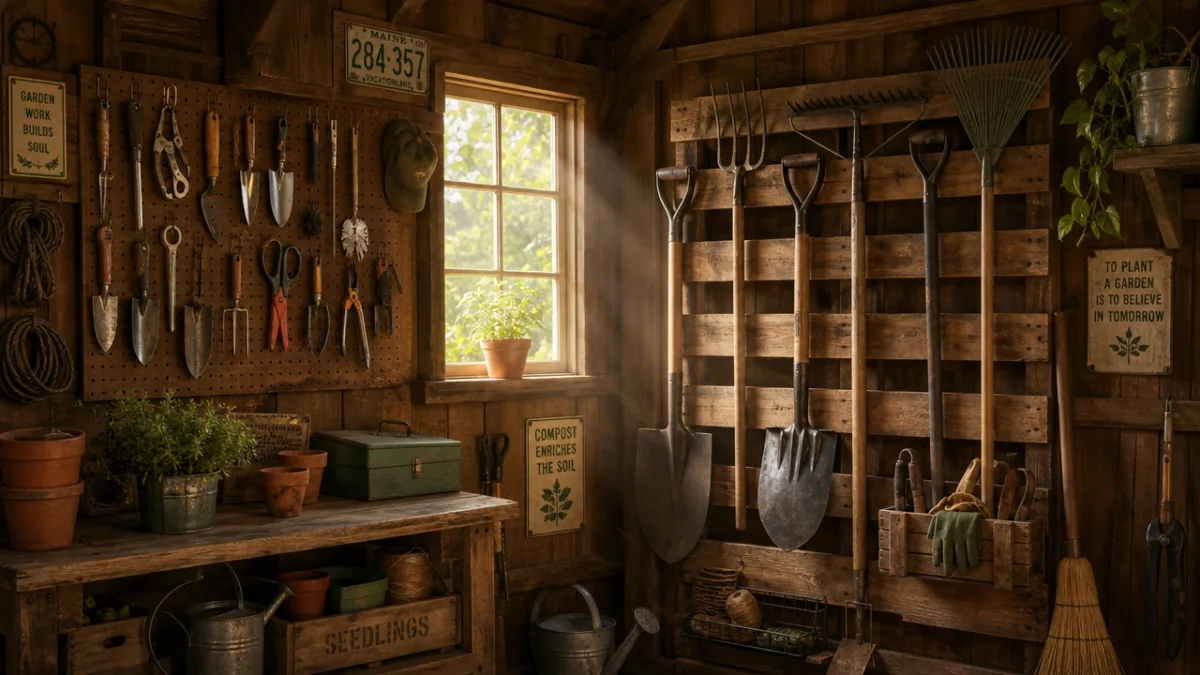
Wooden pallets have become a beloved material in the DIY community, and garden storage is one of their best applications. A single standard pallet mounted vertically on a shed wall instantly creates a grid of gaps between the slats that can hold hand tools, small pots, seed packets, and gardening gloves without any additional modification. Sand the wood lightly, seal it against moisture with an outdoor-rated finish, and you have a rustic, charming organizer that costs almost nothing and can be customized with hooks, shelves, or small baskets tucked into the existing structure.
Beyond the basic pallet, creative gardeners have used pallet wood to build custom tool racks, potting shelves, and even full wall-covering organizer panels that rival expensive commercial systems. The irregular nature of reclaimed pallet wood gives these projects character that smooth, mass-produced storage units simply can’t match. If you have basic woodworking skills and a weekend afternoon to spare, building a pallet-based storage system can be both a satisfying project and a genuinely functional improvement to your gardening life.
Repurposed and Upcycled Storage Genius
Some of the most clever garden storage ideas come not from specialty garden stores but from looking at ordinary household items with fresh eyes. The principle is simple: anything that holds, hangs, or organizes has potential in the garden shed. Old colanders, wine crates, vintage milk crates, retired kitchen utensil holders, and even repurposed plumbing pipes have all found second lives as charming and highly functional garden tool organizers. This approach saves money, reduces waste, and gives your storage space a personal, curated character that standard store-bought solutions rarely achieve.
Old metal buckets and galvanized tubs are particularly well-suited to garden storage. Drill a few drainage holes in the bottom if they’ll be used outdoors, mount several to a fence or wall with sturdy brackets, and you have an instantly attractive storage system for hand tools, trowels, bulb planters, and garden gloves. Galvanized metal ages beautifully in outdoor conditions, developing a gentle patina that actually improves its appearance over time. Group buckets by tool type — one for digging tools, one for pruning tools, one for twine and ties — and the organizational system practically maintains itself.
PVC pipe offers another remarkably versatile upcycled storage material. Sections of wide-diameter PVC pipe mounted horizontally to a wall or fence create individual slots that are perfectly sized for long-handled tools. The smooth interior prevents tools from scratching each other, and the pipe can be cut to any length to accommodate your specific tool collection. For hand tools, smaller diameter pipes can be bundled together and mounted vertically to create a compact organizer that holds an impressive number of items in a very small footprint. Paint the pipes to match your shed’s color scheme for a finished look.
Magnetic and Hanging Strip Systems
Magnetic tool strips, long popular in professional kitchens for knife storage, translate brilliantly to garden shed applications. Strong neodymium magnetic strips mounted at eye level can hold small metal tools — pruning snips, dibbers, bulb planters, hand cultivators — firmly and visibly without any hooks, bins, or brackets. Because the tools are held magnetically rather than stored in a container, every single item is immediately visible and accessible with a single reach. No more digging through a bucket hoping your favorite hand pruner is somewhere in the pile.
For tools that aren’t metal, or for the more decorative side of your garden storage, hanging fabric organizer pockets offer a soft alternative. These canvas or outdoor-fabric pouches can be hung from hooks, nails, or tension rods and create individual pockets for seed packets, plant labels, small bottles of plant food, gardening gloves, and other irregularly shaped items that don’t cooperate with rigid storage systems. Many gardeners use the back of their shed door as a prime location for a hanging organizer, capturing useful storage space that would otherwise go completely unused.
Outdoor and Garden-Based Storage Structures
Not all garden tool storage needs to happen inside an existing shed or garage. For gardeners who lack a dedicated outbuilding, or who want storage closer to specific garden areas, purpose-built outdoor storage structures offer a compelling solution. A compact tool locker or lean-to shed positioned near your main garden beds means you’re never more than a few steps from whatever you need, and the organizational benefits of a dedicated structure — even a small one — over scattered outdoor storage are enormous.
Vertical garden towers and multi-purpose planting structures can do double duty as tool storage when designed thoughtfully. A rustic arbor or pergola at the entrance to a kitchen garden, for example, might incorporate a small built-in cabinet on one side for storing frequently needed hand tools, twine, and garden ties. These integrated solutions are space-efficient and architecturally interesting, making the storage an attractive feature of the garden rather than something to be hidden away. Custom-built versions can be designed to match fencing, raised beds, or other existing structures for a cohesive garden aesthetic.
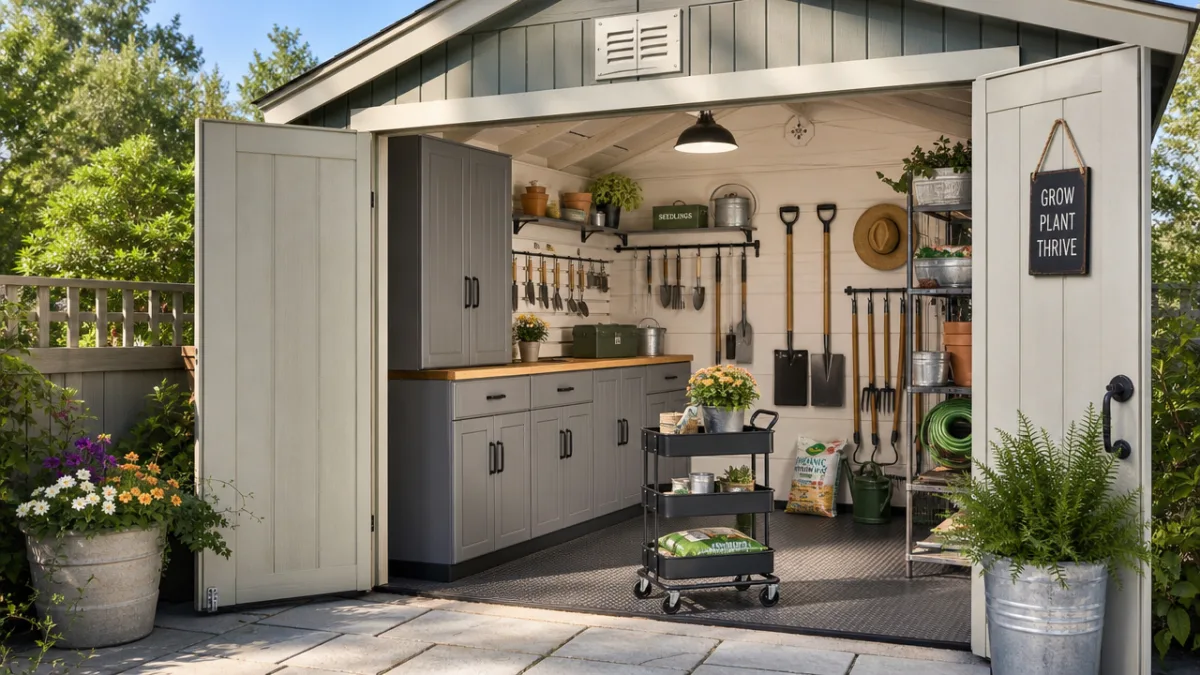
A dedicated outdoor tool cabinet with weatherproof construction — powder-coated steel, cedar, or marine-grade plywood — offers security and protection that open wall systems can’t match. Modern outdoor storage cabinets often include features like lockable doors, adjustable interior shelving, and built-in tool holders that hold long-handled implements upright without tipping. Position one of these near your garden’s water source and add a small shelf for pots, gloves, and plant food, and you’ve created a self-contained garden station that makes the entire outdoor space function more smoothly.
Raised Bed Tool Caddies and In-Garden Storage
A rolling tool caddy positioned between raised beds is one of the most practical garden storage innovations for dedicated vegetable and flower gardeners. These wheeled organizers — often made from galvanized metal, cedar, or durable resin — travel easily across garden paths and keep your most frequently used tools within arm’s reach no matter where you’re working. Rather than making multiple trips back to the shed for a forgotten trowel or pair of snips, everything travels with you as you move through the garden, dramatically streamlining the work session from start to finish.
Specialized Storage for Hoses, Pots, and Small Accessories
Garden hoses represent one of the most frustrating storage challenges in the entire yard. A standard garden hose left in a pile is heavy, unwieldy, prone to kinking, and nearly impossible to untangle gracefully under the noon sun when you’re already running late watering the beds. Dedicated hose storage solutions — wall-mounted reels, hose pots, decorative hose holders, and hideaway hose boxes — transform what is often a tangled, tripping hazard into a neat, functional element of the garden. The investment in a quality hose reel or holder pays dividends in time and frustration saved every single time you water.
Pot and planter storage is equally important and often overlooked. Empty pots in a range of sizes tend to accumulate quickly in any active garden, and without a storage system, they end up stacked chaotically in corners, nesting improperly and cracking under their own weight. A simple wooden or metal tiered shelving unit dedicated to pot storage keeps sizes sorted and accessible, while a cabinet with doors hides the inevitable collection of mismatched nursery pots that every gardener accumulates. Hanging small pots by their drainage holes on a wall-mounted dowel rod is another elegant solution that keeps them organized and visible.
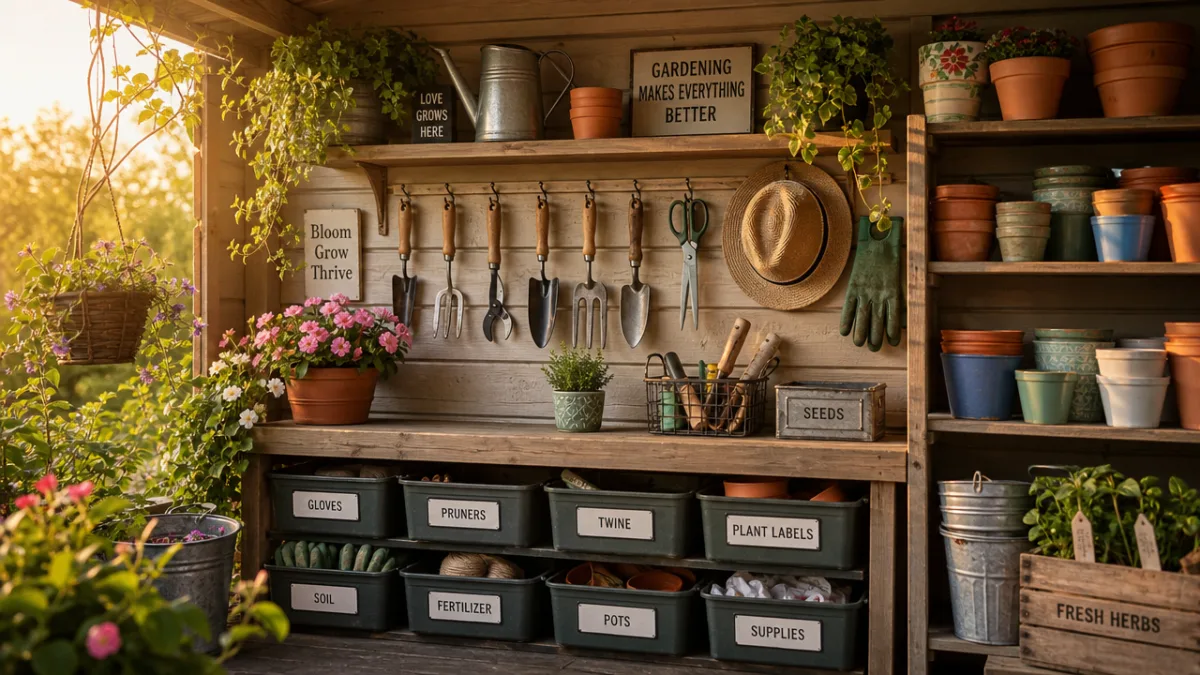
Small garden accessories — seed packets, plant labels, twist ties, garden wire, batteries for your garden lights, and plant food concentrates — have a habit of disappearing into the chaos of a busy shed. A designated small-parts storage system, whether a set of labeled glass jars on a shelf, a multi-drawer organizer borrowed from a hardware store context, or a simple canvas tote hung by the door, keeps these essentials findable. Labeling is the key to maintaining any small-parts system; even the most beautifully organized drawer will dissolve into confusion if the contents aren’t clearly marked and consistently returned.
Seasonal Rotation and Storage Planning
Smart garden storage isn’t static — it should evolve with the seasons. Tools you use constantly in spring and summer, like trowels, pruners, and hoses, should occupy prime real estate in your storage system: eye level, near the door, immediately accessible. Tools that only come out in autumn and winter, like frost protection fleece, bulb planters, and pruning saws, can live higher up on shelves or toward the back of the shed without causing any inconvenience. Building seasonal rotation into your storage plan prevents the gradual drift toward chaos that affects most garden sheds over time.
A useful practice is conducting a brief tool audit at the beginning of each season. Pull everything out, clean and oil metal surfaces, check handles for cracks or splinters, sharpen blades that need attention, and return items thoughtfully to their designated places. This seasonal reset takes only an hour or two but pays enormous dividends in tool longevity and daily-use convenience. It’s also the perfect moment to dispose of tools that are beyond repair and to identify gaps in your collection before the busy season begins rather than in the middle of it.
Making Your Storage System Work Long-Term
The best garden storage system is one that you actually use consistently, which means it needs to be intuitive, accessible, and genuinely easier than the alternative of just dropping things in a pile. If returning a tool to its proper place requires more effort than simply leaning it against the wall, the system will fail regardless of how clever or beautiful it is. This is why the most effective storage solutions are those built around the real habits and workflow of the gardener using them, not around an idealized version of how gardening should work.
Visual labeling is one of the most powerful maintenance tools available. Outlining each tool’s spot on a pegboard, labeling shelves with their contents, and marking bins with their categories creates a system that communicates its own logic to anyone who uses it. Family members who help in the garden but aren’t deeply invested in the organizational system will find it far easier to put things back correctly when the correct location is explicitly marked. This seemingly small detail is the difference between a system that stays organized for years and one that deteriorates within a few weeks.
Finally, give yourself permission to iterate. Your first garden storage solution doesn’t need to be perfect — it needs to be better than what you had before. Start with the most pressing problem (perhaps those long-handled tools that keep falling over) and solve it well. Then address the next challenge. Over time, through small improvements guided by real experience of what works and what doesn’t, you’ll develop a storage system that fits your garden, your tools, and your working style with a precision that no off-the-shelf solution could ever provide. The garden, after all, is a place of ongoing growth and improvement — and your storage system can be too.
Top Storage Ideas at a Glance
- Pegboard wall systems with customizable hooks and baskets for complete tool visibility and flexible layouts that adapt as your collection grows.
- Spring-loaded wall-mounted tool holders that grip long handles securely and store up to fifteen tools in minimal wall space.
- Repurposed pallet organizers offering rustic charm and free or near-free tool storage using reclaimed wood and basic hardware.
- Galvanized metal bucket clusters mounted to fences or walls, sorted by tool type for instant grab-and-go access during gardening sessions.
- Magnetic tool strips borrowed from the kitchen world, ideal for keeping small metal tools visible, separated, and instantly accessible.
- Rolling garden caddies that travel with you between beds, eliminating repeated trips back to the shed for forgotten tools mid-session.
- Dedicated hose reels or hose pots that prevent kinking, tangling, and the perennial frustration of untangling a hose under pressure.
- Labeled small-parts systems using jars, multi-drawer organizers, or canvas totes to keep seeds, ties, and accessories consistently findable.
- Seasonal rotation protocols that keep current-season tools at the front and frequently audited to ensure everything remains sharp, clean, and ready.








What do you think?
It is nice to know your opinion. Leave a comment.