










“`html
Curating Wonder: Growing a Glass Globe Collection and Discovering the Magic of Totems
The Irresistible Allure of Glass Globe Collecting
There’s just something about a glass globe. Maybe it’s sitting on a sunny windowsill, throwing little rainbows across the wall, or tucked into the corner of a cabinet like some mysterious relic from another dimension — either way, it pulls your attention in a way that most decorative objects simply don’t. Collectors all over the world have fallen into the quiet obsession that starts with owning just one, because one is never enough. The moment you pick up that first smooth, cool sphere and feel its weight in your hands, you get it. You understand why people end up dedicating entire shelves — and sometimes entire rooms — to these things.
Part of the appeal is how many different things a glass globe can be. They sit right at the crossroads of art, science, history, and spirituality all at once. One globe might be a paperweight, another a crystal ball, another a feng shui energy piece, and another just a beautiful sculpture you can’t stop looking at. Some collectors zero in on antique mercury glass, others hunt exclusively for hand-blown art glass from Murano or studios in the Pacific Northwest. There’s a whole community dedicated to vintage fisherman’s floats — those battered green and blue spheres that actually spent time drifting through cold ocean currents before washing ashore. They’re considered folk art now, and rightly so; you can practically feel the miles in them.
For a lot of collectors, the hunt is half the fun. Combing through antique shops, estate sales, artisan markets, and online listings turns a hobby into something closer to an adventure. Every new piece comes with its own little story — where you found it, who made it, what made you stop and pick it up in that exact moment. Building a collection this way is really a form of personal curation, a visual autobiography told through light-catching spheres of every imaginable size, color, and texture.
Recent Additions: Expanding the Globe Collection with Intention
Adding to an established collection is something you learn to approach carefully. It’s tempting to grab every gorgeous sphere you come across, but over time most collectors figure out that being selective is what keeps a display from looking like clutter. When you choose new pieces with an eye toward color palette, scale, and how light moves through different types of glass, the whole thing starts to feel less like a pile of stuff and more like a composed work of art. Each new addition should either feel at home with what’s already there or shake things up in a way that makes everything better.
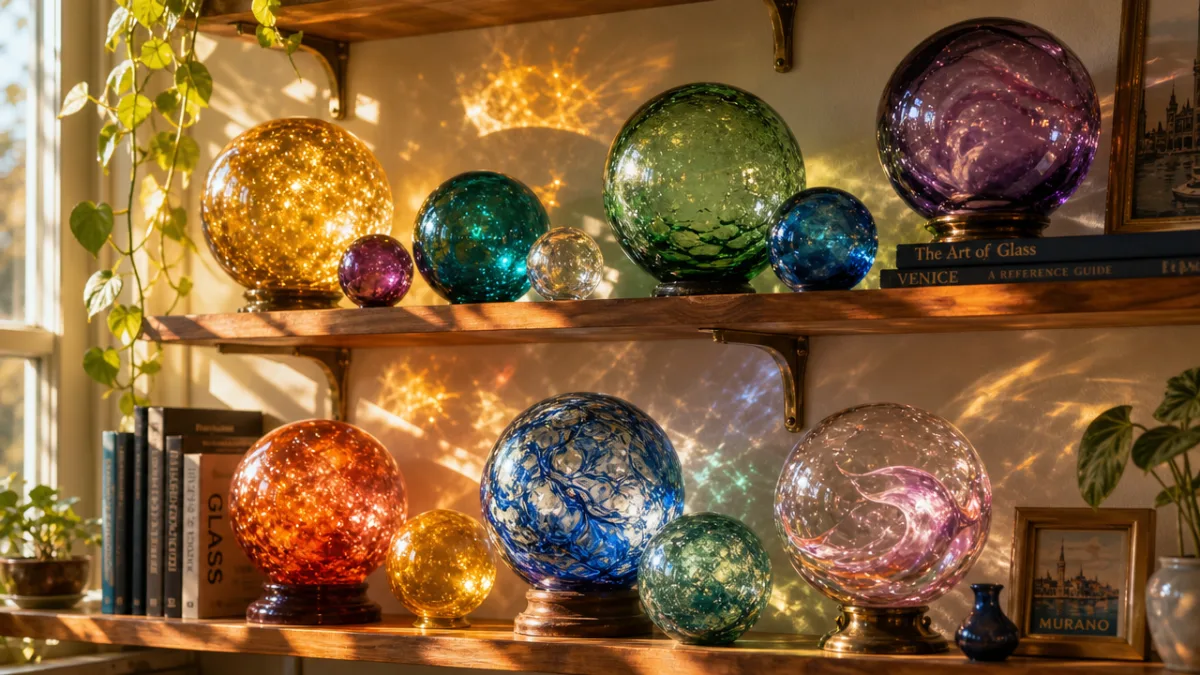
A really exciting category to add is iridescent art glass — those globes with swirling internal patterns that seem to shift and breathe depending on how the light hits them. Made through lampworking or glassblowing, they contain these whole interior worlds of color: deep indigo bleeding into copper gold, seafoam green dissolving into milky white. One well-placed iridescent globe can anchor an entire shelf, drawing your eye in and holding it while your brain just wanders through the colors. Pairing them with simpler, clearer globes creates a nice rhythm — complexity and simplicity trading off across the display.
Etched or sandblasted globes are another wonderful find. Artists carve patterns directly into the surface of the sphere — botanical motifs, celestial maps, sacred geometry, abstract textures — and the etching catches light in a completely different way than smooth glass does. That matte-against-polished contrast gives each globe a layered, almost tactile quality. When you put one near a light source, it casts the most extraordinary shadows, essentially turning into a tiny projector that animates everything around it.
Introducing Totems: Ancient Concept, Contemporary Resonance
The idea of a totem goes back a long, long way and shows up across cultures all over the world — Indigenous North American traditions, African spiritual practices, Celtic symbolism, and even modern psychology all have their versions of it. At the heart of it, a totem is about connection: between a person and a natural force, between the individual and something larger than themselves, between the everyday world and something a little more mysterious. In contemporary collecting and decorating culture, the word has taken on a broader, more personal meaning — basically any object that carries real symbolic or spiritual weight for the person who keeps it.
New totems in a home collection can take all kinds of forms. Natural objects like crystals, feathers, bones, and stones have been used as personal totems forever, valued for their energetic presence and their ability to ground a space. Handcrafted figures in wood, clay, or metal can become totems when they represent something that genuinely matters to you. In the context of a glass globe collection, small figurines, carved animals, or symbolic objects placed among the globes add a whole new layer to the story being told — the globes representing the cosmic and the infinite, the totems anchoring that energy to something specific and deeply personal.
From a design standpoint, the combination is genuinely powerful. Glass is transparent, light-loving, and universal in its beauty. Totems are opaque, dense with meaning, and intensely particular. Put them together and you get a visual dialogue that makes a display feel alive rather than just decorative. A small carved wooden animal sitting next to a cluster of glowing globes doesn’t feel random or forced — it feels like two halves of the same story, the seen and the unseen, the tangible and the luminous, having a conversation.
Designing a Display: Arranging Globes and Totems with Purpose
Displaying globes and totems well takes some real thought about composition, scale, and how objects relate to their surroundings. A random arrangement of beautiful things is still a random arrangement. The goal is something that feels curated, balanced, and intentional — where your eye knows where to go and gets to rest along the way. Interior designers talk about creating visual resting points, little areas of simplicity that let your eye pause before moving to something more complex. In a globe and totem display, that might mean leaving generous breathing room around a particularly striking piece, or grouping smaller objects in clusters of three or five, which the brain finds naturally satisfying.
Varying the height is one of the most effective moves you can make. Putting globes on pedestals, small wooden risers, or stacks of beautiful books creates a dynamic landscape across a shelf or table. Tall, slender totems give you vertical anchors that pull the eye upward and add some architectural structure. Smaller, rounder pieces can be nestled at different levels to create organic, flowing movement across the whole arrangement. The thing to avoid is a flat, linear layout where everything sits at the same height — it just looks static and a little dull.
Lighting really deserves its own conversation when it comes to glass globes, since light is basically what these objects are made for. Natural daylight works one kind of magic — soft, shifting, changing with the seasons and time of day. Artificial lighting gives you more control and lets you position things to really maximize how light moves through the glass. Small LED spotlights or fairy lights tucked behind a display create a warm, glowing effect that makes the globes look lit from within. And candles, while they need more attention, cast a flickering, living light that interacts with glass in a way no electric light can quite match.
Don’t overlook the surfaces and backgrounds your collection sits against, either. Against a white or light wall, glass globes look crisp and modern, and their colors really pop. Against a dark wall, those same globes will glow dramatically, their internal colors intensified by the contrast. Textured surfaces — rough linen, distressed wood, natural stone — provide an earthy counterpoint to the smoothness of glass and the refinement of carved totems. The background isn’t neutral. It’s actively shaping how your whole display feels.

The Spiritual and Emotional Dimensions of Collecting
Collecting beautiful, meaningful objects is not a trivial thing. Psychologists and anthropologists have long recognized that humans are wired to make meaning, and that the objects we choose to surround ourselves with serve real psychological and emotional purposes. A glass globe collection built up over years of searching becomes a kind of material autobiography. Each piece holds its own memory — the Saturday morning flea market, the little gallery tucked down a side street on vacation, the friend who knew exactly what would make you light up. Looking at your collection is like looking at a map of moments, a three-dimensional journal of experiences and connections.
Totems carry this kind of significance even more explicitly. A totem is, by definition, an object loaded with concentrated meaning — symbolic shorthand for values, relationships, or spiritual commitments that matter deeply to whoever keeps it. Adding a new totem to your home is a deliberate act, a way of saying that this symbol, this energy, this presence belongs in your everyday life. A lot of collectors describe finding the right totem less as a discovery and more as a recognition — as if the object were already theirs and they were just finally running into it. That quality of deep personal resonance is what separates a true totem from something that’s merely decorative.
When glass globes and totems come together in a home space, some practitioners of intentional interior design call it a “power spot” — a place that functions as a visual and energetic anchor for the room. Not unlike the way traditional altars in spiritual practices around the world serve as focal points for attention and reflection, a thoughtfully assembled collection of meaningful objects can do something similar in a contemporary, secular context. A lot of collectors say that just sitting near their display — letting their eyes move among the globes and totems without any particular agenda — genuinely calms them down and brings them back to themselves. That’s not nothing. That’s a real part of daily wellbeing.
Practical Tips for Growing Your Own Globe and Totem Collection
If you’re thinking about starting or expanding your own glass globe collection, a few guiding principles can make the difference between building something truly meaningful and just accumulating stuff. The most important one is patience. The best collections grow slowly, with care and some real discrimination, each piece chosen because it genuinely speaks to you — not just because it was available and pretty. Try to resist the urge to fill your shelves quickly. Leave some space empty for a while, waiting for the right piece to arrive. An incomplete collection full of things you truly love will always be more satisfying than a crowded display full of things you settled for.
When it comes to finding globes and totems, mixing up your sources keeps the hunt interesting and exposes you to a wider range of objects. Some worthwhile places to explore include:
- Antique shops and estate sales, where vintage glass globes including mercury glass, Depression-era colored glass, and old fishing floats can sometimes be found at accessible prices
- Art glass studios and galleries, particularly those featuring the work of independent glassblowers who create one-of-a-kind pieces that will never be replicated
- Artisan craft markets and maker fairs, where both glass artists and carvers of wooden or ceramic totems often sell their work directly
- Online marketplaces specializing in handmade and vintage goods, which connect collectors with artists and dealers from around the world
- Natural history and science supply shops, which sometimes carry beautiful glass spheres originally intended as scientific instruments or educational tools
- Spiritual and metaphysical shops, excellent sources for crystal spheres, carved animal totems, and other objects with symbolic and energetic significance
It’s also worth thinking about care and maintenance. Glass globes do best when handled with clean, dry hands — skin oils transfer easily and can be stubborn to remove — and a soft microfiber cloth is all you need for regular dusting. Avoid harsh cleaning sprays, which can damage certain glass finishes. Totems made from natural materials like wood, bone, or stone may appreciate the occasional conditioning with an appropriate natural oil to keep them from drying out or cracking. Keeping your collection clean and cared for is really a form of respect for the objects themselves — a small ritual that keeps you in regular, mindful contact with the things that matter to you.
And expect your display to evolve. As your collection grows, pieces that once had pride of place will naturally be superseded by newer, more resonant finds. Rather than seeing that as a loss, think of it as the collection breathing — it’s a living thing that shifts and reorganizes as your own life and tastes change. Some pieces might find new homes with friends who’ll love them just as much. Others might move to a secondary display in a different room, where they get to be experienced in fresh light and a fresh context. The collection is never really finished. It’s always in the middle of becoming something.

Sharing the Passion: Building Community Around Your Collection
One of the genuinely unexpected rewards of collecting is the community that grows up around it. Glass globe collectors have found each other all over the world through social media, online forums, and in-person events, building friendships around a shared love of these remarkable objects. Pinterest and Instagram have become especially powerful gathering places, where images of beautiful displays inspire and influence one another, and where word of a new artist or an incredible find spreads instantly to people who will actually care. Whether you have five globes or five hundred, posting images of your collection opens up a conversation — and those conversations are often surprisingly rich.
There’s also real potential for your collecting passion to educate and inspire the people around you. Friends and family who visit your home and encounter a thoughtfully arranged display of glass globes and totems tend to get genuinely curious. They want to know where things came from, how they were made, what they mean. Those conversations become opportunities to share what you know about glassmaking traditions, artistic techniques, the history of certain types of glass, or the cultural and spiritual significance of totems from around the world. A collection that makes people ask questions is doing more than decorating a room — it’s creating a space for real connection and genuine learning.
If you want to go deeper into the world of glass art specifically, try visiting a studio or gallery where glassblowers actually work. It’s a transformative experience. Watching a skilled artist handle molten glass — gathering the glowing material onto the blowpipe, shaping it with breath and tools and what is clearly decades of intuition — makes every glass globe feel newly miraculous. Once you have some sense of the skill, the risk, and the artistry that goes into creating even a simple glass sphere, your relationship with your collection shifts. It’s not just appreciation anymore. It’s closer to reverence.
“`








What do you think?
It is nice to know your opinion. Leave a comment.