










Minimal Cozy Candle Corner: How to Create the Perfect Ambient Sanctuary in Your Home
There is something deeply human about gathering around a soft, flickering light. Long before electricity transformed our evenings into bright, productive affairs, candlelight was the heartbeat of domestic life — warm, intimate, and unhurried. Today, as more people seek refuge from the overstimulation of modern living, the minimal cozy candle corner has emerged as one of the most beloved interior design trends across social media and home styling communities alike. It is not simply about placing a few candles on a shelf. It is about intentionally carving out a small sanctuary where the outside world recedes and the present moment becomes enough.
The appeal of the candle corner is universal because it asks very little of you in return for so much. You do not need a large home, an expensive renovation, or a professional interior designer. What you need is a small, underused nook, a thoughtful selection of candles and complementary objects, and a genuine desire to slow down. The minimal aesthetic that defines this trend strips away clutter and distraction, leaving only what is beautiful and purposeful. The result is a corner of your home that feels curated rather than accumulated, peaceful rather than busy.
This guide will walk you through every layer of creating your own minimal cozy candle corner, from choosing the right location and understanding the principles of minimalist styling to selecting candles, layering textures, and maintaining the space so it continues to serve your wellbeing over time. Whether you live in a studio apartment or a sprawling house, the philosophy remains the same: less truly is more, and the quietest corner of your home can become its most meaningful place.
Understanding the Minimal Cozy Aesthetic
Before diving into the practical steps of setting up your candle corner, it is worth understanding what the minimal cozy aesthetic actually means, because the two words might seem to pull in opposite directions. Minimalism, in its design sense, refers to the deliberate removal of excess — clean lines, neutral palettes, empty space used as a compositional element rather than something to be filled. Coziness, by contrast, conjures warmth, softness, layering, and a sense of lived-in comfort. The magic of this particular design philosophy is in discovering that these two ideas are not opposites at all but rather perfect complements.
The Scandinavian concept of hygge (pronounced hoo-gah) offers perhaps the closest cultural reference point for what a minimal cozy candle corner embodies. Hygge is the Danish and Norwegian practice of cultivating comfort, togetherness, and a sense of well-being through simple pleasures — and candlelight is one of its most essential ingredients. Danes, who endure long, dark winters, burn more candles per capita than almost any other nation, and they do so with a kind of ritualistic intentionality that the rest of the world is only beginning to adopt. The minimal cozy candle corner is hygge made physical and permanent within your home.
What distinguishes a truly minimal cozy corner from a simply cluttered one is the principle of intentional editing. Every object in the space should earn its place by contributing to either visual harmony or sensory experience, preferably both. A beautifully shaped ceramic candle holder earns its place. A scented soy candle in a muted tone earns its place. A small, artfully worn book earns its place. But a random assortment of mismatched items placed together without thought creates visual noise rather than visual rest. Learning to edit ruthlessly — and lovingly — is the core skill this aesthetic demands.
Choosing the Right Location in Your Home
The location of your candle corner matters enormously, both for the practical safety concerns that come with open flames and for the psychological effect the space will have on you. Many people instinctively gravitate toward a windowsill, a fireplace mantel, or a dedicated shelf in a living room or bedroom. All of these can work beautifully, but the best location is ultimately the one that fits naturally into a moment of your day — a place you already pause, breathe, or transition between activities. Think about where you naturally slow down in your home and let that guide your choice.
Corners are particularly well-suited to this kind of setup for both aesthetic and functional reasons. Architecturally, a corner creates a natural enclosure that feels protected and private, almost like a miniature room within a room. This sense of containment is part of what makes a corner feel cozy rather than exposed. If your chosen corner has a small shelf, a floating ledge, a side table, or even a windowsill, you already have the bones of your setup. If it is a bare corner with only wall space, a slim console table, a wooden crate turned on its side, or a simple three-tiered plant stand can provide the tiered surface variation that makes candle displays visually dynamic.
Lighting in the surrounding environment also plays a crucial role in how your candle corner reads and feels. A corner that receives some natural light during the day but can be dimmed or closed off in the evening creates the most dramatic and satisfying transformation when the candles are lit. Consider the relationship between your candle corner and your window treatments, overhead lighting, and any lamps in the vicinity. Ideally, you want to be able to reduce all other light sources so the candles become the primary illumination in that area of the room, creating that soft, glowing atmosphere that is the entire point of the endeavor.
Selecting Candles That Align With the Minimal Aesthetic
Not all candles are created equal when it comes to achieving a minimal cozy aesthetic. The candle market is vast and filled with options ranging from the sublimely understated to the aggressively decorative, and making thoughtful selections here is what separates a styled corner from a generic one. The most important visual qualities to look for in candles for a minimal setup are simplicity of form, restraint of color, and quality of material. Column candles, pillar candles, taper candles, and clean-lined jar candles all work beautifully within this aesthetic. Novelty shapes, heavily illustrated labels, and highly saturated colors tend to fight against the calm visual language you are trying to build.
In terms of color palette, the minimal cozy candle corner leans heavily on neutrals and near-neutrals. Ivory, cream, warm white, sand, taupe, dusty terracotta, sage green, and charcoal are all palette-appropriate and look particularly beautiful when grouped together in varying heights and widths. A monochromatic grouping — all ivories and creams, for instance — creates an almost sculptural quality that is deeply satisfying to look at. If you want to introduce color, do so through one or two accent candles rather than across the entire display, treating color as a punctuation mark rather than a sentence.
Material matters for both aesthetics and performance. Soy wax and beeswax candles burn cleaner and longer than paraffin, produce less soot, and often have a more matte, organic surface texture that suits the minimal aesthetic very well. For unscented pillar candles used primarily for their visual effect, look for ones with a slightly rough or handmade quality — small imperfections in the wax surface actually add warmth and authenticity to the display. For scented candles in glass vessels, choose brands whose packaging uses clean typography, minimal graphics, and vessels that are beautiful enough to display even when the candle has burned down to its end.
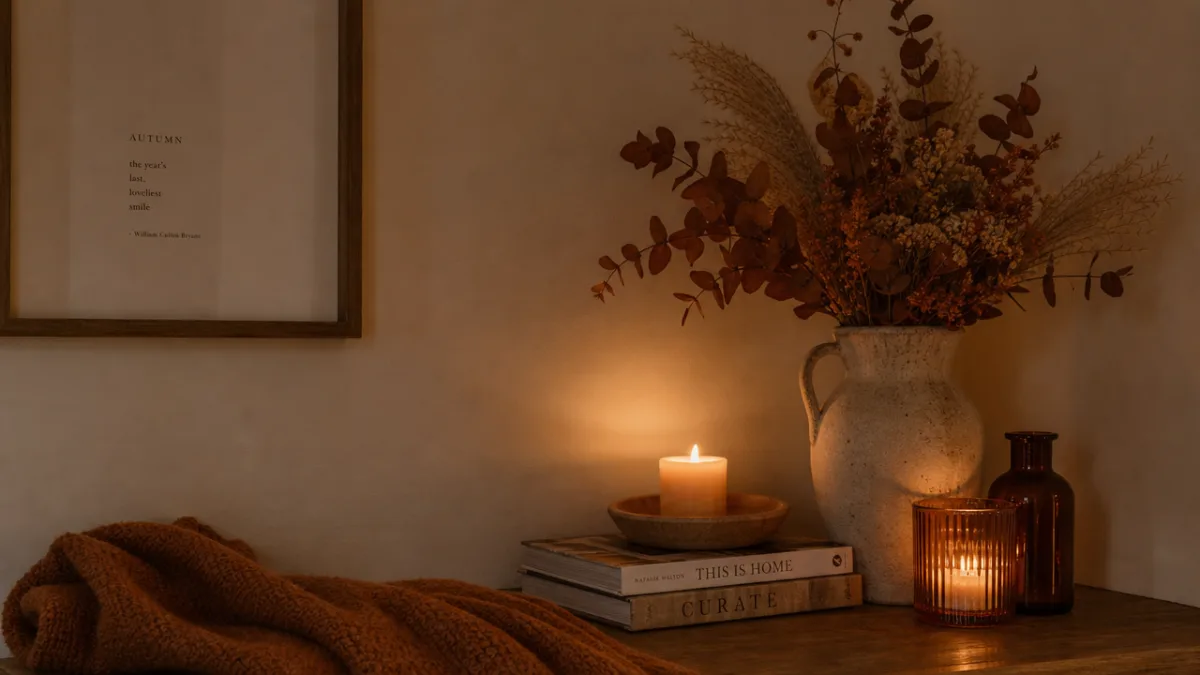
Height variation within your candle grouping is one of the most effective compositional tools available to you. A display that uses only candles of the same height reads as flat and uninteresting, while a grouping that plays with dramatic height differences — a tall, slender taper alongside a wide, low pillar and a medium jar candle, for example — creates visual rhythm and draws the eye through the arrangement rather than stopping it abruptly. Think of your candle display as a small skyline, with each element contributing to an overall silhouette that is more interesting than any individual piece alone.
Layering Textures and Complementary Objects
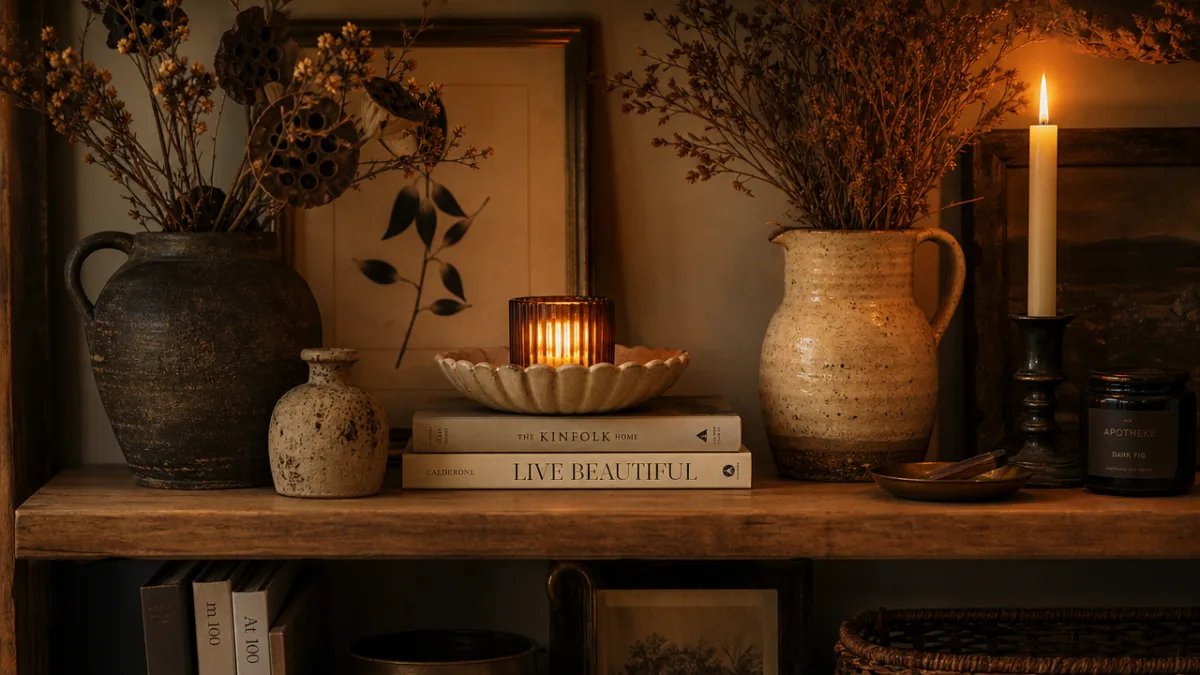
A candle corner becomes truly evocative when the candles are surrounded by carefully chosen companion objects that reinforce the same sensory and aesthetic mood. This is where the styling process becomes genuinely creative, and where the difference between a beautiful corner and an unforgettable one often lies. The principle of layering — placing objects at varying heights and depths, mixing materials with different textures, and allowing some empty space to breathe between items — is what transforms a simple candle arrangement into a fully realized vignette.
Some of the most effective companion objects for a minimal cozy candle corner include the following categories, each of which adds a distinct textural or tonal quality to the overall composition:
- Natural organic elements — dried botanicals, a small bundle of eucalyptus, dried pampas grass stems, a pinecone or two, or a smooth stone collected on a walk. These bring the outside world in and add an earthy, grounding quality that feels both minimal and deeply alive.
- Ceramic and clay objects — small handmade vessels, a matte ceramic tray, an organic-shaped bowl used as a catch-all for matches. The handmade quality of ceramics introduces warmth and imperfection that counters any sterility in the minimal aesthetic.
- Textile elements — a small folded linen cloth beneath a candle grouping, a tiny woven trivet, a fringe-edged fabric runner on a shelf. Textiles soften hard surfaces and add a layering quality that reads as both cozy and considered.
- Books and paper goods — a small stack of artfully covered books placed horizontally, a single art print leaned casually against the wall behind the display, a handwritten note tucked into a frame. These objects carry personal meaning and suggest a life being lived, not merely curated.
- Reflective surfaces — a small mirror, a brass or bronze tray, a glass bud vase. When candlelight is present, these surfaces multiply and scatter the glow in the most beautiful way, making the entire corner feel luminous.
The key to successful layering is restraint. It is always better to add one object too few than one too many. Once your corner is assembled, take a photograph of it and study the image — photography has a way of revealing imbalance and clutter that our three-dimensional perception sometimes misses. If something feels visually heavy or distracting in the photograph, remove it and observe how the space settles and breathes. The right arrangement will feel both complete and spacious, as though every object was always meant to be exactly where it is.
Creating Ritual Around Your Candle Corner
One of the most underappreciated dimensions of the minimal cozy candle corner is the way it invites ritual into daily life. A ritual, in the domestic sense, is simply a repeated action invested with intention and meaning — something you do not merely because it is necessary but because doing it in a particular way enriches your experience of the day. The act of lighting your candles in the evening, of choosing a particular fragrance to match your mood or the season, of dimming the other lights and sitting quietly in the glow for even ten minutes, constitutes a small but genuinely powerful ritual that anchors you in the present moment.
Research in environmental psychology supports what most people intuitively feel: that intentionally curated physical environments have measurable effects on mood, stress levels, and cognitive function. Soft, warm light has been shown to reduce cortisol and promote the kind of relaxed alertness associated with creativity and emotional openness. Fragrance engages the limbic system — the brain’s emotional and memory center — more directly than any other sensory input, which is why a particular candle scent can transport you instantly to a feeling of safety, comfort, or nostalgia. Your candle corner, in this sense, is not merely decorative. It is a mood-regulation tool built into the architecture of your daily life.
Consider building specific rituals around your candle corner that correspond to different moments in your day or week. A morning ritual might involve lighting a single unscented beeswax candle alongside your first cup of tea or coffee and spending five minutes in quiet contemplation before the day’s demands begin. An evening ritual might involve lighting the full arrangement, putting on ambient music, and engaging in something slow and analog — reading a physical book, writing in a journal, or simply sitting and doing nothing at all. A weekly ritual might involve refreshing the botanical elements, trimming candle wicks, rearranging objects, and dusting surfaces as a form of mindful maintenance rather than mere housekeeping.
Seasonal Refreshing and Long-Term Maintenance
One of the great joys of a candle corner is that it need not remain static. Because the setup is intentionally minimal — with a small number of thoughtfully chosen objects rather than a large collection of things — refreshing it with the seasons is neither expensive nor time-consuming, but it yields a deeply satisfying sense of renewal. Each season brings its own palette, its own botanical materials, its own candle fragrance families, and its own emotional register, and allowing your corner to reflect those shifts keeps it feeling alive and relevant rather than like a decorative decision made once and forgotten.
Seasonal refreshing ideas organized by time of year might include the following approaches:
- Autumn and winter — lean into the darkest, most indulgent version of the cozy aesthetic. Add deeper tones like amber, rust, and midnight green. Incorporate cinnamon sticks, dried orange slices, and small pinecones as botanical accents. Choose candle fragrances in the warm spice, woodsmoke, sandalwood, and amber families. Add a small woven textile or fur-textured object for additional warmth.
- Spring — lighten the palette dramatically. Swap deep tones for pale blush, sage, and soft white. Introduce fresh or dried botanicals with a delicate, airy quality — dried lavender, preserved rose buds, or a tiny sprig of eucalyptus. Choose fresher, greener fragrance profiles — white tea, bergamot, lily, or fresh linen.
- Summer — embrace the most minimal version of the display, since long daylight hours mean the corner will be seen more often in natural than candlelight. Pare back to the essential objects, introduce coastal textures like sea glass or smooth river stones, and choose light, clean fragrances — citrus, sea air, or fresh herbs.
Long-term maintenance of your candle corner is a simple but important practice that preserves both the beauty and the safety of the space. Trim candle wicks to approximately a quarter of an inch before each lighting to prevent excessive smoke and uneven burning. Replace pillar and taper candles before they burn down to within an inch of their holders, as the heat from a very low flame can crack ceramic and damage wooden surfaces. Dust your display regularly using a soft cloth — candlelight reveals dust in particularly unforgiving ways, and a dusty corner quickly loses its sense of curated calm. Wipe down glass vessels when wax residue accumulates around their edges, and replace spent candles with new ones that continue the color and scale logic of your original composition.
Perhaps most importantly, allow your candle corner to evolve with you. The objects that belong there may change as your taste develops, as you travel and bring home small finds, as you move through different seasons of life and find yourself drawn to different textures and moods. A candle corner that has been tended with care over several years becomes something more than a styled shelf — it becomes a record of attention and intention, a small autobiographical space that reflects not just your aesthetic preferences but your ongoing relationship with the simple, timeless pleasure of light.
Safety Practices and Smart Candle Habits
A truly well-considered candle corner is not only beautiful but safe. Open flames in the home carry inherent risks that are easily mitigated through consistent habit and thoughtful setup decisions, and addressing safety with the same intentionality you bring to aesthetics is simply responsible design. The minimal aesthetic actually works in your favor here — a less cluttered display reduces the risk of accidental ignition from nearby materials, and the discipline of editing your corner to only essential, purposeful objects means you are less likely to place flammable materials too close to a flame without realizing it.
The most important safety practices for a candle corner are straightforward and easy to incorporate into your ritual:
- Never leave burning candles unattended, and always extinguish them before leaving a room or going to sleep.
- Keep candles at least three inches apart from one another to prevent heat transference and uneven burning.
- Ensure that no flammable materials — dried botanicals, fabric runners, paper goods — are within six inches of an open flame at any time.
- Place candles on stable, heat-resistant surfaces only. A candle that wobbles is a candle that falls.
- Use a candle snuffer rather than blowing candles out, which sends a trail of smoke into the air and can disturb a carefully placed arrangement.
- Keep candles away from drafts, vents, and open windows, as moving air causes uneven burning and increases fire risk.
- Consider flameless LED candles in flicker mode for times when you want the visual warmth of candlelight without the open flame — modern LED candle technology has become remarkably convincing and allows for longer, unattended display.
Candle safety also extends to the materials you choose. Always burn candles in appropriate holders designed for the size and type of candle you are using. A taper candle in a holder that is too wide will lean and drip wax unpredictably; a wide pillar candle in a holder that is too small creates a pool of liquid wax with nowhere to go. Match the holder to the candle with as much care as you match the candle to the display, and your corner will not only look right but function safely and beautifully for years to come. The minimal cozy candle corner, at its best, is a practice of care — care for your environment, care for your senses, and care for the small, luminous moments that make a home feel truly alive.








What do you think?
It is nice to know your opinion. Leave a comment.