










Cozy Self-Care Space: Creating Your Perfect Neutral Bedroom Glow
There is something quietly transformative about a bedroom that feels genuinely yours — a space designed not for guests or appearances, but entirely for your own restoration. The neutral bedroom aesthetic has grown beyond a simple design trend into something closer to a philosophy, one that prioritizes calm over stimulation and intentionality over accumulation. When the colors on your walls and the textures beneath your fingers are chosen to soothe rather than impress, the room becomes a genuine sanctuary rather than just a place where you happen to sleep.
Self-care has been a buzzword for long enough that it risks losing its meaning, but in the context of your personal space, it carries real weight. A bedroom designed with self-care in mind is not about luxury for its own sake. It is about recognizing that the environment you return to each evening shapes your mental state, your sleep quality, your ability to decompress, and ultimately your capacity to show up fully in every other area of your life. When the space supports you, everything else becomes a little more manageable.
This guide explores every dimension of building a cozy, glowing, neutral bedroom that functions as a true self-care retreat. From the foundational palette decisions to the layering of light, texture, and scent, each section offers practical and thoughtful guidance to help you create a space that feels like an exhale at the end of a long day. Whether you are starting from scratch or refining what you already have, these principles translate into real, livable comfort.
The Foundation: Choosing Your Neutral Palette
Neutrals are often misunderstood as the absence of color, when they are really the presence of subtlety. A well-chosen neutral palette for a bedroom does not mean white walls and beige furniture arranged without feeling. It means selecting tones that carry warmth, depth, and personality without competing for attention. Warm whites, greige blends, soft taupes, linen tones, and dusty blush shades all fall within a neutral range that can feel rich and enveloping rather than cold or clinical, depending entirely on how they are layered and lit.
The starting point is almost always the walls, and here the undertone matters enormously. A white with a pink undertone will read very differently in the evening than a white with a yellow undertone, and either will shift dramatically depending on the light sources in your room. Before committing to a paint color, live with large swatches for several days and observe them at different times — morning light, afternoon sun, and especially the warm artificial light of evening when you will most often be in your bedroom seeking rest and restoration.
Once your wall color is established, the remaining palette layers in through textiles, furniture, and accessories. A cohesive neutral scheme works best when it incorporates variation in tone and texture rather than relying on a single repeated shade. Consider pairing a warm white wall with natural linen bedding, a stone-toned throw, wooden furniture in a honey or walnut finish, and a woven jute rug underfoot. Each element speaks the same quiet language while contributing its own distinct note to the overall composition.
- Warm whites and off-whites create a soft, luminous backdrop that flatters both natural and artificial light throughout the day.
- Greige (a blend of gray and beige) is exceptionally versatile and pairs effortlessly with wood tones, metals, and soft textiles.
- Dusty blush and muted terracotta introduce warmth without introducing color in a way that feels jarring or overly vibrant.
- Linen tones and natural fiber shades ground a room visually and evoke an organic, earthy calm.
- Soft charcoal or warm taupe can anchor the palette without darkening the mood, especially when used in smaller doses on textiles or furniture.
The Art of Layered Lighting for a Bedroom Glow
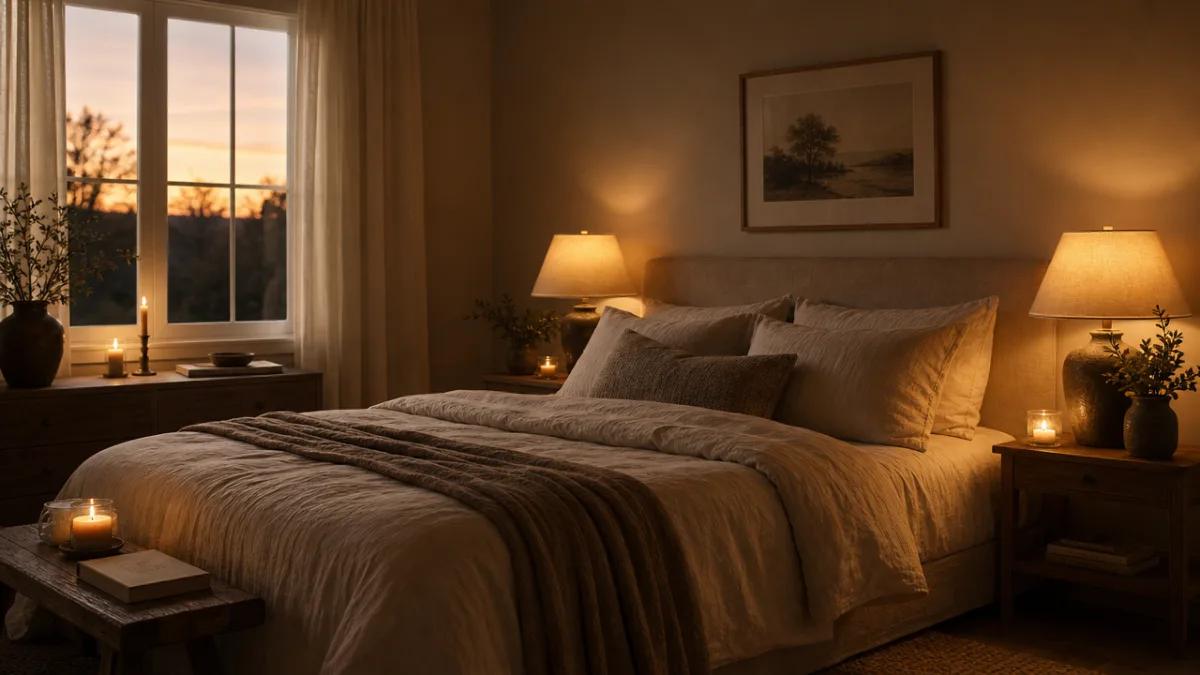
Lighting is the single most powerful tool in creating the glowing, cozy atmosphere that transforms a neutral bedroom into a true self-care sanctuary. Most people dramatically underestimate the impact of lighting choices, relying on a single overhead fixture to do work that really requires three or four different light sources working in concert. The goal for a bedroom designed around rest and relaxation is to create lighting that can shift dramatically depending on the time of day and the mood you are trying to cultivate.
The concept of layered lighting involves three distinct tiers: ambient, task, and accent. Ambient light provides overall illumination and sets the baseline mood of the room — this might be a ceiling fixture, but ideally one with a dimmer switch that allows you to reduce intensity as the evening progresses. Task lighting serves functional purposes like reading or getting dressed, and is best placed at bedside tables or within a dedicated vanity area. Accent lighting is where the warmth and glow truly emerge, through table lamps with fabric shades, string lights tucked behind a headboard, candles, or small LED strips that wash a wall in a gentle, indirect light.
For the signature warm glow that defines a cozy neutral bedroom, pay close attention to the color temperature of your light bulbs. Bulbs are measured in Kelvins, and for a bedroom environment you want to stay firmly in the warm range — between 2700K and 3000K at most. These tones mimic the quality of candlelight and the golden hour, producing a flattering, restful atmosphere that signals to both your eyes and your nervous system that it is time to slow down. Cooler, blue-toned light above 4000K is stimulating rather than soothing, and has been shown to interfere with melatonin production when used in the evening hours.
- Install a dimmer switch on your main overhead light to give yourself full control over ambient intensity throughout the evening.
- Choose bedside lamps with warm-toned fabric or linen shades, which diffuse light softly rather than casting sharp shadows.
- Add a string of warm LED fairy lights or Edison bulbs behind the headboard or along a shelf for atmospheric accent lighting.
- Keep a small selection of quality candles for moments when you want the flickering, deeply warm quality of real flame.
- Use a salt lamp or a small decorative lamp in a corner to create a secondary light source that adds depth and warmth to the room.
Textiles and Texture: Building the Cocoon Effect
If lighting sets the mood of a self-care bedroom, then textiles determine its physical experience. The way a space feels to move through and rest within is just as important as how it looks in photographs, and a bedroom designed for genuine comfort prioritizes the tactile above almost everything else. The cocoon effect — that sense of being wrapped in warmth and softness on all sides — is achieved through deliberate layering of different fabrics, weights, and textures across the bed, the floor, the windows, and the seating areas of the room.
Begin with the bed, which is rightly the focal point of any bedroom and the site of the most intimate daily self-care ritual: sleep. Invest in the highest quality bedding you can reasonably afford, prioritizing natural fibers like linen, cotton percale, or cotton sateen. Linen in particular has an organic rumpled quality that reads as effortlessly cozy and improves with every wash, growing softer and more characterful over time. Layer the bed with a flat sheet, a lightweight quilt or duvet, and at least one additional throw blanket folded at the foot of the bed or draped casually over one corner — this creates both visual depth and practical flexibility for different temperatures throughout the night.
Beyond the bed, look for opportunities to introduce texture through every available surface. A chunky knit throw over an armchair invites you to curl up with a book. A sheepskin or faux fur rug beside the bed means your feet land on something plush and warm first thing each morning. Linen curtains that pool slightly on the floor rather than cutting off precisely at the window sill add a softness and romance to the room that no structured blind can replicate. Even the inclusion of a woven cushion or a velvet pillow against a linen backdrop introduces a textural conversation that makes the space feel curated and alive.
Intentional Scent and Sensory Self-Care
A truly immersive self-care bedroom engages all five senses, and scent is one of the most direct and immediate pathways to emotional state. The olfactory system is uniquely connected to the limbic brain — the seat of emotion and memory — which is why a particular fragrance can shift your mood almost instantaneously in a way that visual changes cannot. Incorporating intentional scent into your bedroom environment is one of the simplest and most effective upgrades you can make to your daily self-care practice, and it requires very little space or investment to do well.
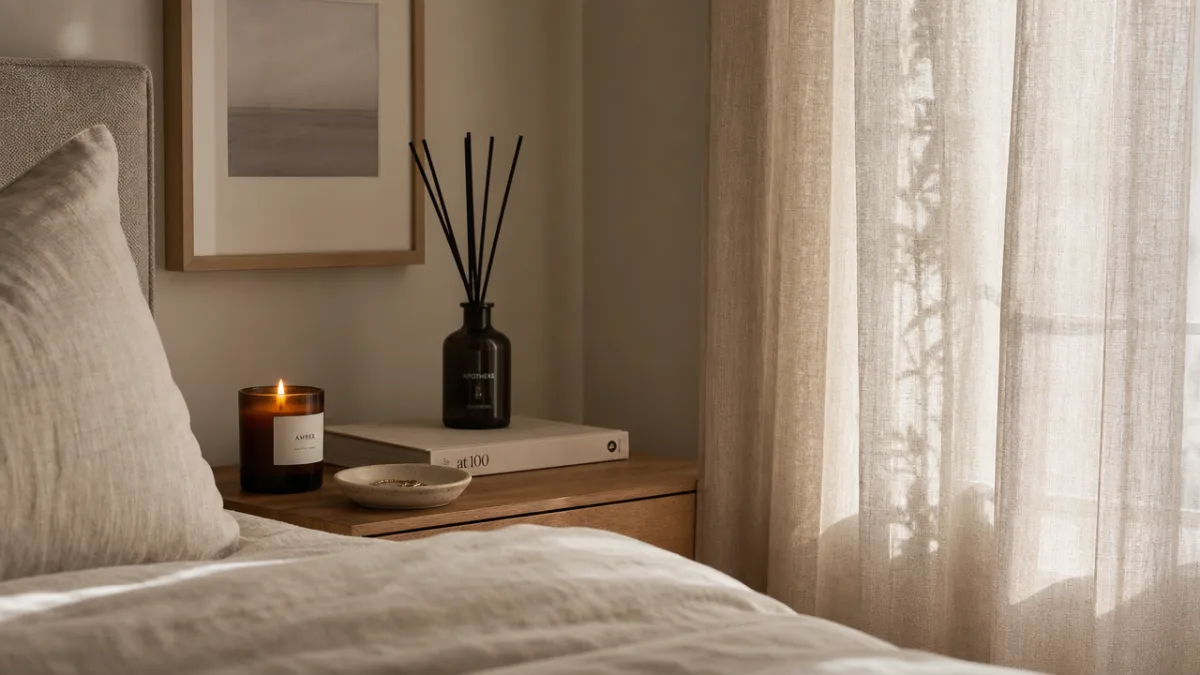
For a self-care bedroom, the most important principle regarding scent is consistency and intention. Rather than rotating through many different fragrances indiscriminately, choose a signature scent for your bedroom that becomes associated specifically with rest, safety, and restoration. Lavender is the most researched option, with substantial evidence supporting its ability to reduce anxiety and improve sleep quality. Sandalwood, cedarwood, and vetiver offer a deeper, woodier warmth that feels grounding and earthy. Vanilla and amber add a soft sweetness that many people find deeply comforting. A blend of any of these — perhaps a lavender and sandalwood candle or a cedarwood and vanilla reed diffuser — can become the olfactory signature of your personal sanctuary.
Delivery method matters as much as the fragrance itself. Candles offer the additional benefit of warm, flickering light and are ideal for evenings when you are actively present in the room winding down. Reed diffusers provide a continuous, low-level scent that operates passively throughout the day and night, maintaining a subtle aromatic baseline without requiring attention. Essential oil diffusers allow you to adjust intensity and blend scents with precision. Linen sprays misted onto your pillowcase before bed engage scent at the precise moment your head meets the pillow, creating a powerful sensory cue for sleep that can deepen over time into a genuine conditioning response.
Curating a Clutter-Free, Restorative Environment
The visual noise of clutter is one of the most underestimated threats to the restorative quality of a bedroom. Research consistently demonstrates that cluttered environments elevate cortisol levels — the primary stress hormone — and create a low-level cognitive load that prevents full relaxation even when the body is at rest. A self-care bedroom must therefore be as thoughtfully edited as it is thoughtfully decorated, with storage solutions that keep the visual field clear and surfaces that contain only what is genuinely meaningful or functional.
The most sustainable approach to maintaining a calm, clutter-free bedroom is not minimalism as a rigid aesthetic but intentionality as a practice. Before any object enters your bedroom, consider whether it belongs there. Phones, laptops, and work-related materials are the most significant disruptors of bedroom serenity, not only for their visual presence but for the psychological associations they carry. Creating a physical boundary between work life and rest space — even a small basket near the door where devices are deposited before bed — can shift the felt quality of your bedroom environment dramatically.
For storage, built-in or furniture-integrated solutions are preferable to freestanding organizers that add visual complexity. An upholstered storage bench at the foot of the bed contains extra blankets while serving as a seating surface. Bedside tables with drawers or lower shelves keep nighttime essentials accessible but out of sight. A wardrobe with clean, simple doors removes the visual chaos of hanging clothing from the room entirely. The surfaces that remain visible — a bedside table, a dresser top, a windowsill — should be treated as small, curated compositions rather than landing strips for whatever comes in the door at the end of the day.
- Use matching storage containers and baskets to organize items on open shelves, maintaining a cohesive visual rhythm.
- Limit bedside table surfaces to three to five items maximum — a lamp, a book, a glass of water, and perhaps one small meaningful object.
- Implement a weekly five-minute reset practice to return the room to its baseline order, preventing slow accumulation of clutter over time.
- Designate one drawer or basket as a catch-all for miscellaneous items, so they have a home without cluttering visible surfaces.
Plants, Nature, and the Living Element
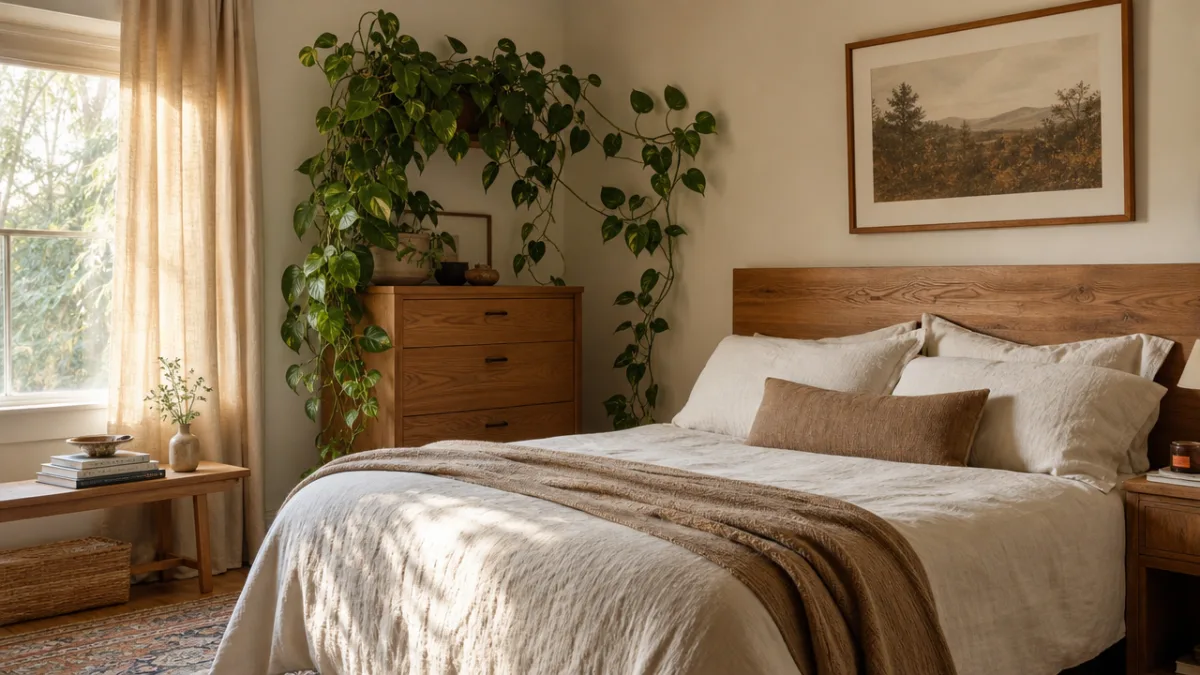
A neutral bedroom glows most fully when it includes something living. The biophilic design principle — the idea that humans have an innate need for connection with the natural world — is well supported by both intuition and research, and incorporating natural elements into your bedroom environment produces measurable benefits for wellbeing, mood, and cognitive restoration. Plants are the most direct and accessible way to introduce the living world into an interior space, and in a neutral bedroom they add color, texture, and a sense of gentle vitality without disrupting the calm, cohesive palette.
For a bedroom context, the most appropriate plants are those that thrive in lower light conditions and require relatively little maintenance, since the bedroom is typically the least sun-drenched room in a home and the last place you want to introduce a source of stress or obligation. Pothos, snake plants, peace lilies, and philodendrons are all excellent choices — forgiving, visually beautiful, and known for their air-purifying qualities. A single larger plant in a woven or terracotta pot in one corner of the room can be as impactful as a collection of smaller ones, and often reads as more elegant in a neutral, restrained interior.
Beyond plants, the natural world can enter the bedroom through materials and motifs that evoke the organic. A driftwood sculpture on a shelf, a bundle of dried pampas grass or eucalyptus in a ceramic vase, a bowl of smooth stones collected from a meaningful place — each of these brings a quality of earthy realness into the space that purely manufactured objects cannot replicate. The goal is not to simulate nature in a literal or theatrical way but to maintain a quiet thread of organic reference throughout the room that keeps the environment feeling alive, grounded, and genuinely connected to something beyond the four walls.
Establishing a Self-Care Ritual Within Your Space
The most beautifully designed bedroom will only realize its full potential when it is paired with intentional rituals that give the space its meaning and purpose. A room is shaped by what happens within it over time, and a self-care bedroom becomes more deeply restorative the more consistently it is used for the practices that restore you. This does not require elaborate routines or dedicated hours — small, consistent rituals repeated daily carry more transformative weight than occasional grand gestures, and they create the powerful psychological associations that make a space feel genuinely safe and restorative the moment you enter it.
An evening wind-down ritual anchored in your bedroom might begin with lowering the lights an hour before bed, lighting your signature candle, and spending even ten minutes doing something that has nothing to do with productivity — reading a physical book, journaling, stretching gently, or simply sitting in the quiet with a cup of herbal tea. The specific activity matters far less than the consistency and the intentionality, the act of signaling clearly to your nervous system that the day is done and recovery has begun. Over time, the environmental cues — the dimmed lights, the particular scent, the feel of familiar textiles — do much of this signaling automatically, making the transition to rest increasingly effortless.
Morning rituals within the bedroom are equally worth considering. Making the bed each morning is widely cited by people who practice it as one of the highest-return daily habits, not because the act itself is profound but because it sets a tone of care and intentionality for the day ahead, and because it means the space you return to each evening is already prepared to receive you. Opening curtains to invite natural morning light, taking a few conscious breaths before reaching for a phone, or spending two minutes simply appreciating the space you have built — these small acts of presence compound over time into a genuinely different relationship with your home, your rest, and ultimately yourself.
Ultimately, a cozy self-care bedroom with a warm neutral glow is not a destination you arrive at once and maintain effortlessly. It is a living relationship, one that evolves with your needs, your seasons, and your growing understanding of what genuinely restores you. The principles here — intentional color, layered light, sensory richness, curated simplicity, and rooted ritual — provide a framework, but the most important ingredient is your own attentiveness to what feels right in the space and what does not. A bedroom that truly supports you will be one you return to not just out of necessity but out of genuine desire, a room that feels less like a functional room in a house and more like the quietest, most honest version of yourself made visible and habitable.








What do you think?
It is nice to know your opinion. Leave a comment.