










Crochet Floor Basket Free Patterns: Your Complete Guide to Crafting Beautiful Storage Solutions
Introduction to Crochet Floor Baskets
Crochet floor baskets have become one of the most beloved home decor trends in recent years, and it is easy to understand why. These handcrafted storage solutions combine functionality with artistic expression, allowing crafters of all skill levels to create something truly unique for their living spaces. Whether you are looking to organize blankets in your living room, store toys in a nursery, or keep laundry contained in your bathroom, a crochet floor basket offers a warm, textural alternative to mass-produced plastic or wicker bins.
The beauty of working with free patterns is that you can explore a wide variety of styles, techniques, and materials without any financial investment. The crochet community is extraordinarily generous, with designers and hobbyists sharing their creativity online through blogs, social media platforms, and dedicated craft websites. This means that whether you prefer a minimalist Scandinavian aesthetic, a boho-chic layered look, or a bold modern design, there is almost certainly a free pattern out there waiting for you to discover it.
Getting started with crochet floor baskets does not require advanced skills, although some patterns do call for intermediate knowledge of certain stitches. Many popular patterns are designed with beginners in mind, using basic stitches like single crochet or half double crochet worked in continuous rounds. The key factors that distinguish a floor basket from a smaller decorative piece are the materials used and the scale of the project, both of which we will explore in depth throughout this guide.
Choosing the Right Materials for Your Floor Basket
The material you choose is perhaps the single most important decision you will make when crocheting a floor basket, as it determines the basket’s durability, structure, and overall appearance. Unlike delicate amigurumi or lightweight garment projects, floor baskets need to hold their shape under the weight of their contents and withstand regular handling. This is why most experienced crafters recommend working with sturdy, thick materials that provide natural stiffness without the need for additional stiffening sprays or inserts.
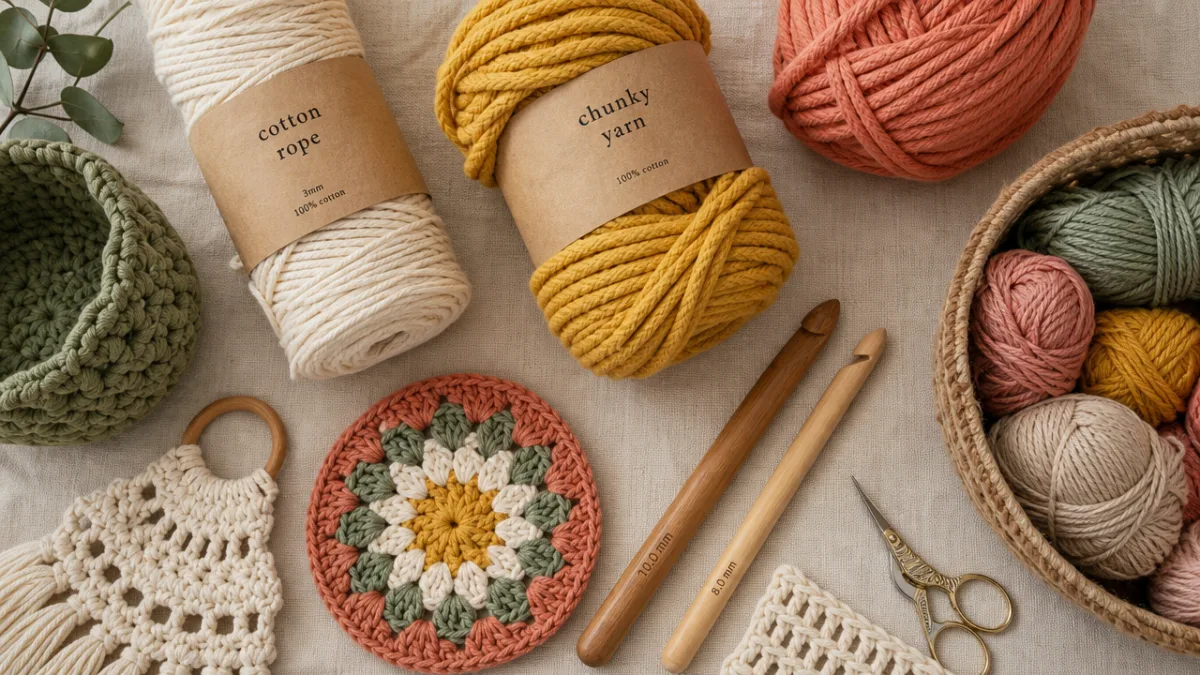
Rope and cord yarns are consistently the most popular choice for crochet floor baskets, and for very good reason. Cotton rope, in particular, has become a staple material in the crafting world because it is durable, washable, and available in a wide range of thicknesses. Most floor basket patterns call for rope measuring between 3mm and 8mm in diameter, with thicker rope producing a chunkier, more textured result and thinner rope allowing for more detailed stitch definition. Macrame cotton cord is another excellent option that provides similar structural benefits while offering a slightly softer finish.
Chunky yarn and jumbo yarn are also worth considering, especially for crafters who prefer working with traditional fiber materials. T-shirt yarn, sometimes called zpagetti or fabric yarn, is a particularly popular choice because it is eco-friendly, being made from repurposed fabric offcuts, and it creates baskets with wonderful body and texture. When choosing any material, it is important to consider the recommended hook size on the label and test your tension with a small swatch before committing to an entire project, as gauge can significantly affect the final dimensions of your basket.
- Cotton rope (3mm–8mm): Best for structured, firm baskets with clean stitch definition
- Macrame cord: Ideal for natural, bohemian-style designs with a slightly rustic finish
- T-shirt yarn: Eco-friendly option that creates soft yet sturdy baskets in vibrant colors
- Chunky wool blend: Great for cozy, textured baskets suited to cooler climates
- Jute twine: Perfect for rustic or farmhouse-style aesthetics with natural earth tones
Essential Stitches and Techniques for Beginners
One of the most encouraging things about crochet floor baskets is that the majority of popular patterns rely on just a handful of foundational stitches. If you already know how to single crochet and work in the round, you are well on your way to completing your first basket. The magic ring, also called the magic circle or adjustable ring, is typically used to start the base of a basket, creating a tight center point from which you increase outward in each round until the base reaches your desired diameter.
Working in continuous rounds, rather than joined rounds with a slip stitch and turning chain, is the most common technique used for crochet baskets. This method creates a seamless, spiral appearance that is both aesthetically pleasing and structurally sound. You will want to use a stitch marker to keep track of where each round begins and ends, as it can become quite difficult to count rounds in thick rope or cord without one. Simply place a removable marker in the first stitch of each new round and move it up as you progress.
Once the base is complete, transitioning to the sides of the basket involves working straight up without any further increases. This is where the structural integrity of your material truly shines, as the sides of a well-made basket should stand upright on their own with minimal effort. Some patterns incorporate textural elements like the waistcoat stitch, the spike stitch, or simple color changes into the side panel, adding visual interest to what might otherwise be a straightforward series of single crochet rounds. For added structure, you can also crochet around a length of rope or cord as you work, a technique known as core crochet or crocheting over rope.
- Begin with a magic ring and chain 1 to start your first round
- Work 6 single crochet stitches into the ring, then pull the ring closed tightly
- Increase every stitch in round 2, giving you 12 stitches total
- Continue increasing every alternate stitch in subsequent rounds to expand the base
- Once the base reaches your target size, work straight rounds upward for the sides
- Finish with a slip stitch round or a row of reverse single crochet for a polished edge
Popular Free Pattern Styles and Where to Find Them
The variety of free crochet floor basket patterns available online is genuinely staggering, catering to every taste, skill level, and intended use. Classic round baskets are the most widely shared pattern type, and they range from simple beginner-friendly designs with minimal shaping to complex patterns featuring colorwork, textured stitches, and decorative handles. Oval baskets are another popular format, particularly for use as laundry hampers or storage beneath a bench, as their elongated shape maximizes capacity in narrow spaces.
Websites like Ravelry, Yarnspirations, and AllFreeCrochet host thousands of free patterns organized by skill level, yarn weight, and project type, making it easy to filter your search and find something that suits your current abilities and aesthetic preferences. Independent designers also share free patterns on their personal blogs and Instagram accounts, often accompanied by detailed photo tutorials and video walkthroughs that are incredibly helpful for visual learners. Pinterest itself is an excellent discovery tool, functioning as a visual search engine that connects you directly to the source patterns behind the images that catch your eye.
Some of the most-shared free floor basket patterns include the Simple Rope Basket, which uses chunky cotton rope and basic single crochet to create a clean, modern look in just a few hours, and the Boho Fringe Basket, which adds decorative tassels or fringe around the rim for a playful, festival-inspired aesthetic. Striped color block baskets are perennially popular because they allow crafters to use up leftover yarns while creating a bold, graphic visual statement. Handled baskets, which incorporate sturdy crocheted or store-bought handles, are particularly useful for portable storage applications like grocery toting or toy organization.
Sizing Your Basket: From Small Accent Pieces to Large Floor Storage
Determining the right size for your crochet floor basket before you begin is an important step that will save you time and frustration later in the project. The finished dimensions of your basket depend on three interconnected variables: the thickness of your material, the size of your crochet hook, and the number of rounds you complete for both the base and the sides. Most free patterns will specify a gauge and target measurements, but it is always worth making a small test swatch and measuring it carefully before diving into the full project.
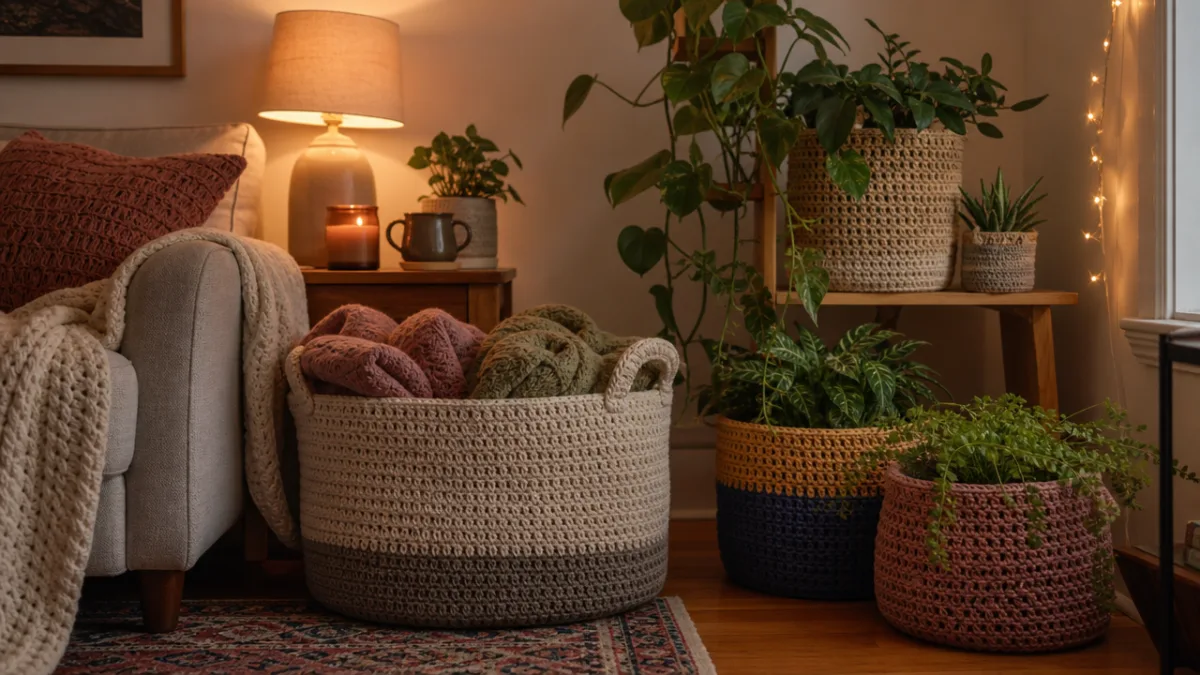
Small floor baskets, typically measuring between 20cm and 30cm in diameter and 15cm to 20cm in height, are perfect for bathrooms, bedside tables, or entryway catch-all storage. Medium baskets in the 30cm to 45cm range work wonderfully as plant pot holders, magazine organizers, or toy bins in children’s rooms. Large floor baskets exceeding 45cm in diameter are the statement pieces of the genre, capable of holding large throw blankets, laundry, or oversized stuffed animals with room to spare. These larger pieces typically require thicker rope or cord to maintain their structure at scale.
One useful trick for customizing the size of any pattern is to understand the mathematics behind the increases. When crocheting a flat circle, you increase by 6 stitches every round to maintain a flat, even shape without cupping or ruffling. This means that each additional round of the base adds approximately 6 stitches, and the circumference grows predictably with each pass. If a pattern’s base comes out too small or too large compared to your target dimensions, you can add or remove base rounds accordingly before transitioning to the sides, adjusting your stitch count to match. This flexibility is one of the great advantages of working with a round basket construction.
Decorative Techniques to Personalize Your Basket
Once you have mastered the structural basics of crocheting a floor basket, the real creative fun begins with personalization. Color is perhaps the most immediate and impactful way to customize your basket, and there are several approaches to incorporating it effectively. Simple stripe patterns created by changing yarn colors at the start of a new round are the easiest method, and they produce clean, graphic results that work beautifully in contemporary interior design schemes. For a more complex look, you can experiment with tapestry crochet, which involves carrying multiple yarn colors across each round and switching between them to create intricate geometric patterns or even pictorial designs within the basket’s side panel.
Textural embellishments offer another avenue for personalization that goes beyond color. Crocheted flowers, leaves, or geometric appliqués can be made separately and then sewn onto the completed basket for a dimensional, handcrafted look. Leather or fabric handles in complementary colors add both functionality and a professional finish that elevates the basket from a craft project to a boutique-quality home accessory. Braided or knotted rope embellishments around the rim or body of the basket draw on macrame traditions and complement the natural, artisan quality of handmade crochet work beautifully.
Do not overlook the finishing details that can make a significant difference in the polished appearance of your completed basket. Weaving in ends carefully and securing them with a dab of fabric glue ensures that your basket maintains its clean look through repeated use and washing. Blocking your basket, either by dampening it and reshaping it by hand or by using a steamer, can dramatically improve the evenness of your stitches and the regularity of the basket’s shape. Some crafters also choose to add a fabric lining to the interior of their baskets, which not only looks beautiful but also prevents smaller items from slipping through any gaps in the crochet fabric.
Caring for Your Crochet Floor Basket
Proper care and maintenance will extend the life of your handmade crochet floor basket significantly, keeping it looking beautiful and functioning well for years to come. The care requirements for your basket will depend primarily on the materials you used to make it, so it is always worth noting the fiber content and manufacturer’s care instructions before you begin washing or treating your finished piece. Cotton rope and macrame cord baskets are generally the most forgiving, as cotton is a naturally washable fiber that can typically handle machine washing on a gentle cycle with cool water.
For baskets made from T-shirt yarn or chunky wool blends, hand washing in cool water with a gentle, wool-safe detergent is usually the safest approach. Avoid wringing or twisting your basket, as this can distort the shape and weaken the fibers over time. Instead, gently press excess water out of the basket and then reshape it by hand before leaving it to air dry flat or upright in a well-ventilated area away from direct sunlight. Direct sunlight can cause some dyes to fade over time, particularly in brightly colored yarns, so storing or displaying your basket out of harsh light will help preserve its vibrancy.
Regular light maintenance is just as important as occasional deep cleaning. Brushing the exterior of your basket gently with a soft bristled brush can help remove dust and lint that accumulates over time, particularly in the textured recesses between stitches. If your basket begins to lose its shape after heavy use, a light misting with water and a gentle reshaping session followed by air drying can often restore its original form. With thoughtful care, a well-made crochet floor basket can become a cherished household item that improves with age and continues to serve your storage needs beautifully for many seasons.
Tips for Success: Making Your First Crochet Floor Basket
Approaching your first crochet floor basket project with a clear plan and realistic expectations will set you up for a rewarding and enjoyable crafting experience. Start by selecting a pattern that is explicitly labeled as beginner-friendly, and read through the entire pattern before picking up your hook or materials. This preview will help you identify any unfamiliar techniques you may need to research in advance, any special materials you need to source, and the overall scope of the project in terms of time and material quantities.
Investing in quality materials for your first project is worth the modest additional expense. Well-spun cotton rope with a consistent twist will be significantly easier to work with than cheaper alternatives that may split, tangle, or vary in thickness across the length of the skein. Similarly, a good quality crochet hook with an ergonomic handle will make the physical demands of working with thick rope far more comfortable, reducing hand fatigue during longer crafting sessions. Many experienced crafters recommend a hook size slightly larger than what a pattern specifies when working with very stiff or tightly twisted rope, as this helps maintain an even tension without straining your hands.
Finally, embrace the imperfections that are an inevitable part of handmade craft. Your first crochet floor basket may have slightly uneven sides, a base that is not perfectly flat, or color changes that are less than seamless. These quirks are not flaws but rather evidence of the human hands and creative energy that went into making something real and lasting. As you complete more projects, your technique will naturally improve, your tension will become more consistent, and your creative confidence will grow. The crochet community is also an invaluable resource for encouragement and troubleshooting, so never hesitate to post a question in an online forum or reach out to a fellow crafter when you get stuck. Every expert was once a beginner, and the satisfaction of completing a beautiful, functional crochet floor basket from a free pattern is a reward that is absolutely worth the learning curve.








What do you think?
It is nice to know your opinion. Leave a comment.