










Neoporteria odieri: A Complete Guide to This Remarkable Chilean Cactus
Introduction to Neoporteria odieri
Neoporteria odieri is a genuinely fascinating cactus — not exactly a household name, but that’s part of its charm. Native to the coastal and inland regions of Chile, this little globe-shaped plant has been quietly winning over serious cactus collectors for decades. It’s got striking spines, a tough constitution, and flowers that can stop you in your tracks. If you’ve never heard of it before, that’s okay — it tends to fly under the radar compared to flashier species. But once you learn where it comes from and what makes it tick, it’s hard not to fall a little bit in love with it.
The genus Neoporteria has had a bit of an identity crisis over the years, taxonomically speaking. Botanists have shuffled species around between Neoporteria, Nichelia, Islaya, and other related genera so many times that the literature can feel like a maze for newcomers. These days, many authorities prefer to lump Neoporteria odieri and its relatives under the broader genus Eriosyce, thanks to advances in DNA-based research. But whatever name you go by, the plant itself hasn’t changed — it’s still the same slow-growing, spine-covered gem that rewards patient growers with genuinely breathtaking blooms.
For collectors who focus on South American cacti, this one is a bit of a jewel. Growing it isn’t always straightforward, though. Its natural home along the Chilean coast comes with a very specific climate — cool marine fogs, mineral-rich soils, long dry spells — and the plant has adapted so precisely to those conditions that recreating them in cultivation takes some care and attention. That tension between wild toughness and cultivation sensitivity is exactly what makes growing Neoporteria odieri so engaging. Get it right, and it’s one of the most satisfying plants you can have on a shelf.
Taxonomy and Botanical Classification
The taxonomy of Neoporteria odieri is honestly a bit of a rabbit hole, and a pretty interesting one at that. The genus Neoporteria was first established by Britton and Rose in the early twentieth century to bring together a group of South American cacti with shared characteristics. As botanical science evolved and DNA analysis became routine, researchers went back to the drawing board more than once. Today, many authorities place Neoporteria odieri within Eriosyce, grouping it with species that share woolly areoles and funnel-shaped flowers with distinctively colored tepals.
Within the family Cactaceae, the species sits in the tribe Notocacteae alongside a whole range of South American globular cacti. The species name “odieri” is thought to honor a European botanist or collector involved in early explorations of Chilean flora, though the historical records aren’t always consistent on this point. That kind of commemorative naming was standard practice in the nineteenth and early twentieth centuries, when European naturalists were racing to document South America’s extraordinary biodiversity for the first time.
There’s also a fair amount of natural variability within the species itself, and several varieties and forms have been described in the literature. Some populations have denser spines, others show different coloration or slightly different body shapes depending on where they grow in Chile. For collectors, this is actually a nice feature — specimens from different localities can look quite distinct while technically being the same species. Botanical gardens and specialist societies have done a lot to preserve these distinct forms and get them into growers’ hands internationally.
Natural Habitat and Geographic Distribution
Neoporteria odieri is endemic to Chile, and its home turf is genuinely dramatic. The species is centered on the coastal and semi-coastal zones of northern and central Chile, where the Humboldt Current runs cold along the Pacific. That cold current does something remarkable — it keeps the coastal climate unusually cool and fog-prone even in areas that would otherwise be quite warm for their latitude. Pair that with intense sunlight, mineral-poor sandy or rocky soils, and long dry seasons, and you’ve got conditions that most plants simply can’t handle. Neoporteria odieri, though, is perfectly at home there.
In the wild, you’ll find these plants tucked into rocky outcrops, clinging to well-drained hillsides, and sometimes growing in almost pure sand along the coast. They share their habitat with other tough Chilean species — bromeliads, drought-adapted shrubs, and fellow cacti — in a plant community known as the Chilean coastal matorral. The soils are gritty, nearly devoid of organic matter, and drain instantly. Rather than growing deep roots, the plants spread their root systems wide to catch moisture from coastal fogs and the occasional rainfall that comes through.
Altitude adds another layer to the story. While many plants grow near sea level on coastal cliffs and dunes, the species also shows up at moderate elevations inland where conditions stay arid and rocky. This range of environments accounts for a lot of the morphological variation you see across different populations. Plants in foggier areas tend to grow in denser clusters, while those in more exposed, drier spots tend to be more solitary and develop particularly heavy spine systems — both as a defense against herbivores and as a way of reducing water loss.
Physical Description and Morphology
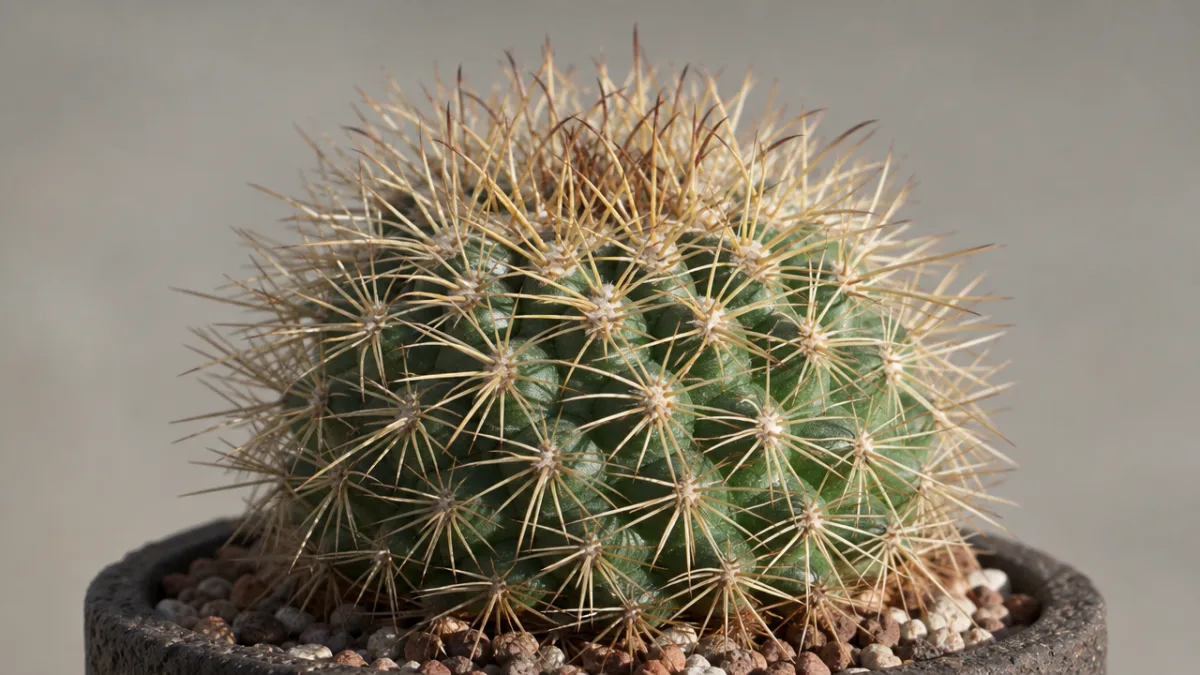
Neoporteria odieri is a medium-sized cactus, typically growing as a solitary globe or short cylinder that tops out somewhere around 15 to 20 centimeters tall and about as wide. The stem is green to grey-green and runs with pronounced vertical ribs from the apex down to the base. Those ribs are divided into distinct tubercles — small, nipple-like bumps — where the areoles sit. It’s a beautifully textured surface, both visually appealing and functionally useful for water storage.
The spination is really what sets this plant apart. The central spines tend to be darker — brown, black, or reddish — while the surrounding radial spines are lighter, often white or pale yellow, creating a striking contrast that’s hard to miss. Depending on the specimen and its growing conditions, you might find anywhere from a dozen to several dozen spines per areole. On mature plants, the spine coverage can get so dense that it nearly hides the green body beneath, giving the whole plant an almost fur-like look that’s completely unlike most cacti people are familiar with.
Then there are the flowers. If the spines are what get your attention first, the flowers are what make you stick around. They emerge near the crown of the plant and open in shades ranging from pale pink to vivid magenta or carmine, usually with a darker stripe running down the center of each tepal. The flowers themselves are relatively small — two to four centimeters across — but they appear in clusters and can come in impressive numbers during blooming season. The stamens and style are nicely displayed inside, and in the wild, bees and beetles are the main pollinators drawn in by the color and nectar.
After successful pollination, the plant produces small berry-like fruits that ripen to red or pinkish. Inside, there are small black seeds embedded in a slightly mucilaginous pulp. Birds and small mammals eat the fruits, which is how the seeds get spread across the landscape. The seeds themselves are on the larger side for a cactus this size, with a tough coat that helps them survive the harsh conditions of the Chilean coastal zone until conditions are right for germination.
Cultivation and Care Requirements
If there’s one thing to get right with Neoporteria odieri, it’s drainage. In the wild, this plant never sits in standing water, and its roots will rot quickly if you let that happen in cultivation. A specialized cactus mix with a heavy proportion of inorganic material — pumice, perlite, gritty sand — is the way to go. Most experienced growers aim for something in the range of 50 to 70 percent inorganic by volume, with the rest being a low-nutrient organic component like coir or fine bark. It might feel like you’re barely giving the plant anything to work with, but that’s actually the point.
Watering should follow the rhythms of the plant’s natural climate as closely as you can manage. In spring and early summer, water moderately — soak the root zone thoroughly, then let it dry out completely before watering again. Come midsummer, the plant often goes semi-dormant and needs a lot less water. In autumn, picking up the watering a bit can actually encourage flowering, which is a nice reward for your patience. Then through winter, especially if it’s cool, keep things mostly dry. Sticking to this seasonal cycle makes a real difference to the plant’s long-term health and its willingness to bloom.
Light and temperature are worth thinking about too. Neoporteria odieri is more cold-tolerant than you might expect given its coastal Chilean origins — many specimens handle brief frosts down to around minus five degrees Celsius without lasting damage, as long as they’re dry at the time. Wet cold is a different matter and is reliably fatal. For light, give it as much as you can: a south-facing windowsill, a greenhouse, or a well-positioned outdoor spot during the growing season will all produce tighter, more spiny, more floriferous plants than a shadier location ever will.
Feeding should be light. A low-nitrogen fertilizer formulated for cacti and succulents, applied at half strength two or three times during the growing season, is plenty. Too much nitrogen pushes soft, lush growth that looks wrong and is more prone to disease. Switching to a potassium-rich fertilizer in late summer helps harden up the plant’s tissues before the cooler, drier months arrive — a small tweak that pays off over winter.
Propagation Methods
Seed is the main way to propagate Neoporteria odieri, since the species doesn’t usually produce offsets that can be neatly separated from the parent. Growing from seed is slower than some methods, but there’s something genuinely satisfying about watching the whole life cycle unfold. Sow seeds in a very well-draining mix — a 50/50 blend of fine horticultural sand and cactus compost works well — in shallow trays or small individual pots. Surface sow and cover with a light layer of fine grit rather than burying the seeds, and you’ll generally get better germination results.
Getting germination going isn’t complicated. Aim for temperatures between 18 and 24 degrees Celsius with a consistently moist (not wet) medium, and most seeds will sprout within two to four weeks, though some take their time. A propagation heat mat can speed things up noticeably. Once seedlings appear, protect them from intense direct sun for the first few weeks while their root systems establish, then gradually introduce more light over the following months as they grow.
Grafting is another option, mainly used to speed up slow seedlings or rescue a plant that’s lost its roots to rot or injury. Trichocereus pachanoi, Harrisia tortuosa, and various Echinopsis species are all popular rootstocks that bring plenty of vigor to the grafted scion. A grafted Neoporteria odieri will typically grow and flower much faster than one growing on its own roots — appealing if you’re impatient. That said, own-rooted plants are generally seen as more authentic, and plenty of growers in the hobby prefer them on principle.
Conservation Status and Threats
Like a lot of specialized plants with a limited natural range, Neoporteria odieri is under real pressure in the wild. Habitat loss from agricultural expansion, coastal development, and urban sprawl is eating into populations that have likely existed in the same spots for centuries. The species’ narrow geographic range means that even localized disturbances — a construction project, an invasive plant taking hold, a change in land use — can knock out a meaningful chunk of the overall wild population. Chilean and international conservation organizations are paying more attention to this problem, though the scale of it remains daunting.
Illegal collection from the wild has been a serious issue historically, and it hasn’t entirely gone away. CITES regulations offer some protection, but enforcement in remote areas is genuinely difficult, and demand from collectors keeps the pressure on. The encouraging shift is that awareness within the cactus-growing community has improved considerably over recent decades. Many specialist nurseries now offer seed-grown Neoporteria odieri, which means there’s simply no good reason to seek out wild-collected plants anymore — and most knowledgeable collectors wouldn’t want them anyway.
Climate change adds a longer-term layer of concern. Shifts in the Humboldt Current, changes in coastal fog patterns, and altered rainfall could fundamentally reshape the conditions that this plant has spent millennia adapting to. Botanical gardens and seed banks are doing important work here, preserving genetic diversity through living collections and stored seed that might be critical for future restoration efforts. Collectors who grow and propagate Neoporteria odieri from seed are part of that effort too, whether they think of it that way or not.
- Support nurseries and suppliers that sell only seed-grown or legally propagated specimens, never wild-collected plants.
- Consider participating in seed exchanges through reputable cactus societies, which help distribute genetic diversity among collectors.
- Document your plants with locality data if known, as this information has scientific value for future research and conservation planning.
- Engage with and support organizations working on Chilean flora conservation, whether through membership, donations, or citizen science initiatives.
- Grow multiple individuals from different seed sources where possible to help preserve the genetic breadth of the species in cultivation.
Ultimately, the future of Neoporteria odieri in the wild comes down to a mix of stronger habitat protection, continued engagement from growers and collectors, and broader public awareness of just how special Chilean coastal ecosystems are. Every person who grows this plant responsibly and shares it ethically is part of an informal conservation network that, taken together, genuinely matters. This isn’t just a story about a beautiful, spiny little cactus — it’s about what we choose to pay attention to, and whether we’re willing to act as decent stewards of the remarkable diversity of life that still exists on this planet.








What do you think?
It is nice to know your opinion. Leave a comment.