










Crumble: The Ultimate Guide to Britain’s Most Beloved Comfort Dessert
A Brief History of the Crumble
The crumble is one of those dishes that feels like it’s always been around — like it was never invented so much as it simply appeared, bubbling away in British kitchens since the beginning of time. But its origins are actually pretty recent. Most food historians trace it back to the Second World War, when rationing made the idea of a proper pie crust basically impossible. There just wasn’t enough butter, flour, or sugar to go around. So home cooks improvised: a rough, simple topping made from whatever they had. No rolling, no fussing — just rubbed-together crumbs scattered over fruit and shoved in the oven.
What’s so lovely about that origin story is the total lack of intention behind it. Nobody sat down to create a new British classic. People were just trying to feed their families something warm and sweet when the cupboards were nearly bare. And somehow, completely by accident, they landed on something that’s never really gone out of fashion. These days you’ll find crumble on the menu at Michelin-starred restaurants and in the ovens of student flats in equal measure — and that’s about as good a measure of a recipe’s staying power as you’ll get.
Over the years, crumble has travelled a long way from its wartime roots. It started as a strictly British thing — usually apples or rhubarb, nothing fancy — and gradually spread across the world, picking up all kinds of influences along the way. Scandinavian spices, French pastry techniques, American pecans and maple syrup. The variations are endless. But through all of it, the soul of the dish has stayed exactly the same: soft, yielding fruit underneath a golden, buttery, sandy crust. That combination is apparently hard to argue with, wherever you are in the world.
Understanding the Perfect Crumble Topping
The topping is where most of the real debate in crumble-making happens, and honestly, it deserves the attention. At its simplest, you only need three things: plain flour, cold butter, and sugar. The classic British ratio is two parts flour to one part each of butter and sugar, though plenty of experienced bakers adjust that based on feel, fruit, or whatever texture they’re going for. The method matters more than anything: the butter has to be cold, and you work it into the flour with your fingertips — not a food processor — until the whole thing looks like rough, uneven breadcrumbs.
It’s worth understanding a little of the science here, because it actually changes how you approach it. When you rub cold butter into flour, the fat coats the flour particles and stops gluten from developing — which is the complete opposite of what you’re doing when you make bread. That’s why a crumble topping has that distinctive short, crumbly texture instead of being chewy or doughy. If your butter is too warm when you start, it blends in too smoothly and you end up with something closer to a paste. Those lumpy, uneven bits in a good crumble topping aren’t a mistake — they’re exactly what you’re aiming for.
Once you’ve got the basic three-ingredient version down, there’s a lot of room to play. Rolled oats are one of the most popular additions — they give the topping a slightly nutty, chewy quality and help it clump together into those satisfying clusters. Ground almonds bring richness and a faint marzipan note that’s particularly good with stone fruits like plums and cherries. Chopped hazelnuts, walnuts, or pecans all work beautifully too. And don’t underestimate spice: a pinch of cinnamon, a little nutmeg, or some ground ginger can completely transform the character of the topping and make it feel like it was made specifically for the fruit underneath.
- Use plain flour rather than self-raising — self-raising gives the topping a strange, leavened texture that you really don’t want.
- Keep your butter in the fridge right up until the moment you start rubbing it in. Cold butter is non-negotiable.
- Demerara sugar will give your topping a deeper caramel flavour and a really satisfying crunch compared to caster sugar.
- Don’t overwork the mixture — the moment it looks like coarse, uneven crumbs, stop. Walk away.
- Pop the finished topping in the fridge for 20 minutes before it goes on the fruit. It makes a noticeable difference to the crunch.
Choosing and Preparing Your Fruit
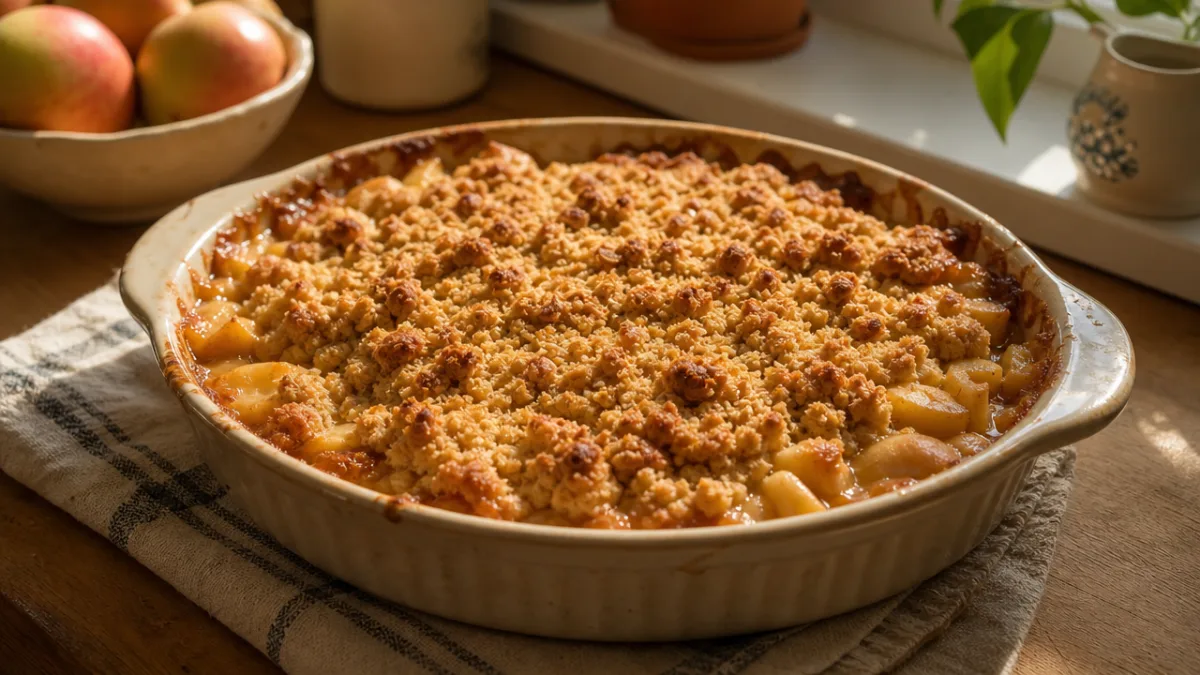
The fruit is really the heart of the whole thing, and you’ve got more options than you might think. Traditionally, British crumble meant Bramley apples or rhubarb — and there are good reasons both of those became the classics. They both turn wonderfully soft and jammy when they cook, and their natural tartness is exactly what you need to balance out the sweetness of the topping. That contrast between sharp fruit and sugary crust isn’t just about personal taste; it’s what keeps a crumble from becoming sickly-sweet and one-note. Get that balance right and the whole dish clicks into place.
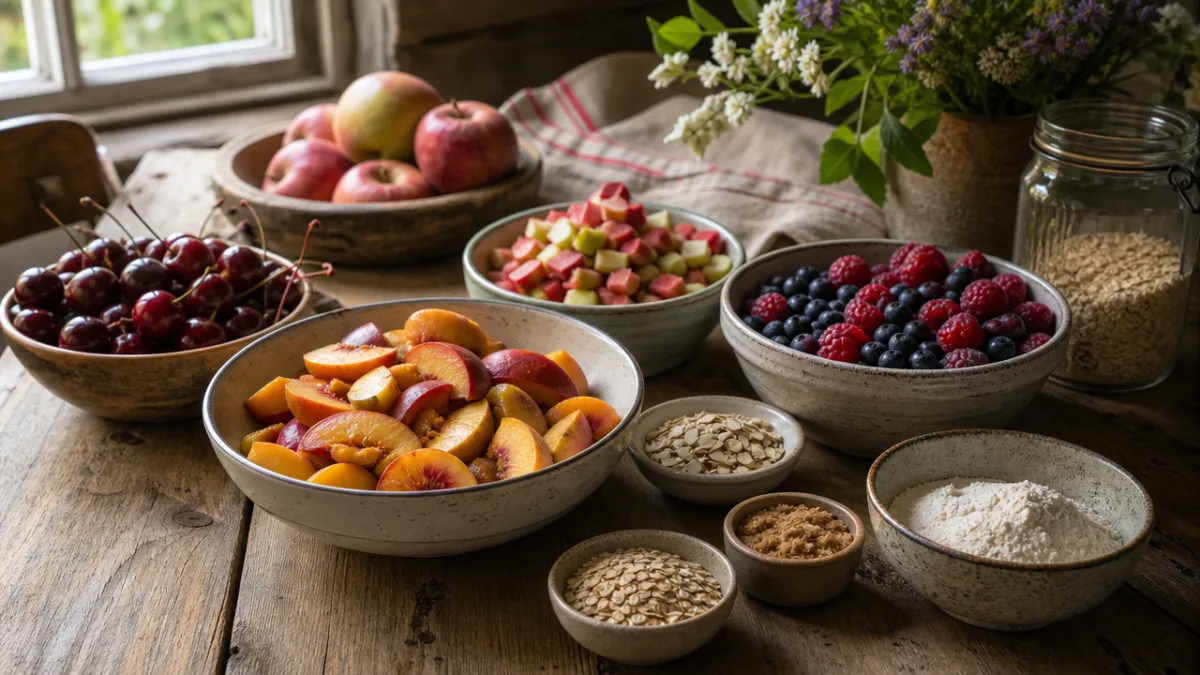
Preparing the fruit properly is something a lot of first-time crumble makers skip over, and it’s a mistake. Different fruits release very different amounts of liquid as they cook, and if you don’t account for that you’ll end up with either a dry, mealy filling or a watery swamp. Apples are relatively well-behaved and don’t release much juice — you can mostly just peel, slice, and go. Rhubarb, on the other hand, throws out a huge amount of liquid and really benefits from being tossed with sugar and left to sit for half an hour first, so you can drain off the excess before it goes in the dish. Berries fall somewhere in the middle and usually work best when mixed with something sturdier like apple to give the filling a bit of body.
Seasoning the fruit is just as important as seasoning a savoury dish, and it’s something recipes tend to gloss over. Sugar is the obvious one, but beyond that, a bit of citrus zest, a squeeze of lemon juice, a scrape of vanilla, or a good pinch of warming spice can make a real difference. A small amount of cornflour stirred through the fruit helps thicken the juices as they cook, so you end up with something glossy and saucy underneath the topping rather than a thin, watery puddle. These are small details, but they’re the difference between a crumble that’s merely comforting and one that’s genuinely, properly delicious.
- Peel, core, and slice your fruit into even pieces so everything cooks at the same rate.
- Toss the fruit with sugar, spice, and a little citrus juice, then actually taste it and adjust — it should be pleasantly tart, not sweet.
- For juicy fruits like rhubarb or berries, drain off the excess liquid before adding the topping, or you’ll regret it.
- Spread the fruit in an even layer in a deep dish and leave a little space at the top — the juices will bubble up as it bakes.
- Add the crumble topping in an even layer and press it down very lightly. Not firmly — you want texture, not compacted sand.
Classic and Creative Variations
Apple crumble and rhubarb crumble will always be the undisputed champions of the genre, but the past couple of decades have seen all sorts of interesting variations take hold. Pear and ginger crumble has become a real household favourite — ripe pears have this gentle, floral sweetness that pairs brilliantly with the kick of stem ginger, and a topping enriched with ground almonds rounds it all out beautifully. It feels sophisticated without being the least bit fussy. Plum crumble, made with dark Victoria plums and a handful of flaked almonds scattered over the top, has an almost wintry richness that’s exactly what you want on a cold autumn evening.
Summer opens up a whole different set of possibilities. White peaches and raspberries together make a crumble that feels genuinely luxurious — add a small amount of rose water to the topping and you’ve got something that looks and tastes far more impressive than the effort involved. Mango crumble, popular in Australia and parts of the Caribbean, takes the tropical sweetness of the fruit and pairs it with a coconut-enriched topping, and the combination really is as good as it sounds. Banana crumble is more divisive — people either love or strongly don’t love it — but its devotees swear by the caramelised, almost toffee-like quality you get when banana cooks under a brown-sugar topping.
And then there are savoury crumbles, which honestly deserve far more attention than they get. A crumble made with roasted tomatoes, courgettes, and herbs, topped with flour, butter, grated cheese, and chopped thyme, is an outstanding side dish or light main course. Leek and cheese crumble with a crisp green salad is the kind of thing that converts even the most committed sceptics. The technique is identical to the sweet version — only the ingredients change. Savoury crumbles are a good reminder that the crumble is really a structure, not a recipe: a flexible template that holds up to almost any combination of flavours you care to try.
Serving and Storing Your Crumble
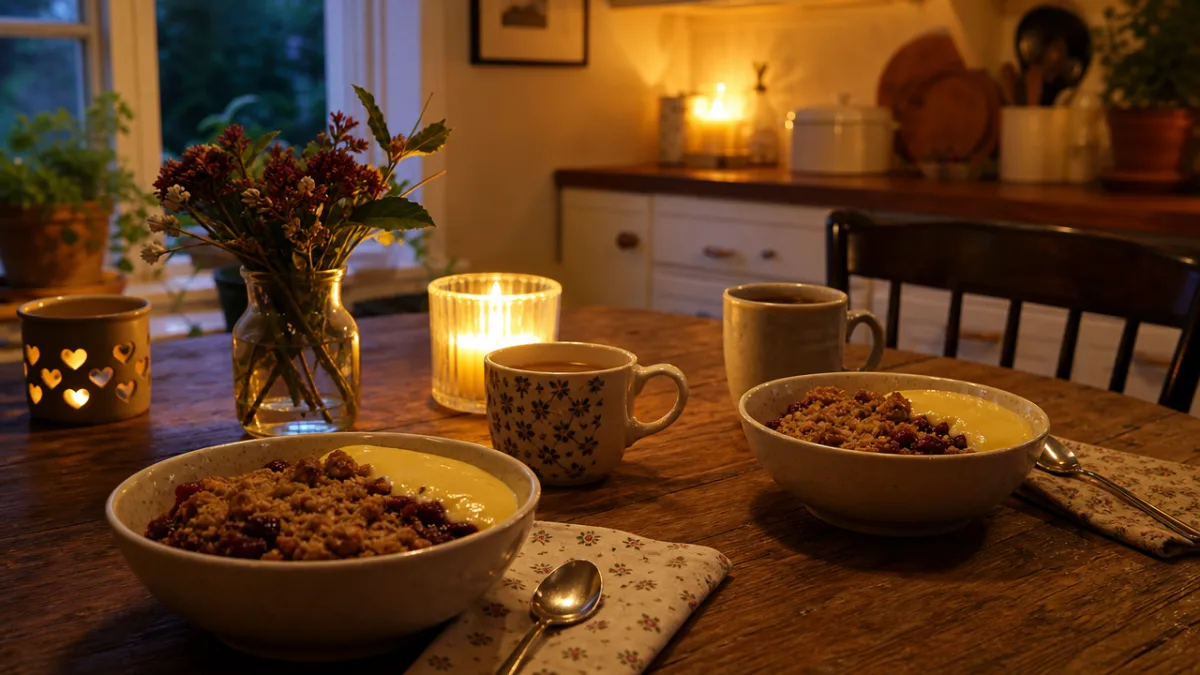
How to serve a crumble is, somewhat unexpectedly, a topic people feel very strongly about. The classic answer is custard — proper, homemade pouring custard made with egg yolks, cream, sugar, and vanilla, brought to just the right consistency and poured generously over the hot crumble at the table. The contrast between cool, flowing custard and a hot, crunchy topping is one of the best textural experiences in British food, and no amount of describing it really does it justice until you’ve actually had it. Making custard from scratch is absolutely worth the effort, though a decent shop-bought version is a perfectly respectable backup.
Double cream and ice cream are the other two camps, and both have their loyal defenders. Cold double cream poured over a hot crumble melts just slightly into the surface of the topping in a way that’s quietly excellent. Clotted cream, if you can get hold of it, is richer still and tips the whole thing into something genuinely decadent. Vanilla ice cream operates on a different principle — the hot-and-cold contrast is dramatic and immediately satisfying, and vanilla is neutral enough to work with basically any fruit filling without competing with it. Crème fraîche is the more modern option, and its slight tartness is particularly good with sweeter fruit combinations that need a little balancing out.
One of crumble’s many practical virtues is that it keeps well. Leftovers will hold in the fridge for up to three days and reheat nicely in the oven — the microwave works too, though it will soften the topping. A lot of experienced crumble makers will tell you it’s actually better the next day, once the fruit juices have had time to soak up into the base of the topping and add another layer of flavour and texture. It also freezes beautifully, before or after baking, which makes it ideal for batch cooking. A frozen, unbaked crumble that goes straight from freezer to a preheated oven turns out almost indistinguishable from a freshly assembled one — which makes it one of the best desserts there is for last-minute entertaining.
The Crumble as Cultural Comfort
It would feel wrong to write about crumble purely in terms of technique without acknowledging what it actually means to people. For a huge number of families across Britain and beyond, crumble isn’t just a dessert — it’s a memory. It’s the pudding that appeared every Sunday afternoon throughout childhood, always made in the same old ceramic dish, always smelling of cinnamon and warm sugar. It’s what grandmothers made when the apple tree in the garden produced more fruit than anyone could eat. It’s what gets cooked when someone is ill, or grieving, or just really needs something warm and uncomplicated to hold onto.
That emotional dimension is part of why crumble has held its place in popular affection even as food culture has become dramatically more sophisticated and globally diverse. At a time when restaurant menus push into increasingly intricate territory and food media celebrates technical precision and avant-garde presentation, the crumble just quietly refuses to play along. It’s simple, visually humble, and honest in a way that more elaborate dishes sometimes aren’t. Eating a crumble is a small act of self-permission — permission to want something ordinary, to find pleasure in the unpretentious, to be comforted without any fuss.
That’s probably why it has survived every culinary trend that’s swept through British food since the 1940s. Nouvelle cuisine in the 70s and 80s dismissed it as heavy and old-fashioned. Pacific Rim fusion came and went. Molecular gastronomy had its moment. None of it touched the crumble, because the crumble was never trying to compete. It just kept doing what it does: asking nothing of the person eating it except appetite and a willingness to be comforted, and offering in return something that technically impressive dishes often can’t quite manage — the feeling of being genuinely, unconditionally at home.








What do you think?
It is nice to know your opinion. Leave a comment.