










Meditation Candles: A Complete Guide to Illuminating Your Practice
The Ancient Connection Between Candlelight and Meditation
For thousands of years, flames have served as focal points for human contemplation and spiritual practice. Long before electricity transformed the modern world, candlelight was the primary companion of those who sought stillness and inner reflection. Across virtually every major spiritual tradition — from Buddhist monasteries in Tibet to Catholic cathedrals in medieval Europe, from Vedic fire rituals in ancient India to Jewish Shabbat ceremonies — the act of lighting a flame has been understood as something far more than a practical necessity. It is a threshold, a signal to the mind and body that a different quality of attention is being invited.
The psychological power of a flame is not merely symbolic. Neuroscience has begun to validate what contemplatives have long known intuitively: watching a candle flame engages the brain’s default mode network in a way that is distinct from ordinary visual stimulation. The gentle, irregular movement of a flame — never exactly repeating, always subtly alive — provides what researchers sometimes call “soft fascination,” a state in which attention is held lightly rather than gripped tightly. This is precisely the quality of awareness that meditation traditions describe as the goal of practice. The flame, in other words, teaches the mind how to meditate simply by being itself.
Understanding this ancient relationship helps us appreciate why the resurgence of interest in meditation candles in contemporary wellness culture is not merely a trend. It represents a rediscovery of something genuinely useful. When people reach for a candle before sitting down to meditate, they are participating in an unbroken lineage of human beings who found that a small, quiet light could help them find a small, quiet place within themselves. That continuity across time and culture speaks to something real about the human nervous system and its response to gentle, living light.
Choosing the Right Candle for Your Meditation Practice
Not all candles are created equal when it comes to supporting a meditation practice, and the differences between them matter more than many beginners realize. The first consideration is material. Paraffin candles, which are derived from petroleum byproducts, release a range of volatile organic compounds when burned, including benzene and toluene at higher temperatures. In a meditation space — typically a small, enclosed room where you may be sitting for extended periods with focused attention on your breath — air quality is not a trivial concern. For this reason, many practitioners prefer candles made from beeswax, soy wax, or coconut wax, all of which burn more cleanly and produce significantly less soot and chemical byproduct.
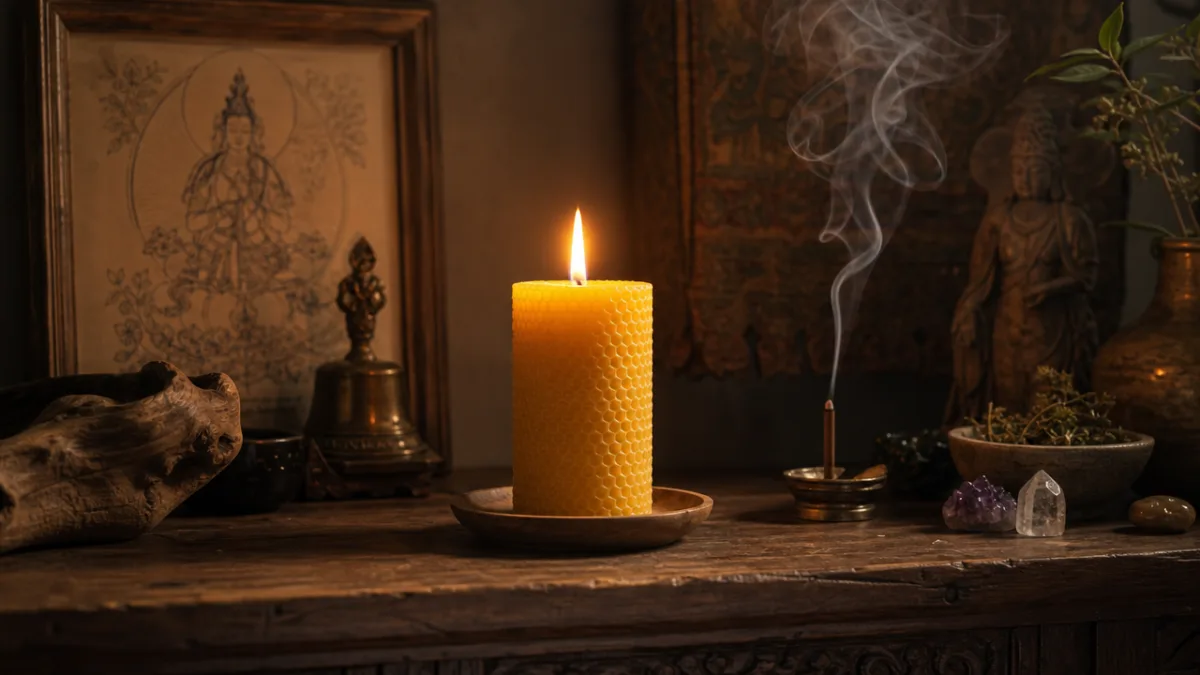
Beeswax candles hold a particularly special place in the meditation tradition. They burn longer and brighter than most alternatives, and they release a faint, natural honey scent that many people find grounding without being distracting. More remarkably, beeswax candles are said to emit negative ions when burned, similar to those produced by waterfalls and ocean waves, which may help neutralize pollutants in the air and promote a sense of calm alertness. Whether or not the ion research fully holds up to scrutiny, the subjective experience of burning high-quality beeswax in a quiet room is noticeably different from burning a standard paraffin candle, and that difference is worth taking seriously.
The physical form of the candle also matters. Pillar candles offer stability and a long burn time, making them suitable for extended practice sessions. Taper candles, with their elegant vertical flame, are particularly effective for trataka, the traditional yogic practice of candle-gazing. Tea lights are convenient for creating atmosphere and are easy to extinguish and replace. Jar candles contain the wax and reduce the risk of drips, making them practical for everyday use. Consider your specific practice style, the length of your typical sessions, and the physical setup of your meditation space when selecting a candle form that will genuinely serve you rather than simply look appealing.
The Role of Scent: Aromatherapy and Meditation Candles
Scent is the most direct of all the senses, traveling via the olfactory nerve to the limbic system — the brain’s emotional and memory center — without passing through the cortical processing that mediates our experience of sight and sound. This neurological shortcut means that a carefully chosen scent can shift your mental and emotional state more quickly and reliably than almost any other environmental cue. When a scented candle is lit at the beginning of a meditation session, the brain begins to associate that particular fragrance with the internal state of practice. Over time, simply smelling that scent can begin to induce the neurological conditions associated with meditation, making it a genuinely powerful tool for those who practice consistently.
Different essential oil profiles serve different aspects of meditation practice. Lavender and chamomile are widely recognized for their calming, anxiety-reducing properties, making them excellent choices for practitioners who struggle with stress or racing thoughts at the start of a session. Frankincense has been used in sacred contexts for millennia and has a peculiar ability to deepen the breath and quiet mental chatter — modern research has identified a compound in frankincense called incensole acetate that may have direct psychoactive effects on the brain’s ion channels. Sandalwood is grounding and earthy, particularly useful for practitioners who feel scattered or anxious. Eucalyptus and peppermint can promote alertness, which makes them better suited to morning practice or to those whose challenge is not agitation but sleepiness.
A word of caution is important here. Many commercially available scented candles use synthetic fragrance oils rather than genuine essential oils. Synthetic fragrances can contain hundreds of undisclosed chemical compounds, many of which are not tested for long-term inhalation safety, and they typically lack the therapeutic properties of their natural counterparts. When selecting a scented meditation candle, look for products that specify the use of pure essential oils and that disclose their fragrance ingredients. The price difference between a quality naturally scented candle and a synthetic alternative can be significant, but when you consider that you will be breathing the air around that candle for twenty to sixty minutes at a stretch, the investment in quality becomes easier to justify.
Color Psychology and the Visual Environment of Meditation
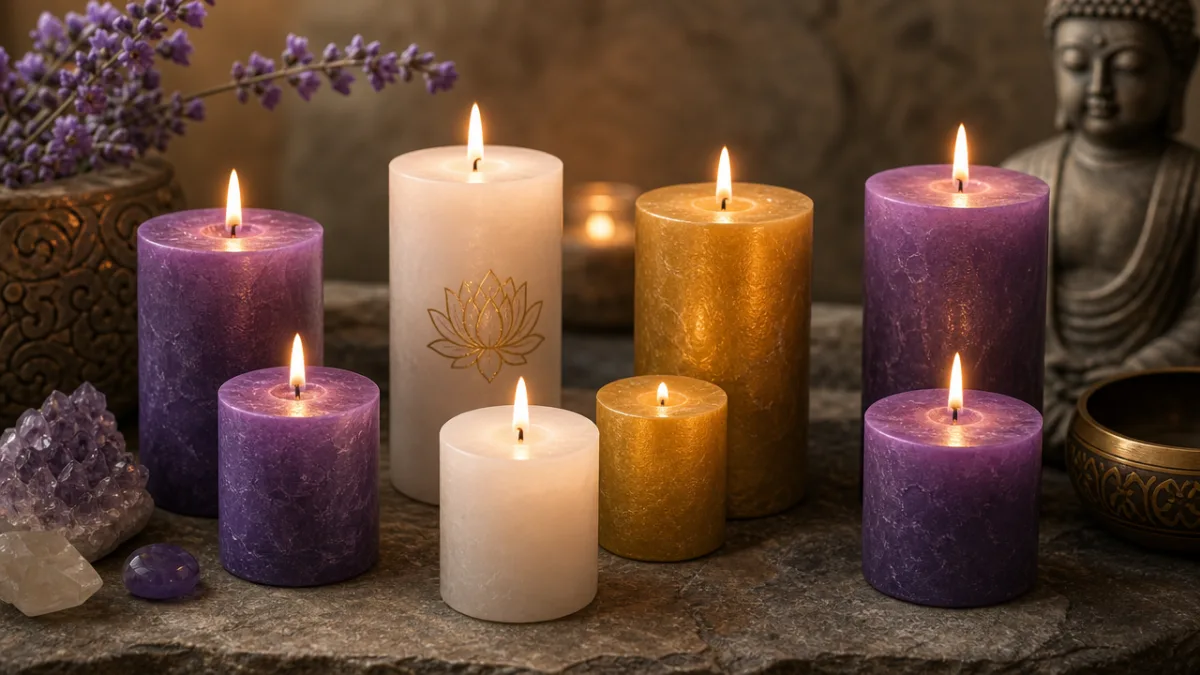
The color of a candle’s wax and flame contributes meaningfully to the visual environment of your practice space, and color psychology offers useful guidance for those who wish to be intentional about this dimension of their setup. White candles are perhaps the most universally recommended for meditation, representing clarity, purification, and open awareness. A white candle makes no particular claim on your attention or emotional state; it simply offers light. For practitioners who prefer a clean, uncluttered approach to their practice, white is an excellent default choice that works across different styles of meditation and different times of day.
Beyond white, the color spectrum of candles maps interestingly onto different intentions and practices. Blue candles — particularly deep indigo or cerulean shades — are associated with calm, communication, and depth of awareness, making them popular choices for practitioners who work with visualization or mantra. Purple candles evoke spiritual connection and are often used in traditions that emphasize the transcendent dimensions of practice. Green candles carry associations with healing, balance, and the natural world, and they can be particularly supportive for practices focused on the heart center or loving-kindness meditation. Gold and amber candles bring warmth and abundance, and their light has a particular quality that feels celebratory and generous.
The interaction between candle color and the overall color palette of your meditation space is worth considering as well. A single white candle in a room with warm ochre walls will cast a different quality of light than the same candle in a room with cool gray tones. Darker colored candles absorb and reflect light differently from light-colored ones, and the visual warmth of the overall environment can significantly affect your capacity to settle into stillness. Many experienced practitioners recommend keeping the meditation space itself relatively neutral in color, so that the candle — whatever its color — can function as a clear focal point rather than one element competing for attention among many. The simplicity of the environment supports the simplicity of mind that meditation cultivates.
Practical Techniques: Using Candles as Meditation Objects
One of the most direct ways to incorporate a candle into meditation practice is through the ancient technique known in Sanskrit as trataka, which translates roughly as “steady gaze.” In this practice, the meditator sits comfortably at a distance of roughly two to three feet from a lighted candle, positioned so that the flame is approximately at eye level. The eyes remain softly open and fixed on the tip of the flame — specifically, the brightest point just above the wick. The gaze is held steady but not strained, with blinking minimized but not forcibly suppressed. The aim is not to stare aggressively but to maintain a quality of easy, unwavering attention, allowing the mind to be drawn into the flame rather than reaching out toward it.
Trataka is traditionally said to strengthen the eyes, sharpen concentration, and develop the capacity for one-pointed attention that supports deeper meditation. After gazing at the flame for several minutes, the practitioner closes their eyes and attempts to hold the afterimage of the flame in the space between the eyebrows, at what many traditions call the third eye center. This inner flame then becomes the object of meditation, with the practitioner resting their awareness on it as it gradually fades. The practice bridges outer and inner experience in a beautifully direct way, using the external candle as a doorway to internal visualization. Many practitioners find that consistent trataka practice improves their ability to concentrate in all forms of meditation, not only candle-based techniques.
Beyond trataka, candles can serve as simple ambient supports for other meditation styles. In breath-focused practices such as vipassana or mindfulness meditation, the soft light of a candle creates a contained, warm visual field that encourages the practitioner to turn inward. In mantra practice, glancing occasionally at a candle’s steady flame can help re-anchor the attention when the mind wanders. For body scan practices or yoga nidra, a candle lit in the room and then moved out of the direct line of vision provides a felt sense of warmth and presence without demanding visual attention. There is no single correct way to use a candle in meditation — the key is intentionality, bringing the same quality of awareness to the ritual of lighting and the act of attending to the flame that you bring to every other dimension of your practice.
Creating a Sacred Space: Setting Up Your Candle Altar
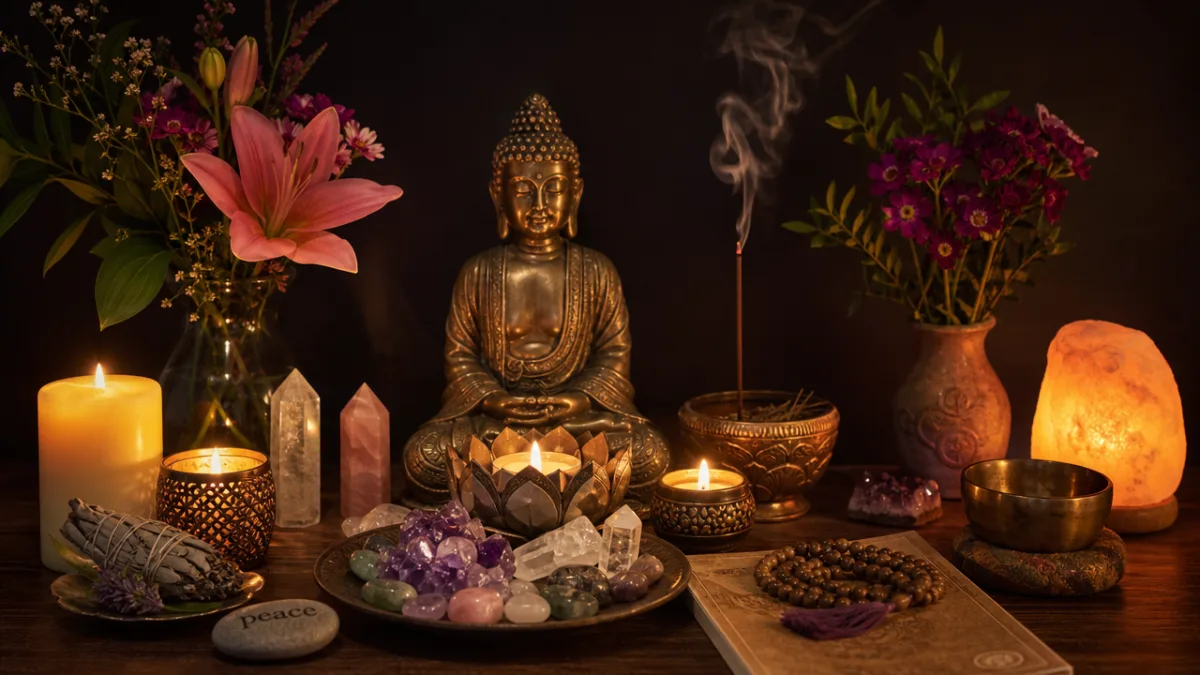
The concept of a dedicated meditation space, however modest, is recognized across contemplative traditions as a powerful support for practice. When we return repeatedly to the same physical location with the same intention, the space itself begins to carry a quality of stillness that makes it easier to settle into practice. The arrangement of objects within that space — including candles — functions as a visual reminder of what the space is for and what qualities of mind and heart we are cultivating. Creating even a simple candle altar does not require elaborate resources or a large amount of room; a single candle on a small shelf, placed with care and returned to consistently, can serve the purpose fully.
When setting up a candle altar, the following elements are worth considering as companions to your primary candle or candles. A natural surface — wood, stone, or ceramic — grounds the altar energetically and practically, providing a stable, heat-resistant base. Fresh flowers or a small plant introduce the living quality of nature and are regularly refreshed, keeping the altar from becoming stale or static. A meaningful object, such as a small statue, a crystal, a photograph, or a natural item collected on a meaningful walk, provides a personal anchor and reminds the practitioner of their deeper intention. Incense, if used, should be placed to one side rather than directly in front of the candle, so that neither the flame nor the smoke interferes with the other.
Safety is an aspect of altar setup that deserves explicit attention rather than being taken for granted. Candles should always be placed on stable, non-flammable surfaces, well away from curtains, cushions, or any other flammable material. They should never be left burning unattended, and they should be extinguished before leaving the room or ending a session. A candle snuffer — a small bell-shaped metal cap on a handle — is preferable to blowing out the flame, both because it preserves the integrity of the wick and because the simple act of snuffing a flame carries a quality of gentle closure that reinforces the intentionality of the practice. These practical measures are themselves expressions of the mindful awareness that meditation is designed to cultivate.
- Choose a stable, dedicated surface at a height that places the flame at or slightly below eye level when seated.
- Keep the area clear of flammable materials within at least twelve inches of any burning candle.
- Use a candle snuffer rather than blowing out the flame to close your session with intention.
- Refresh the space regularly by replacing flowers, clearing dust, and occasionally rearranging objects to keep attention fresh.
- Store candles properly away from direct sunlight and heat to preserve the integrity of both wax and fragrance.
Deepening Your Practice: Candle Rituals and Intentions
The act of lighting a candle at the beginning of a meditation session need not be merely mechanical. Many practitioners find that transforming this simple act into a brief ritual significantly enhances the quality of their practice. Before striking the match or touching a lighter to the wick, take a moment to settle into stillness. Take three deliberate breaths, feeling the weight of the body and the support of the ground beneath you. Then, as you light the candle, hold in mind a clear intention for your practice — not a goal to achieve or a problem to solve, but a quality you are cultivating or an offering you are making. This might be as simple as an intention to be present, to cultivate kindness, or to practice with greater consistency and care.
Working with intentions in candle meditation connects individual practice to a wider tradition of dedication. In many Buddhist and Hindu traditions, meritorious actions — including meditation — are formally dedicated to the benefit of all beings rather than kept for the practitioner alone. This gesture of opening the fruits of practice outward is understood not as self-diminishment but as a practice of generosity that actually deepens the meditation by releasing the grasping quality that can otherwise infect even spiritual practice. Lighting a candle for someone who is suffering, or in memory of someone who has died, is a small and beautiful way of embodying this spirit of dedication. The candle becomes a physical expression of the practitioner’s care, burning steadily in the world on behalf of another.
As your meditation practice matures and deepens over weeks, months, and years, your relationship with candles as practice tools will likely evolve as well. What begins as a simple atmospheric aid may gradually become a genuine focus of contemplation, a teaching in itself. The flame offers endless material for reflection: its dependence on fuel and air, its capacity to light other flames without diminishing itself, its steady burning in the face of surrounding darkness, its inevitable extinguishing when conditions no longer support it. These are not merely poetic observations but genuine invitations to inquiry, the kind of sustained attention to immediate reality that lies at the heart of contemplative practice in every tradition. A candle, approached with sufficient care and curiosity, is not simply a support for meditation — it is meditation, offered in light.








What do you think?
It is nice to know your opinion. Leave a comment.