










The Joy of Crocheting Graduation Toys: A Heartfelt Handmade Tradition
Graduation is one of life’s most significant milestones, a moment that deserves to be celebrated with something truly special and personal. While store-bought gifts are convenient, a handmade crochet graduation toy carries a warmth and intentionality that no mass-produced item can replicate. Whether you’re crafting for a kindergarten graduate or a doctoral student crossing the stage, a crocheted keepsake communicates love, effort, and thoughtfulness in every single stitch. These toys become treasured mementos that graduates often keep for years, tucked on a shelf or displayed proudly as a reminder of their hard work and the people who cheered them on.
The tradition of handcrafting gifts for celebrations has deep roots across cultures, and crochet in particular has experienced a remarkable renaissance in recent years. Younger generations have embraced the craft with enthusiasm, discovering that working with yarn and a hook is both meditative and productive. Graduation crochet toys sit at the intersection of this renewed interest in handmade goods and the timeless desire to mark important life transitions with something meaningful. Free patterns have made it easier than ever for crafters of all skill levels to participate in this tradition without needing advanced techniques or expensive materials.
What makes graduation-themed crochet toys especially delightful is the incredible variety of designs available. From adorable amigurumi owls wearing tiny mortarboards to miniature bears clutching rolled-up diploma scrolls, designers have poured tremendous creativity into this niche. A quick search online reveals a thriving community of pattern creators who share their work freely, enabling anyone with basic crochet skills to produce something genuinely impressive. This article explores fifteen of the most charming free patterns available, organized by skill level, style, and the type of graduate they best suit, so you can find the perfect project for your next celebration.
Why Crochet Toys Make Perfect Graduation Gifts
A crochet toy occupies a unique space in the world of gifts because it is simultaneously functional, decorative, and deeply personal. Unlike a gift card or a generic figurine, a handmade toy tells a story about the maker’s relationship with the recipient. The hours spent selecting yarn colors, following a pattern, and weaving in ends all represent a deliberate investment of time — something increasingly rare in our fast-paced digital world. For a graduate who has spent years pouring effort into their studies, receiving a gift that reflects equal dedication from someone they love can be profoundly moving.
There is also a wonderful practical dimension to crochet graduation toys that extends beyond sentimentality. Many graduates, particularly those heading off to college dorms or first apartments, appreciate having a small, lightweight keepsake that doesn’t take up much space but still makes their new environment feel like home. A small crocheted owl or bear sitting on a desk or bookshelf serves as a gentle daily reminder of family, achievement, and the support system waiting back home. For younger graduates like preschoolers or kindergarteners, these toys double as beloved stuffed animals that see years of play and comfort.
From a crafter’s perspective, graduation toys offer the satisfying challenge of incorporating themed elements — caps, tassels, tiny diplomas, academic robes — into classic amigurumi construction. This creative constraint pushes makers to think carefully about color choices, proportion, and embellishment, resulting in pieces that are genuinely impressive to behold. Many crafters find that graduation season inspires some of their best work precisely because the occasion demands something special. The process itself becomes a form of celebration, a way of participating in the graduate’s achievement through the quiet, focused work of the hands.
Beginner-Friendly Graduation Crochet Patterns Worth Trying
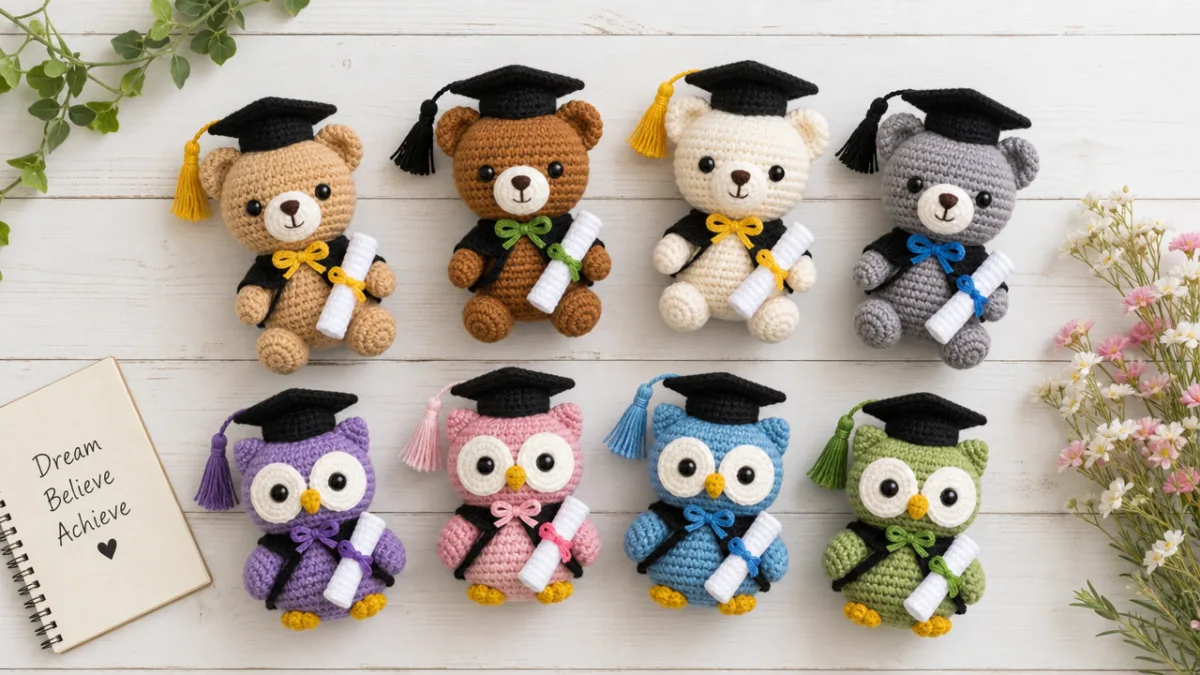
For those new to crochet or amigurumi, the prospect of crafting a graduation toy might seem daunting, but many designers have specifically created patterns accessible to beginners. These patterns typically use simple geometric shapes — spheres, cylinders, and flat circles — combined in clever ways to produce recognizable characters. The basic graduation bear, for instance, involves nothing more complex than a round head, oval body, simple limbs, and a flat cap made from a circle and a short cylinder. With worsted weight yarn and a 4mm hook, even a crafter who learned to crochet only weeks ago can produce a charming result.
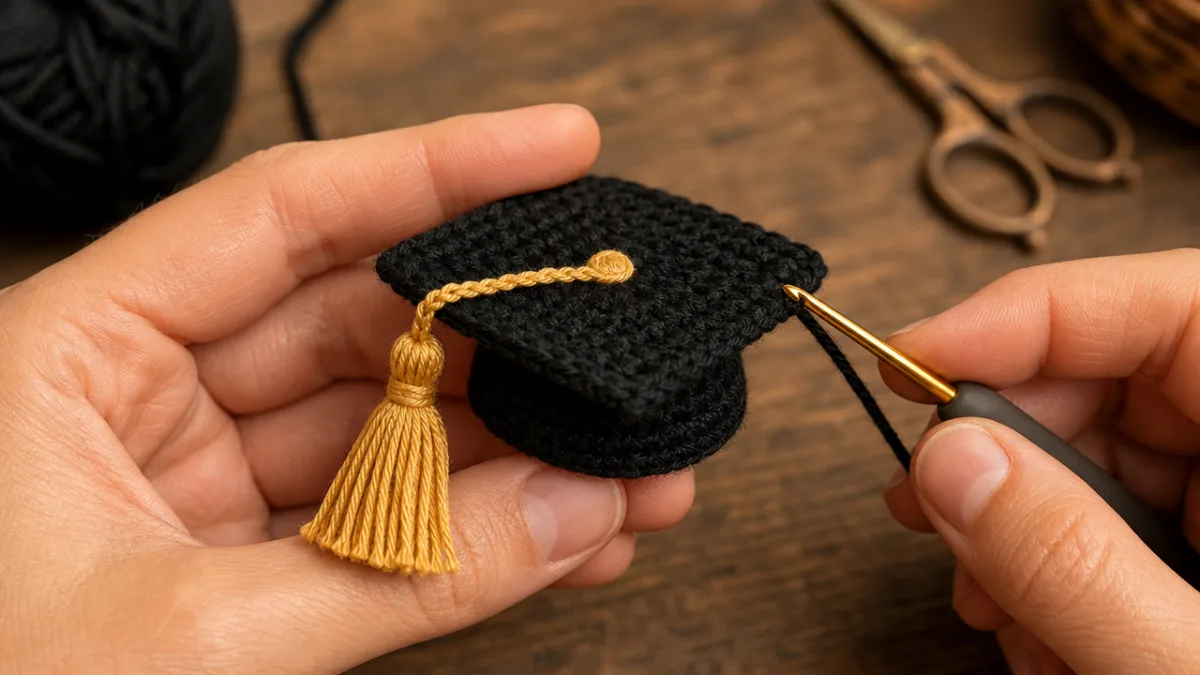
One of the most popular beginner graduation patterns features a simple round owl with big button eyes, wearing a miniature graduation cap with a dangling tassel made from cut yarn. The owl body is worked in continuous rounds — one of the most fundamental amigurumi techniques — and the cap is added as a separate piece that gets sewn on at the end. Designers often include step-by-step photo tutorials alongside these patterns, making it easy to follow along even when written pattern notation feels confusing. Several versions of this owl pattern exist in the free pattern community, each with slightly different sizing and embellishment options.
Another excellent beginner option is the graduation duck, a perennial favorite that can be customized in school colors to make it feel even more personal. The body and head are simple spheres worked in yellow or white yarn, with small wings, a flat beak, and tiny webbed feet added as afterthoughts. The graduation cap, worked in black yarn, completes the look with delightful effect. What makes this pattern particularly friendly for beginners is that slight imperfections in the shaping actually add to the charm rather than detracting from it — a slightly lopsided duck wearing a graduation cap is, if anything, even more endearing than a perfectly symmetrical one.
Simple Techniques That Elevate Beginner Projects
Even beginner crafters can incorporate a few simple techniques that elevate their graduation toys from charming to truly impressive. Safety eyes, available at craft stores and online retailers, give amigurumi a professional finish that hand-embroidered eyes sometimes lack, especially for those still developing their embroidery skills. Choosing safety eyes in a size proportional to the toy’s head — typically 9mm to 12mm for small toys — makes an enormous difference in the final appearance. Many free patterns specify eye size, but crafters should feel empowered to adjust based on their preference and the yarn weight they’re using.
Stuffing technique also plays a significant role in the quality of finished graduation toys. Polyfill stuffing is the standard choice, but the amount and distribution matter greatly. Under-stuffed toys look deflated and sad, while over-stuffed ones become misshapen and tight. The goal is a firm but slightly yielding finish that holds the toy’s shape while still feeling pleasant to handle. Some experienced crafters add a small handful of plastic pellets at the base of seated toys to improve stability, a trick that works especially well for graduation bears or cats that are meant to sit upright on a shelf or desk.
Color selection is perhaps the most powerful tool available to the beginner crafter working on graduation toys. Most free patterns are written in generic colors, but substituting the graduate’s actual school colors transforms a generic pattern into an unmistakably personal gift. A bear worked in crimson and white for a Harvard graduate communicates something very different from the same pattern worked in blue and gold for a UCLA alum. Taking a few minutes to research school colors before starting a project is well worth the effort, and many yarn brands offer extensive color palettes that make finding close matches surprisingly easy.
Intermediate Graduation Patterns for More Ambitious Crafters
Once a crafter has mastered the basics of amigurumi construction, a whole new world of graduation toy patterns becomes accessible. Intermediate patterns typically introduce elements like jointed limbs that allow for poseable characters, more complex facial features including open mouths and dimensional noses, and multi-piece outfits that can be removed or changed. A graduation bear with a removable cap and gown, for example, requires careful attention to sizing and proportion but produces a genuinely heirloom-quality piece that graduates of any age will treasure. These patterns reward the extra time and care they demand.
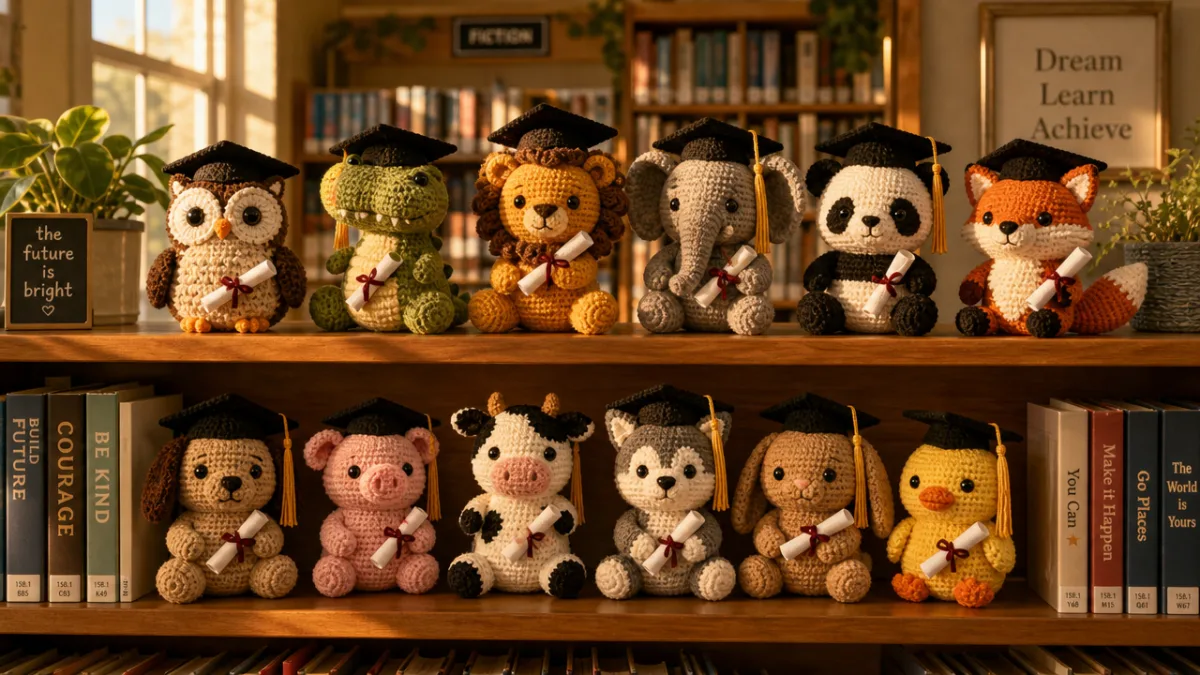
One standout intermediate pattern in the free crochet community features a graduation mouse complete with a tiny rolled diploma tied with a ribbon. The mouse body uses classic amigurumi construction, but the addition of wire-supported ears that can be shaped and positioned, along with a long crocheted tail that curves naturally, pushes it into intermediate territory. The diploma is a tiny masterpiece of its own — a small rectangular piece of white yarn worked in rows, rolled and secured with a thin length of satin ribbon in the graduate’s school color. This detail alone often prompts gasps of delight when the gift is unwrapped.
The graduation lion is another beloved intermediate pattern, featuring a dimensional mane worked in loop stitches or cut yarn fringe that surrounds the face. Lions have long been popular graduation motifs because of their association with pride, courage, and achievement — all qualities worth celebrating at this life milestone. The mane construction, which involves either a separate ring of loops that gets sewn around the face or individual strands of yarn knotted through finished stitches, takes some patience but produces a stunning result. Several designers offer free versions of this pattern, with variations ranging from realistic to whimsically cartoonish.
Adding Custom Details to Intermediate Patterns
Intermediate crafters have the skills to add meaningful custom details that transform a standard pattern into something unique. Embroidering the graduate’s name, graduation year, or a tiny “#1” on the toy’s gown or body takes only a few extra minutes but personalizes the gift in a way that a purchased item simply cannot match. Chain stitch embroidery in a contrasting yarn color works beautifully for this purpose, and the slight texture of the stitching against the crocheted surface creates a pleasing tactile quality. Some crafters go further, stitching the graduate’s initials in a decorative script that mimics the calligraphy of diplomas.
Miniature accessories offer another avenue for personalization that intermediate crafters can explore. A graduation toy made for a nursing graduate might carry a tiny crocheted stethoscope; one made for an engineering graduate might hold a miniature ruler or calculator. These accessories are typically worked in simple flat pieces using fine yarn or embroidery thread, and while they require some improvisation since few patterns include them, the basic shapes are well within an intermediate crafter’s capabilities. The result is a toy that tells the specific story of this graduate’s achievement rather than celebrating graduation in a generic sense.
Jointing techniques open up wonderful possibilities for intermediate graduation toys as well. Needle jointing, which uses long doll-making needles and button thread to connect limbs through the body, allows bears and other characters to be posed with their arms raised in celebration or their legs crossed in a scholarly seated position. This technique requires some practice to execute neatly, but numerous free video tutorials make it accessible to anyone willing to invest a bit of time. A jointed graduation bear that can be posed and repositioned becomes an interactive keepsake rather than a static one, adding another dimension to the gift’s appeal and longevity.
Advanced Graduation Crochet Toy Patterns for Experienced Makers
For experienced amigurumi makers, the graduation theme opens doors to genuinely complex and ambitious projects that showcase the full range of the craft. Advanced patterns might feature realistic proportions with carefully calculated increases and decreases, full outfits with structural integrity including crocheted graduation gowns with proper drape and fitted sleeves, or elaborate scenes where multiple figures interact on a crocheted base — a classroom setting, a stage with a podium, or a lawn scattered with crocheted flowers in school colors. These projects can take many hours or even weeks to complete, but they produce pieces that are genuinely extraordinary.
One of the most impressive free patterns available for advanced crafters is a graduation octopus, a whimsical design that places a mortarboard atop a round cephalopod head surrounded by eight tentacles, each worked in a different school color. The challenge lies in maintaining consistent tension across all eight tentacles while also building in the subtle curl at the tip of each one — a detail that requires careful attention to decreasing technique. The octopus has become a popular figure in the crochet community generally, partly because of its symbolic resonance: eight arms reaching out in different directions evokes a graduate’s expanding possibilities beautifully.
Advanced crafters with a background in garment construction will find particular satisfaction in creating graduation toys with fully realized textile outfits. A graduation bear dressed in a miniature version of the recipient’s actual school regalia — correct hood colors for their degree, accurate gown styling — requires research as well as technical skill, since academic dress varies considerably by institution and degree level. Some crafters use this as an opportunity to practice colorwork techniques, working small bands of pattern into the gown that echo the graduate’s school crest or motto. These deeply researched, technically accomplished pieces represent the highest expression of the graduation crochet toy tradition.
Designing Your Own Graduation Toy Pattern
Experienced crafters who have worked through many existing patterns often reach a point where they want to create their own graduation toy designs from scratch. Pattern design begins with a concept sketch and a clear understanding of the proportions desired, followed by swatching to determine gauge with the chosen yarn and hook combination. Most amigurumi designers work from a basic head circumference and then calculate all other measurements as proportions of that figure — body length might be 80% of head circumference, limb length might be 60%, and so on. These ratios, once internalized through practice, make the initial pattern drafting process much faster.
Writing the pattern clearly enough for others to follow is a skill unto itself, distinct from the construction skills required to make the toy. Good amigurumi patterns specify stitch counts at the end of every round, use consistent abbreviations defined at the pattern’s beginning, and include notes about any tricky transitions or techniques that might catch a less experienced maker off guard. Pattern testing — recruiting a small group of other crafters to work through the written instructions and provide feedback — is an essential step before sharing a pattern publicly, as errors that seem obvious to the designer often become serious stumbling blocks for testers approaching the pattern fresh.
The free pattern community is extraordinarily generous, and many designers who develop original graduation toy patterns choose to share them without charge, contributing to the rich ecosystem of resources that benefits crafters at every level. Platforms like Ravelry, Etsy’s free download section, and personal craft blogs host thousands of free amigurumi patterns, and submitting an original graduation design to these platforms connects designers with an appreciative global audience. Some designers eventually transition to selling patterns after establishing a following through free offerings, but many continue sharing freely as a way of giving back to the community that taught and inspired them.
Tips for Choosing the Right Pattern for Your Graduate
Selecting the perfect graduation crochet pattern requires thinking carefully about the specific graduate you’re celebrating and what will resonate most deeply with them. Age is an obvious consideration — a kindergarten graduate will be delighted by a brightly colored simple bear or duck, while a college graduate might appreciate something more sophisticated and symbolically resonant. But personality matters just as much as age. A science graduate who loves astronomy might treasure a crocheted rocket ship or planet wearing a graduation cap far more than a conventional bear, even if they’re the same age as a classmate who would prefer the classic option.
The time available before the graduation ceremony is another practical consideration that significantly shapes pattern choice. If you have several weeks, an ambitious intermediate or advanced pattern is entirely achievable with consistent daily work sessions. If you’re starting two or three days before the event, however, a beginner-friendly pattern that can be completed in a few hours is the wiser choice. A beautifully executed simple bear will always outshine a rushed and imperfect complex one, so honest self-assessment about available time is an important part of the selection process. Many experienced crafters keep a small stash of simple graduation patterns on hand precisely for these last-minute occasions.
Yarn availability and budget are also worth considering when choosing a pattern. Most graduation toys use relatively small amounts of yarn — often less than a single skein — which means that crafters can splurge on nicer fibers without breaking the bank. A small graduation bear made in soft merino wool or bamboo blend yarn has a luxurious feel and appearance that acrylic cannot quite replicate, and the difference is immediately apparent when the gift is received. That said, high-quality acrylic yarns like those in premium lines from major yarn brands are entirely appropriate for graduation toys and offer the significant practical advantage of being machine-washable, which matters if the graduate has young children or pets in their household.
Finishing and Presenting Your Crochet Graduation Gift
The presentation of a handmade crochet graduation toy deserves as much thought as the making itself. A beautifully crafted toy presented in a crumpled plastic bag sends a very different message than the same toy nestled in tissue paper inside a thoughtfully chosen gift box. Many crafters attach a small tag to their finished toys noting the yarn content — important information for anyone with fiber allergies — along with a brief personal message. Some go further, writing out the pattern name and any personalizations made, creating a small card that becomes part of the gift’s story and allows the recipient to share details with admirers who inevitably ask about the toy.
Blocking, the process of wetting or steaming a finished piece to even out stitches and improve drape, is a finishing step that many amigurumi makers skip but that can genuinely improve the appearance of larger graduation toys. A light steaming with an iron held a few inches above the surface (never touching directly) evens out any uneven tension and gives the piece a polished appearance. This is particularly effective on flat pieces like graduation caps, which can sometimes come out slightly warped from the construction process. A well-blocked cap sits flat and straight atop the toy’s head rather than tilting at an awkward angle.
Finally, consider adding a small personal touch that connects the toy specifically to the graduate’s journey. A tiny crocheted book in the colors of their favorite subject, a miniature version of their sport equipment if they were an athlete, or even a small heart embroidered in their school’s primary color are all simple additions that transform a beautiful generic gift into a deeply personal one. These finishing touches require only a few extra minutes of work but communicate that you paid attention to who this person is and what their achievement means in the context of their specific life. That attention is, ultimately, what handmade gifts are all about — the evidence of genuine care translated into tangible, enduring form.








What do you think?
It is nice to know your opinion. Leave a comment.