










The Timeless Appeal of Metal Bottle Cap Crafts
Metal bottle caps are one of the most overlooked treasures hiding in plain sight. Every time you crack open a cold beverage, you hold in your hand a tiny disc of stamped steel or aluminum that carries incredible potential for artistic transformation. These humble objects, typically destined for the recycling bin or worse, the landfill, possess a unique combination of durability, texture, and visual character that makes them ideal raw materials for a surprising range of creative projects. The corrugated edges, the printed logos, the metallic sheen — all of these qualities become artistic assets in the hands of a skilled crafter.
The history of bottle cap art stretches back further than most people realize. Almost from the moment crown caps were patented in 1892 by William Painter, collectors and tinkerers began finding uses for them beyond their intended purpose. By the mid-twentieth century, folk artists in Africa, Europe, and the Americas were incorporating bottle caps into sculptures, mosaics, and decorative objects with remarkable sophistication. Today, the tradition continues to evolve, blending historical craft sensibility with contemporary design aesthetics and a growing awareness of the importance of upcycling and sustainable creative practice.
What makes bottle cap crafting particularly accessible is the low barrier to entry. You need no special training, no expensive equipment, and no rare materials to get started. The caps themselves are free if you collect them yourself, or inexpensive if you source them from flea markets, online marketplaces, or fellow hobbyists. A few basic tools — a hammer, some adhesive, a drill or awl for punching holes, and a surface to work on — are all that stand between you and a genuinely stunning handmade creation. This accessibility is precisely why bottle cap art has such a devoted global community of practitioners at every skill level.
Essential Tools and Materials for Getting Started
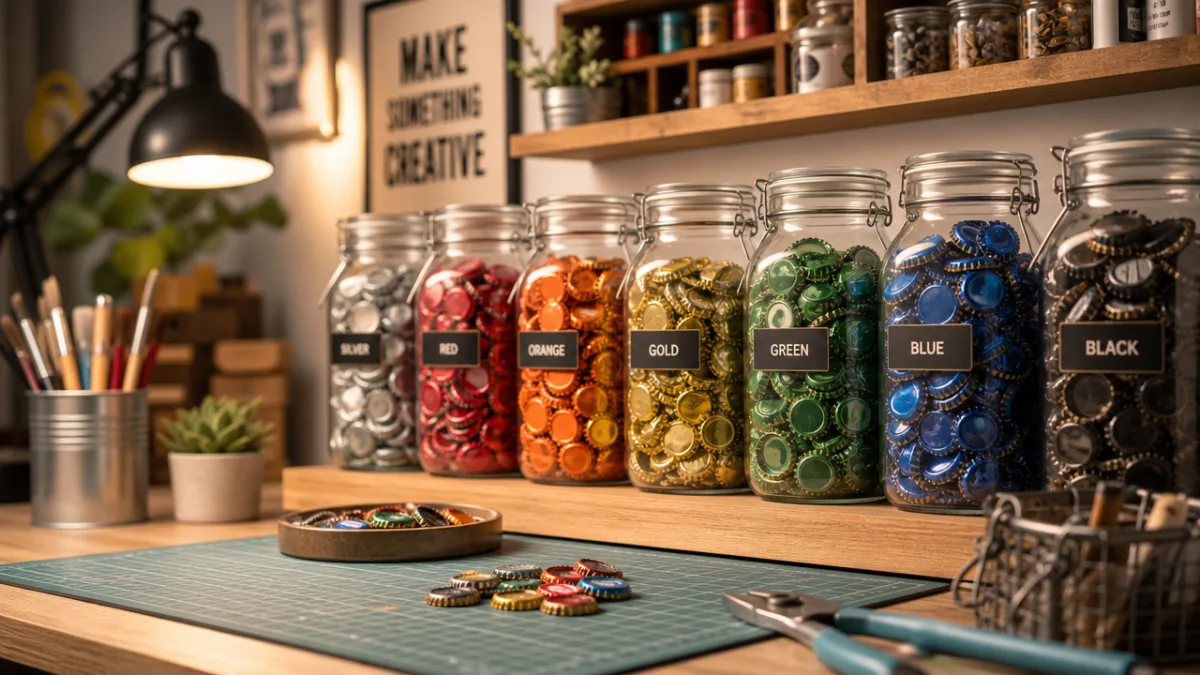
Before diving into specific projects, it pays to build a solid foundation of tools and materials that will serve you across multiple crafts. A sturdy work surface is your first consideration — a self-healing cutting mat or a piece of thick plywood will protect your table and give you a reliable base for hammering, gluing, and drilling. You will also want a set of needle-nose pliers for bending and shaping caps, a center punch or awl for creating holes without cracking the metal, and a rubber or wooden mallet for flattening caps when your project requires a smooth, even disc rather than the natural domed shape.
Adhesives deserve special attention because bottle caps present unique bonding challenges. The smooth, painted metal surface does not grip glue the way porous materials like wood or fabric do, so you need products designed for metal-to-metal or metal-to-other-surface bonding. Two-part epoxy adhesives provide the strongest permanent bonds and are ideal for mosaic work and sculptural pieces that will be handled or displayed outdoors. For lighter applications like picture frames or shadow boxes, a strong cyanoacrylate gel works well. If you plan to incorporate caps into resin projects, no adhesive is needed at all — the caps simply suspend beautifully within the poured resin itself.
Building your cap collection strategically will save time and expand your creative options considerably. Rather than accepting whatever caps come your way, consider organizing a targeted collection effort focused on color families, brand designs, or metallic finishes. Certain craft beer brands produce caps with particularly vivid lithographic printing, while mass-market soda caps often come in bold, high-contrast color schemes that work well for mosaic borders and geometric patterns. Vintage caps sourced from antique stores carry an aged patina and nostalgic graphic design language that adds tremendous character to any project. Storing your collection sorted by color in clear containers makes design work faster and more intuitive.
- Two-part epoxy or strong cyanoacrylate gel adhesive for permanent bonding to metal surfaces
- Center punch or leather awl for creating clean holes without splitting the cap
- Needle-nose pliers for bending, shaping, and curling cap edges
- Rubber or wooden mallet and a flat steel block for pressing caps completely flat
- Clear casting resin for embedding projects and jewelry applications
- Sandpaper in multiple grits for roughing metal surfaces before gluing
- Wire cutters and 20-gauge craft wire for linking and assembling multi-cap pieces
Creating Stunning Bottle Cap Mosaics
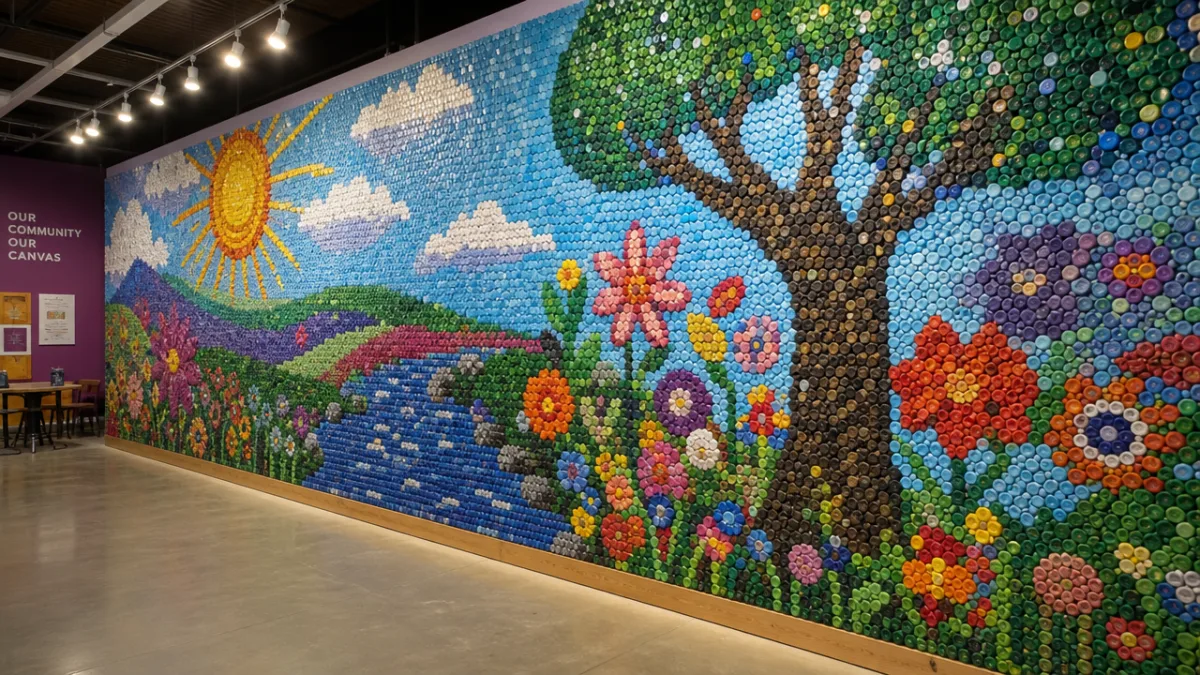
Mosaic work is arguably the most visually impactful application for bottle cap art, and it scales beautifully from small decorative panels to large wall installations. The basic principle is identical to traditional tile mosaic: you are creating an image or pattern by assembling many small, colored units into a coherent composition. Bottle caps, however, bring several advantages over ceramic or glass tiles. Their uniform circular shape creates a naturally rhythmic, almost pixelated quality that gives bottle cap mosaics a distinctive visual texture unlike anything achievable with conventional mosaic materials. The slight dome of an unflattened cap also catches light dynamically, making the finished piece appear to shift and shimmer as the viewer moves.
Planning your mosaic design before touching a single cap is time well invested. Working from a printed or gridded reference image, map out your color zones and identify which caps from your collection correspond to each area. Simple, graphic subjects — portraits with high contrast, bold geometric abstractions, landscapes with clearly defined sky and ground planes — translate most effectively into bottle cap mosaic. Avoid designs with extremely fine detail or subtle gradients, as the relatively large size of each cap unit limits resolution. A design that reads beautifully at arm’s length and reveals its fascinating material texture up close is the sweet spot to aim for.
The substrate you choose for your mosaic will affect both the construction process and the finished look significantly. Exterior-grade plywood, sealed with primer, is the most popular choice because it is lightweight, easy to cut to any shape, and accepts both adhesive and hanging hardware reliably. MDF board offers an even smoother surface and is ideal for indoor pieces, though it is heavier and less moisture-resistant. For smaller decorative pieces, repurposed wooden frames, trays, and serving boards make excellent ready-made substrates that add their own rustic charm to the finished work. Whatever base you choose, lightly sand the surface and wipe it clean before applying any adhesive to ensure the caps bond securely.
Jewelry and Wearable Art from Bottle Caps
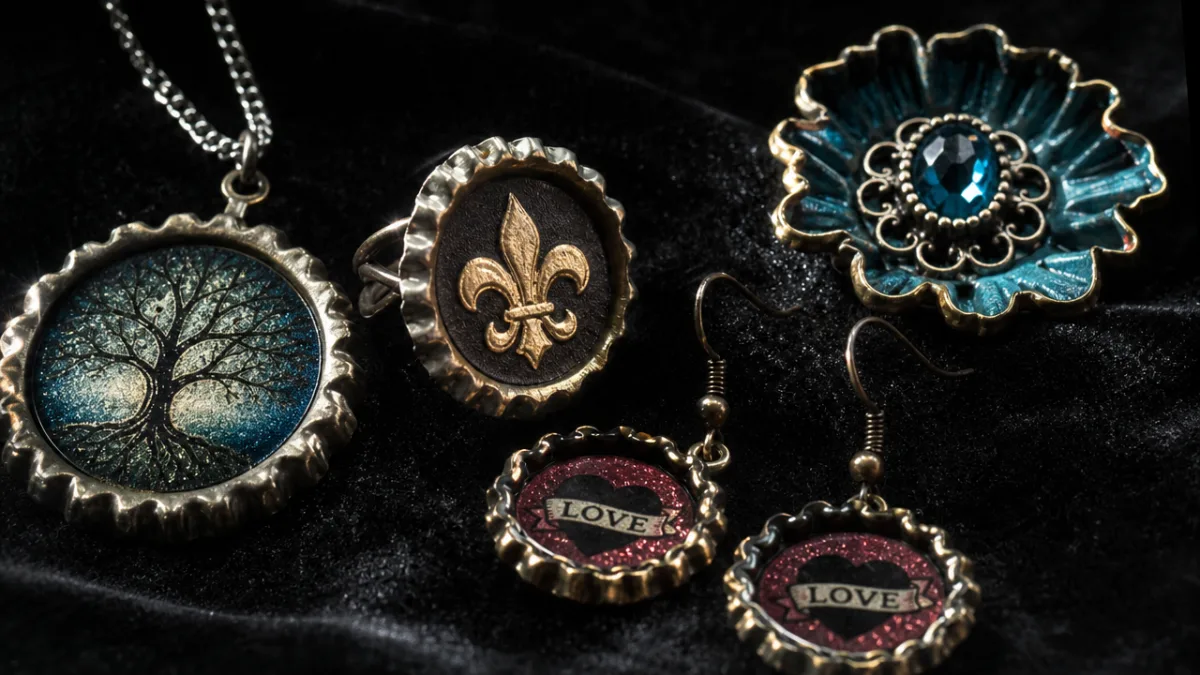
Transforming bottle caps into wearable jewelry is a craft tradition with deep roots in folk art communities around the world, and contemporary jewelry designers continue to push the form in exciting new directions. The cap’s circular shape, roughly the size of a large coin, is naturally suited to pendant necklaces, brooch pins, earring bases, and even cuff bracelet components. The printed face of the cap becomes a miniature canvas for the designer — you can showcase the original graphic design, paint or stamp over it, fill it with resin and embedded objects, or sand it back to bare metal for a sleek industrial look. Each approach produces a dramatically different aesthetic result from the same starting material.
Resin filling is one of the most popular and versatile techniques in bottle cap jewelry making. By pressing a cap face-up into a silicone mold or simply working with its natural shape, you can pour a small quantity of UV-cure or two-part casting resin into the interior dome and embed virtually anything within it — tiny dried flowers, glitter, photographs cut to size, watch parts, fabric swatches, or small charms. Once cured, the resin creates a glass-like surface that protects the embedded elements and gives the piece a professional, polished appearance indistinguishable from commercially produced resin jewelry. A jewelry bail glued to the back transforms the finished cap into a pendant in seconds.
For those interested in a more artisanal, handworked aesthetic, cold-working techniques open up remarkable creative possibilities. Using a dapping block and punch set — tools borrowed from traditional metalsmithing — you can reshape flattened caps into new three-dimensional forms: deeper domes, layered floral shapes, or abstract organic curves. Texturing hammers leave beautiful surface marks in the soft metal, and a simple liver-of-sulfur patina solution darkens the steel and highlights any texture you have applied. Combined with beaded wire wrapping, macramé cord, or leather straps, cold-worked caps produce jewelry that sits comfortably in the growing market for handcrafted, upcycled accessories with genuine material authenticity.
Functional Home Décor Projects
Some of the most satisfying bottle cap craft projects are those that produce objects you actually use every day. A bottle cap trivet, for example, is both practical and visually striking — arrange caps in a tight honeycomb grid, bond them together with strong epoxy, and mount the assembly on a thin cork or silicone backing, and you have a heat-resistant surface that sparks conversation every time you set a pot on it. The metallic caps conduct and distribute heat effectively, and the non-porous surface wipes clean easily. Customizing the color arrangement to match your kitchen’s palette makes this a genuinely personalized addition to any home.
Picture frames offer another wonderful canvas for bottle cap decoration that suits every skill level from beginner to experienced crafter. A plain wooden frame from any craft store becomes something extraordinary when its flat surface is covered in a single layer of caps arranged in a repeating pattern, an organic cluster, or even a miniature mosaic depicting something meaningful to the photo’s subject. Because the frame itself provides structural support, there is no need to worry about adhesive load-bearing capacity — you are simply decorating a surface, which allows you to work more quickly and experimentally. Frames decorated this way make deeply personal and impressive handmade gifts for weddings, new babies, and milestone birthdays.
Tabletop and bar décor represents perhaps the most naturally fitting home for bottle cap art, given the caps’ origin as beverage markers. Bar carts, home pub rooms, and game rooms are transformed by bottle cap art that nods to the material’s origins while transcending them. A coffee table with a bottle cap inlay set under poured epoxy resin is a showpiece that will last decades — the resin creates a perfectly level, durable tabletop surface while preserving the caps in archival-quality clarity below. Coasters, bar trays, and wall-mounted bottle openers incorporating caps are smaller-scale versions of the same principle, each a small functional sculpture that brings genuine handmade character to spaces that commercial furnishings simply cannot replicate.
- Bottle cap trivet: arrange caps in a honeycomb grid and bond to a cork backing for heat resistance
- Decorated picture frame: cover a flat wooden frame surface in patterned or mosaic cap arrangements
- Resin-inlay coffee table: embed caps in a poured epoxy tabletop for a durable, translucent showcase
- Wind chime: thread caps on fishing line or wire, spaced to produce a gentle metallic sound in the breeze
- Coat hooks or key rack: mount a row of heavy-duty hooks on a plank decorated with cap mosaics
- Magnetic photo display: glue small magnets inside caps and use them as decorative photo-holding magnets on your refrigerator
Sculptural and Mixed-Media Applications
For artists seeking a more ambitious challenge, bottle caps function superbly as a primary material in three-dimensional sculptural work. The caps can be linked, wired, soldered, riveted, or simply stacked and glued to build complex forms at any scale from palm-sized figures to large environmental installations. Because steel caps are relatively rigid, they can support their own weight in vertical structures when properly interconnected, making it possible to build freestanding sculptures without an internal armature for smaller pieces. Larger works typically benefit from a welded or bolted steel skeleton clad in caps, a technique used by professional artists who have created bottle cap sculptures exhibited in museums and public spaces internationally.
Mixed-media work is where bottle cap crafting intersects most productively with contemporary fine art practice. Combining caps with wood, wire mesh, found objects, paint, textile, and photography allows artists to create layered, conceptually rich pieces that use the cap’s inherent associations — consumption, disposal, popular culture, recycling — as meaningful content rather than merely decorative texture. An artist might embed caps into a painted canvas to create relief surfaces, incorporate them into assemblage boxes alongside personal photographs and found ephemera, or use them as the building blocks of a larger narrative installation about consumer culture and environmental responsibility. At this level, the craft of working with caps becomes a vehicle for genuine artistic statement.
Community and collaborative bottle cap art projects have emerged as a particularly exciting application of this medium. Schools, community centers, neighborhood organizations, and arts collectives have mounted ambitious public art installations assembled from thousands of donated caps collected over months or years, with the collection process itself becoming a form of community engagement and environmental education. These projects typically result in large-scale murals or sculptural installations that become beloved landmarks, carrying dual significance as both aesthetic achievements and tangible symbols of collective action and creative collaboration. The bottle cap, in this context, is not just a material but a social artifact — each one carrying the small history of a moment of shared human enjoyment.
Tips for Finishing, Sealing, and Displaying Your Work
Proper finishing is the step that separates amateur-looking bottle cap crafts from professional, gallery-quality pieces, yet it is an area many beginners overlook in their excitement to see the finished result. The printed lithography on bottle caps, while vibrant when new, is susceptible to fading, chipping, and rust if left unprotected — particularly in humid environments or pieces displayed outdoors. A clear acrylic sealer applied in two or three thin coats provides excellent protection for most indoor projects, locking in color and creating a unified surface sheen. Choose matte, satin, or gloss finishes according to your aesthetic preference: gloss maximizes the metallic reflectivity of the caps, while matte creates a more subdued, artistic quality that can actually increase the perceived sophistication of the work.
Displaying your bottle cap art effectively requires the same thoughtful consideration you would give to any artwork. Lighting is paramount — metal surfaces are highly responsive to directional light, and even a modest spotlight or LED picture light will dramatically enhance the visual impact of a bottle cap mosaic or sculpture by creating highlights and shadows that reveal the texture and dimensionality of the caps. Hang mosaic pieces at eye level and ensure they are mounted securely, as even medium-sized mosaics on plywood can be surprisingly heavy. For three-dimensional sculptures, a simple wooden or steel plinth elevates the piece literally and figuratively, framing it as an object of deliberate aesthetic consideration rather than a casual craft object.
Documenting and sharing your bottle cap art has never been easier or more rewarding. The online crafting community that has grown around platforms like Pinterest, Instagram, and dedicated craft forums is genuinely supportive and endlessly inspiring, with artists at every level sharing detailed process photographs, material sourcing tips, and design innovations with extraordinary generosity. Photographing your work in good natural light or with a simple lightbox setup will do justice to the genuine quality of what you have made, and sharing that work invites connection with a global community of like-minded creators. Whether you sell your pieces, give them as gifts, display them in your own home, or simply make them for the joy of making, bottle cap art is a creative practice that rewards every hour invested in it with tangible, beautiful, enduring results.








What do you think?
It is nice to know your opinion. Leave a comment.