










Cardboard Ball Chair: The Ultimate Guide to Sustainable Seating Innovation
Introduction to the Cardboard Ball Chair
The cardboard ball chair represents one of the most fascinating intersections of sustainable design, creative engineering, and functional furniture making. At first glance, the idea of sitting on a chair made from cardboard might seem unconventional or even impractical, but these remarkable pieces challenge every assumption we hold about what furniture can and should be made from. Designers and DIY enthusiasts around the world have been pushing the boundaries of this humble material for decades, discovering that cardboard, when properly constructed, can be surprisingly strong, durable, and beautiful.
What makes the ball chair concept particularly compelling is its spherical or near-spherical form, which distributes weight and stress in a way that maximizes the structural potential of layered cardboard. Unlike flat-pack or box-style cardboard furniture, the rounded shape allows for a more organic load distribution, meaning the chair can support significantly more weight than most people would expect. This engineering principle, borrowed from architecture and nature alike, transforms an otherwise flimsy material into something with genuine structural integrity and even a kind of elegance.
Beyond the engineering marvel, the cardboard ball chair carries profound meaning in today’s world of mounting environmental concerns. We live in an era where millions of tons of cardboard are discarded every year, much of it ending up in landfills despite being recyclable. The ball chair concept invites us to look at that discarded material differently — not as waste, but as a raw resource waiting to be reimagined. Whether you are a professional designer, a student exploring sustainable materials, or a passionate DIY maker, the cardboard ball chair offers a compelling project that is equal parts practical experiment and artistic statement.
The History and Origins of Cardboard Furniture Design
Cardboard furniture has a longer and more distinguished history than most people realize. The idea of using corrugated and layered cardboard as a structural material in furniture design began gaining serious traction in the 1960s and 1970s, a period marked by widespread experimentation with unconventional materials and a growing counterculture interest in affordable, accessible design. Iconic designers like Frank Gehry, who would later become one of the world’s most celebrated architects, created an entire line of cardboard furniture called “Easy Edges” in 1972 that demonstrated the material’s genuine potential for sophisticated, lasting design.
Gehry’s work was groundbreaking because it proved that cardboard could be taken seriously as a furniture material in commercial and high-design contexts. His pieces used layers of corrugated cardboard laminated together to create forms that were not only structurally sound but visually striking. The success of his cardboard furniture line opened doors for generations of designers who followed, each bringing their own innovations in technique, form, and philosophy to the medium. The ball chair concept grew naturally from this tradition of structural experimentation, with makers discovering that curved and spherical forms offered unique advantages over flat construction methods.
Throughout the 1980s and 1990s, cardboard furniture remained something of a niche interest, associated primarily with student housing, budget living, and conceptual design projects. However, the rise of the maker movement in the early 2000s, combined with growing awareness of environmental sustainability, sparked a significant revival of interest in cardboard as a legitimate design material. Online platforms and social media, including Pinterest, helped spread inspiration and tutorials that made cardboard furniture — including ball chairs — accessible to a global community of creative makers who were eager to build something beautiful and functional from discarded materials.
Materials and Tools You Will Need
Building a cardboard ball chair requires gathering the right materials before you begin, and the good news is that most of what you need is either freely available or extremely affordable. The primary material is, of course, cardboard itself. You will want to collect as much corrugated cardboard as possible, ideally in large flat sheets rather than small scraps. Appliance boxes from washing machines, refrigerators, and televisions are ideal because of their large surface area and thick, sturdy corrugation. Many appliance stores and furniture retailers will gladly give these boxes away for free, making your raw material essentially zero cost.
In addition to cardboard, you will need a strong adhesive to bond the layers together. White PVA glue diluted slightly with water works well for laminating layers, while a stronger wood glue or dedicated cardboard adhesive is better for structural joints and high-stress areas. Many builders also use a combination of glue and hot melt adhesive from a glue gun, using the hot glue for quick bonding during construction and PVA for a stronger, longer-lasting hold. Having both options available gives you flexibility throughout the build process and helps you move quickly without waiting for layers to dry completely before continuing.
Beyond adhesive, the following tools will make your build significantly easier and more precise:
- A sharp craft knife or box cutter with plenty of spare blades, since cardboard dulls blades quickly
- A sturdy metal ruler or straight edge for making accurate straight cuts
- A self-healing cutting mat to protect your work surface
- A compass or trammel for drawing circles and arcs accurately
- Sandpaper in various grits for smoothing the finished surface
- Acrylic paint, varnish, or sealant for finishing and protecting the completed chair
- Clamps or heavy books for holding glued sections in place while drying
You may also want to consider creating a simple mold or template to guide the spherical shape of your chair. Some builders use an inflated exercise ball as a forming surface, layering cardboard over it in sections before deflating and removing the ball once the structure sets. Others prefer to work from precise geometric templates cut from paper or thin card, using these to cut consistent curved pieces that fit together like a three-dimensional puzzle. Whichever approach you choose, investing time in preparation and planning before you begin cutting will save considerable frustration and wasted material later in the process.
Step-by-Step Construction Process
The construction of a cardboard ball chair begins with planning your design and scale. A comfortable seating ball chair typically has an outer diameter of somewhere between 100 and 130 centimeters, which provides enough interior volume for an adult to sit inside comfortably with room to recline or shift position. Sketch your design first on paper, deciding whether you want a fully enclosed egg-shape with a circular opening at the front, a more open bowl configuration, or a complete sphere with a large cutout for entry. Your design choice will affect both the construction method and the final character of the piece.
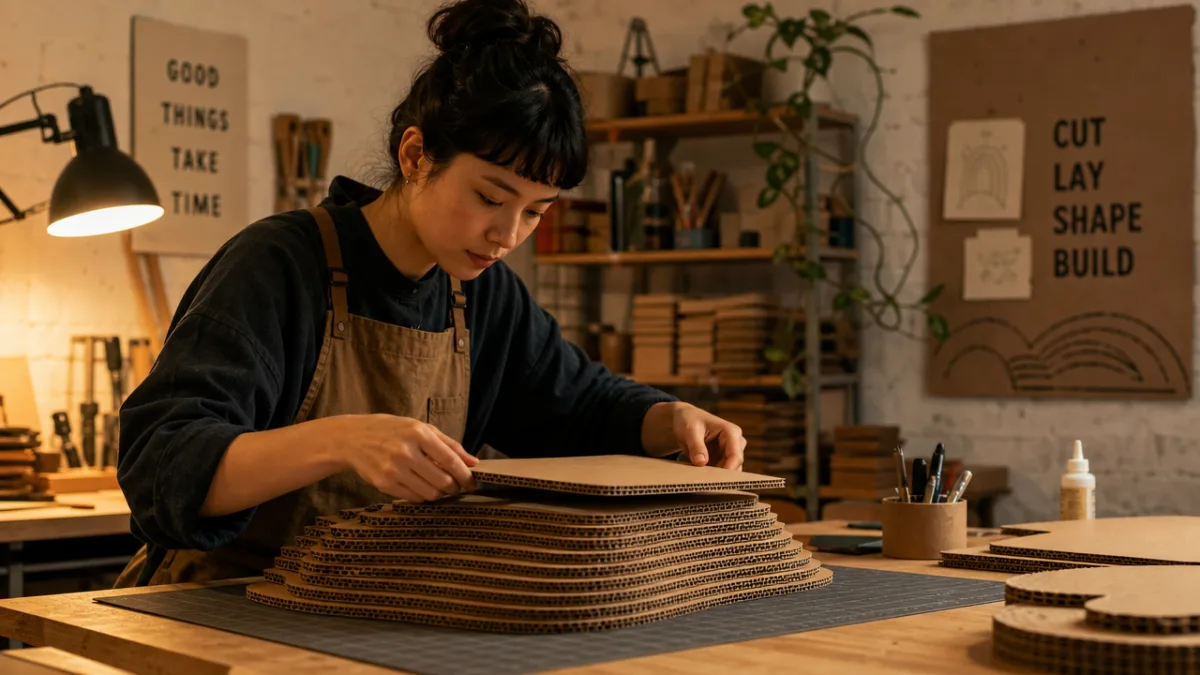
Once your design is settled, begin by cutting your cardboard into strips and curved sections according to your templates. The most common structural approach for a ball chair involves building up the form in layers, similar to how a papier-mâché form is built, but using thick laminated cardboard rather than paper. Start with a base ring that will form the bottom of the chair and give it stability on the floor. This base ring should be made from multiple laminated layers of cardboard, at least five to eight layers thick, to provide enough rigidity to support the full weight of the chair and its occupant without flexing or deforming.
With your base ring established, begin building up the walls of the chair by adding curved strips of laminated cardboard, gluing each new layer to the previous one and clamping or weighting it in place until the adhesive sets. Work gradually around the circumference, keeping the form as consistent and symmetrical as possible as you build upward and inward toward the top of the sphere. It is helpful to check your progress frequently against your templates or against a physical reference like an exercise ball to ensure you are maintaining the correct curvature throughout the build.
The interior of the chair will need finishing to make it comfortable for sitting. Options include:
- Adding a custom-cut foam cushion that fits the curved interior perfectly
- Lining the interior with fabric stretched over a thin batting layer for a soft, upholstered feel
- Applying multiple coats of smooth plaster or papier-mâché to create a seamless interior surface
- Installing a suspended fabric hammock seat for a floating, swing-like experience inside the ball
The exterior finishing process is just as important as the structural build and deserves careful attention. Once your chair is fully assembled and completely dry, sand the exterior surface progressively with coarser and then finer grit sandpaper to remove any rough edges or uneven layers. Fill any gaps or imperfections with a lightweight filler or more diluted PVA glue, allow it to dry, and sand again until you have a smooth, consistent surface. At this stage you can apply a primer coat followed by your chosen paint or finish, transforming the raw, industrial-looking cardboard construction into a polished and visually striking piece of furniture.
Structural Strength and Weight Capacity
One of the most common questions people ask about cardboard furniture — and ball chairs in particular — is how strong they actually are. The answer surprises most people. A well-built cardboard ball chair constructed from multiple laminated layers of corrugated cardboard and properly cured adhesive can support well over 150 kilograms, and some documented examples have withstood loads considerably beyond that. The key to this impressive load-bearing capacity lies in the combination of the lamination technique and the spherical geometry, both of which work together to distribute stress across the structure rather than concentrating it at weak points.
Corrugated cardboard itself is an engineering triumph at the material level. The fluted middle layer sandwiched between two flat liner sheets creates an I-beam effect on the micro scale, giving the material a strength-to-weight ratio that is genuinely remarkable for something made primarily from wood pulp and water. When you laminate multiple layers of this material together with the grain and corrugation running in alternating directions — similar to the logic behind plywood — you create a composite that is orders of magnitude stronger than any single layer alone. This is the same principle that allows cardboard tubes and honeycomb panels to serve as structural elements in lightweight construction and even aerospace engineering.
The spherical shape of the ball chair adds another layer of structural advantage that is less intuitive but equally important. Spheres and domes are among the most efficient structural forms in nature and engineering because they distribute applied loads in multiple directions simultaneously, allowing stress to flow around the structure rather than concentrating along a single path. This is why eggshells can withstand surprising amounts of compressive force, why geodesic domes can span enormous distances with minimal material, and why the cardboard ball chair can be both light and remarkably sturdy. The geometry is doing significant structural work, allowing the cardboard to perform far beyond what its modest material properties might suggest.
That said, there are important limitations and considerations to keep in mind when using a cardboard ball chair. Moisture is the primary enemy of cardboard furniture. Even a well-sealed and painted ball chair should be kept away from damp environments, direct water exposure, and high-humidity conditions, all of which can weaken the adhesive bonds and cause the cardboard layers to delaminate or warp over time. A thorough coating of waterproof sealant or polyurethane varnish on all exterior surfaces will significantly extend the chair’s lifespan, but it is not a complete solution for truly wet conditions.
Sustainability and Environmental Impact
Perhaps the most compelling aspect of the cardboard ball chair, beyond its novelty and surprising structural performance, is what it represents in terms of environmental responsibility and circular design thinking. The global furniture industry is one of the most resource-intensive manufacturing sectors in the world, consuming vast quantities of timber, metal, plastic, foam, and synthetic fabrics, much of which ends up in landfills at the end of a product’s useful life. Against this backdrop, a chair built entirely from reclaimed cardboard waste embodies a radically different approach to design — one that begins with what already exists rather than with extraction of new resources.
Cardboard is one of the most widely recycled materials in the world, and yet a significant proportion of it still ends up in landfills, particularly when it is contaminated, wet, or too thick for standard recycling streams. By intercepting this material before it reaches the waste stream and transforming it into durable, functional furniture, ball chair makers are practicing a form of upcycling that goes beyond simple recycling. Rather than breaking the material back down into pulp and reprocessing it at industrial scale — a process that itself consumes energy and water — upcycling preserves the material in a higher-value form, extending its useful life without additional processing energy.
The environmental credentials of the cardboard ball chair extend beyond just the material itself. Because the construction process requires only simple hand tools, no electricity-powered machinery is needed for cutting, shaping, or joining the material. The adhesives used, primarily PVA or water-based wood glue, have a much lower environmental impact than the solvent-based adhesives and synthetic resins used in conventional upholstered furniture manufacturing. And at the end of its life, a cardboard ball chair can be fully composted or recycled, returning its constituent materials to the biosphere or manufacturing cycle without leaving behind synthetic residues or non-biodegradable components.
Teaching and sharing the cardboard ball chair concept also has a valuable educational dimension that amplifies its environmental impact beyond any individual piece of furniture. When designers, teachers, and makers document and share their processes on platforms like Pinterest, they inspire others to look differently at waste materials in their own lives and communities. A child who participates in building a cardboard ball chair may carry with them for the rest of their life an understanding that creativity and resourcefulness can transform what society considers rubbish into something genuinely useful and beautiful. That shift in perspective, multiplied across thousands or millions of people, has the potential to reshape how we collectively think about materials, waste, and value.

Design Variations and Creative Possibilities
While the classic ball chair takes its inspiration from the iconic Eero Aarnio 1960s design — a hollow sphere with a circular opening and a cushioned interior — the cardboard interpretation of this form opens up countless possibilities for personalization and creative variation. Some makers have built elongated egg chairs rather than true spheres, finding that the oval form offers a more comfortable reclined seating position while maintaining the enclosed, cocoon-like quality that makes these chairs so appealing. Others have experimented with asymmetrical cutouts, creating dramatic openings that frame views of a room or landscape in unexpected ways.
The surface treatment of a finished cardboard ball chair is an entire creative discipline in itself. Beyond simple painted finishes, makers have explored techniques including decoupage with patterned papers or fabric, intricate geometric designs painted in contrasting colors, metallic spray finishes that make the cardboard look like burnished steel or copper, and even mosaic tile applications for outdoor-adjacent pieces that need additional waterproofing. The naturally textured surface of layered cardboard, when left partially visible under a transparent finish, creates a uniquely beautiful aesthetic that speaks honestly about the material and the making process.
For those interested in taking the concept further into functional design, the ball chair structure can be adapted to serve as a hanging or suspended piece rather than a floor-standing one. Suspended from a ceiling mount with a heavy-duty chain or rope, the ball chair becomes a swing chair with a very different experiential quality — gently rocking and rotating, fully enclosed, a kind of private sensory retreat within a shared living space. This hanging configuration requires additional structural reinforcement at the attachment points and careful ceiling mounting, but the result is a piece of furniture with a genuinely transportive quality that is difficult to achieve with conventional materials and construction methods.
Collaborative and large-scale versions of the cardboard ball chair have also appeared in design education and installation art contexts. Design schools have used the ball chair as a group project that teaches students about structural engineering, sustainable materials, and iterative making within a single engaging challenge. Installation artists have created oversized cardboard ball chairs as public sculptures, inviting audiences to interact physically with the work and experience firsthand the surprising material qualities of laminated cardboard. These applications point toward a future in which the cardboard ball chair is understood not just as a DIY novelty but as a genuinely versatile design proposition with applications across furniture, education, and public art.








What do you think?
It is nice to know your opinion. Leave a comment.