










This Circular Economy Poster Concept Could Change How We Think About Waste
The Power of Visual Communication in Environmental Advocacy
In an age where attention spans are shrinking and environmental crises are growing, the challenge of communicating complex sustainability concepts to a general audience has never been more pressing. A single well-designed poster can accomplish what hours of lectures or thousands of words sometimes cannot: it can shift a perspective in seconds. The circular economy poster concept making waves on Pinterest is a compelling example of how thoughtful graphic design can transform abstract economic theory into an accessible, emotionally resonant visual story that ordinary people can immediately understand and act upon.
Visual communication has always played a central role in social movements. From wartime propaganda posters to civil rights imagery, the right combination of color, form, and message has repeatedly proven capable of moving mountains. Environmental advocacy is no different, and sustainability communicators have long struggled to translate dense academic and policy language into imagery that connects with everyday consumers. A well-executed infographic or poster does not merely inform — it invites the viewer into a new way of seeing the world, one where the relationship between production, consumption, and disposal is fundamentally reimagined.
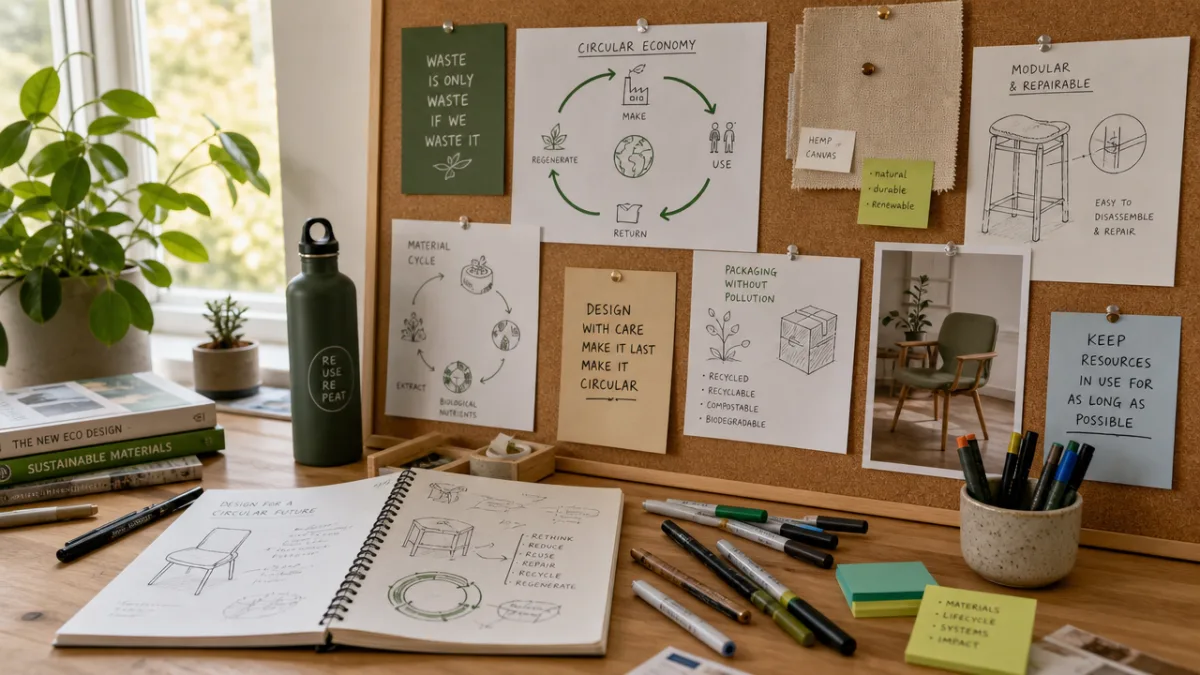
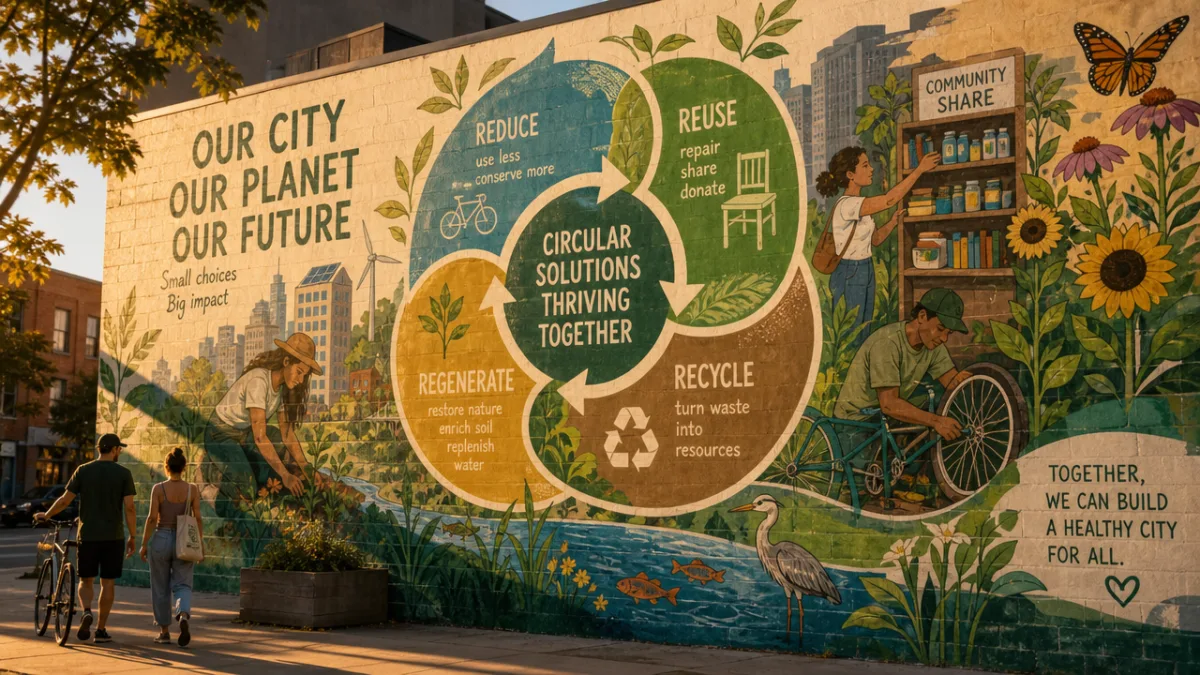
What makes this particular circular economy poster concept so noteworthy is its apparent ability to strip away jargon and replace it with intuitive visual metaphors. Rather than presenting the circular economy as a dry policy framework, it appears to render it as something almost natural — a flowing cycle that mirrors the rhythms of ecosystems that have sustained life on Earth for billions of years. By grounding an economic concept in visual language borrowed from biology and nature, the design bridges the gap between the technical and the personal, making viewers feel that sustainability is not an obligation imposed from the outside but a return to something fundamentally sensible.
Understanding the Circular Economy: More Than Just Recycling
Most people, when they think about reducing waste, think about recycling. They picture blue bins on the curb, glass bottles sorted from cardboard, and the modest satisfaction of knowing a plastic container will be remade into something new. But the circular economy is a far more ambitious and transformative concept than curbside recycling could ever suggest. It represents a fundamental rethinking of how we design, manufacture, sell, use, and reclaim every product in our economy, with the explicit goal of eliminating waste not by managing it at the end of a product’s life, but by designing it out of the system entirely from the very beginning.
The circular economy rests on three core principles, each of which challenges assumptions that have underpinned industrial capitalism for more than two centuries. First, it calls for designing out waste and pollution, meaning that products should be engineered from the outset so that no harmful byproducts enter the environment. Second, it advocates for keeping products and materials in use for as long as possible, through strategies such as repair, reuse, remanufacturing, and sharing. Third, it champions the regeneration of natural systems, acknowledging that healthy ecosystems — soils, oceans, forests — are not just nice to have but are the foundational infrastructure upon which all economic activity ultimately depends.
Understanding these principles is critical to appreciating why a poster concept built around them has the potential to shift public consciousness. When people grasp that the circular economy is not just a greener version of business as usual but a genuinely different operating model, their relationship to everyday choices — what they buy, how long they keep it, and what they do with it afterward — begins to change. The poster, as a medium, is particularly well suited to catalyzing this shift because it can make the interconnectedness of these principles visible all at once, in a single glance, without requiring the viewer to read a report or sit through a presentation.
- Design for longevity: Products built to last longer reduce the frequency of replacement, cutting both resource extraction and manufacturing emissions over time.
- Product-as-a-service models: Companies retain ownership of their products and lease access to consumers, creating a powerful financial incentive to maximize durability and repairability.
- Industrial symbiosis: The waste outputs of one manufacturing process become the raw material inputs for another, dramatically reducing landfill dependency.
- Regenerative agriculture integration: Biological nutrients — food waste, organic matter — are returned to the soil in ways that rebuild rather than deplete natural fertility.

Why Poster Design Matters for Systemic Change
There is a long and underappreciated tradition of using graphic design as an instrument of systemic change. The Bauhaus movement in early twentieth-century Germany recognized that design was not merely decoration but a force capable of reshaping how societies organized themselves. More recently, designers working at the intersection of social justice and environmental advocacy have revived this tradition, producing work that does not just describe problems but actively participates in solving them. The circular economy poster concept under discussion belongs firmly in this lineage — it is not passive communication but active provocation, designed to disturb comfortable assumptions about waste and value.
The specific choices made in a well-crafted sustainability poster can encode entire worldviews. Color palettes drawn from nature — deep greens, warm earth tones, ocean blues — signal alignment with ecological values before a single word is read. Circular forms and looping arrows convey the idea of cycles and renewal rather than the linear arrows that typically illustrate industrial supply chains marching from extraction to disposal. Typography choices can suggest either the cold authority of a corporate report or the accessible warmth of a community conversation. All of these decisions add up to a total communicative act that can either alienate viewers or draw them in as participants in a shared project.
Perhaps most importantly, a strong poster concept creates what designers call a “sticky” idea — one that lodges in the viewer’s mind and resurfaces in unexpected contexts. A person who sees a compelling circular economy infographic while scrolling through Pinterest may not immediately change their behavior, but they carry the image and its implications with them. When they later encounter a product with poor repairability, or hear a news story about landfill overcrowding, the visual memory of the poster provides a ready-made framework for interpretation. In this way, good environmental design does not just communicate information; it installs new cognitive tools that help people make sense of the world around them.
How This Concept Challenges the Linear Economy Mindset
The dominant economic model of the past two centuries is what theorists call the linear economy, summarized by the three-word phrase “take, make, dispose.” Resources are extracted from the earth, manufactured into products, sold to consumers, and eventually thrown away. This model made a certain kind of sense when natural resources seemed essentially limitless and landfill space was abundant. But in a world of finite materials, a destabilizing climate, and ecosystems under severe strain, the linear model is not just environmentally harmful — it is economically irrational, a system that destroys value at every stage of its operation rather than capturing and cycling it.
The psychological hold of the linear economy is surprisingly deep. Decades of consumer culture have conditioned most people in wealthy countries to relate to objects as temporary rather than durable, as disposable rather than precious. Fast fashion, single-use packaging, and planned obsolescence have normalized the idea that things are meant to be used briefly and then discarded. Challenging this mindset requires more than logical argument — it requires a kind of visual and emotional reframing that helps people feel differently about the objects in their lives. The circular economy poster concept appears to achieve exactly this, presenting an alternative mental model not as a sacrifice or a restriction but as a more elegant and satisfying way of relating to the material world.
The contrast between linear and circular thinking can be illustrated concretely by considering the life of a single smartphone. In the linear model, rare earth metals are mined at significant environmental and human cost, assembled into a device designed to be replaced in two to three years, and ultimately discarded in ways that frequently result in toxic materials leaching into soil and groundwater. In a truly circular model, that same device is designed from the outset for easy disassembly, its components are reclaimed and remanufactured, and the manufacturer retains responsibility for the product throughout its entire useful life. The poster that makes this comparison visible and visceral is doing important work that policy documents and academic papers cannot.
- Awareness: The viewer encounters the circular model as a coherent alternative to the linear default, often for the first time.
- Recognition: Familiar objects and processes are seen in a new light, as participants in a system rather than isolated transactions.
- Agency: The viewer begins to identify specific ways their own choices — purchasing decisions, disposal habits, advocacy — connect to the larger system.
- Advocacy: Equipped with a compelling visual framework, the viewer becomes capable of sharing and explaining circular economy principles to others.
Real-World Applications Inspired by Circular Economy Thinking
The circular economy is far from a purely theoretical concept. Around the world, pioneering businesses, cities, and governments are already implementing circular principles at meaningful scale, demonstrating that the transition from a linear to a circular economy is not a utopian fantasy but a practically achievable transformation. These real-world examples are precisely the kind of content that a strong poster concept can celebrate and amplify, turning abstract principles into recognizable stories of change that viewers can point to as proof that another way of doing things is already underway.
In the consumer goods sector, companies like Patagonia have built entire brand identities around circular principles — repairing garments, accepting worn items back for resale, and publicly discouraging unnecessary new purchases. Interface, the carpet tile manufacturer, pioneered a carpet-leasing model in the 1990s that allowed it to reclaim and recycle tiles at the end of their life, dramatically reducing both its material costs and its environmental footprint. In the food industry, growing networks of anaerobic digestion facilities are capturing the energy and nutrients locked in organic waste streams, turning what was once landfill fodder into biogas and compost that returns fertility to agricultural soils.
Cities, too, are emerging as critical arenas for circular economy innovation. Amsterdam has formally committed to becoming a fully circular city by 2050, embedding circular principles into its procurement policies, building codes, and urban planning frameworks. Copenhagen uses waste heat from its data centers and manufacturing facilities to warm homes, turning what would otherwise be a wasted energy stream into a community resource. San Francisco, through a combination of aggressive composting mandates and producer responsibility legislation, has achieved landfill diversion rates that would have seemed impossible two decades ago. Each of these examples represents a story that a well-designed poster could bring to life, making the circular economy feel not distant and idealistic but immediate and achievable.
- Renewable energy integration: Circular economy principles extend to energy systems, prioritizing sources like solar and wind whose “fuel” is infinitely renewable and whose infrastructure can itself be designed for eventual material recovery.
- Construction and demolition: The built environment accounts for a vast share of global material consumption; circular building design emphasizes disassembly-ready structures and the reuse of salvaged components.
- Pharmaceutical take-back programs: Rather than flushing unused medications into waterways, circular approaches create closed-loop systems for safe reclamation and either safe disposal or reprocessing.
- Digital product passports: Emerging technologies allow manufacturers to attach detailed material and component information to products, enabling far more efficient recovery and remanufacturing at end of life.
The Role of Social Media and Visual Platforms in Spreading Circular Ideas
The fact that this circular economy poster concept surfaced on Pinterest is itself deeply significant. Pinterest, along with Instagram, Behance, and similar visually oriented platforms, has become one of the most important channels through which design ideas — including ideas with serious social and environmental implications — propagate through culture. A concept that might once have been confined to a sustainability conference presentation or an academic journal can now reach millions of people within days of being posted, shared, and re-pinned by engaged communities of designers, educators, activists, and curious general users.
Social media’s role in environmental communication is complicated, of course. The same platforms that can spread powerful sustainability messaging can also amplify greenwashing, superficial eco-aesthetics, and feel-good content that substitutes for genuine engagement with systemic change. The difference between circular economy content that actually shifts thinking and content that merely performs environmental concern often comes down to depth and specificity. A poster concept that clearly illustrates the mechanics of a circular system — how materials flow, where value is created, what roles different actors play — is far more likely to generate genuine understanding than a vague image of a green earth with an inspirational quote superimposed on it.
When genuinely substantive circular economy design does achieve viral spread on platforms like Pinterest, the effects can be remarkable. Design educators incorporate shared concepts into their curricula. Journalists use arresting infographics as visual anchors for feature articles. Policy advocates share posters in testimony and public comment processes to build intuitive support for regulatory proposals. Perhaps most powerfully, ordinary people who encounter a compelling visualization share it with friends and family, initiating conversations about waste, value, and responsibility that would rarely arise spontaneously. In this way, a single poster concept, well executed and widely shared, can function as a kind of cultural seed — planting a new way of seeing that grows through networks of human connection far beyond any formal educational or policy channel.
The future of circular economy advocacy likely lies precisely at this intersection of rigorous systems thinking and compelling visual communication. As the climate crisis intensifies and the limitations of the linear economy become impossible to ignore, the demand for clear, accessible, emotionally resonant communication about alternatives will only grow. Poster concepts like the one that inspired this article are not peripheral to that effort — they are central to it. They demonstrate that the tools of good design, applied with both aesthetic skill and intellectual seriousness, can help build the popular understanding and cultural momentum that every successful systemic transformation ultimately requires.
What Individuals and Organizations Can Do With This Inspiration
Encountering a concept as compelling as this circular economy poster design should not be merely a passive aesthetic experience — it should be an invitation to action. For individuals, that action might begin with a personal audit of their own consumption habits, asking honestly which products in their lives are designed for longevity and repairability and which are engineered for rapid replacement. It might involve supporting businesses that have made genuine commitments to circular principles, or advocating with local government for policies — such as extended producer responsibility legislation or composting mandates — that create the systemic conditions under which circular practices can flourish at scale rather than remaining niche choices for the environmentally motivated few.
For designers, marketers, and communications professionals, the poster concept offers a more specific kind of inspiration: a reminder that the skills of their disciplines carry genuine civic weight. Every infographic created about sustainability, every product label designed to communicate material content and end-of-life options, every brand campaign that celebrates durability over disposability contributes to the gradual cultural shift that the circular economy requires. Professionals in these fields are not merely service providers to their clients — they are participants in a larger conversation about what kind of economy and society their communities want to build, and their creative choices have consequences that extend well beyond any individual project or campaign.
Organizations working in sustainability, education, and public policy can draw a practical lesson from the viral success of compelling circular economy visuals: invest in communication. It is not enough to develop robust circular economy strategies if those strategies are communicated only in technical reports read by specialists. The ideas need to be translated into forms that engage lay audiences — posters, short videos, interactive web experiences, public art installations — that make the principles of the circular economy feel not like bureaucratic requirements but like genuinely exciting invitations to participate in building something better. The organizations that master this kind of communication will be far more effective advocates for the systemic changes the moment demands.
- Commission original circular economy infographics and make them freely available for sharing under open licenses, maximizing their spread and impact.
- Partner with schools and universities to integrate circular economy visual literacy into design, business, and environmental studies curricula.
- Use circular economy design concepts in community engagement processes, helping residents visualize the benefits of local circular initiatives before they are implemented.
- Create multilingual versions of compelling circular economy visuals to ensure that the ideas reach communities whose first language is not English, broadening the base of public understanding and support.
Ultimately, the most important thing that a compelling circular economy poster concept can do is make people believe that a different kind of economy is possible — not just in theory, but in the real, material world where they live and work and consume and discard. Belief in possibility is the precondition for all meaningful change. When design achieves that, it is not just making something beautiful; it is making something genuinely necessary. The circular economy needs champions, communicators, and visionaries across every sector of society, and a well-crafted poster reaching the right person at the right moment can be the spark that creates one more of each.








What do you think?
It is nice to know your opinion. Leave a comment.