










The Upcycled Garden Volume 15: Using Recycled & Salvaged Materials In Your Garden
Why Upcycling Belongs in Every Garden
There is something quietly radical about looking at a broken terra cotta pot, a rusted wheelbarrow, or a stack of old timber pallets and seeing not junk but the beginning of something beautiful. The upcycled garden movement has been growing steadily for years, and with good reason. Gardeners who embrace salvaged and recycled materials are not only cutting costs dramatically but also reducing the enormous environmental burden that comes from manufacturing new plastics, ceramics, and metals. Every item diverted from the landfill and given new life in a garden represents a small but meaningful act of stewardship toward the planet we are all trying to tend.
Beyond the environmental argument, there is a deeply aesthetic one. Mass-produced garden décor tends toward the generic, the perfectly molded, the interchangeable. Upcycled gardens, by contrast, carry history in their imperfections. A weathered wooden door repurposed as a garden gate brings decades of character that no new pressure-treated timber can replicate. Vintage colanders become whimsical herb planters. Old rain boots, painted in cheerful colors, serve as charming containers on a front porch. The patina, the rust, the worn paint — these qualities give an upcycled garden a soul that money genuinely cannot buy from any garden center.
This fifteenth volume of The Upcycled Garden series digs deep into practical techniques, creative inspirations, and sourcing strategies that will help you transform your outdoor space using materials that most people would overlook or discard. Whether you are a seasoned green-thumbed upcycler or someone just beginning to see potential in cast-off objects, this guide is designed to spark ideas, sharpen skills, and remind you that the most inventive gardens are rarely built from new materials purchased at full price. They are assembled, piece by reclaimed piece, with patience, creativity, and joy.
Sourcing Salvaged Materials: Where to Look and What to Gather
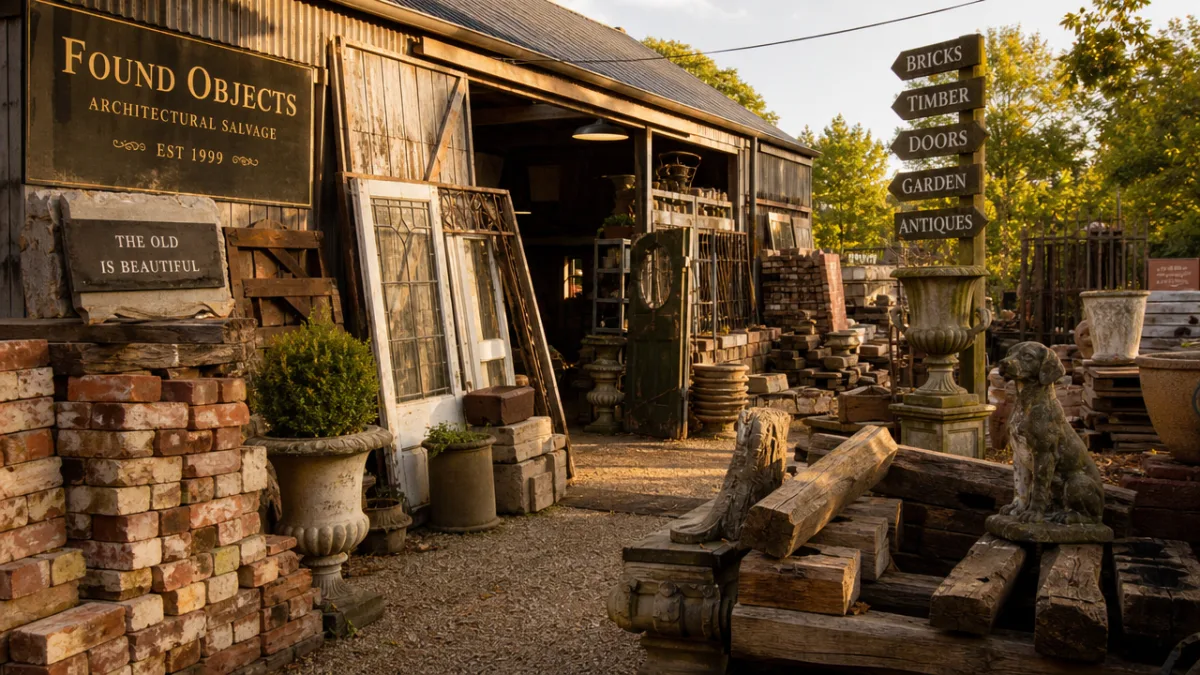
The first challenge most new upcyclers face is simply knowing where to find good salvaged materials. The truth is that once you train your eye to see potential rather than waste, sources appear almost everywhere. Architectural salvage yards are perhaps the richest hunting grounds available, offering everything from antique iron fencing and reclaimed brick to old wooden window frames and vintage cast iron pipes. These yards sort and price their inventory, making them easy to browse, and the staff is typically knowledgeable and enthusiastic about creative reuse. A single afternoon at a salvage yard can yield enough inspiration and raw material to redesign an entire garden corner.
Beyond dedicated salvage yards, everyday community resources offer tremendous opportunity. Websites like Freecycle, Facebook Marketplace, Craigslist, and local Buy Nothing groups are constantly populated with items that people need to remove from their properties — old fencing, broken concrete pavers, timber offcuts, ceramic tiles, and household containers of every conceivable shape and size. Driving through neighborhoods on bulk rubbish collection days can be equally productive. What one household considers trash another gardener recognizes as exactly the raised bed edging, the trellis material, or the quirky planter they have been searching for. There is no shame in stopping the car and taking a closer look.
It also pays to cultivate relationships with local tradespeople. Plumbers, electricians, builders, roofers, and demolition contractors regularly remove materials from job sites that they are simply obligated to dispose of. A friendly conversation and a business card left with the right contractor can result in a steady supply of copper pipe offcuts, reclaimed roofing slates, leftover bricks, or old cast iron radiators — all of which have wonderful second lives as garden features. Similarly, reaching out to local restaurants, cafes, and grocers can secure a supply of wooden wine crates, food-grade barrels, and pallets that make excellent planters and compost bin structures.
- Architectural salvage and reclamation yards for structural materials, fencing, and decorative ironwork
- Online platforms including Freecycle, Facebook Marketplace, and Buy Nothing groups for free or low-cost finds
- Bulk rubbish collection days in your neighborhood for furniture, containers, and building materials
- Local builders, plumbers, and demolition contractors for offcuts, reclaimed pipes, and structural elements
- Restaurants, cafes, and grocers for wooden crates, barrels, and food-safe pallets
- Thrift stores, charity shops, and estate sales for household items that translate beautifully into garden planters
Planters and Containers: Giving New Life to Old Vessels
Containers and planters represent one of the most accessible entry points into upcycled gardening, and the variety of objects that can be repurposed for planting is genuinely astonishing. Almost any vessel that can hold soil and allow for drainage has the potential to become a planter. Old colanders, wooden crates, vintage suitcases, cracked ceramic mixing bowls, worn leather boots, enamel washing basins, galvanized steel buckets, and even broken china toilets have all found successful second lives as planters in creative gardens around the world. The key practical requirement is drainage — most containers simply need a few holes drilled or punched in the base to prevent waterlogging and root rot.
Wooden pallets deserve special mention here because they are so widely available and so versatile. A standard pallet can be stood upright, lined with landscape fabric, filled with soil, and planted with herbs, strawberries, or cascading flowers to create a vertical garden that takes up minimal horizontal space. Laid flat, a pallet becomes a raised bed frame when a few boards are added to increase the depth. Stacked and secured, pallets form the walls of a surprisingly sturdy compost bin. The main caution with pallets is to check the stamp: pallets marked HT (heat treated) are safe for food gardens, while those marked MB (methyl bromide) should be avoided for anything edible, though they remain fine for purely ornamental plantings.
For gardeners with a more formal aesthetic, reclaimed terracotta roof tiles, old chimney pots, and salvaged stone sinks make extraordinarily elegant planters that blend seamlessly into cottage or heritage garden styles. Stone sinks in particular, known as Belfast or butler sinks in the United Kingdom, are highly sought after for growing alpine plants, succulents, and herbs because their depth and drainage properties are ideal, and their weathered appearance develops character with every season. Chimney pots, filled with trailing plants, create dramatic vertical focal points in borders or along pathways, their height drawing the eye upward and adding structural interest that few purpose-built planters can match.
Raised Beds and Garden Structures from Reclaimed Timber
Reclaimed timber is among the most valuable and versatile materials available to the upcycled gardener. Old railway sleepers, scaffold boards, fence posts, structural beams from demolished buildings, and the humble wooden pallet all offer robust, character-rich material for constructing raised beds, cold frames, garden furniture, trellises, and pathways. Reclaimed timber typically comes pre-weathered, with a silvery or honey-toned surface that fits naturally into garden settings without requiring any treatment to achieve that desirable aged look. It is also, in many cases, harder and denser than newly milled timber, having dried and seasoned over many decades of previous use.
Building raised beds from salvaged timber is one of the most rewarding upcycling projects a gardener can undertake. The structure itself can be as simple as four scaffold boards screwed together at the corners into a rectangle, or as elaborate as a tiered, L-shaped bed with built-in seating and a trellis back panel assembled from a mixture of reclaimed timbers. The joy of working with salvaged wood is that uniformity is neither required nor desirable — mixing different widths, colors, and wood types creates a patchwork aesthetic that is uniquely appealing and utterly impossible to replicate with new materials. Each piece of timber brings its own grain, nail holes, saw marks, and surface variation to the finished structure.
Old wooden ladders are a particularly charming and practical structural element in the upcycled garden. Leaned against a wall or fence, a vintage ladder provides instant climbing support for peas, beans, sweet peas, or climbing roses at minimal cost. Laid horizontally between supports, it creates a rustic pergola effect that can carry climbing plants overhead, filtering light and creating dappled shade beneath. Wooden doors salvaged from demolition projects serve similarly as gate structures, archways, or privacy screens, and their panels can often be fitted with chicken wire to support climbing plants or to create a protected area for young seedlings. The structural possibilities of salvaged timber are limited only by imagination and basic joinery skill.
- Railway sleepers for robust, long-lasting raised bed walls and pathway edging
- Scaffold boards for quick, affordable raised beds that are easily assembled without specialist tools
- Old wooden ladders as vertical growing supports and decorative structural features
- Reclaimed doors and window frames as garden gates, arches, privacy screens, and trellis bases
- Structural beams from demolition sites for heavy-duty pergola and arbor construction

Water Features and Irrigation Using Recycled Materials
Water is the lifeblood of any garden, and incorporating recycled materials into water management and water features is both environmentally responsible and aesthetically rewarding. Rainwater harvesting is perhaps the most impactful single change any gardener can make, and it need not involve expensive purpose-built water butts. Large food-grade barrels, old wine or whiskey barrels cut in half, galvanized water troughs, and even repurposed chest freezers with sealed bottoms can all serve as rain catchment containers. Connected to a downspout with a simple diverter kit, these vessels can capture hundreds of liters of free rainwater during a single downpour, dramatically reducing the need for mains water in dry summer periods.
Small water features constructed from salvaged materials add movement, sound, and wildlife habitat to garden spaces that would otherwise lack these qualities. An old ceramic pot or stone trough sealed at the base with waterproof sealant becomes a miniature pond that will quickly attract frogs, newts, dragonflies, and birds within a single season. A reclaimed copper pipe or old watering can fitted with a small submersible pump creates a gentle bubbling fountain that brings calm and sound to a seating area. Even a cracked Belfast sink, partially buried and filled with water and aquatic plants, becomes a thriving miniature ecosystem that costs almost nothing to create and provides enormous ecological benefit to local wildlife communities.
Drip irrigation systems assembled from repurposed materials represent another practical application of the upcycling philosophy. Old plastic bottles with small holes pierced in their caps can be inverted and pushed into the soil beside thirsty plants, releasing water slowly and directly to the root zone — a technique widely used in water-scarce regions and one that dramatically reduces evaporative water loss compared to overhead watering. Lengths of old hose pipe, perforated at intervals and laid along raised bed rows, function identically to commercially sold soaker hoses at a fraction of the cost. These simple, low-tech solutions demonstrate that effective water management in the garden requires ingenuity far more than expensive equipment.
Decorative Features and Garden Art from Salvaged Objects
Perhaps the most joyful dimension of the upcycled garden is purely decorative — the use of salvaged objects as art, focal points, and whimsical accents that express the personality of the gardener as clearly as any painting expresses the character of its creator. An old bicycle frame, planted with trailing nasturtiums spilling from its basket, becomes a sculpture. A collection of mismatched vintage china plates and cups, arranged on a fence or wall, creates a mosaic of color and pattern. Rusted metal tools — spades, rakes, forks with broken handles — grouped together and fixed to a weathered shed wall form an evocative still life that celebrates the history and labor of gardening itself.
Mosaic work, using broken tiles, crockery, and mirror glass, is one of the most enduring forms of upcycled garden art. Broken ceramics that would otherwise go to landfill can be transformed into stunning decorative surfaces on pots, stepping stones, garden table tops, and wall panels. The technique requires little more than exterior-grade tile adhesive, waterproof grout, and a willingness to experiment with color and pattern. Even gardeners with no formal artistic training find that working with broken pieces in this way produces surprisingly beautiful results, because the irregular edges and varied glazes of found crockery create an organic visual complexity that is difficult to achieve with purpose-cut tiles.
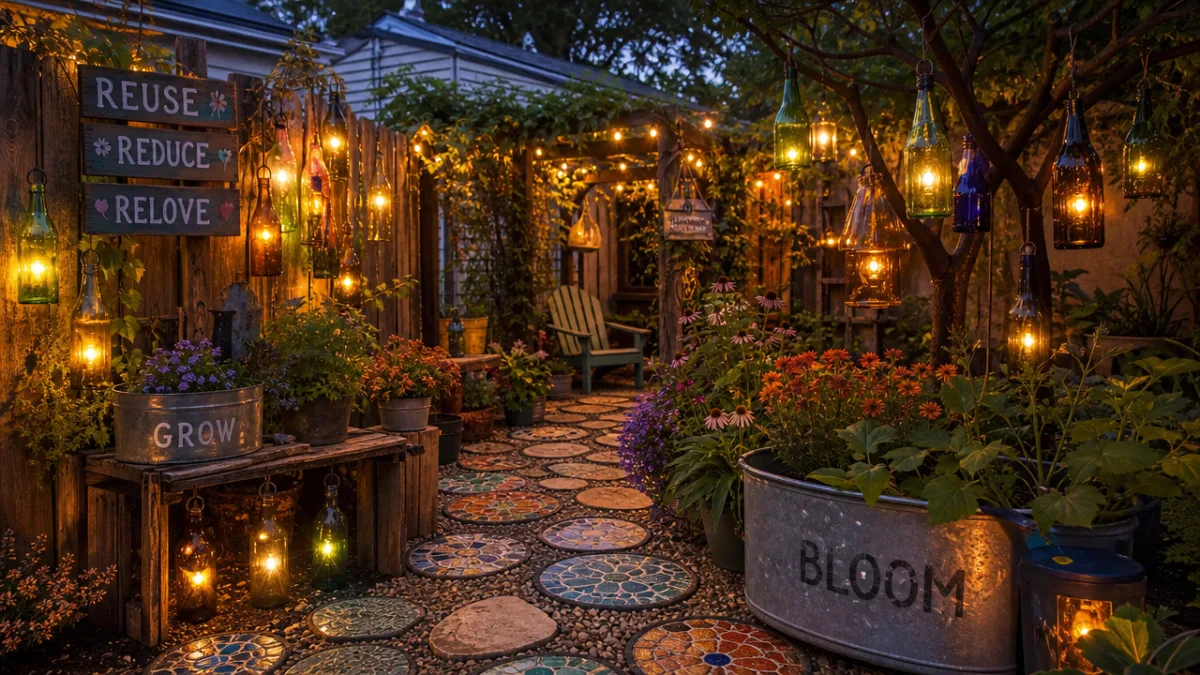
Lighting adds a final, magical dimension to the upcycled garden that transforms the space after sunset. Old glass bottles, filled with solar fairy lights, glow beautifully along pathways or hung from tree branches. Vintage lanterns found at thrift stores, fitted with solar inserts, provide ambient light without any electrical installation. Tin cans punched with patterns and fitted with tea lights cast intricate shadow patterns across garden walls and fences on summer evenings, creating an atmosphere that far exceeds what their humble origins might suggest. The upcycled garden, illuminated by salvaged light sources on a warm evening, is a place of extraordinary beauty — proof that creativity and care will always outshine cost and newness.
Safety, Sustainability, and Getting the Most from Your Upcycled Garden
While the upcycled garden is a place of creativity and environmental responsibility, it is important to approach certain salvaged materials with appropriate caution. Lead paint was widely used on household and garden furniture prior to the 1970s in many countries, and sanding or disturbing painted surfaces from this era without proper respiratory protection carries genuine health risks. Similarly, treated timbers from before the 1990s may contain chromated copper arsenate (CCA), a preservative now banned from residential use but still present in older wood. These materials are best avoided for raised beds growing food crops, though they remain suitable for purely ornamental structures. A quick test with a lead paint testing kit, available inexpensively from hardware stores, provides peace of mind when working with older painted items.
From a broader sustainability perspective, the upcycled garden sits at the intersection of environmental responsibility and practical thrift in a way that few other hobbies can match. Every kilogram of material diverted from landfill, every item of new plastic not purchased, every manufactured product not shipped represents a genuine reduction in carbon footprint and resource consumption. When upcycled gardening is combined with composting kitchen and garden waste, growing food at home, and supporting local biodiversity through plant choices and water features, the cumulative environmental benefit becomes substantial. The garden itself — once a site of conventional consumption — becomes a model of circular economy thinking applied at the domestic scale.
The most important advice for anyone developing an upcycled garden is simply to begin — to resist the paralysis of waiting for the perfect object or the right moment and instead to start with whatever salvaged materials are available right now. The upcycled garden is never finished, never perfect, and never static, and that is precisely what makes it so alive. Materials arrive, get used, get rearranged, wear out, and are replaced by new finds. The garden evolves continuously, shaped by opportunity and imagination rather than a fixed plan or a budget. Over time it accumulates layers of history and character that reflect the life being lived alongside it, becoming not just a productive and beautiful outdoor space but a genuine expression of the values, creativity, and resourcefulness of the person who tends it.








What do you think?
It is nice to know your opinion. Leave a comment.