










Recycled Crafts: Transforming Everyday Waste into Beautiful Creations
The Art and Philosophy of Upcycling
Recycled crafting is more than a hobby — it is a mindset that challenges us to look at ordinary discarded objects and see extraordinary potential. When we reframe a glass jar as a candle holder, a cardboard tube as a stamp, or a worn denim jacket as the foundation for an embroidered masterpiece, we are participating in a long tradition of human creativity and resourcefulness. The philosophy of upcycling invites us to slow down, observe our surroundings, and ask a simple but powerful question: what else could this become?
Throughout history, people have repurposed materials out of necessity, sewing quilts from fabric scraps, building furniture from salvaged wood, and turning tin cans into storage. Today, recycled crafting has evolved into a celebrated art form embraced by designers, educators, and everyday makers alike. What was once born of scarcity is now driven by environmental awareness and aesthetic curiosity. The modern upcycler is motivated not just by saving money, but by a genuine desire to reduce waste and participate in a more conscious, circular economy.
The psychological benefits of recycled crafting are equally compelling. There is a deep satisfaction in transforming something destined for a landfill into an object of beauty or utility. Studies in occupational therapy and psychology consistently show that hands-on creative work reduces stress, sharpens focus, and builds a sense of accomplishment. When that creative work is also environmentally responsible, the sense of purpose deepens further. Recycled crafts invite us into a virtuous cycle of creativity, sustainability, and personal well-being.
Essential Materials and How to Source Them
One of the most appealing aspects of recycled crafting is that the raw materials are essentially free and available everywhere. Your own home is the best starting point. Before tossing anything in the recycling bin, pause and consider its potential. Glass bottles and jars offer endless possibilities for storage, lighting, and decoration. Cardboard boxes and tubes can become sculptures, organizers, frames, and even furniture for children’s playrooms. Newspapers and magazines provide colorful, textured paper for decoupage, origami, and collage work.
Beyond your home, community resources open up a world of materials. Thrift stores carry glass, ceramics, fabric, wood, and metal at minimal cost. Neighborhood buy-nothing groups and online marketplaces frequently offer free fabric scraps, leftover hardware, old picture frames, and broken furniture that crafters can repurpose magnificently. Local businesses are often willing to set aside materials they would otherwise discard — bakeries may offer burlap coffee sacks, printing companies may give away sample paper stacks, and fabric stores often sell or donate their remnants and selvedge edges.
Building a thoughtful collection of basic crafting supplies alongside your recycled materials makes every project more achievable. A few key tools and adhesives go a long way:
- Strong craft glue and a hot glue gun for bonding mixed materials quickly and securely
- A sharp craft knife and cutting mat for precision work with cardboard, paper, and thin plastics
- Acrylic paints and brushes for transforming surfaces and adding color to any base material
- Sandpaper in various grits for smoothing wood, preparing surfaces, and distressing finishes
- Twine, wire, and ribbon for binding, hanging, and adding decorative texture to finished pieces
- Mod Podge or a DIY flour-and-water paste for decoupage projects using paper and fabric
Organizing your materials as you collect them makes the difference between an inspiring creative space and an overwhelming clutter disaster. Simple systems — labeled boxes by material type, a dedicated shelf for glass, a bin for fabric scraps — keep your workspace functional and your creativity flowing freely rather than getting bogged down in searching for what you need.
Paper and Cardboard Projects for All Skill Levels
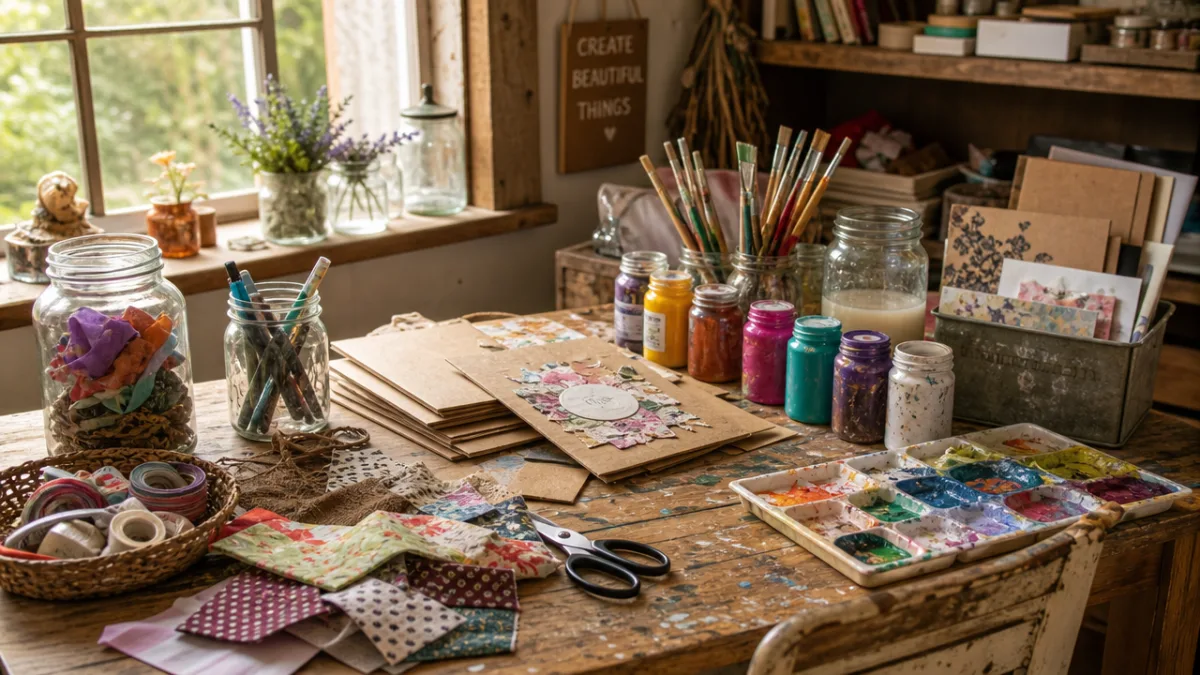
Paper and cardboard are among the most versatile and accessible recycled crafting materials. Their low weight, ease of cutting, and receptiveness to paint, glue, and ink make them ideal for crafters of every age and skill level. Beginners can start with simple newspaper collages or hand-rolled paper beads made from magazine strips — projects that require only scissors and glue but produce surprisingly beautiful results. More advanced crafters can explore architectural cardboard sculpture, constructing miniature buildings, geometric abstractions, or functional organizers entirely from packaging materials.
Decoupage is one of the most rewarding paper-based recycled crafts, allowing you to completely transform the surface of almost any object — boxes, furniture, vases, trays — using torn or cut paper layered with adhesive medium. Old maps, vintage book pages, patterned tissue paper, and colorful magazine images all become design elements in this technique. The finished surface, once sealed, is surprisingly durable and water-resistant, making decoupage items genuinely functional as well as decorative. A set of mismatched storage boxes can be unified and beautified in an afternoon with nothing more than old newspapers and Mod Podge.
Papier-mâché opens up even more sculptural possibilities, allowing crafters to build three-dimensional forms over armatures made from balloons, wire, or crumpled foil. Traditional papier-mâché uses strips of newspaper soaked in a paste of flour and water, layered repeatedly to build thickness and strength. Once dry, the surface can be sanded smooth and painted with acrylics to achieve almost any finish — from rustic and textured to smooth and glossy. Bowls, masks, wall art, and decorative animals are all achievable through this ancient technique using only discarded newspaper and kitchen pantry staples.
Upcycling Glass, Metal, and Plastic
Glass is one of the most beautiful and rewarding materials to work with in recycled crafting. Its transparency, weight, and the way it interacts with light make finished pieces feel luxurious despite the humble origins of the materials. Wine bottles can be transformed into elegant vases, pendant lights, or garden edging. Mason jars and pasta sauce jars become lanterns, terrariums, bathroom organizers, and gift packaging. With a glass cutter and a few safety precautions, more adventurous crafters can even cut glass bottles cleanly to create drinking glasses, planters, or mosaic tiles.
Metal cans are similarly versatile once their sharp edges are addressed safely. Punched tin lanterns, made by hammering nail holes into a pattern on a filled-with-ice tin can, cast gorgeous starlight patterns when a candle or LED tea light is placed inside. Larger cans make excellent planters for herbs, with a coat of spray paint giving them a polished, intentional look. Old silverware — bent, soldered, or drilled — has become a popular medium for jewelry, wind chimes, garden markers, and wall art. Even aluminum foil, often discarded after a single use, can be saved, cleaned, and repurposed for embossed art or used as a mold release layer in resin casting.
Plastic is the most complex material in the recycled crafter’s toolkit, requiring a bit more care and creativity. Plastic bottles can be cut and shaped into flowers, garden cloches, hanging planters, and bird feeders. Plastic bags can be fused together with an iron between sheets of parchment paper to create a durable, waterproof fabric suitable for tote bags and wallets. Old CDs and DVDs, which would otherwise be impossible to recycle conventionally, make stunning mosaic tiles that catch and scatter light beautifully. Plastic lids in various sizes become painting stamps, sorting trays, or even weaving looms for small fiber projects.
Fabric and Textile Recycling for the Creative Home
Fabric and textile waste represents one of the largest and most urgent categories of household waste worldwide. The fashion industry’s rapid cycles mean that clothing becomes unwanted long before it wears out, and worn garments are often discarded even when large portions remain entirely usable. Recycled textile crafting addresses this problem joyfully, transforming old clothing, linens, curtains, and fabric scraps into quilts, rugs, tote bags, home accessories, and wearable art. Even garments too damaged for donation can yield useful fabric: a stained shirt becomes a stack of polishing cloths; a ripped pair of jeans becomes the raw material for a patchwork cushion cover.
Rag rugs are among the oldest and most satisfying textile recycling projects. Made by braiding, crocheting, weaving, or knotting strips of fabric cut from old clothes and linens, rag rugs are functional, durable, and deeply personal — each one a textile record of the garments and household linens that shaped daily life. No special equipment is needed to braid a simple oval rug; the technique can be mastered in an afternoon and requires only fabric strips and a large blunt needle for sewing the coils together. More elaborate versions use a loom or a simple cardboard loom made from a repurposed box.
Quilting is perhaps the most celebrated form of textile recycling, with a rich cultural history in communities around the world. Modern quilters continue this tradition with great creativity, piecing together fabric from old shirts, dresses, curtains, and even neckties to create quilts that function simultaneously as warm bedcovers and as visual narratives. Memory quilts — made from a loved one’s clothing after their passing, or from a child’s outgrown garments — carry extraordinary emotional weight. Even sewers without much experience can complete a simple patchwork quilt using a basic grid pattern and a sewing machine, or by hand-stitching each seam with patience and care.
Beyond rugs and quilts, recycled fabric opens up a wide landscape of project possibilities across all skill levels:
- Tote bags and market bags sewn from old curtains, upholstery fabric, or denim jeans
- Fabric bunting and garlands cut from patterned shirts and sewn or glued to twine
- Stuffed animals and soft sculptures filled with repurposed stuffing from worn-out pillows
- Embroidered patches cut from denim and stitched onto jackets, bags, or framed as art
- Braided or twisted fabric jewelry, including bracelets, necklaces, and hair accessories
- Draught excluders sewn from old trouser legs and filled with rice or dried beans
Recycled Crafts for Children and Educational Settings
Recycled crafts are uniquely powerful in educational contexts, offering children hands-on engagement with concepts of sustainability, creativity, and resourcefulness that no textbook can deliver as effectively. When a child builds a rocket ship from cardboard tubes and bottle tops, they are not just making something fun — they are learning to see the world as a reservoir of possibility, internalizing the idea that waste is really just an invitation to imagine. Teachers and parents around the world have long known that the most engaging craft projects are often built entirely from the recycling bin rather than from expensive store-bought craft kits.
Simple projects that work beautifully with children include egg carton insects and flowers, toilet roll animals and puppets, plastic bottle terrariums, and newspaper hats and boats. These projects require minimal preparation, minimal mess, and minimal cost, yet they engage children’s imaginations deeply. The open-ended nature of recycled crafting is particularly valuable for children’s creative development — unlike a paint-by-numbers kit, a pile of cardboard scraps and glue invites pure invention, encouraging divergent thinking and problem-solving skills that translate into every area of learning.
In classroom settings, recycled crafting can be integrated across the curriculum in meaningful ways. An art class can explore texture, color, and form through collage made from magazine cuttings. A science class can build model ecosystems inside plastic bottle terrariums. A history class can research and recreate traditional crafts from other cultures using simple recycled materials as stand-ins for historically authentic ones. A design and technology class can challenge students to build the tallest possible structure from newspaper and tape, or to engineer a bridge from cardboard that can hold a textbook. The possibilities are genuinely limitless, constrained only by imagination.
Sharing Your Work and Building a Recycled Crafting Community
One of the most energizing aspects of the recycled crafting movement is its inherently communal nature. Crafters have always gathered to share techniques, exchange materials, and inspire one another, and the digital age has expanded these communities to a global scale. Pinterest boards dedicated to upcycling and recycled crafts gather millions of ideas in one searchable visual space. Instagram and TikTok have made it possible to share a finished project with a worldwide audience within minutes, and the response — comments, saves, shares, followers inspired to try the same thing — creates a feedback loop of creative motivation that keeps makers returning to their workbenches.
Local crafting communities offer something that online spaces cannot fully replicate: the physical experience of making alongside others. Craft swaps, where participants exchange recycled materials and handmade items, create opportunities for connection and resource sharing that benefit everyone involved. Community upcycling workshops — run by libraries, community centers, schools, and independent crafters — teach practical skills while building social bonds across age groups and backgrounds. When an experienced crafter teaches a neighbor how to make a rag rug from old T-shirts, both people gain something valuable: one gains a skill, and the other gains the deep satisfaction of sharing knowledge.
Starting your own recycled crafting community is more accessible than it might seem. A monthly craft night among friends, a neighborhood material swap organized through a local Facebook group, or a workshop offered at a community garden or library — all of these can spark a local culture of creative sustainability. The key is to keep the atmosphere welcoming and non-prescriptive, emphasizing experimentation and play over perfection. When people feel free to try things, fail cheerfully, and try again, the crafting table becomes a place of genuine joy and connection that extends well beyond the finished objects it produces.
Ultimately, recycled crafting is about far more than the objects it creates. It is a practice of attention — learning to see the overlooked, the discarded, and the ordinary with fresh eyes. It is a practice of humility — working with what you have rather than always reaching for the new and the perfect. And it is a practice of hope — a daily, tangible expression of the belief that transformation is always possible, that beauty can emerge from the most unlikely places, and that individual creative choices, made consistently and joyfully, can add up to something genuinely meaningful for the planet we all share.








What do you think?
It is nice to know your opinion. Leave a comment.