










Experts Swear By These Organization Ideas for Keeping Your Pantry Clutter-Free
Why Pantry Organization Is Worth the Investment
A well-organized pantry is about so much more than looking pretty — it’s a working system that quietly saves you time, money, and stress on a daily basis. When your pantry is a mess, you end up buying things you already have, watching food expire in the back of a shelf, and burning five minutes every night just trying to find the pasta. Professional organizers consistently rank the pantry as one of the most impactful spaces in the whole house, and for good reason: it gets used constantly and touches your daily routine in ways few other spaces do.
The average household throws away a staggering amount of food every year, and a lot of it comes down to things getting shoved to the back of a shelf and forgotten. Food waste researchers have found that better storage visibility alone can cut that waste by as much as thirty percent. When you can actually see what you have, you naturally grab the older stuff first, use things before they go bad, and make smarter calls at the grocery store. So really, getting organized isn’t just a nice-to-have — it saves money and reduces waste at the same time.
Here’s something that professional organizers, interior designers, and home efficiency experts all agree on: a clutter-free pantry starts with intention, not a shopping cart full of bins. Before you buy a single container or label, take a step back and think about how your household actually uses the pantry. What do you cook most? What does your kid need to grab on their own? What can safely live out of the way? Once you’ve answered those questions, the tools you choose will actually serve you — and you’ll be a lot less likely to abandon the whole system three months in.
The First Step: A Full Pantry Audit
Any organizer worth listening to will tell you the same thing: before you organize, you edit. Pull absolutely everything out of your pantry and spread it across the kitchen table or counter. Yes, everything. It feels chaotic at first, and that’s okay — it’s supposed to. You can’t build a useful system around clutter, and you won’t know what storage solutions you actually need until you can see the full picture. Try to think of it as a fresh start rather than a giant mess to deal with.
As you go through everything, sort it into three piles: keep, donate, and toss. Check expiration dates while you’re at it — if something has been lurking in the back of a cabinet for two years, it’s probably time to let it go. Anything that’s still sealed and in date but just not something your family eats is a great candidate for a local food bank. This step alone can seriously shrink the volume of what you need to store, which makes everything that comes next a whole lot easier.
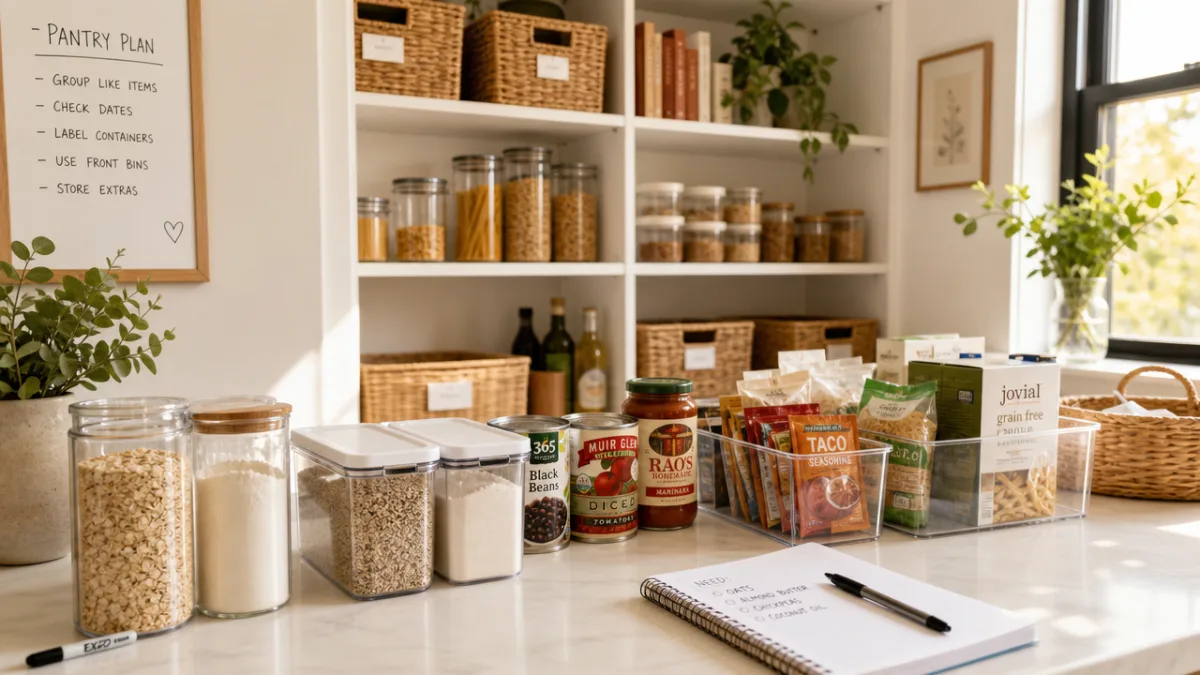
Once you’ve got your keep pile sorted out, group items by category before putting anything back. Think baking supplies, canned goods, grains and pastas, snacks, breakfast stuff, condiments, oils and vinegars, spices — whatever makes sense for your household. Seeing all your categories laid out at once gives you a real sense of how much space each one needs, and helps you plan out your shelves strategically. It also reveals some surprises — maybe you have a mountain of baking supplies but no real snack zone, which explains why mornings and after school feel like a free-for-all every single day.
Choosing the Right Containers and Storage Solutions
Once you know what you’re actually storing, you can make smart choices about containers instead of just guessing. Clear, airtight canisters are the number one recommendation from professional organizers, and the logic is hard to argue with: you get visibility and freshness in one product. When dry goods like flour, sugar, rice, oats, and pasta move out of their original packaging and into uniform clear containers, the visual clutter disappears, the food stays fresh longer, and you can tell at a glance when you’re running low. The matching containers also give the whole pantry a calm, intentional feel instead of a jumbled one.
Stackable bins and pull-out baskets are another game-changer, especially on deeper shelves where things tend to disappear into the back and never come out. Pull-out drawers let you see everything in a deep cabinet without having to dig around. For canned goods, tiered shelf risers or rolling can organizers that bring the oldest cans forward automatically are incredibly helpful — they prevent the classic pile-of-cans problem and keep your first-in, first-out rotation working without any extra effort on your part.
Consider these expert-recommended container and storage categories when building out your system:
- Airtight canisters — ideal for grains, flours, sugars, cereals, and any dry good prone to staleness or pest attraction
- Stackable bins with labels — great for grouping snack bars, pouches, or irregularly shaped packaging that does not stand on its own
- Pull-out basket drawers — perfect for deep shelves where visibility is limited without physical effort
- Lazy Susans or turntables — excellent for corner spaces, oils, condiment bottles, and spice jars
- Over-the-door organizers — a frequently underutilized solution that dramatically expands storage without taking up shelf space
- Tiered can organizers — keep canned goods visible, accessible, and properly rotated at all times
The material you choose matters more than most people think. Glass canisters look beautiful and don’t react with food, but they’re heavy and breakable — maybe not the best call if you have young kids or high shelves. BPA-free plastic is lightweight and tough, though it can scratch and absorb odors over time. Bamboo-lidded containers split the difference nicely and bring a warm, natural feel to the space. But honestly, consistency matters more than any specific material. A pantry full of matching containers — whatever they’re made of — will feel more organized and be easier to maintain than a hodgepodge of mismatched sizes and styles.
Zoning Your Pantry for Maximum Efficiency
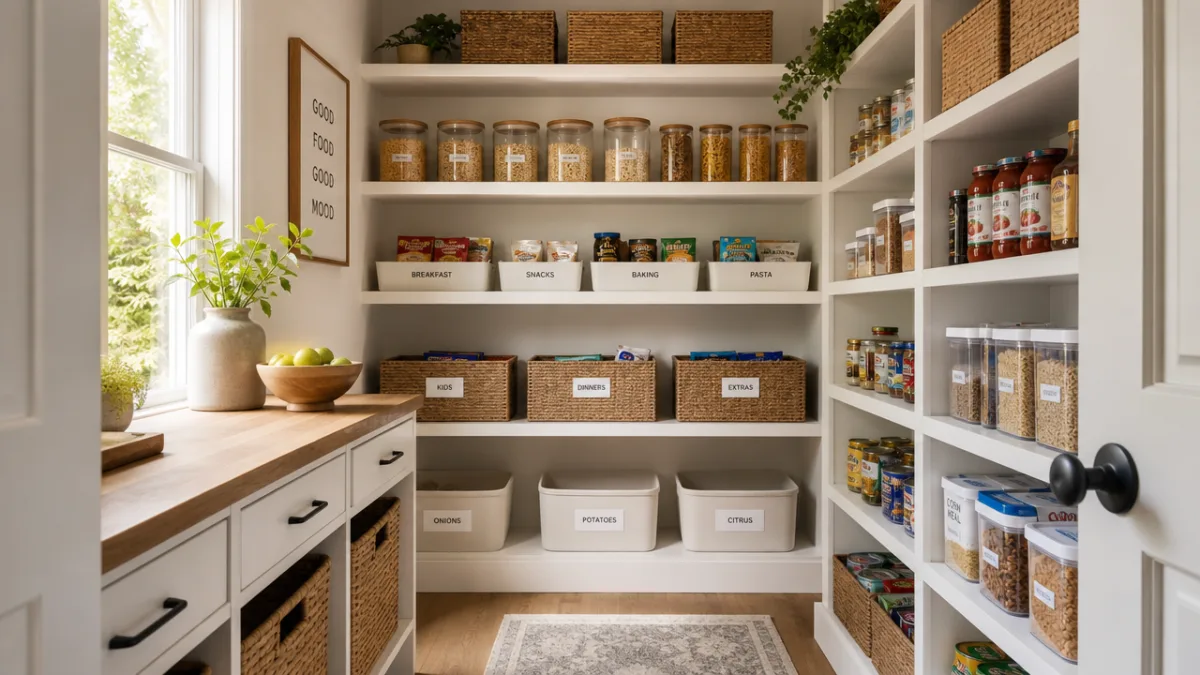
Professional organizers talk about “zoning” as one of the most powerful tools in any storage space, and the pantry is one of the best places to put it into practice. The idea is simple: you give every category of items its own dedicated area and then stick to it. When everyone in your household knows that snacks live on the second shelf to the left and baking supplies are up top on the right, the pantry becomes something you can navigate on autopilot — and keeping it tidy stops feeling like a constant battle.
Where you place each zone should come down to how often you use things and who needs to reach them. Items you grab every single day — coffee, cereal, breakfast staples, kids’ snacks — should live at the most convenient height, somewhere between eye level and waist level. Things you use less often, like specialty baking ingredients or holiday cooking supplies, can move to higher shelves or harder-to-reach spots. And anything heavy — big bags of flour, cases of water — should always be stored low, both for safety and because it’s just easier that way.
Here is a simple zoning framework that many organizing experts recommend as a starting point:
- Eye-level zone — everyday essentials: cereals, canned staples, frequently used condiments, snacks
- Below eye-level zone — cooking ingredients used several times a week: oils, vinegars, pasta, grains, sauces
- Above eye-level zone — less-used items: specialty flours, backup stock, appliances, or seasonal items
- Floor-level zone — heavy or bulky items: large water bottles, big bags of pet food, bulk purchases, appliances
- Door zone — small, frequently grabbed items: spice packets, foil, plastic wrap, small snacks, paper goods
One zoning consideration that often gets overlooked — but makes a huge practical difference — is accessibility for kids. Designating one bin or shelf at a child-friendly height as the official snack zone, stocked with pre-approved grab-and-go options, lets kids be independent about snack time without rummaging through everything else. That one small change can dramatically cut down on pantry chaos in households with young children, and it’s also a great way to teach kids early on about where things belong and why that matters.

Labeling Systems That Actually Work Long-Term
Labels are the unsung heroes of any organization system that actually lasts. Without them, even the most beautifully set-up pantry will slowly drift back into chaos as people put things back in the wrong spots or forget which container holds what. Labels create a shared language in your kitchen — they remove the guesswork, speed up cooking and meal prep, and make grocery restocking easier because you can see at a glance exactly what’s running low and where it lives.
The key to a labeling system that holds up is keeping it simple and making sure it’s durable. Experts suggest labels that are easy to read from a distance, placed consistently in the same spot on each container, and made from something that won’t peel, smear, or fade after a few months. Chalkboard labels are great if your pantry contents change often — they wipe clean and can be rewritten whenever you need, which is especially handy for bins and baskets that might hold different things by season. A label maker gives you a cleaner, more polished look and is a solid choice for clear canisters where you want everything to feel intentional and tidy.
Beyond basic content labels, it’s worth getting into the habit of adding expiration date stickers to items when you bring them home from the store. It takes less than a minute per grocery run and can save a surprising amount of food waste over the course of a year. Some organizers also recommend labeling the shelf itself — not just the container — so that even when a bin is removed or sitting empty, the zone is still clear and things get put back in the right place. These small, consistent habits are exactly what separate a pantry that stays organized for years from one that falls apart within a few weeks.
Maintaining Your Organized Pantry Over Time
The biggest mistake people make after a big organizational overhaul is treating it like a one-and-done project. An organized pantry doesn’t maintain itself — it needs small, consistent attention built into your regular routine. The good news is that once a solid system is in place, keeping it up takes a fraction of the effort that the original setup required. Experts figure a well-designed pantry only needs about five to ten minutes of attention per week, which is nothing compared to the daily frustration of navigating a disaster zone.
Tying pantry maintenance into your grocery routine is one of the most effective things you can do. Before you put away new groceries, spend sixty seconds scanning what’s already there — note what’s getting low, pull anything close to expiration toward the front, and fish out anything that’s been forgotten in the back. When you put new groceries away, always tuck them behind the older stuff. This first-in, first-out approach is something professional organizers have borrowed directly from restaurants and retail, and it works just as well at home.
A quick monthly reset — even just fifteen minutes — keeps small messes from snowballing into bigger ones. It doesn’t need to be a full audit like the one you did at the start; just pull out whatever category has gotten messy, do a quick re-sort, wipe down the shelf, and put things back. Done monthly, this kind of light maintenance keeps your pantry in great shape year-round and means you’ll never need another major overhaul. Think of it as a small investment in one of the hardest-working spaces in your home.
And finally, get everyone in the household involved. Show your kids where things go and make putting food away a shared responsibility. If guests or family members are helping in the kitchen, take thirty seconds to walk them through the system so they can participate rather than accidentally undo it. At the end of the day, a pantry is a shared resource — and the more people who understand how it works, the more naturally it sustains itself. The best organization system isn’t the one that looks most impressive in photos. It’s the one that holds up through real, daily life, month after month, year after year.








What do you think?
It is nice to know your opinion. Leave a comment.