










25 Rugs You’d Never Guess Were Painted: The Ultimate Guide to Painted Floor Rugs
The Art of the Painted Rug: A Creative Revolution in Home Décor
There is a quiet revolution happening on the floors of homes around the world, and it involves little more than paint, a steady hand, and a willingness to think differently about interior design. Painted rugs — designs applied directly to hardwood, concrete, or even plywood floors — have emerged as one of the most surprisingly convincing and budget-friendly ways to transform a living space. What once seemed like a compromise for those who couldn’t afford the real thing has evolved into a genuine art form, capable of producing results so realistic and beautiful that guests routinely drop to their knees to touch what they’re certain must be woven fabric.
The appeal of painted rugs goes far beyond mere economics, though the savings are undeniably significant. A hand-painted rug on a hardwood floor can cost a fraction of a quality woven rug, yet deliver the same visual warmth, definition, and personality to a room. For homeowners who rent and cannot install permanent flooring changes, or for those who simply want the flexibility to update their décor without major investment, a painted rug offers an extraordinary degree of creative freedom. The design possibilities are virtually limitless, from traditional Persian and Turkish-inspired patterns to bold geometric shapes, vintage Moroccan motifs, and custom color palettes that perfectly match existing furnishings.
Perhaps most remarkably, the techniques required to create a convincing painted rug have become far more accessible in recent years. With the proliferation of online tutorials, specialized paints, and stenciling tools, even those without formal artistic training can achieve results that would have seemed miraculous a decade ago. Chalk paint, floor paint, latex enamel, and even standard acrylic craft paints have all been used successfully to create stunning floor designs. The key lies in understanding the right materials for each surface type, and in learning the layering and sealing techniques that give a painted rug its durability and its uncanny, tactile-looking depth.
Choosing the Right Surface and Paint for Your Painted Rug
The foundation of any successful painted rug project is a thorough understanding of the surface you are working with, because not all floors respond the same way to paint, and the wrong combination of materials can lead to peeling, cracking, or a finish that simply doesn’t have the visual depth of a convincing rug design. Hardwood floors are among the most popular surfaces for painted rugs, and for good reason: their smooth, consistent texture provides an ideal canvas, and the natural wood grain that shows faintly through a translucent base layer can actually add to the realism of the final design, mimicking the subtle texture variations found in woven textiles.
Concrete floors, which have become increasingly popular in modern and industrial-style homes, present a different set of opportunities and challenges. Their slightly porous nature means they absorb paint more readily, which can create beautiful matte effects that closely resemble the flat weave of a kilim or dhurrie rug. However, this same porosity means that multiple coats of a good-quality concrete sealer are essential to protect the finished design and prevent moisture from working its way under the paint layers over time. Plywood subfloors, often found in older homes during renovation projects, are another surprisingly excellent surface for painted rugs, as their smooth face grain takes paint evenly and can be sanded to a near-perfect smoothness before any design work begins.
When it comes to paint selection, the choices can feel overwhelming, but a few key principles simplify the decision considerably. For floors that will receive heavy foot traffic, a floor-specific enamel or porch-and-floor paint offers the best combination of durability and color vibrancy. Many professional painters and dedicated hobbyists swear by chalk paint for its exceptional coverage, easy distressing properties, and compatibility with almost any sealer product. Whatever paint type you choose, always apply a primer appropriate to your surface type before beginning your design work, and plan for a minimum of two finish coats over your design layers to ensure the colors are rich and fully opaque.

25 Styles That Fool Every Eye: The Most Convincing Painted Rug Designs
The range of painted rug designs that have fooled even the most discerning interior design enthusiasts is truly astonishing, and exploring these styles reveals just how far the craft has advanced. Persian and Oriental-inspired designs remain perennial favorites, and with good reason: their intricate medallion centers, flowing border patterns, and rich color combinations of deep red, navy, ivory, and gold translate beautifully to a painted surface. When executed with careful attention to the characteristic layering and shading techniques of traditional Persian carpet design, these painted versions can be virtually indistinguishable from their woven counterparts in photographs, and highly convincing even under direct examination.
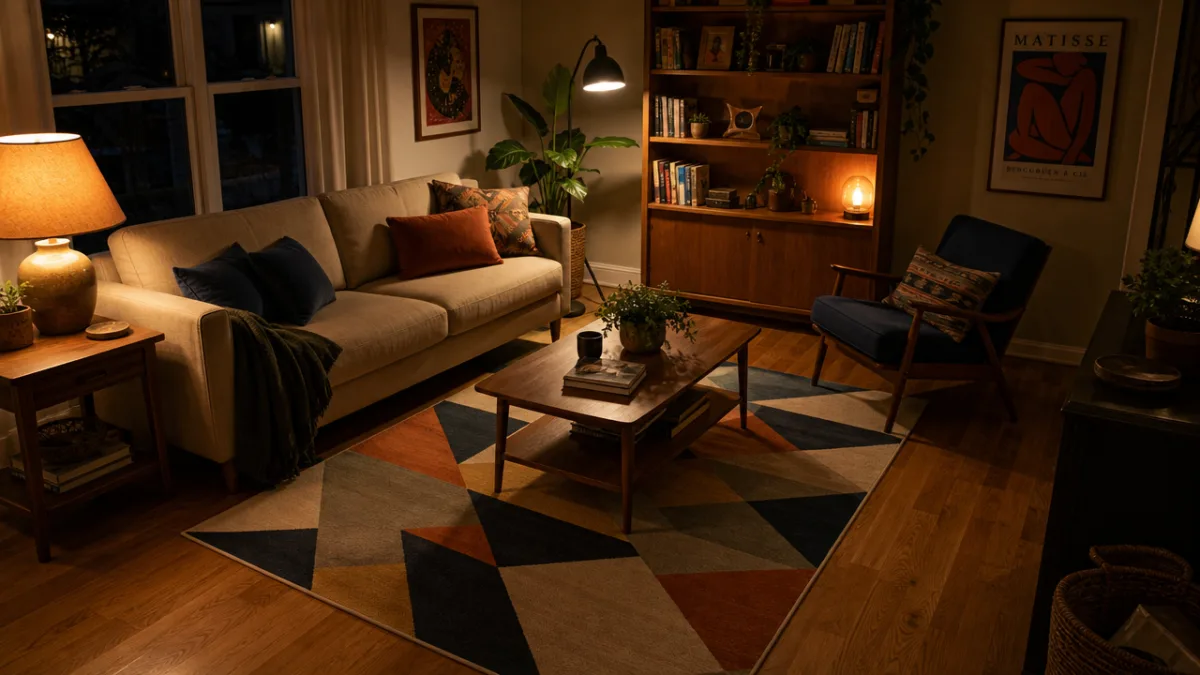
Among the twenty-five styles most frequently cited as the most convincing painted rugs, a diverse array of aesthetic traditions is well represented. Some of the most popular and successful include the following approaches, each with its own set of techniques and materials that contribute to its realism and visual impact. Geometric Moroccan patterns with their bold star motifs and interlocking angular shapes work exceptionally well as painted designs because their strong lines can be executed cleanly with painter’s tape and stencils. Vintage Turkish kilim designs, with their flat graphic quality and bold color contrasts, are another strong choice for beginners because the absence of heavy shading makes them more forgiving while still delivering dramatic results.
- Persian Medallion Rugs: These feature a central medallion surrounded by intricate floral and arabesque borders, and are most convincing when painted with multiple thin, transparent glaze layers that build depth and suggest the dimensional quality of woven pile.
- Moroccan Trellis Patterns: Characterized by their repeating diamond or ogee trellis grids, these designs translate beautifully to painted floors and are among the easiest for beginners to execute using commercial stencils.
- Vintage Beni Ourain Style: These minimalist Berber-inspired designs feature simple diamond and lozenge shapes on a cream or ivory background and are remarkably easy to paint while achieving a high-end, editorial look.
- Flat-Weave Kilim Designs: With their graphic, almost pixelated geometric patterns, kilim-style painted rugs have a folk art quality that looks genuinely handmade and highly authentic.
- Traditional Dhurrie Striped Patterns: Simple horizontal or diagonal stripe combinations can be executed with painter’s tape for crisp, clean edges and produce a sophisticated result that reads as genuinely textile-based.
- Antique Faded Oriental Designs: By deliberately layering and partially distressing paint, skilled painters can create the convincing appearance of a centuries-old rug with beautifully faded, time-worn colors.
- Contemporary Abstract Designs: Free-form brushwork in a controlled palette can produce stunning modern art rug effects that would be extraordinarily expensive to achieve in actual woven form.
Beyond these individual styles, some of the most breathtaking painted rugs combine elements from multiple traditions, creating genuinely one-of-a-kind designs that could not exist as manufactured products. A homeowner in a Victorian-era house might blend traditional Oriental border patterns with a contemporary color palette of blush, sage, and charcoal, producing something that feels both historically rooted and thoroughly modern. These hybrid approaches represent the ultimate expression of what painted rugs make possible: the freedom to design something perfectly suited to a specific space, personality, and aesthetic vision, without being constrained by what happens to be commercially available at any given moment.
Step-by-Step Techniques Used by the Best Painted Rug Artists
Understanding the specific techniques that the most skilled painted rug artists employ is essential for anyone hoping to move beyond basic stenciling and achieve genuinely professional, convincing results. The process invariably begins long before any paint touches the floor, with careful planning and precise measurement. Successful painters almost universally recommend sketching the design to scale on graph paper first, then transferring the overall dimensions and key reference points to the floor using chalk lines and a long straight edge. This planning phase determines not only the overall dimensions and placement of the rug but also the proportional relationship between the central field and the surrounding border, which is one of the most critical factors in making a painted rug look authentically rug-like rather than like a simple floor stencil.
The layering sequence used in professional painted rug work is another area where technique dramatically separates convincing results from amateurish ones. The most skilled practitioners almost always begin with a solid base coat in the dominant background color of the rug design, applying two full coats and allowing complete drying time between each. They then add the largest design elements — typically the main border pattern and the overall field color transitions — before working progressively inward toward finer details. This approach mirrors the way actual rugs are constructed, with the underlying structure established first and decorative detail added on top, and it produces a natural sense of visual hierarchy that contributes powerfully to the overall realism of the finished piece.
Shading and highlighting techniques deserve special attention, as they are often the difference between a painted rug that genuinely fools the eye and one that reads clearly as painted from across the room. In a real woven rug, the pile of the yarn catches light differently depending on the direction in which it lays, creating subtle shadows and highlights that give the surface a dimensional, almost luminous quality. Skilled painted rug artists replicate this effect by adding thin, semi-transparent layers of a slightly lighter or darker value over the base colors in strategic areas, particularly along the edges of major design motifs and within the larger field areas. This technique, borrowed directly from fine art painting, is what gives the most convincing painted rugs their remarkable three-dimensional quality.

Essential Tools for Painted Rug Projects
Having the right tools assembled before beginning a painted rug project makes an enormous practical difference to both the process and the outcome. Beyond the obvious requirements of paint and brushes, several specialized tools have proven invaluable to painted rug artists working at every skill level. High-quality painter’s tape — specifically the type designed for use on delicate surfaces — is perhaps the single most important tool in the painted rug artist’s kit, as it enables the crisp, clean edges that give geometric designs their professional, finished appearance. For complex curved or floral patterns, commercially available rug stencils, which are available in a wide range of traditional and contemporary designs, dramatically reduce both the time required and the level of artistic skill needed to achieve convincing results.
- Floor-specific enamel or chalk paint in your chosen color palette
- High-adhesion primer appropriate to your floor surface type
- Delicate-surface painter’s tape in multiple widths (1-inch and 2-inch are most useful)
- Commercial rug stencils or custom-cut Mylar stencils for repeating patterns
- A set of artist’s brushes in multiple sizes for detail work and shading
- Dense foam rollers for smooth, even base coat application
- Chalk lines for establishing precise layout measurements
- A water-based polyurethane floor finish in matte or satin sheen for sealing
Sealing, Protecting, and Maintaining Your Painted Rug
A painted rug that is not properly sealed and protected is a painted rug that will not last, and the sealing process is therefore one of the most critical — and most frequently underestimated — stages of the entire project. The ideal sealer for most painted rug projects is a water-based polyurethane floor finish, which offers excellent durability, resistance to scratching and scuffing, and the important advantage of not yellowing over time the way oil-based products can. Most painted rug professionals recommend applying a minimum of three to four coats of sealer, with light sanding using a very fine-grit sandpaper between each coat after the first one. This multi-coat approach builds up a protective surface that is genuinely thick and resilient enough to withstand years of regular foot traffic without showing significant wear.
The sheen level of the sealer you choose will have a profound impact on the final appearance of your painted rug, and this decision deserves careful consideration before you begin the finishing process. A high-gloss finish will make colors appear more vivid and saturated, and will be the easiest to clean, but will also look distinctly painted and may reduce the textile-like realism you have worked hard to achieve. A matte finish, by contrast, will provide the most convincing textile-like appearance, as actual woven rugs rarely have a reflective surface, but matte sealers tend to show scuff marks and require more frequent reapplication in high-traffic areas. A satin finish represents an excellent middle ground for most applications, offering good durability and cleanability while retaining a low enough sheen to keep the design reading as believably textile in quality.
Long-term maintenance of a painted rug is simpler than many homeowners expect, though it does require some consistent attention to keep the finish looking its best. Regular sweeping or gentle vacuuming to remove abrasive grit and dust is the single most important maintenance practice, as it is tiny particles of dirt ground underfoot that cause the most wear to a painted surface over time. Damp mopping with a well-wrung mop and a mild, pH-neutral cleaner is perfectly safe for a well-sealed painted rug, and will keep the surface looking clean and fresh without degrading the sealer. When scuffs or minor scratches do appear over the years, spot-reapplication of sealer to the affected area — or a full recoating of the entire design every several years — will restore the surface to like-new condition and extend the life of the painted rug indefinitely.
Inspiration, Community, and Where to Find the Best Painted Rug Ideas
One of the most exciting aspects of the painted rug movement is the thriving community of artists, designers, and enthusiastic amateurs who share their work, techniques, and inspiration across a wide range of online platforms. Pinterest remains the undisputed hub of painted rug inspiration, with hundreds of thousands of pins documenting projects ranging from simple two-color geometric designs executed by first-time DIYers to breathtakingly complex Oriental medallion designs that represent dozens of hours of skilled work by experienced decorative painters. The visual nature of the platform makes it ideal for this particular craft, and the ability to organize inspiration images into dedicated project boards helps enormously when planning a new design and trying to establish a coherent color palette and style direction.
Beyond Pinterest, Instagram has become an increasingly important platform for the painted rug community, with a growing number of professional decorative painters and dedicated hobbyists documenting their projects through process videos and before-and-after reveals that have attracted large and enthusiastic followings. These accounts are invaluable not only for inspiration but also for the practical tips and product recommendations that creators share in their captions and stories. Many of the most followed painted rug creators also offer online workshops, downloadable stencil templates, and step-by-step video courses that have made it possible for people with no prior painting experience to achieve genuinely impressive results on their first attempt.
The broader movement toward creative, budget-conscious interior design has also elevated the painted rug from a niche craft curiosity to a genuinely respected design solution that appears in mainstream shelter magazines, professional interior design portfolios, and even high-end vacation rental properties where distinctive, Instagram-worthy floor treatments are a valued differentiator. This mainstreaming of the painted rug has driven significant innovation in both the tools and materials available to practitioners, with specialty paint brands developing floor-specific formulations that offer better adhesion, more vibrant color options, and improved durability compared to the standard house paints that earlier generations of painted rug enthusiasts had to make do with. The result is a craft that has never been more accessible, more beautiful in its potential outcomes, or more richly supported by community knowledge and shared experience.
Getting Started: Your First Painted Rug Project
For anyone inspired to attempt their first painted rug project, the most important piece of advice from experienced practitioners is deceptively simple: start smaller and simpler than you think you need to. A modest-sized geometric design in two or three colors, executed cleanly with painter’s tape on a well-primed surface, will teach you everything you need to know about surface preparation, paint behavior, layering sequence, and sealing technique. The skills and confidence gained from a single successful small project will prepare you fully for progressively more ambitious designs, and the satisfaction of seeing a beautifully finished painted rug in your own home — knowing that you created it yourself with a few dollars’ worth of paint and a weekend’s focused effort — is one of the most rewarding experiences that the world of DIY interior design has to offer.








What do you think?
It is nice to know your opinion. Leave a comment.