










Small Space Storage Ideas With Furniture You Already Have for Renters
Why Renters Have a Unique Storage Challenge
Renting a small apartment puts you in a tricky spot that homeowners rarely have to think about. You can’t drill deep into walls without kissing your security deposit goodbye, you can’t bolt in permanent shelving, and you’re often stuck with a floor plan that was designed to be affordable rather than actually livable. The result? Your place can feel cluttered and chaotic almost from the moment you move in, even if you’re genuinely trying to keep things minimal.
Here’s the thing though — most renters already have more storage potential sitting in their apartments than they realize. The trick is stopping yourself from seeing each piece of furniture as doing just one job. Your bed isn’t only a place to sleep. Your sofa isn’t just somewhere to sit. Your dining table isn’t only for eating. Once you start looking at every piece as a potential storage system in disguise, things get a lot more interesting.
This guide is written specifically for renters who want to make the most of what they already have — no expensive new furniture, no lease violations, and nothing that can’t be undone before move-out day. Whether you’re in a studio, a one-bedroom, or a shared house, these ideas will help you take back control of your space and turn it into somewhere that actually feels calm and functional.
Maximizing Your Bed’s Hidden Storage Potential
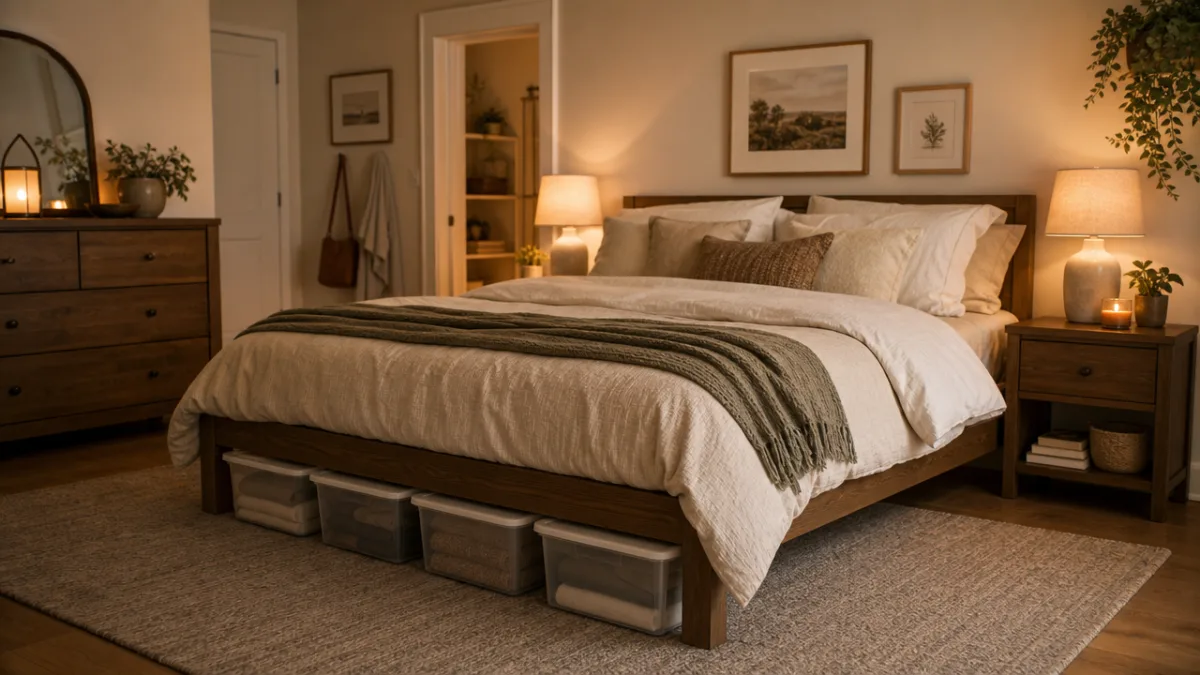
The space under your bed might be the most overlooked real estate in your entire apartment. A standard queen sits somewhere between twelve and sixteen inches off the ground, which is enough room to comfortably fit flat storage containers, seasonal clothes, extra bedding, luggage, and books. If your frame sits too low to be useful, bed risers are a cheap, damage-free fix that can give you a surprising amount of extra clearance in under ten minutes.
Flat rolling bins with lids are great here because you can slide them in and out without hauling the whole container out from under the frame. Vacuum-seal bags are even better for bulky stuff — think heavy winter coats, chunky sweaters, and thick blankets that are eating up your closet space from October through April. Rotate those under the bed seasonally and suddenly your closet has breathing room again, without adding a single new piece of furniture to your home.
The bed itself can pull extra duty too, depending on how it’s built. Headboards with shelves are great for books, a lamp, or small baskets for odds and ends. If yours is just a flat panel, try sliding a narrow console table or slim bookshelf behind it against the wall — it creates the look of a built-in headboard while giving you actual vertical storage. And don’t forget the sides of your bed. In a small bedroom, a slim rolling cart or even a little step stool can stand in for a nightstand and take up far less floor space than a traditional one.
Transforming Your Sofa and Living Room Furniture Into Storage Systems
The living room is usually where clutter piles up fastest, and it’s also where you have some of the best opportunities to use what you’ve already got more cleverly. Take your sofa — it probably sits a few inches off the ground, which is just enough space for flat things like a yoga mat, board games in shallow boxes, or a decorative tray. And if your cushions have zippered covers, those hollow interiors can actually hold small lightweight things like a spare remote, a charging cable, or a tightly rolled throw blanket.
Coffee tables might be the single best storage opportunity in any living room. If yours has a lower shelf, that’s prime space for baskets, books, and storage boxes. If it’s just a flat surface on legs, consider swapping it out temporarily for a lidded ottoman — you get hidden storage inside and a soft surface for your feet. Speaking of ottomans, a lot of renters already own one and use it purely as a footrest, never once thinking to open the top. That interior is perfect for remote controls, gaming accessories, cables, and blankets you don’t need out all the time.
Bookshelves and media consoles work best when you mix open display with some concealed storage. A few decorative baskets on the lower shelves can hide miscellaneous stuff while actually adding to the look of the room. The tops of these pieces — often just collecting random things — can hold a row of matching bins or boxes that look intentional and add real storage volume. You can even use the slim gap between the back of a freestanding bookshelf and the wall behind it for flat things like rolled gift wrap, art prints, or extra curtain panels.
Using Kitchen Furniture and Cabinets More Effectively
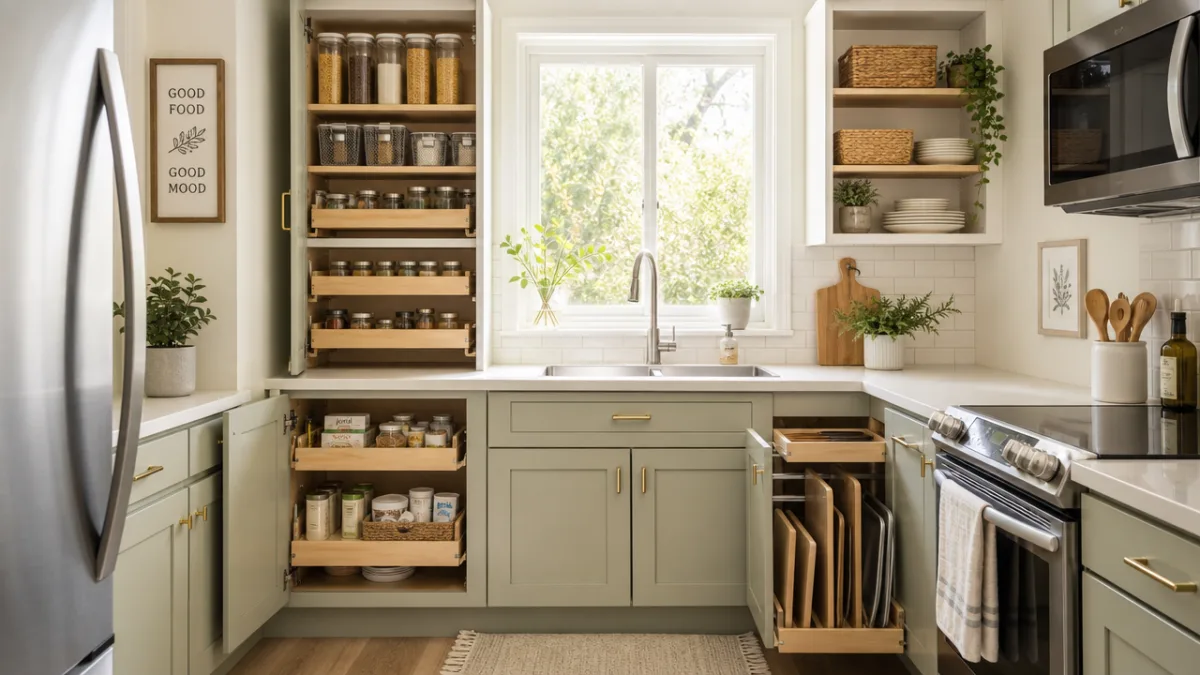
Rental kitchen cabinets have a way of feeling like they’re never enough, no matter how much stuff you try to pare down. But the honest truth is that most people use only a fraction of the storage their cabinets could actually hold. The interior vertical space in a typical cabinet, for instance, can usually fit a lot more than one layer of dishes or pots — it just doesn’t happen automatically without a little help from some simple, damage-free organizers.
Shelf risers are a game-changer here. No installation, no damage, and they let you stack dishes, mugs, or pantry items in two tiers inside a cabinet that used to hold just one row. Wire stackable shelves do the same thing in open pantry areas. The insides of cabinet doors are another spot most people completely ignore. Over-the-door organizers with hooks or pockets often attach without any screws and can hold cleaning supplies, pot lids, or spice jars — freeing up real cabinet space for the bigger stuff.
If you have a small kitchen table or a wheeled cart, those can do a lot more than you might think. A kitchen island with drawers or a lower shelf is one of the most efficient setups a renter can have — you get a workspace, a surface, and concealed storage all in one. Even a basic wheeled cart can hold small appliances and keep larger items on its lower shelf, then roll out of the way into a corner or closet when you don’t need it.
- Use tension rods vertically inside cabinets to create dividers for cutting boards, baking sheets, and pan lids, keeping them organized and easily accessible without stacking.
- Hang a pegboard on the back of a kitchen door or inside a pantry cabinet using adhesive hooks to hold frequently used utensils and small tools without any permanent wall damage.
- Stack nesting bowls and cookware to minimize the footprint of your most-used items, reserving premium cabinet space for less stackable pieces.
- Use the top of your refrigerator as a functional shelf for items used infrequently, keeping them in a single decorative bin or basket to maintain a tidy appearance.
- Install removable drawer organizers inside junk drawers to maximize the usable space and reduce the time spent searching for small items.
Repurposing Entryway and Hallway Furniture for Maximum Function
Most renters treat the entryway as basically a passthrough — a hook on the wall, a mat on the floor, and that’s it. But your entryway is actually one of the most strategically important spots in a small apartment, because anything you can catch and organize at the door never ends up drifting deeper into your space to create clutter. If you already have any piece of furniture that could reasonably live near your front door — a small bench, a narrow console table, even a spare dining chair — it can become a genuinely useful storage station.
A bench by the door, even without built-in storage, gets a lot more functional the moment you slide a basket or two underneath it. Those baskets can wrangle shoes, umbrellas, pet stuff, or reusable bags all in one spot. If your bench has a hinged seat, that compartment is great for seasonal accessories — gloves, scarves, hats in winter — or less-used items like spare keys or extension cords. Even a dining chair paired with an adhesive hook strip on the wall above it creates a makeshift coat station that stops outerwear from ending up on your bedroom floor.
Narrow console tables are a natural fit for hallways because they barely take up any floor depth while still giving you a surface and usually a lower shelf. The surface is perfect for a tray holding your daily essentials — keys, sunglasses, mail to deal with — while the shelf below can hold a shoe basket or tote bags. And the wall above, even in a no-holes rental, can work with adhesive picture-hanging strips to support lightweight floating shelves or a small pegboard organizer. Done right, a hallway that felt like dead space becomes one of the hardest-working spots in your whole apartment.
Closet Furniture Hacks That Require Zero Permanent Changes
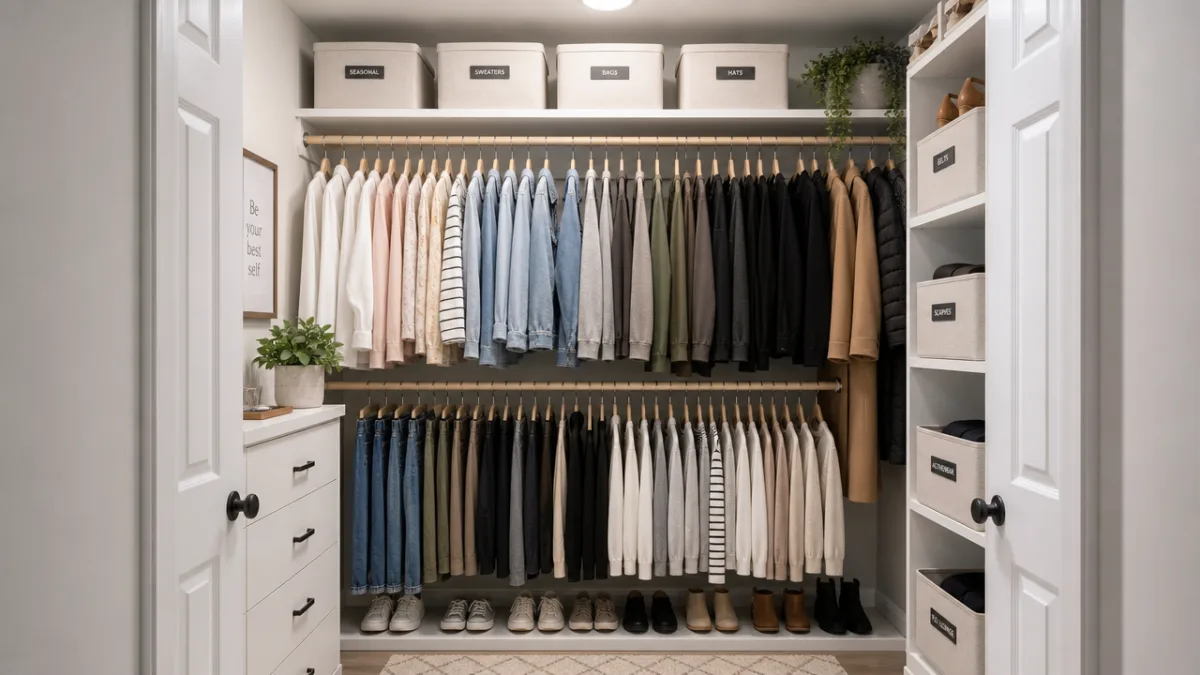
The typical rental closet comes with one hanging rod and maybe one shelf above it — which leaves an enormous amount of the closet’s actual cubic footage sitting completely empty. In a studio especially, where that closet might need to handle storage for your entire household, this can feel really limiting. The good news is you don’t need to rip anything out or install a custom system. Freestanding furniture and portable organizers can create real structure inside the closet without touching a single thing permanently.
A freestanding double-hang rod — the kind that just hooks over your existing rod — instantly turns one hanging space into two shorter ones, doubling your capacity for shirts, jackets, and folded pants. Underneath the lower rod, you now have a natural spot for a small portable dresser, a set of stacking drawers, or a shoe rack, all of which come with you when you move. Stackable clear bins on the upper shelf let you actually see what’s inside without pulling everything down, which makes a huge difference for those hard-to-see high shelves.
Shoes are probably the biggest source of closet chaos for most people, and they’re also one of the easiest problems to solve. An over-the-door shoe organizer with clear pockets hangs without screws over any closet door and can hold up to two dozen pairs without taking up any floor space at all. If you have a narrow bookshelf sitting around, repurposing it as a shoe rack inside or just outside the closet is a surprisingly clean and easy-to-maintain solution. And don’t forget the back of the closet door for hooks — bags, belts, scarves, and accessories can all live there, turning what was just a door into a genuinely functional storage wall.
Creating a Storage Mindset That Sustains Itself Over Time
Even the most thoughtfully organized apartment will slowly drift back toward chaos if your habits don’t support the systems you’ve set up. For renters, this is especially true — the constraints are ongoing, not temporary. The most important long-term habit is making sure every single thing you own has a specific place to live. When that’s true, tidying stops being a big project and turns into a quick five-minute reset instead.
Regularly taking stock of what you actually own matters just as much in a small space. Renters who’ve been in their apartments for a year or more tend to accumulate things that seemed useful at move-in but have been quietly sitting there ever since, taking up storage space that could be doing something better. A seasonal look through what’s under the bed, inside your ottoman, and in your closet organizers helps make sure your systems are still working for you rather than slowly becoming extra junk collectors. Letting go of things that don’t earn their keep in a small space is one of the most impactful things you can do — maybe even more than any organizational trick.
And finally, remember that the goal here isn’t a perfectly curated apartment. It’s a place that feels calm, functional, and like yours. That’s completely achievable without buying anything new, without touching your lease agreement, and without spending a lot of money. The furniture you already have, approached with a little intention and creativity, is genuinely enough to make your home work beautifully for the life you’re living right now.








What do you think?
It is nice to know your opinion. Leave a comment.