










Home Organization: 100+ Storage Solutions for a Clutter-Free Home
Why Home Organization Changes Everything
A clutter-free home isn’t just easier on the eyes — it genuinely changes how you feel day to day. Research has shown that physical clutter creates mental noise, raising cortisol levels and making it harder to focus, relax, or feel comfortable in your own space. When your home is organized, your brain can stop quietly cataloguing everything around you and actually rest. There’s something almost surprising about it: just knowing where things belong turns out to be quietly life-changing in a way most people don’t fully appreciate until they’ve experienced it for themselves.
The connection between a tidy home and a calmer mind isn’t just something people say — there’s real science behind it. Princeton University researchers found that visual clutter actively competes for your attention, draining mental resources and nudging up stress levels. Walking into a room where the surfaces are clear genuinely helps your nervous system settle. It’s why so many people describe that deep exhale after a big declutter — like they’d been holding tension for months without realizing it.
And the practical benefits are just as real. The average American loses roughly 2.5 days a year hunting for misplaced things, and plenty of money gets spent replacing items that were already somewhere in the house. A solid storage system quietly solves both of those problems. Once good habits and systems are in place, keeping things tidy stops feeling like a battle and starts feeling more like a natural rhythm.
Decluttering First: The Foundation of Every Storage Solution
No storage product in the world can fix a home that simply has too much stuff in it. This is something every organization expert — from Marie Kondo to Peter Walsh — has been saying for years, and it’s true: you have to declutter before you organize. Trying to organize clutter is a bit like rearranging deck chairs on the Titanic. It feels productive in the moment, but the real problem hasn’t moved an inch. The honest, sometimes uncomfortable first step is taking a real look at everything you own.
One of the most practical ways to do that is the four-box method. As you work through each room, every item gets sorted into one of four destinations: keep, donate, sell, or discard. It sounds simple, but that structure prevents the aimless shuffling that derails most decluttering attempts. Every object gets a real decision. Setting a timer for each room helps too — it keeps the momentum going and makes the whole process feel a lot less endless.
Once you’ve edited down to what you actually use and love, everything gets a lot easier. You’ll probably find you need far fewer bins and baskets than you thought, because a lot of what felt like a storage problem was really a volume problem in disguise. That realization alone can save you hundreds of dollars on organizers that would have just given your clutter a tidier address. Edit first, then shop — in that order.
Kitchen Storage Solutions That Actually Work
The kitchen is one of the hardest rooms to keep organized, mostly because it’s doing so many jobs at once — food storage, cooking, eating, homework, socializing. So much happens here that clutter builds up faster than almost anywhere else in the house. The approach that works best is zone-based organization: giving each category of item its own clearly defined area, and setting things up so that access feels natural rather than like a minor inconvenience every single time.
Cabinet and drawer organization is usually where the biggest improvements happen, and even small additions can make a noticeable difference. Here are some solutions worth considering:
- Pull-out cabinet organizers that bring things at the back of deep cabinets within easy reach
- Drawer dividers for utensils, spices, and baking supplies so you’re not digging through a chaotic junk drawer every time
- Stackable clear containers for pantry staples like grains, pasta, and cereals that make everything look tidy and easy to find
- Lazy Susans for corner cabinets so nothing gets permanently lost in the back
- Pegboards mounted inside cabinet doors to hold lids, cutting boards, and flat trays vertically
- Under-shelf baskets that add a whole extra layer of storage inside existing cabinets
- Magnetic knife strips that free up drawer space and keep your blades in much better shape
Counter organization is worth thinking about carefully, because clear counters are both the visual hallmark of an organized kitchen and genuinely useful for cooking. A good rule of thumb: only the things you use every single day earn a spot on the counter. The bread maker that comes out twice a year, the oversized fruit bowl that quietly collects random stuff — those belong in a cabinet or pantry. A nice canister set for everyday dry goods and a stylish tray to group your coffee maker, kettle, and toaster can make the whole space feel intentional rather than just busy.
Bedroom and Closet Organization for Restful Living
Your bedroom should feel like a place to actually unwind — a real retreat from the rest of the day. But because it’s private space that guests rarely see, it’s also where disorder tends to creep in quietly. Clothes end up on chairs, books stack up on nightstands, charging cables snake across the floor, and gradually the room that’s supposed to help you relax becomes another low-grade source of stress. Reclaiming it starts with giving it the same intentional attention you’d give any other room in your home.
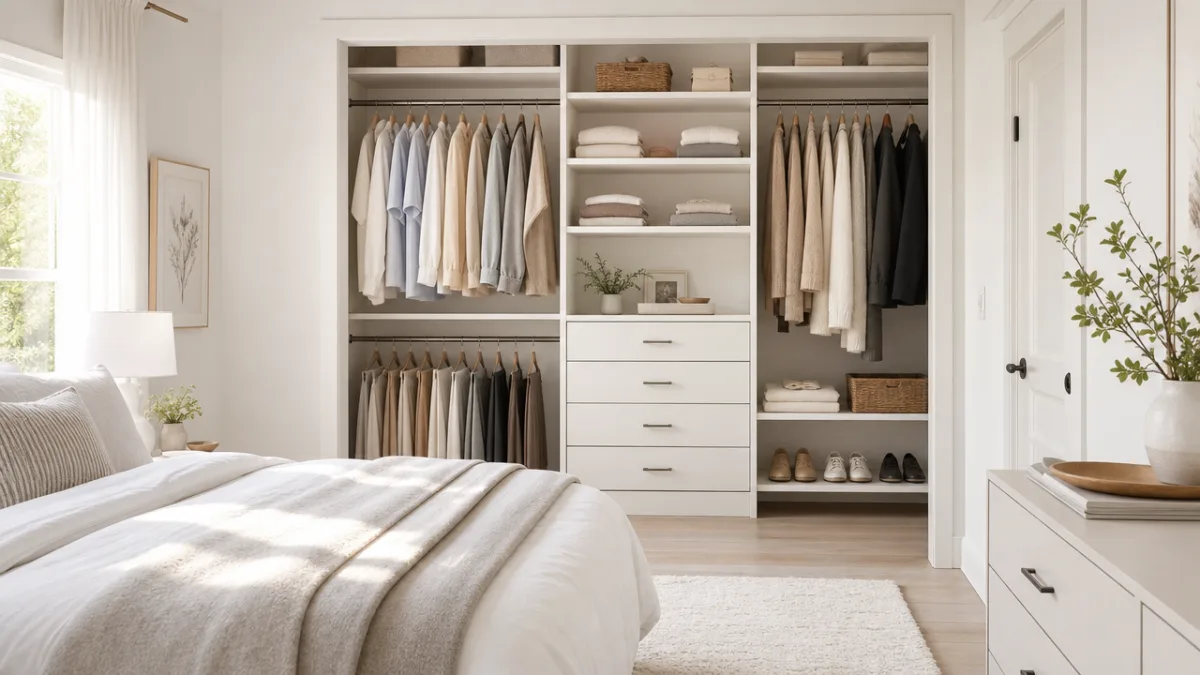
The closet is usually the place to start, and even a small or awkwardly shaped one can be dramatically transformed with the right approach. The single most impactful change most people can make is installing a closet system that actually uses the full height of the space. The standard setup — one rod, one shelf — wastes a huge amount of vertical room. A modular system with double hanging sections for shorter items, shelves for folded clothes, drawers for accessories, and a dedicated shoe area can effectively double or triple your usable space without touching the rest of the room.
Under-bed storage is another asset most people completely overlook. That footprint is generous, and flat rolling bins work beautifully for seasonal clothes, extra bedding, or holiday items you only need a few times a year. If your bed sits too low for standard bins, simple bed risers can solve that. Vacuum storage bags are worth a look too — they compress bulky things like comforters and winter sweaters down to a fraction of their usual size, and keep everything protected from dust in the process.
Bathroom Organization: Small Space, Big Impact
Bathrooms are almost always small, but they have to accommodate an enormous amount of stuff — skincare, medications, cleaning supplies, towels, and more. That’s a lot to ask of a tiny space. The upside is that small rooms respond really well to organization efforts. Even modest changes can make a bathroom feel noticeably bigger, calmer, and much easier to use day to day.
The cabinet under the sink is usually a disorganized mess, but it has a lot of untapped potential. Because the plumbing interrupts the space, you need organizers designed for that specific layout — stackable units with adjustable shelves that work around the pipes are easy to find and don’t cost much. Grouping things by category helps a lot: cleaning products in one spot, extra personal care items in another, hair tools in their own zone. A tension rod installed under the shelf makes a clever spot to hang spray bottles, which frees up the floor of the cabinet entirely.
Vertical space in bathrooms is almost always underused, and taking advantage of it is one of the quickest ways to add meaningful storage without any renovation. Over-the-toilet shelving units make good use of a space that typically does nothing, and they hold plenty — towels, toilet paper, a few decorative pieces. Floating shelves above the toilet or near the vanity mirror add both storage and a little style at the same time. In the shower, a corner tension caddy is an easy no-drill solution for shampoos and soaps. And don’t ignore the back of the bathroom door — a slim organizer there can handle hair products, accessories, or overflow items without taking up any floor space at all.
Living Spaces and Entryways: Organizing the Rooms Everyone Sees
Your entryway is the first thing you and every guest experience when walking in, and it sets the tone for the whole home. It’s also, notoriously, one of the most chaotic spots in most houses — shoes everywhere, bags dropped on the floor, keys missing, mail piling up. Turning it into a space that actually works is one of those changes that pays off every single day. Even if you don’t have a formal entryway, carving out a small organized zone near the front door creates the same functional benefits.
A good entryway system works because it gives every category of incoming item a specific home, so there’s no decision fatigue leading to random dumping. Hooks, bins, and shelves can be configured in all sorts of ways depending on your household. Some of the most effective options include:
- A wall-mounted key hook or small dish placed right next to the door so keys never go missing again
- A bench with built-in storage or cubbies underneath that handles shoes while giving you a place to actually sit when putting them on
- Hooks at different heights so adults and kids can all hang their own bags and coats without help
- A designated tray or mail sorter that stops paper from migrating to every other room in the house
- A slim console table with a drawer for sunglasses, lip balm, dog leashes, and all those small things that otherwise vanish
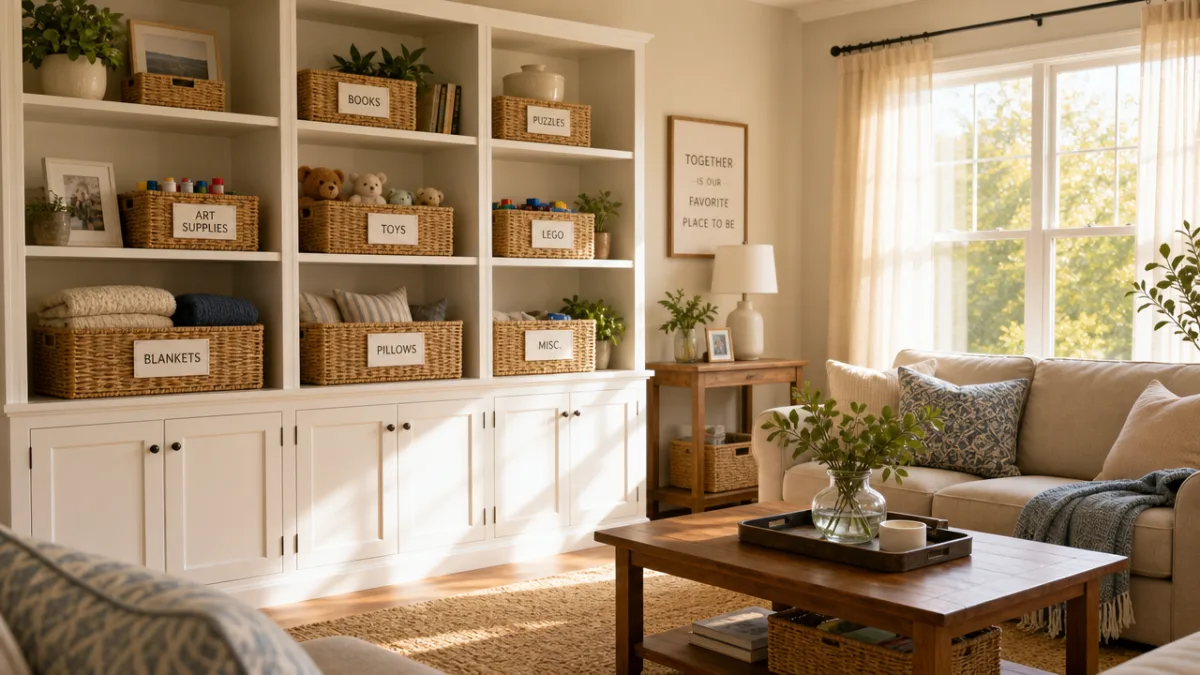
Living rooms call for a different kind of organization — one focused on creating a space that stays tidy during real daily life, not just right after cleaning. The key is making sure every item that belongs in the room actually has a home in the room, and that putting things away takes no more effort than leaving them out. Storage ottomans that double as coffee tables, bookcases with a mix of open and closed storage, and decorative baskets for blankets and toys all let the room work hard without ever looking overwhelmed.

Building Lasting Organizational Habits
Good systems and smart products will only get you so far. The real secret to a home that stays organized is the habits — the daily routines and shared household agreements that stop disorder from building up in the first place. This is why so many people do beautiful organization overhauls that look perfect on day one and slowly fall apart over the following weeks. The physical system and the behavioral habit need to be built together. One without the other doesn’t really hold.
The most powerful habit you can adopt is the one-in, one-out rule, applied consistently. Every time something new comes into your home — a new purchase, a birthday gift, a kitchen gadget — something else leaves. It keeps the overall volume of your belongings steady, which means your storage systems stay manageable no matter how much time passes. It also makes you naturally more thoughtful about bringing new things home, because knowing something else has to go changes how you evaluate what you’re acquiring.
Daily resets are the other habit that tends to separate organized households from chaotic ones. A reset is just a brief window — usually ten to fifteen minutes in the evening — where everyone returns things to where they belong, surfaces get cleared, and the home comes back to its baseline. It’s a small daily investment that prevents the slow accumulation of mess that compounds into something overwhelming over time. Once it becomes routine, it stops feeling like a chore. You just wake up each morning to a home that already feels calm and ready, and that makes a bigger difference to your day than you might expect.








What do you think?
It is nice to know your opinion. Leave a comment.