










5 Smart Storage Hacks That Instantly Transform Any Space
Why Smart Storage Changes Everything About How You Live
Here’s something most people don’t realize: clutter isn’t a personality flaw. It’s almost always a design problem. When a home doesn’t have enough thoughtful storage built into it, stuff naturally ends up on surfaces, floors, and in corners — and that constant visual noise quietly wears you down every single day. There’s actually solid research connecting physical clutter to mental fog, and once that clicks for you, tidying up stops feeling like a punishment and starts feeling like something you’re doing for yourself.
Smart storage isn’t about buying more bins or just shoving things out of sight. It’s about rethinking how your daily life actually flows — figuring out where the friction is, where things pile up, and why. A good storage system works with your habits, not against them. If you always drop your keys on the kitchen counter, the fix isn’t to force yourself to walk over to a hook by the front door every time. It’s to put a pretty little dish or hook right there on the counter, where the habit already lives.
The five hacks in this article don’t require a big budget or a contractor. They come from interior design principles, a bit of organizational psychology, and the hard-won experience of people who’ve actually turned chaotic, cramped spaces into calm ones. Whether you’re in a studio apartment or a house with more rooms than you know what to do with, these ideas scale — and you’ll notice the difference in days, not months.
Hack One — Vertical Space Is Your Most Underused Asset
Look up. No really, take a second right now and look at the walls around you. There’s a good chance you’ve got several feet of completely empty space between the top of your furniture and the ceiling just sitting there doing nothing. That’s prime real estate — and it’s one of the most overlooked storage opportunities in just about any home. Tall shelving units, stacked cabinets, and wall-mounted systems can effectively double your storage without taking up a single extra square foot of floor space.
There’s also a nice psychological bonus here. Low, horizontal clutter tends to feel oppressive because it sits right in your line of sight and competes for your attention all day. Storage that goes up toward the ceiling actually makes a room feel taller and more open. Interior designers use this constantly in small apartments to create a sense of drama on a tight budget. Floor-to-ceiling bookshelves, for instance, are one of the oldest tricks in the book for making a small room feel intentional and grand rather than just cramped.
Once you start looking, you’ll find opportunities everywhere. In the kitchen, add a second shelf above your existing cabinets for things you don’t reach for often — seasonal bakeware, extra stock. In the bedroom, swap out a standard wardrobe for a floor-to-ceiling system with a mix of hanging space, shelves, and drawers. In the living room, mount floating shelves high on the walls for books and a few decorative pieces. The investment is usually pretty small — some brackets and boards from the hardware store — but the difference it makes can be genuinely surprising.
- Install floating shelves at least 12 inches above door frames to capture that dead space you’d otherwise never use.
- Use the tops of kitchen cabinets for baskets holding rarely used items.
- Mount pegboards on walls in garages, craft rooms, or kitchens for flexible, tool-friendly storage.
- Stack open storage cubes vertically rather than spreading them out across the floor.

Hack Two — Furniture That Does Double Duty
One of the best mindset shifts you can make in a smaller space is deciding that every piece of furniture should earn its place. A sofa that’s just a sofa, an ottoman that’s just an ottoman, a bed that’s just a bed — those are missed opportunities. Luckily, multi-functional furniture has come a long way from the clunky, obviously-practical stuff of the past. There are genuinely beautiful options now that you’d want in your home even if they didn’t have a storage drawer hidden in them.
Storage ottomans might be the most versatile place to start. They work as a coffee table, a footrest, extra seating when people come over, and a hidden compartment for blankets, remotes, board games, or whatever tends to pile up on your couch. A large square storage ottoman with a tray on top becomes an elegant focal point of a living room while quietly swallowing a surprising amount of clutter. The trick is choosing one in a fabric and color that looks deliberate — like you picked it for style, not just function.
Beds with built-in storage are probably the single biggest square-footage win available in a bedroom. A standard queen with storage drawers in the base can hold as much as an entire dresser — clothes, linens, off-season stuff. In a small bedroom, that might mean you don’t need a dresser at all, which suddenly makes the whole room feel way more open. Hydraulic lift-bed frames go even further, opening up an enormous cavity under the whole mattress surface — enough for luggage, seasonal bedding, and anything else you only need a few times a year.
Dining benches with storage lids, entryway benches with cubbies underneath, side tables with shelves, wheeled kitchen islands with shelving inside — they’re all versions of the same smart idea. Whenever you’re shopping for a new piece of furniture, just make it a habit to ask whether a storage-integrated version exists at a similar price and look. More often than not, it does, and the long-term payoff is well worth any small extra cost.
Hack Three — The Magic of Categorized, Labeled Systems
Storage without organization is just moving clutter around. This is the trap so many people fall into — they buy bins and baskets, fill them up, feel great about it for a few weeks, and then six months later everything has somehow descended back into chaos. What’s missing is a consistent system of categories that makes it obvious where things belong, so putting something away doesn’t require much thought at all. When it feels like work to return something to its place, people just won’t do it, and the mess comes back.
Professional organizers call this “a home for everything.” Every object in your home should have a designated spot that makes intuitive sense, and ideally that spot should be close to where the item actually gets used. Cooking utensils live near the stove. Phone chargers live where you usually sit in the evenings. Scissors live in two or three places, because scissors are somehow always needed in a different room than where they are. When something doesn’t have a home, it becomes a nomadic object that wanders from surface to surface indefinitely.
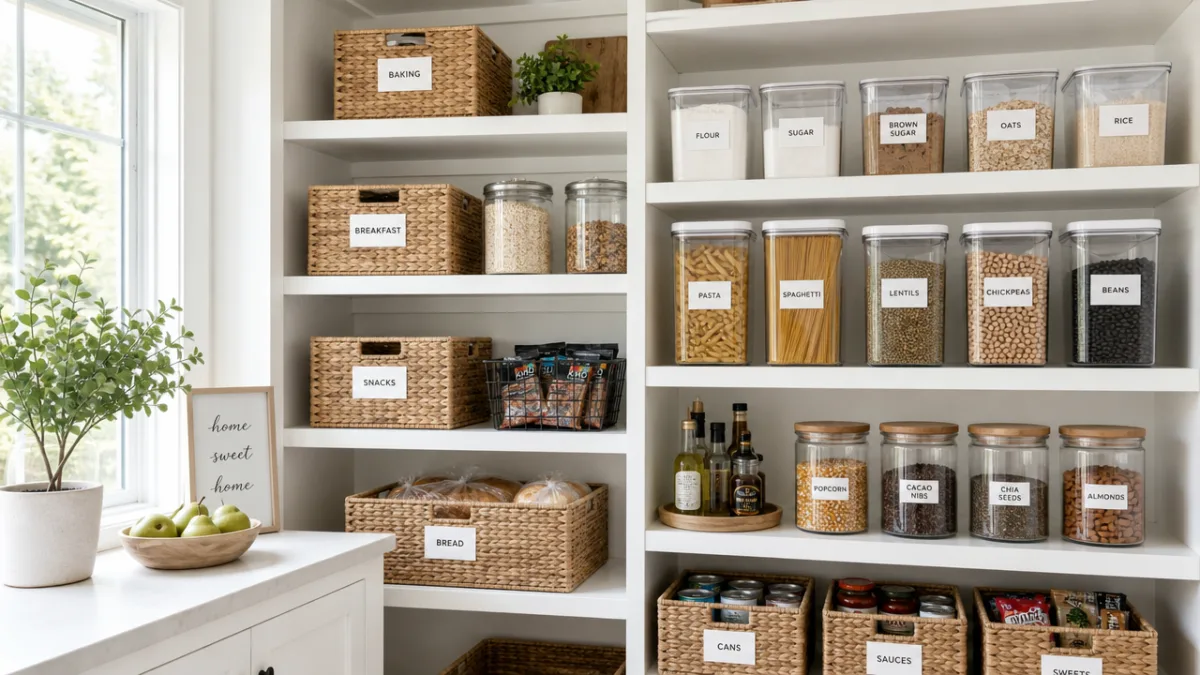
Labeling is what makes these systems actually stick, especially in homes with multiple people or kids. Labels take away ambiguity. When a basket in the pantry says “pasta and grains,” nobody has to guess where the orzo goes or waste time hunting for it. Labels also create a kind of shared agreement in a household — they signal that a system exists and that it’s worth maintaining. You don’t need a label maker to start; masking tape and a marker work just fine and can honestly look kind of charming depending on the aesthetic you’re going for.
- Group items by category first, then by how often you use them — most-used stuff at eye level and arm’s reach.
- Use clear containers wherever possible so you can see what’s inside without opening anything.
- Label both the container and the shelf so that even an empty container gets put back in the right spot.
- Revisit and reset your systems every three to six months as your habits and needs shift.
- Get everyone in the household involved in the labeling process so the system speaks everyone’s language.
Hack Four — Hidden Storage in Plain Sight
Some of the cleverest storage solutions are the ones you’d never guess are storage at all — things that look like décor but are quietly doing a job. The goal is storage that actually adds to the look of a room rather than screaming “I have a lot of stuff to hide.” This is especially powerful in living spaces and bedrooms, where you want the vibe to feel curated and calm, not just efficiently organized.
Decorative baskets and boxes are the workhorses here. A beautiful woven basket on a bookshelf can swallow charging cables, a stack of unread mail, a kid’s small toys, or any number of things that would otherwise be scattered across a surface. Stacked vintage suitcases do the same thing with a lot more personality — they hold off-season clothes or extra linens while functioning as a statement piece in their own right. Decorative boxes on a console table can hide everything from medications to batteries to the small, miscellaneous stuff that accumulates in every household.
Built-in storage disguised as architecture is the elevated version of this idea. Window seats with lift-up cushions, stair risers with drawers built in, banquette seating with hinged tops, walls paneled to conceal entire storage rooms — these are the concept taken as far as it can go. You don’t need a renovation budget to benefit from the same thinking, though. A tension rod inside a cabinet door to hold spray bottles, or a magnetic strip mounted inside a medicine cabinet for bobby pins and nail clippers, applies the exact same logic on a tiny budget.
Mirrors with hidden storage behind them are another underused gem. A full-length mirror on a wall that swings out to reveal a shallow cabinet is perfect for jewelry, accessories, or medications — and it keeps your bathroom counter or dresser surface completely clear. Artwork that opens to a safe or shallow shelf, hollow books arranged on a shelf — these take the idea into genuinely playful territory. There’s real satisfaction in a space that looks simpler than it actually is, and a little bit of theater in revealing all the cleverness underneath.
Hack Five — The One-In-One-Out Rule and the Declutter Foundation
No storage system — no matter how well-designed — can fix having too much stuff. That’s the uncomfortable truth underneath every organizing makeover, and it’s worth saying plainly rather than tiptoeing around it. Before any of these hacks can do their best work, you need to have an honest conversation with yourself about how much you actually need to store. The best storage solution for something you no longer need isn’t a prettier container. It’s the donation bin.
The one-in-one-out rule is the simplest, most sustainable way to keep clutter from creeping back after you’ve done the hard work of getting organized. It’s exactly what it sounds like: whenever something new comes into your home — a piece of clothing, a kitchen gadget, a book, a toy — something of similar size and category goes out. The rule is smart because it works at the moment of acquisition, when the decision is actually easy. You’re comparing one new, specific thing against what you already have, while both are right in front of you.
Making it work comes down to a few simple habits. Keep a donation box somewhere accessible — a closet corner, the back of your car, a spot near the front door — so that things leaving your home have a clear, easy path out. Before any significant purchase, get in the habit of asking “what leaves?” Not as a restrictive rule, but as a genuinely useful question that often reveals whether you even really want the new thing. Over time, this practice quietly shifts how you relate to buying stuff — less about acquiring things, more about curating the specific collection of objects that actually serves your life.
- Each season, pick one category of belongings — clothes in spring, kitchen tools in fall — and do a one-in-one-out review if things have gotten ahead of you.
- Edit down your possessions before buying storage containers — more storage for too much stuff just delays the real problem.
- Give yourself a 20 to 30 minute time limit on decluttering sessions so it never feels like a massive, dreaded project.
- Resist the urge to immediately fill the space that opens up after decluttering — empty space in a home is a feature, not a failure.
Bringing It All Together — A Sustainable Approach to an Organized Home
These five hacks — vertical storage, multi-functional furniture, categorized and labeled systems, hidden-in-plain-sight solutions, and the one-in-one-out rule — work best when you think of them as one integrated approach rather than five separate tricks. Each one tackles a different piece of the puzzle: creating space, making furniture work harder, building systems, keeping things beautiful, and managing how much stuff you have in the first place. Together, the effect is cumulative — a home that genuinely feels different to live in. Calmer, more functional, more like the life you actually want.
The order you tackle things in matters. Start with decluttering, because there’s no point building elegant storage around things that shouldn’t be in your home. Then take stock of your vertical space and your furniture before buying anything new. Build your categorized systems around how your household actually works — not some idealized version of how it should work — and use labels to lock them in. Then layer in the decorative storage elements that make the practical feel beautiful, so your organized home is also somewhere you actually enjoy being.
Keeping a home organized is honestly easier than getting it organized in the first place — but it does ask for a shift in how you think about it, from a project to a practice. An organized home isn’t a destination you reach and then coast from. It’s a series of small, daily decisions about where things live and whether new things have earned a spot. The encouraging part is that those decisions get faster and more intuitive the longer you do this. Eventually you’ll notice that your home more or less takes care of itself — and all that mental energy you used to spend navigating clutter is finally free for something a lot more interesting.








What do you think?
It is nice to know your opinion. Leave a comment.