










20 Genius Zero-Cost Home Décor Hacks That Look Pinterest-Perfect
Introduction: The Art of Decorating for Free
There is a deeply satisfying kind of creativity that emerges when constraints are placed upon us. When the budget reads zero, the imagination has no choice but to stretch itself in unexpected directions, and what results is often more personal, more meaningful, and more beautiful than anything a shopping cart could produce. Zero-cost home décor is not a compromise — it is a philosophy, one that prioritizes resourcefulness over retail therapy and ingenuity over impulse buying.
The concept of transforming a living space without spending a single dollar might sound like wishful thinking, but thousands of people are doing it every day. From rearranging furniture to repurposing everyday objects, the hacks in this article are rooted in the principle that beauty is not purchased — it is discovered. Your home is already full of raw material waiting to be reimagined, and all it takes is a fresh perspective and a little effort to unlock its full potential.
Pinterest boards around the world are overflowing with stunning interiors that cost next to nothing, and that is not an accident. The platform has long been a gathering place for creative problem-solvers who understand that style has little to do with a price tag. Whether you rent, own, or are simply trying to breathe new life into a tired space, these twenty genius hacks will give you everything you need to create a home that looks curated, intentional, and effortlessly chic — all without opening your wallet.
Rearranging and Reimagining What You Already Own
One of the most powerful and underestimated decorating tools available to you costs absolutely nothing: moving things around. Most people place their furniture once and never revisit the decision, even as their needs, tastes, and daily habits evolve. A fresh furniture arrangement can make a room feel entirely new, improving traffic flow, creating conversation zones, and drawing attention to architectural features that were previously ignored. Start by pulling everything to the center of the room and working from scratch.
Beyond furniture, consider rotating décor objects between rooms. That vase sitting forgotten on a bathroom shelf might look extraordinary on your dining table. The stack of books in your bedroom could become a stylish riser for a CANDLE display in the living room. When you start seeing your possessions as interchangeable design elements rather than fixed pieces assigned to permanent locations, the creative possibilities multiply enormously. A simple walk through your home with fresh eyes can unearth dozens of hidden gems hiding in plain sight.
Shelving is another area ripe for reinvention. Rearranging the objects on your existing shelves using the rule of thirds — grouping items in odd numbers, varying heights, and mixing textures — can make a bookshelf look like a professionally styled vignette. Remove half of what is currently on display to create breathing room. Pull books forward and backward to add depth. Layer smaller objects in front of taller ones. These small adjustments require only time and thoughtfulness, yet they produce results that genuinely look curated and deliberate.
- Pull all furniture away from the walls to create a more intimate, layered feel
- Swap art between rooms to give each space a fresh focal point
- Rotate seasonal items from storage to refresh the look without buying anything new
- Edit shelves ruthlessly — less is almost always more when it comes to visual impact
- Use books as risers, pedestals, and architectural elements throughout the home

Nature as Your Free Interior Designer
Nature has been providing free, endlessly beautiful décor since long before the concept of interior design existed. A walk outside — through a park, a garden, along a beach, or even just down a residential street — can yield an extraordinary collection of decorating materials. Branches, pebbles, dried seed pods, pinecones, eucalyptus leaves, moss, and river stones all carry a quiet, organic beauty that no manufactured object can fully replicate. Bringing these elements inside instantly adds texture, warmth, and a grounding earthiness to any space.
Foliage arrangements are among the most effective zero-cost décor hacks available. A handful of leafy branches cut from a backyard shrub, arranged loosely in a tall glass jar or repurposed bottle, creates a statement piece that rivals anything sold in a high-end home store. Even weeds, when arranged with intention and placed in the right vessel, can look extraordinary. Dried grasses and wildflowers are particularly striking, and the drying process only requires leaving them upside down in a warm, dry space for a week or two.
Water becomes a surprisingly effective display medium when you use it intentionally. Floating flower heads or leaves in a wide bowl of water creates a meditative, spa-like centerpiece for a dining or coffee table. Pebbles and stones arranged in shallow dishes suggest the kind of Zen minimalism that fills luxury hotel lobbies. Pinecones heaped in a wooden bowl become an instant seasonal display. These arrangements take minutes to assemble, cost nothing, and communicate a level of intentional style that impresses anyone who enters the room.
Do not overlook the simple power of potted plants. If you already have plants, propagating them is entirely free — many common houseplants including pothos, spider plants, snake plants, and succulents can be propagated simply by placing a cutting in water or soil. A single parent plant can yield dozens of offspring over time, filling your home with greenery that purifies the air, adds life to corners, and elevates every surface it touches. Group propagation vessels together on a windowsill for a botanical display that looks curated and intentional.
Repurposing, Upcycling, and Seeing Beyond the Obvious
Every object in your home has the potential to serve a purpose beyond its original design, and some of the most visually striking décor pieces are born from this kind of lateral thinking. An old wooden ladder becomes a blanket rack. A stack of vintage suitcases transforms into a side table. A collection of mismatched frames, unified by a single coat of paint from a forgotten can in the garage, becomes a gallery wall. The key is to look at objects not for what they are, but for what they could become with a small adjustment in context or orientation.
Kitchen and pantry items are a particularly rich source of free decorating material. Mason jars, wine bottles, olive oil tins, and even tin cans make beautiful vessels for flowers, pencils, utensils, and small plants. Group several together for a collected, artisanal look that suggests travel and a life well lived. Glass bottles in varying heights lined along a windowsill catch and scatter light in ways that are genuinely magical, creating a prism effect that shifts throughout the day as the sun moves across the sky.
Fabric is one of the most versatile and often overlooked decorating resources in any home. An old scarf draped over a chair becomes an elegant throw. A length of fabric pinned above a bed creates a canopy effect that transforms an ordinary bedroom into something that feels hotel-luxe. Pillowcases can be stuffed with other fabric scraps to create new throw pillows. Even dish towels, when chosen thoughtfully, add pattern and color to a kitchen in ways that feel intentional rather than accidental. Before you buy anything new, take a full inventory of the fabric in your home — you may be surprised by what you find.
- Transform wine bottles into elegant bud vases by removing labels with warm water and oil
- Use a wooden crate as a coffee table, side table, or wall-mounted shelf
- Repurpose a ladder as a bathroom towel rack or bedroom blanket display
- Turn a stack of hardcover books into a sculptural nightstand riser
- Convert mismatched frames into a cohesive gallery wall using a single unifying color
- Use a vintage colander as a hanging planter by adding twine handles
Lighting Transformations That Cost Absolutely Nothing
Lighting is the single most impactful element of any interior, and yet it is almost always overlooked in conversations about zero-cost decorating. The way light falls in a room — its direction, warmth, intensity, and the shadows it creates — determines the mood more powerfully than any piece of furniture or decorative object. The good news is that you do not need to buy new fixtures or bulbs to dramatically change the way your home feels. You simply need to become more intentional about the light you already have.
Begin with natural light, which is the most flattering and energizing source available. Heavy curtains pulled across windows are one of the most common ways people inadvertently darken and shrink their spaces. If privacy allows, take down heavy drapes entirely and replace them with the sheerest alternative you can find in your existing linen collection — even a light bedsheet hung on tension rods can allow soft, diffused light to fill a room while maintaining a degree of privacy. Mirrors placed strategically opposite windows reflect and amplify natural light, making rooms feel brighter and significantly larger without any structural change.
For evening lighting, the placement of existing lamps makes an enormous difference. Floor lamps directed toward walls and ceilings create ambient uplighting that is warm and atmospheric, as opposed to the harsh overhead lighting that most people rely on by default. Grouping candles together — pillar candles on books, tea lights in clusters — creates a soft, flickering glow that transforms an ordinary evening at home into something that feels special and intentional. Moving lamps from room to room to experiment with placement costs nothing and can yield genuinely transformative results in a matter of minutes.
Window placement of translucent objects is another free lighting hack that produces remarkable visual effects. Hanging crystals, sea glass, or even glass beads in a window captures and scatters light into rainbow prisms across walls and ceilings. Arranging colored glass bottles along a windowsill creates jewel-toned pools of colored light that shift and move throughout the day. These effects are fleeting and ever-changing, which makes them feel alive in a way that static décor never quite achieves — a daily reminder that the most beautiful things in any home are often the ones that cannot be bought.
The Psychology of Display: Curating Like a Professional
Professional interior stylists and set designers understand something that most homeowners never learn: displaying objects is a skill that can be taught, practiced, and refined without spending any money. The principles of good display — scale, balance, repetition, rhythm, and contrast — apply equally whether you are working with objects worth thousands of dollars or items gathered from your recycling bin. Understanding these principles transforms the way you see every surface in your home, from the fireplace mantel to the bathroom counter.
The triangle method is one of the most reliable display principles used by professional stylists. When arranging three or more objects on a surface, imagine drawing a triangle between the tallest points of each object. This creates a visual flow that guides the eye naturally across the arrangement without feeling rigid or symmetrical. Varying the heights within the arrangement — using books, stones, or folded fabric as risers — adds dynamism and prevents the flat, uniform look that makes displays feel uninspired. This technique works on every horizontal surface in your home and requires only objects you already own.
Repetition is another powerful tool that costs nothing to employ. Grouping identical or similar objects together — a collection of white candles, a row of matching jars, a lineup of the same plant in different sizes — creates a sense of intentionality and design consciousness that single objects rarely achieve. The eye reads repetition as curation, as evidence that someone thought carefully about what belongs in a space and why. This is why minimalist interiors, which often contain fewer objects than average homes, tend to feel more sophisticated rather than less furnished.
Color editing is the final and perhaps most transformative display technique available to zero-budget decorators. By gathering all the objects from several spaces and grouping them by color — setting aside everything that is white, or everything that is warm-toned — you create a visual language that ties disparate objects together into a cohesive whole. A shelf full of objects in varying colors often looks chaotic; the same shelf populated only by objects in two or three related tones looks curated and intentional. Before throwing anything away or buying anything new, experiment with color editing — the results are frequently stunning and always free.
- Use the triangle method to create dynamic, visually interesting arrangements on any flat surface
- Group objects in odd numbers — three, five, or seven — for a more natural, organic feel
- Edit by color to create cohesion between unrelated objects from different parts of the home
- Vary heights within every display using books, stones, or folded fabric as free risers
- Leave deliberate negative space — empty areas are not gaps to fill but breathing room for the eye
- Layer objects at different depths, front to back, to create dimension and visual interest
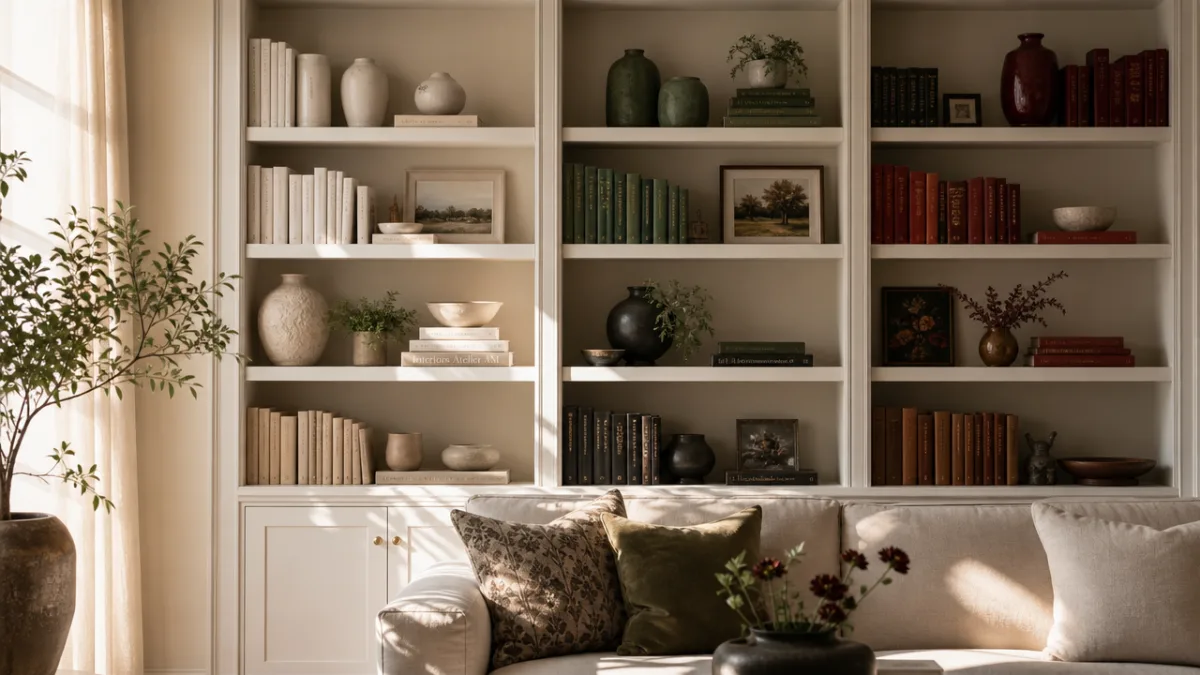
Texture, Pattern, and Layering: The Secrets of Warmth and Depth
Some of the most enviable interiors on Pinterest are not remarkable because of the objects they contain, but because of the way those objects interact with one another through texture, pattern, and layered depth. A room that contains only smooth, flat surfaces — regardless of how beautiful those surfaces may be individually — will always feel cold and two-dimensional. Warmth and visual richness come from contrast: rough against smooth, matte against shiny, soft against hard. Achieving this contrast requires only a thoughtful eye and the willingness to move things around.
Layering textiles is one of the fastest ways to add warmth and perceived luxury to any space. Rather than a single throw blanket on a sofa, try layering two or three — a chunky knit, a linen, and a woven cotton, for instance — draped casually at different angles. Stack rugs if you have more than one, placing a smaller, more textured rug over a larger, flatter one to create depth and visual interest underfoot. Pile cushions in varying sizes, even if they do not match, to create the plush, layered look that characterizes expensive boutique hotel rooms. None of this requires purchasing anything new.
Pattern mixing is another technique that sounds daunting but is entirely learnable. The key to mixing patterns successfully is maintaining a consistent color palette across the patterns in question. Stripes, florals, geometrics, and organic prints can all coexist beautifully when they share two or three common colors. Varying the scale of patterns — pairing a large-scale floral with a small-scale geometric, for instance — prevents visual confusion and allows each pattern to be appreciated individually while contributing to the overall composition. Raid your linen closet, your wardrobe, and your storage boxes for fabric with pattern potential before considering any purchase.
Conclusion: Your Home as a Living Canvas
The twenty hacks outlined in this article share a common thread: they all begin with the premise that a beautiful home is not assembled through shopping, but cultivated through attention, creativity, and a genuine relationship with the space you inhabit. Every room in your home is a living canvas that changes with the seasons, with your moods, with the light on a Tuesday afternoon in November. When you stop waiting for the perfect purchase to complete a room, you begin to see the room itself — with everything already in it — as the starting point for something extraordinary.
The most important tool in any zero-cost decorator’s kit is not a hammer, a brush, or even a good eye for color — it is patience. The willingness to live with a space, to observe it at different times of day, to move one object a foot to the left and then decide it was better where it started, is what separates a home that feels intentional from one that feels accidental. This kind of slow, attentive decorating is impossible to rush and impossible to outsource. It belongs entirely to you, which is precisely what makes it so satisfying.
Begin today with one small change — rearrange a shelf, bring in a branch from outside, group three candles together on a surface where there was previously nothing. Notice how it changes the way the room feels, and then notice how it changes the way you feel in the room. That relationship between person and space, between inhabitant and home, is the real subject of all great interior design. And it has always been, and will always be, completely free.








What do you think?
It is nice to know your opinion. Leave a comment.