










12 Small Movie Theatre Room Ideas That Will Make Your Home the Ultimate Cozy Retreat
Why a Small Home Theatre Room Might Be Your Best Investment
There is something deeply satisfying about creating a dedicated space in your home for cinema. Unlike the living room where distractions lurk around every corner, a small movie theatre room is designed with a single, glorious purpose in mind: immersive entertainment. Whether you are settling in for a Friday night blockbuster or binging a beloved series, having a space purpose-built for viewing transforms the entire experience from casual to extraordinary.
Many homeowners assume that a home theatre requires a massive basement or a sprawling bonus room to be worthwhile. This simply is not true. Some of the most impressive and atmospheric home cinemas have been carved out of spare bedrooms, converted closets, or modest basement nooks. The magic of a small theatre room lies not in its square footage but in the intentionality of its design, the quality of its components, and the warmth of its atmosphere.
Beyond the sensory pleasures, a dedicated movie room adds measurable value to your home. Real estate professionals consistently note that thoughtfully finished entertainment spaces increase buyer interest and perceived property value. Even on a modest budget, a well-executed small theatre room signals that a home has been loved, customized, and lived in with intention. It is an investment that pays dividends in both daily joy and long-term resale appeal.
Choosing the Right Space for Your Home Cinema
The first step toward building your dream movie room is identifying the right candidate space within your home. Spare bedrooms are the most popular choice because they already have four walls, a door for sound containment, and electrical infrastructure in place. A ten-by-twelve foot bedroom, for example, is perfectly adequate for a small theatre setup with seating for two to four people and a screen size between seventy and one hundred inches.
Basement rooms are another excellent option, particularly because they naturally block external light and tend to have lower ambient noise from the street. The slightly cooler temperatures found underground also make basements comfortable for long viewing sessions. However, basements require extra attention to moisture control and soundproofing, both of which are essential for protecting your equipment and maintaining acoustic quality over the long term.
Do not overlook unconventional spaces like large walk-in closets, attic rooms, or even a section of an open-plan room that can be defined with curtains or partition walls. The key criteria for any candidate space are controllable lighting, manageable dimensions, proximity to power and network connections, and the ability to add some degree of acoustic treatment. Once you have identified the right space, the creative work can truly begin.
Seating Ideas That Maximize Comfort in a Compact Space
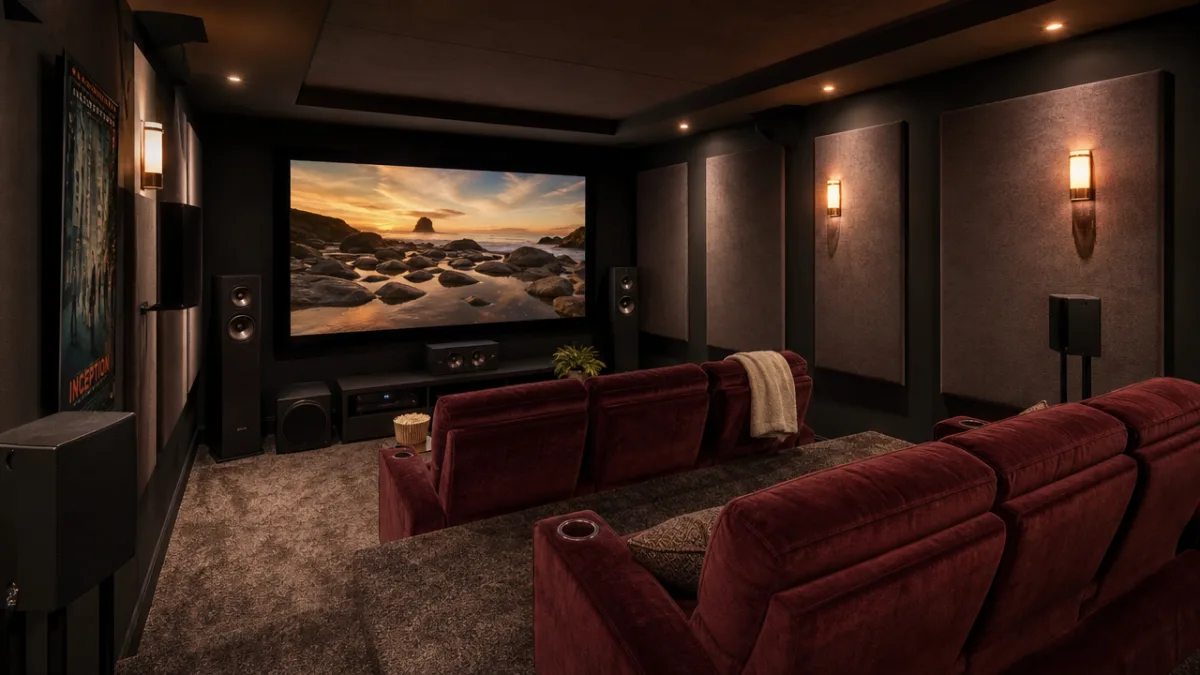
Seating is arguably the most important element of your home theatre experience, and in a small room, every choice must balance comfort with spatial efficiency. Large sectional sofas might seem luxurious, but they can overwhelm a compact space and leave too little room for circulation or an optimal viewing distance. Instead, consider a tiered approach using loveseat recliners on the first row and a small elevated platform with individual seats or a narrow sofa behind.
Floor seating is an underrated option that works beautifully in smaller theatre rooms, especially for families with children. Large, oversized floor cushions, Japanese-style zaisu chairs with back support, or a low platform bed layered with pillows and throws can create an incredibly cozy and flexible viewing environment. These options are easy to rearrange, simple to store, and give the room a relaxed, den-like character that invites long, lazy movie marathons.
If you prefer a more classic cinema feel, look for compact home theatre seating pods designed specifically for small rooms. Many modern recliner chairs are built with a wall-hugging mechanism that allows full recline without needing extra space behind the chair. Pair two or three of these in a single row and you have a genuinely cinematic arrangement that respects your room’s boundaries. Consider chairs in dark velvet or faux leather for that authentic theatre aesthetic.
- Wall-hugger recliners: Recline fully without requiring space behind them, ideal for tight rooms.
- Loveseat recliners: Seat two people with shared armrest controls, saving floor space.
- Floor cushions and poufs: Flexible, storable, and perfect for casual family viewing nights.
- Tiered platform seating: Creates a real cinema feel even in a room with only eight to ten feet of depth.
- Bean bag chairs: A playful, budget-friendly option that adds texture and informality.
Lighting Design That Sets the Perfect Cinematic Mood
Lighting is the unsung hero of home theatre design. Get it right and your small room will feel like a genuine escape from the everyday world. The goal is to eliminate harsh overhead lighting entirely and replace it with layered, dimmable sources that can be adjusted for pre-show ambiance, active viewing, and post-film conversation. Warm tones in the amber and soft white range are almost always preferable to cool or neutral whites, which feel clinical and undermine the cozy atmosphere you are trying to create.
LED strip lights are one of the most versatile and affordable tools in the home theatre designer’s kit. Placed behind the screen, along the base of walls, under seating platforms, or along ceiling coffers, LED strips add depth and dimension without creating glare. Smart LED systems allow you to control color, brightness, and even synchronized lighting effects through your phone or a dedicated remote, letting you change the room’s entire personality with a single tap.
Sconce lights along the side walls serve a dual purpose: they provide enough ambient light for guests to safely navigate the room while also adding architectural interest and a distinctly theatrical character. Look for sconces with shades that direct light upward or downward rather than outward to avoid any direct glare toward the screen. Pairing sconces with a dimmer switch gives you maximum control, allowing you to bring them down to nearly nothing during the film and up to a warm glow during intermissions.
Do not forget the ceiling. A starfield projector or small pinhole LED ceiling installation can transform a plain white ceiling into a breathtaking night sky, adding wonder and dimension to the room even before the film begins. This is particularly effective in rooms with lower ceilings, where it creates an illusion of depth and height. Pair with a deep navy or dark gray ceiling paint to maximize the effect and minimize light reflection onto your screen.

Screen and Projector Options for Small Theatre Rooms
Choosing between a large television and a projector and screen combination is one of the most consequential decisions you will make for your small home theatre. Large format televisions, particularly QLED and OLED models in the seventy-five to eighty-five inch range, offer stunning picture quality, excellent brightness for rooms with some ambient light, and straightforward setup. They are an excellent choice for rooms that double as multipurpose spaces or have windows that are difficult to fully blackout.
Projectors, on the other hand, offer a scale that no television can match at the same price point. A short-throw or ultra-short-throw projector can deliver a hundred-inch or larger image from just a foot or two away from the screen, making them ideal for small rooms where a traditional throw distance would be impractical. Pair a short-throw projector with a quality ambient light rejecting screen and you can achieve a genuinely cinematic image even in a room that is not perfectly light-controlled.
Acoustically transparent screens are a premium option worth considering if you plan to place center channel speakers behind the screen for a more authentic surround sound arrangement. These screens allow audio to pass through the material without degradation, letting you position speakers in their acoustically optimal location without any visible compromise to the room’s aesthetics. While more expensive than standard projection screens, acoustically transparent options represent a meaningful upgrade for serious home cinema enthusiasts.
- Large format OLED TV (75–85 inches): Perfect picture quality with no setup complexity, best for light-controlled rooms with some ambient light.
- Short-throw projector with ALR screen: Delivers 100-inch-plus images from minimal distance, ideal for small rooms.
- Ultra-short-throw laser projector: Sits directly beneath the screen, delivers brilliant brightness and 4K resolution in an incredibly compact footprint.
- Retractable ceiling screen: Disappears when not in use, allowing the room to serve other purposes during the day.
Sound Design and Acoustic Treatment on a Budget
No matter how beautiful your screen looks, poor audio will undermine the entire experience. Sound design in a small home theatre room involves two related but distinct challenges: choosing the right audio system and treating the room itself to control reflections and reverb. Both matter enormously, and neither requires a limitless budget to achieve genuinely impressive results. A little research and some creative application of acoustic principles can transform even a bare, boxy room into a space with rich, enveloping sound.
For the audio system itself, a five-point-one surround sound setup remains the standard for home cinema. This consists of a center channel speaker placed at or near the screen, left and right front speakers flanking the display, left and right surround speakers positioned beside or slightly behind the seating, and a subwoofer for low-frequency effects. In a small room, you do not need large, tower-style speakers to fill the space. Compact bookshelf speakers driven by a quality AV receiver will produce clear, detailed, and powerful sound appropriate to the room’s dimensions.
Acoustic treatment addresses the way sound behaves once it leaves the speakers. Hard, reflective surfaces like bare drywall, hardwood floors, and glass cause sound waves to bounce unpredictably, creating echoes, muddiness, and an uneven frequency response. The simplest and most effective acoustic treatments for a home theatre include heavy curtains or drapes along side walls, thick rugs on the floor, acoustic panels or fabric-wrapped boards on the first and second reflection points, and bass traps placed in the room’s corners to absorb low-frequency buildup.
The good news is that many of the design choices that make a theatre room look and feel cozy also serve an acoustic purpose. Plush upholstered seating absorbs mid and high frequencies. Velvet drapes soften reflections. Carpet underfoot reduces flutter echo. Even bookshelves filled with items and a collection of soft furnishings collectively contribute to a more balanced acoustic environment. This happy alignment between aesthetic goals and acoustic function means that pursuing beauty in your theatre room design is almost always the acoustically correct choice as well.
Decor and Theming Ideas to Personalize Your Cinema Space
This is where your home theatre truly becomes yours. While the technical elements like screens, speakers, and lighting are largely universal in their requirements, the decor and theming of your space is an open invitation to express your personality and passions. Classic Hollywood glamour, mid-century modern minimalism, vintage drive-in nostalgia, sci-fi fantasy, or sleek contemporary cool are all viable directions, and each one can be achieved with thoughtful choices around color, texture, wall art, and accessories.
Movie posters are an obvious and beloved choice for theatre room walls, but the way you frame and hang them matters enormously. Mass-produced poster frames in thin black metal feel generic and cheap. Instead, consider having your favorite posters printed on archival paper and framed in deep shadow boxes with a linen mat, or displayed on illuminated poster frames that backlight the art for a genuine cinema lobby feel. Grouping three or four posters in a consistent style creates a gallery wall effect that reads as intentional rather than accidental.
Concession-themed accessories add a playful and nostalgic dimension to a home theatre room without feeling kitschy when done with restraint. A small dedicated counter or cart housing a popcorn maker, a mini beverage fridge stocked with drinks, and a few glass containers of candy creates a genuine pre-show ritual experience. Pair this with a small chalkboard menu sign listing the night’s film and snack options and you have elevated a simple movie night into a memorable occasion. These small theatrical touches are what transform a room with a big screen into an actual experience.
- Illuminated movie poster frames: Backlit displays that make your favorite film art glow like a real cinema lobby.
- Vintage cinema signage: Retro marquee letters, old-fashioned neon signs, or antique ticket booth elements add authentic atmosphere.
- Velvet curtain panels: Frame the screen with floor-to-ceiling drapes for a dramatic, theatrical presentation.
- Themed throw pillows and blankets: Coordinate colors and textures with your room’s palette for a finished, intentional look.
- Star rating wall art: Film critic-style graphics or custom prints celebrating your favorite movies add personality without clutter.
Smart Home Integration for an Effortless Viewing Experience
A truly great home theatre room is one that feels effortless to use. The best technology in the world loses its appeal when you need three separate remotes, manual adjustments, and a ten-step startup procedure before every film. Smart home integration allows you to consolidate all of these controls into a single, intuitive system that responds to your commands via a universal remote, a smartphone app, or even your voice. The goal is an experience where pressing one button dims the lights, powers on the projector, lowers the screen, and queues up your streaming service of choice.
Universal remote systems from brands like Logitech Harmony or more premium options from Control4 and Crestron can be programmed with activity-based commands that trigger multiple devices simultaneously. A single “Watch Movie” command can handle all of the setup steps described above in seconds. For a simpler and more budget-friendly approach, smart plugs combined with a voice assistant like Amazon Alexa or Google Home can control lamps, strip lights, and powered components without any complex programming.
Consider also the convenience of smart streaming devices and integrated media servers. A dedicated streaming stick or box running an organized interface puts thousands of films and series at your fingertips without the need to switch inputs or navigate multiple apps across different devices. For enthusiasts with large physical media collections, a network-attached storage device loaded with your ripped Blu-ray library and connected to a media server application like Plex or Emby creates a beautiful, customized interface that makes browsing your collection a genuine pleasure rather than a chore.
Building a small home theatre room is one of the most rewarding home improvement projects a movie lover can undertake. From the first decision about which spare room to repurpose, through every choice about seating, lighting, screen technology, acoustics, and decor, the process itself is an expression of your enthusiasm for the cinematic experience. The result is a space that rewards you every single time you step inside, pull the curtains closed, and lose yourself in the magic of a great film — right in the comfort of your own home.








What do you think?
It is nice to know your opinion. Leave a comment.