










Cute Crochet Tapestry Cavalier King Charles Dog Pet Portrait: A Complete Guide to This Beloved Craft Trend
The Art of Crochet Tapestry and Why Pet Portraits Are Taking Over
Crochet tapestry has experienced a remarkable renaissance in recent years, and nowhere is this more evident than in the surge of handcrafted pet portraits flooding creative communities like Pinterest, Instagram, and Etsy. This technique, which involves carrying multiple yarn colors simultaneously to create detailed, pixel-like images within a fabric, allows crafters to capture the expressive faces and distinctive markings of beloved animals with surprising accuracy. The result is a textile artwork that functions simultaneously as a functional item and a deeply personal keepsake.
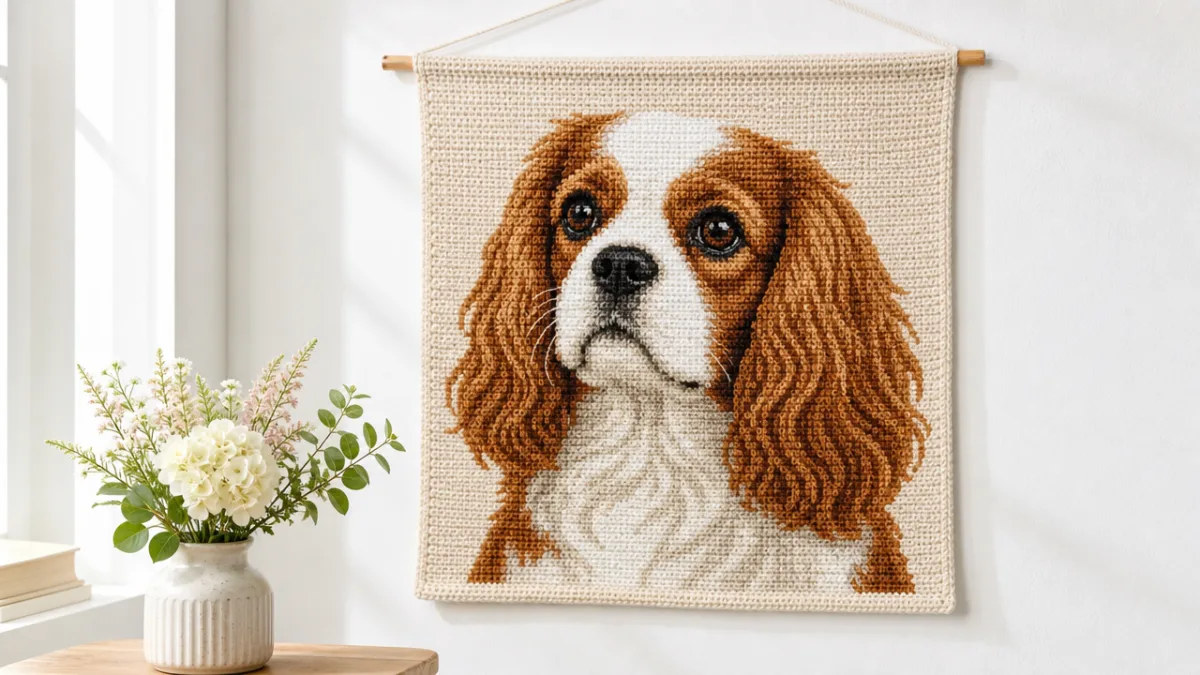
Among all the breeds inspiring tapestry crochet artists, the Cavalier King Charles Spaniel holds a particularly special place. With their large, soulful dark eyes, silky tricolor or Blenheim coats, and gently domed heads, Cavaliers offer a rich visual palette that translates beautifully into the color-blocked aesthetics of tapestry work. Their naturally expressive faces, often described as melting with sweetness, give artists plenty of emotional detail to work with, resulting in portraits that feel genuinely alive even in yarn form.
The growing popularity of pet portrait crochet also reflects a broader cultural shift toward personalized, handmade gifts and home décor. In a world increasingly dominated by mass production, a crochet tapestry featuring someone’s specific dog — complete with that animal’s unique coloring, ear shape, and personality — carries enormous sentimental value. People are willing to invest time, money, and creative energy into pieces that celebrate their animal companions, and the Cavalier King Charles Spaniel, one of the most popular companion breeds in the world, sits squarely at the center of this trend.
Understanding the Cavalier King Charles Spaniel: A Subject Worth Portraying
Before picking up a hook and yarn to create a Cavalier portrait, it helps enormously to understand the breed itself. The Cavalier King Charles Spaniel is one of the largest toy breeds, weighing between 12 and 18 pounds, with a graceful, athletic build softened by flowing feathering on the ears, legs, and tail. They come in four recognized color varieties: Blenheim (rich chestnut on pearly white), tricolor (black and white with tan points), ruby (solid rich red), and black and tan. Each of these coat patterns presents unique opportunities and challenges for the tapestry crocheter.
The breed’s history is as rich as its appearance. Named after King Charles II of England, who was so devoted to his spaniels that he was said to have neglected affairs of state for them, Cavaliers have been beloved companion animals for centuries. They appear in paintings by masters like Van Dyck and Gainsborough, which speaks to their long-standing role as artistic subjects. Today’s crochet portrait tradition carries on this centuries-old appreciation for the breed’s visual elegance, simply translated into a thoroughly modern medium.
For a crocheter planning a tapestry portrait, paying close attention to the Cavalier’s most distinctive anatomical features is crucial to achieving a recognizable likeness. The most important elements include the rounded skull, the well-cushioned muzzle, the large, round, dark brown eyes set well apart and full of warmth, and especially those long, well-feathered ears that frame the face so expressively. Getting these proportions right in a pixel-grid chart is the difference between a generic spaniel face and an unmistakably Cavalier one.
- Blenheim Cavaliers feature chestnut patches on white, often with a distinctive “Blenheim spot” (lozenge mark) on the top of the skull, which can be a charming focal detail in a portrait.
- Tricolor coats require careful color management in tapestry work, as the interplay of black, white, and tan demands precise chart reading and consistent yarn tension.
- Ruby Cavaliers, being a single rich red, allow crafters to focus all their attention on texture, shading, and expression rather than complex color placement.
- Black and tan Cavaliers present strong graphic contrast that can produce particularly striking, bold tapestry designs.
Materials and Tools You Will Need to Create Your Tapestry Crochet Portrait
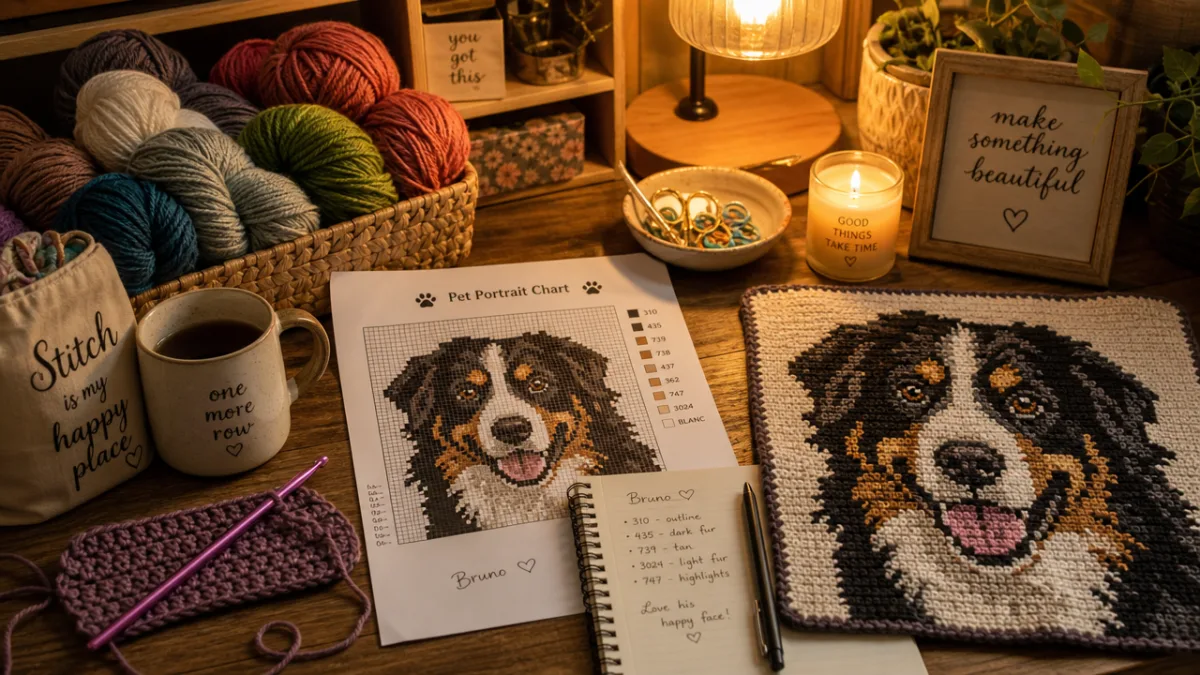
Starting a tapestry crochet Cavalier portrait requires thoughtful material selection, because the quality and weight of your yarn will directly influence how cleanly your design reads. Most experienced tapestry crocheters recommend working with a smooth, tightly spun yarn in a fingering or sport weight for detailed portrait work. Fuzzy or textured yarns, however beautiful on their own, tend to blur the crisp edges that make tapestry images recognizable. Cotton or cotton-blend yarns are particularly popular for this reason, as they have excellent stitch definition and come in an extensive range of colors.
Color selection is arguably the most important single decision you will make in this project. For a Blenheim Cavalier, you will need a warm white or cream, a rich chestnut or deep auburn, and a soft brown or black for the eye and nose details. If you are working a tricolor, add a true black and a warm golden tan to your palette. It is worth purchasing small amounts of several candidate colors and crocheting a test swatch before committing, as yarn colors can look very different in a skein versus worked up in a fabric, and the relationship between two colors changes dramatically when they are placed side by side in a tapestry grid.
Beyond yarn, you will need a crochet hook sized appropriately for your chosen yarn — typically a 2.5mm to 3.5mm hook for fingering and sport weight respectively — along with a printed or digital chart of your design, stitch markers to track your row count, a yarn needle for finishing, and a project bag to keep your multiple yarn balls organized as you work. Many crafters also find it helpful to use yarn bobbins rather than working directly from full skeins, as this prevents the inevitable tangling that comes from carrying multiple colors across your work.
- Choose a smooth, high-twist yarn in fingering or sport weight for the sharpest stitch definition in your finished portrait.
- Select your color palette based on your specific Cavalier’s coat pattern, and always test swatches before purchasing full quantities.
- Source or design a tapestry chart — gridded image files, cross-stitch software, and specialized crochet design apps all work well for this purpose.
- Assemble organizational tools including bobbins, stitch markers, a row counter, and a high-quality hook with a comfortable grip for long working sessions.
- Prepare a blocking board and rust-proof pins for finishing, as a well-blocked tapestry piece makes an enormous difference in the final appearance.
Creating or Sourcing Your Tapestry Chart: Turning a Photograph into a Crochet Pattern
The chart is the blueprint of your tapestry portrait, and spending adequate time on this stage will pay dividends throughout the entire project. The most common approach is to start with a high-quality, front-facing photograph of the Cavalier you want to portray. Good lighting is essential here — a photo taken in soft, even natural light that clearly shows the dog’s face, eye placement, and coat markings will produce a far better chart than a shadowy or blurry snapshot. If you are working from a photo of your own dog, take several shots in good light before choosing the best one to work from.
To convert the photograph into a tapestry chart, you have several options. Dedicated software programs like PixelPerfect, Stitch Fiddle, or even Adobe Photoshop allow you to posterize or pixelate a photograph down to a limited color palette and then overlay a grid. The goal is to reduce the image to a manageable number of colors — usually four to six for a pet portrait — while retaining enough detail to make the subject recognizable. Most beginner to intermediate tapestry crafters work on a canvas of between 40 and 80 stitches wide, which offers enough resolution for a clear portrait without being overwhelming to execute.
Alternatively, you can purchase a pre-made Cavalier King Charles Spaniel tapestry chart from independent designers on platforms like Etsy or Ravelry. Many talented crochet designers specialize specifically in pet portrait charts and have already done the difficult work of translating breed-specific features into clean, workable grids. Buying a professionally designed chart is an especially good choice for beginners who want a reliable starting point, and many sellers offer the option to customize a chart using your own pet’s photograph for a truly personalized result.
Once you have your chart, spend time studying it carefully before you begin crocheting. Walk through the color changes row by row in your mind, noting where transitions happen and where you will need to manage yarn floats on the wrong side of your work. Tapestry crochet typically involves encasing the carried yarn inside your stitches to keep the back of the work tidy, and planning your approach to color management in advance will help you maintain consistent tension throughout the piece. Many crafters find it useful to print the chart in a large format and use a magnetic line guide or sticky note to track their current row as they work.
Step-by-Step Approach to Crocheting Your Cavalier Portrait
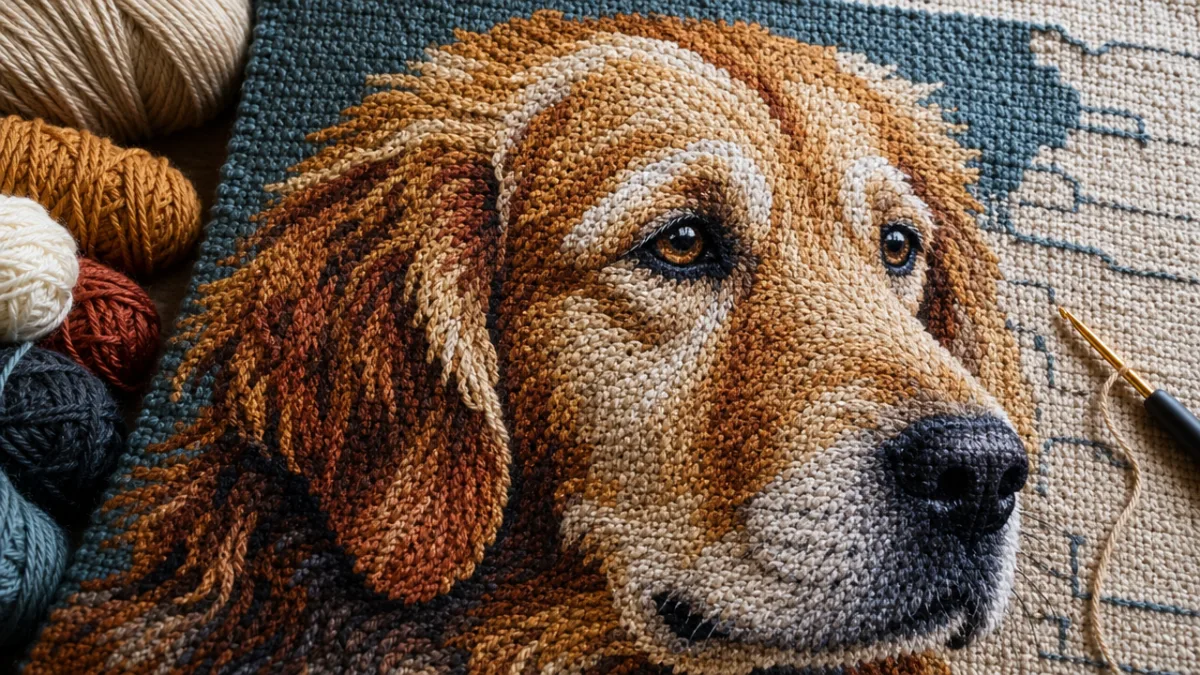
With your materials gathered and your chart prepared, you are ready to begin. Most tapestry crochet pet portraits are worked in rows of single crochet, which creates a dense, stable fabric that displays color changes crisp and clearly. Begin by crocheting a foundation chain equal to the width of your chart in stitches, then work back across in single crochet, introducing your colors according to the first row of the chart. The most common method is to hold the carried color or colors against the top of the previous row and work over them with your active color, encasing them neatly inside your stitches.
Tension management is one of the most discussed challenges in tapestry crochet, and it is especially important when working a portrait where you want clean, blocky color areas rather than puckered or distorted fabric. The key is to keep a relaxed, consistent grip and to ensure that your carried yarn lies flat without pulling or sagging. Many crafters find that they need to consciously loosen their tension slightly when working tapestry compared to standard crochet, because carrying multiple yarns adds bulk inside the stitches and can cause the fabric to cinch inward if you work too tightly.
As you progress through the rows and watch your Cavalier’s face emerge from the grid, you will likely encounter areas that require frequent color changes within a single row. The area around the eyes and muzzle in particular often involves a rapid back-and-forth between colors. In these sections, it helps to slow down and check your chart position after every few stitches rather than working in a rhythm, as a single missed color change can shift the entire image and require frogging (undoing) several rows of work. Patience in these detailed areas pays off spectacularly in the finished portrait.
- Work in single crochet rows for the cleanest stitch definition and most accurate color reproduction in your portrait.
- Encase carried yarn consistently in every stitch to keep the back of your work tidy and prevent loops that could snag or distort the fabric.
- Use a row counter and mark completed rows on your printed chart with a pencil to prevent losing your place during long working sessions.
- Take regular breaks to hold your work at arm’s length and assess whether the image is reading correctly — it is far easier to correct errors early than to frog many rows later.
Finishing, Displaying, and Gifting Your Crochet Cavalier Portrait
Once your final row is complete and all yarn ends are woven in securely, the finishing process transforms a piece of crocheted fabric into a polished, display-worthy artwork. Blocking is the single most transformative finishing step for tapestry crochet portraits. Wet blocking — soaking your piece in cool water, gently squeezing out excess moisture, and then pinning it to a foam blocking board in the correct dimensions — relaxes the stitches, evening out any slight inconsistencies in tension and causing the color areas to settle into clean, well-defined shapes. The difference between a blocked and unblocked tapestry portrait is often dramatic, with the blocked version appearing notably sharper and more professional.
For display purposes, you have a range of wonderful options. Many crafters mount their finished tapestry portrait on a piece of stretched canvas or foam board, securing the edges neatly on the back with fabric glue or lacing the piece over a frame. Others invest in a simple wooden embroidery hoop or dowel rod setup, which gives the work a handcraft-forward aesthetic that feels appropriate for a fiber art piece. If you have made a portrait as a functional item — a pillow cover, a wall hanging, or a small tote bag — the finishing will involve appropriate sewing or assembly steps in addition to blocking.
As a gift, a crochet tapestry Cavalier portrait occupies a category all its own. For dog lovers, receiving a handmade portrait of their specific beloved pet is an experience that mass-produced gifts simply cannot replicate. The knowledge that someone invested hours of skilled, concentrated effort to capture their dog’s face in yarn gives the piece an emotional weight far beyond its material components. Whether presented as a holiday gift, a birthday surprise, a memorial piece for a dog who has passed, or simply a heartfelt gesture between friends who share a love of Cavaliers, this type of portrait tends to become one of a person’s most treasured possessions.
If you find that you enjoy making these portraits and receive enthusiastic responses from friends and family, you may want to consider offering your work for sale or commission. The market for personalized pet portraits of all kinds is robust and growing, and crochet tapestry versions occupy a distinctive niche that distinguishes them from painted, drawn, or digitally rendered alternatives. Setting up a small Etsy shop, sharing your process on Pinterest or Instagram, and connecting with communities of fellow fiber artists can open up a rewarding creative side business built entirely around the art of honoring animals through craft.
Tips for Beginners and Advice for Taking Your Cavalier Portrait Skills Further
If you are new to tapestry crochet, the prospect of a detailed pet portrait might feel daunting, and that instinct deserves respect — this is not the simplest technique in the crocheter’s repertoire. However, with the right approach, even crafters with limited tapestry experience can achieve beautiful results. The most important piece of advice for beginners is to start with a smaller, simpler chart before attempting a highly detailed full-face portrait. A 30-by-30 stitch silhouette of a Cavalier head, using just two or three colors, will teach you the fundamental mechanics of managing multiple yarns while producing a genuinely charming finished piece.
Practice swatching in tapestry before you commit to your portrait project. Work small sections of a test chart to get a feel for how your chosen yarn and hook size interact, how your tension responds when you carry one color versus two, and how your color choices look when worked up in actual stitches. Many beginners are surprised to discover that their gauge in tapestry crochet differs from their gauge in standard single crochet because of the yarn carried inside the stitches, and confirming your gauge before starting your full project will help ensure that your finished portrait matches the intended dimensions.
For more experienced crafters looking to push their skills further, advanced tapestry crochet Cavalier portraits offer exciting avenues for exploration. Shaded or gradient tapestry work, in which you use multiple shades of each color to create the impression of three-dimensional depth and soft fur texture, can produce portraits of truly painterly quality. Some artists work in tapestry tunisian crochet, which creates a denser, flatter fabric with an almost woven appearance. Others experiment with scale, creating large wall-hanging portraits measuring 24 inches or more across that function as genuine statement artworks in a living space.
Engaging with the broader community of tapestry crochet artists will accelerate your development enormously. Online groups on Ravelry, Reddit, and Facebook dedicated to tapestry crochet are full of experienced crafters who freely share pattern recommendations, technique tips, and troubleshooting advice. Following Cavalier-specific accounts on Pinterest and Instagram will expose you to a constant stream of inspiration and keep you connected to the latest trends in pet portrait fiber art. And if you ever have the opportunity to attend a fiber arts festival or crochet retreat in person, the concentrated learning environment and the chance to see other crafters’ work up close is invaluable in ways that no amount of online study can fully replicate.
- Begin with a simplified, reduced-stitch chart if you are new to tapestry crochet, building confidence before attempting a highly detailed full portrait.
- Always complete a gauge swatch specifically in tapestry crochet before starting your project, as your tension will likely differ from standard single crochet work.
- Join online communities dedicated to tapestry crochet and pet portrait fiber art to access a wealth of shared knowledge, pattern recommendations, and supportive feedback on your work.
- Explore advanced techniques like shading with multiple tones, large-scale portrait work, and alternative crochet methods as your skills develop to keep the craft challenging and rewarding.
- Document and share your process and finished pieces on social media platforms, as the feedback and connection you gain from the crafting community are among the most motivating forces in any creative practice.
Ultimately, a crochet tapestry portrait of a Cavalier King Charles Spaniel is far more than a craft project. It is a meditation on the bond between humans and dogs, a celebration of one of the world’s most endearing breeds, and a demonstration of the remarkable capacity of textile art to capture character, warmth, and life. Whether you are making it for yourself, for someone you love, or as part of a growing creative practice, every stitch you place is a small act of devotion — to the craft, to the dog, and to the time-honored tradition of honoring beautiful things by rendering them in your own hands.








What do you think?
It is nice to know your opinion. Leave a comment.