










Introduction to Battery Powered Outdoor Equipment Storage
As battery-powered outdoor equipment becomes increasingly popular among homeowners, the need for thoughtful, organized storage solutions has never been more important. From cordless lawn mowers and electric leaf blowers to battery-operated hedge trimmers and chainsaws, today’s garages and sheds are filling up with sophisticated tools that require more than just a corner of floor space. Proper storage protects your investment, extends the lifespan of your equipment, and ensures that everything is ready to use when the season demands it.
Unlike their gas-powered predecessors, battery-powered tools come with their own unique set of storage considerations. Lithium-ion batteries, which power most modern outdoor equipment, are sensitive to extreme temperatures, moisture, and improper charging habits. Storing these tools correctly means thinking carefully about temperature control, charging station placement, wall-mounted organization systems, and even fire safety protocols. A haphazard pile of equipment in the corner of the garage simply won’t cut it anymore when hundreds or even thousands of dollars worth of battery technology is involved.
This guide walks you through everything you need to know about creating an efficient, safe, and organized storage system for all your battery-powered outdoor equipment. Whether you have a dedicated garden shed, a shared garage space, or even a small utility room, the principles covered here will help you design a storage setup that works for your specific needs, keeps your equipment in peak condition, and makes yard work more efficient and enjoyable every single time you head outside.
Why Battery Powered Equipment Is Replacing Gas Tools
The shift toward battery-powered outdoor tools has accelerated dramatically in recent years, driven by improvements in lithium-ion battery technology, growing environmental awareness, and the sheer convenience of not dealing with gasoline, oil mixtures, or pull-cord frustrations. Major brands like EGO, Greenworks, DeWalt, and Ryobi have invested heavily in developing platforms where a single battery system powers everything from a riding mower to a handheld pruner. This interoperability makes the transition to battery power even more attractive for homeowners who want to simplify their tool collections.
Beyond convenience, battery-powered equipment produces zero direct emissions, operates at significantly lower noise levels than gas counterparts, and requires far less ongoing maintenance. There are no carburetors to clean, no spark plugs to replace, and no stale fuel problems after a season of non-use. For many homeowners, these benefits translate into real savings in both time and money over the course of several years, making the higher upfront cost of battery-powered systems a worthwhile investment worth protecting with excellent storage practices.
Choosing the Right Storage Location
The single most important decision you will make regarding battery-powered outdoor equipment storage is choosing where that storage will live. The ideal location balances accessibility, climate stability, security, and available space. A detached garden shed might seem like the obvious choice, but if it lacks insulation and experiences wide temperature swings throughout the year, it could actually be one of the worst environments for lithium-ion batteries. The best storage locations tend to be temperature-controlled spaces that stay between 40°F and 80°F year-round, which is the sweet spot for battery health and longevity.
Attached garages offer a significant advantage over detached sheds in most climates because they tend to stay warmer in winter and cooler in summer due to their connection to a heated or cooled living space. However, even an attached garage can suffer from extreme temperatures in particularly harsh climates, so adding insulation to the walls and ceiling of a dedicated equipment storage area is often a worthwhile improvement. If you have the option of allocating a small section of a basement utility room or heated workshop, that environment is often ideal for battery storage, especially through winter months when lithium-ion cells can suffer permanent capacity loss if stored in freezing conditions.
Security is another factor that often gets overlooked when selecting a storage location. Battery-powered outdoor tools are valuable and increasingly targeted by thieves. Consider whether your chosen storage location has a solid door with a quality lock, whether it is visible from the street, and whether adding a security camera or motion-activated lighting would provide additional deterrence. Organizing your equipment in a dedicated, lockable space not only protects your investment from theft but also keeps curious children away from power tools and sharp blades, making your property safer for everyone.
Assessing Your Inventory Before Designing Storage
Before purchasing shelving, wall panels, or charging stations, take a thorough inventory of every piece of battery-powered equipment you own. List each item, its dimensions, its battery platform, and how frequently you use it. Equipment you reach for every weekend should be stored at the most accessible height and closest to the door, while seasonal tools like leaf blowers or snow blowers can go in less convenient spots. This inventory exercise prevents the common mistake of buying storage products that don’t actually fit your specific collection of tools and accessories.
Pay particular attention to battery counts as you take stock. Many homeowners accumulate far more batteries than they realize, especially when using a multi-tool platform that spans indoor and outdoor equipment. You might find that you have eight or ten batteries of varying sizes and charge levels scattered throughout the garage. Centralizing all of these into a dedicated charging and storage zone is one of the highest-impact organizational changes you can make, and it begins with simply knowing exactly what you have before designing any storage system.
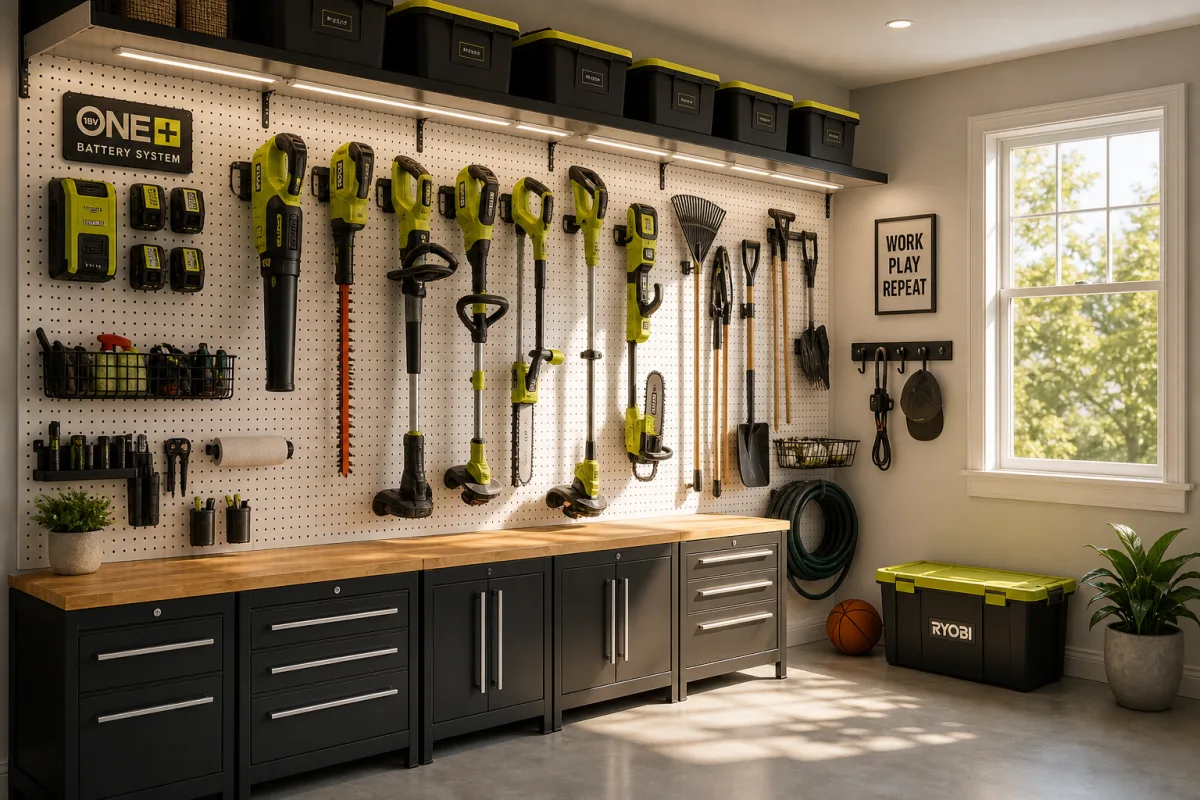
Wall-Mounted Storage Systems for Outdoor Tools
Wall-mounted storage is the cornerstone of any well-organized outdoor equipment storage setup, and it is particularly well-suited to battery-powered tools because most of them are lighter than their gas equivalents. Pegboard panels, slatwall systems, and purpose-built tool wall panels can transform a bare garage wall into a highly functional storage surface that keeps equipment visible, accessible, and off the floor. Keeping tools off the floor is important not only for organization but for protecting batteries and electronic components from moisture that can accumulate at ground level, especially in humid climates or during rainy seasons.
Slatwall panels are arguably the most versatile option for outdoor equipment storage because they accept a wide variety of hooks, brackets, and shelves that can be rearranged as your tool collection changes. Heavy-duty slatwall hooks can hold string trimmers and leaf blowers vertically, while wider brackets can cradle the deck of a battery-powered push mower against the wall, reclaiming valuable floor space. Many homeowners find that mounting their equipment vertically along one full wall of a single-car garage bay can accommodate a surprisingly large collection of tools while still leaving room for a vehicle or workbench.
French cleat systems have also become enormously popular in garage organization communities because they are inexpensive to build from plywood, infinitely customizable, and capable of supporting substantial weight. A full wall of French cleats allows you to design and 3D-print or purchase custom holders for your exact tools, ensuring that every item has a specific home it always returns to. This level of customization is particularly satisfying for battery-powered equipment collections where tools vary widely in shape and size, from compact handheld pruners to large backpack blowers with awkward harness attachments.
Floor Storage Solutions for Larger Equipment
Not every piece of battery-powered outdoor equipment can be wall-mounted, and larger items like riding mowers, robotic mower docking stations, or large battery-powered tillers require dedicated floor space. For these items, designated parking spots marked with floor tape or rubber mat outlines help maintain organization over time and prevent smaller items from accumulating in front of larger ones, which is the primary cause of storage areas becoming cluttered and unusable within just a few months of being organized.
Heavy-duty shelving units with adjustable shelves provide excellent storage for medium-sized equipment, attachments, and accessories. Look for steel wire shelving or solid steel garage shelving rated for at least 250 pounds per shelf when storing heavy batteries, equipment, and tool bags. Labeling every shelf section clearly ensures that items get returned to the correct location by everyone who uses the space, whether that is a family member, a teenager helping with yard work, or a landscaping professional you bring in occasionally for larger projects.
Battery Charging Station Design and Safety
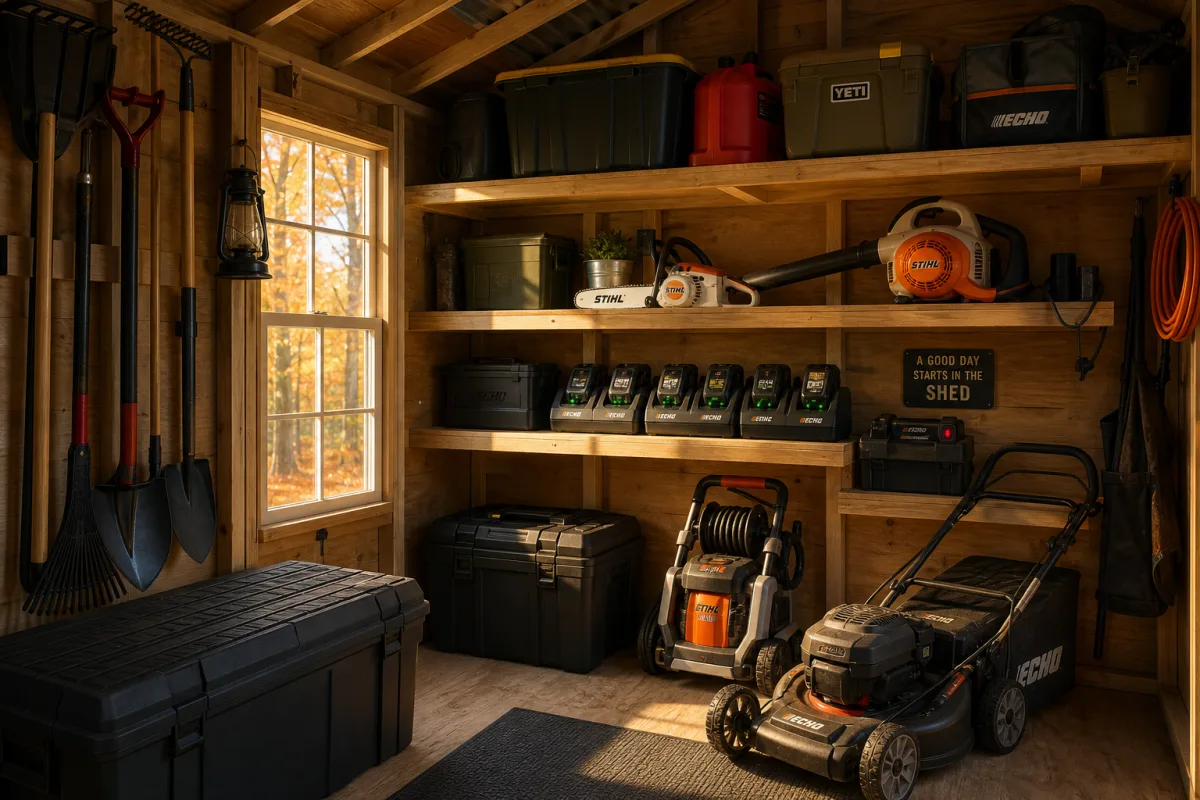
Creating a dedicated battery charging station is one of the most critical elements of a well-designed outdoor equipment storage system, and it is an area where both convenience and safety must be carefully balanced. Lithium-ion batteries should always be charged in a location where a potential fire could be detected quickly and contained, which means charging near a smoke detector, on a non-combustible surface, and away from flammable materials like gasoline cans, rags, or wooden shelving. Many serious garage fires have originated from improperly stored or monitored charging batteries, making this safety consideration genuinely life-saving.
A purpose-built charging station can be as simple as a designated shelf near an electrical outlet with a power strip providing multiple charging ports, or as sophisticated as a custom-built cabinet with ventilation slots, a fireproof liner, and a built-in surge protector. For homeowners with large battery collections spanning multiple voltage platforms, labeling each charger clearly prevents accidentally using the wrong charger with the wrong battery, which can damage cells and potentially create a safety hazard. Color-coded outlet labels or a simple printed guide taped near the charging station can prevent these mix-ups entirely.
Temperature management at the charging station deserves specific attention. Most lithium-ion battery manufacturers explicitly recommend charging batteries only when they are between 50°F and 104°F, and storing them long-term at approximately 40 to 60 percent charge in a cool, dry environment. Charging a battery that is extremely cold or extremely hot can cause permanent cell damage or, in worst cases, thermal runaway. Building your charging station in the climate-stable part of your storage space, away from exterior walls that experience the greatest temperature swings, goes a long way toward protecting battery health through every season.
Organizing Batteries by Platform and Charge Level
One of the most practical habits you can develop for battery-powered equipment storage is organizing your batteries by platform and maintaining a consistent system for tracking charge levels. Color-coded battery holders or clearly labeled bins for each brand and voltage make it immediately obvious which battery goes with which tool, eliminating the frustrating experience of grabbing a battery only to discover it belongs to a different platform entirely. Many experienced tool users keep a dedicated small shelf or drawer with slots sized to hold each battery type upright and visible.
A simple labeling system using tape or marker to indicate whether a battery is fully charged, partially charged, or needs charging saves an enormous amount of time when you are heading out to do yard work and need to quickly assess your power supply situation. Some homeowners use a three-zone system with green, yellow, and red sections of a drawer or shelf to indicate charge status, which provides an at-a-glance inventory of available power that makes planning a productive yard work session much more efficient and less frustrating.
Seasonal Storage Considerations and Winterization
Battery-powered outdoor equipment storage takes on additional complexity when the seasons change and certain tools will sit unused for months at a time. Proper winterization of battery-powered tools is fundamentally different from winterizing gas-powered equipment, but it is no less important. The primary concerns during long-term seasonal storage are battery charge level, temperature, and moisture protection. Following manufacturer recommendations for each specific tool and battery combination is always the best starting point, but several universal best practices apply across virtually all lithium-ion powered outdoor equipment.
Before storing battery-powered tools for the winter season, clean each item thoroughly to remove grass clippings, dirt, and debris that can harbor moisture and cause corrosion over months of storage. Inspect cutting blades, trimmer heads, and other consumable parts for wear and replace anything that will need attention before spring use, so that the equipment is ready to deploy immediately when the grass starts growing again. A few hours of attention at the end of the season pays dividends in the form of tools that start and perform perfectly from day one of the following season without any troubleshooting delays.
For battery storage specifically, most manufacturers recommend bringing batteries indoors during months when garage or shed temperatures will regularly drop below freezing. A shelf in a climate-controlled basement, utility room, or even a heated closet is far preferable to leaving expensive lithium-ion batteries in an unheated garage where overnight temperatures might plunge to 10°F or 20°F. Batteries stored in freezing conditions can lose 20 to 30 percent of their total capacity permanently, meaning a battery that once provided 45 minutes of mowing might only deliver 30 minutes after a single harsh winter of improper storage.
Spring Startup and Storage Inspection
The transition from winter storage back to active use in spring is an excellent opportunity to assess the condition of your entire battery-powered equipment collection and make any organizational improvements before the busy outdoor season begins. Retrieve batteries from indoor winter storage, give each one a full charge cycle, and test each tool for proper operation before the first time you need it for actual yard work. This proactive testing approach prevents the all-too-common frustration of discovering a malfunctioning tool on the day you need it most, like the first warm Saturday of spring when the lawn is overgrown and you have only a few hours to work.
Use the spring inspection as an opportunity to reassess your storage system and make adjustments based on how well it worked over the previous year. Did you find yourself constantly moving things to get to what you needed? Were certain tools always left out because their storage spot was inconvenient? Did batteries end up scattered because the charging station lacked enough organized slots? The answers to these questions point directly toward improvements that will make the next full year of storage more efficient and frustration-free, gradually refining your system toward one that truly works for your specific habits and tool collection.
Smart Technology and Future-Proofing Your Storage System
The world of outdoor equipment storage is increasingly being influenced by smart technology, and forward-thinking homeowners are beginning to incorporate connected devices into their storage setups in ways that save time, protect equipment, and provide peace of mind. Smart power strips with energy monitoring can track how much electricity your charging station consumes and alert you if a charger appears to be drawing abnormal power, which can be an early warning sign of a malfunctioning battery or charger. Smart smoke detectors installed directly above a charging station add a critical layer of fire protection that basic storage setups lack.
Inventory management apps designed for tool collections allow you to photograph and catalog every piece of equipment, record purchase dates and warranty information, and even log maintenance performed on each item. For homeowners with substantial collections of battery-powered outdoor equipment worth several thousand dollars in total, this digital inventory serves both as an organizational aid and as insurance documentation that can be invaluable in the event of theft, fire, or flood damage. Taking fifteen minutes to photograph and catalog your equipment is a small investment of time that could save enormous stress during an insurance claim.
As battery-powered outdoor equipment continues to evolve rapidly, future-proofing your storage system means building flexibility into the design from the beginning. Choose modular storage systems that can be expanded or reconfigured rather than custom built-ins that lock you into a specific layout. Leave extra electrical capacity in your charging station area to accommodate additional chargers as your collection grows. Install more wall panel coverage than you currently need so there is always room to add a hook or bracket for a new tool without a major reorganization project. Designing for growth and change ensures that the organizational system you create today continues to serve you effectively for years and even decades as the landscape of battery-powered outdoor equipment continues to expand and improve.
Building a Maintenance Routine Around Your Storage System
The best storage system in the world provides little long-term value without a consistent maintenance routine that keeps it functional over time. Establishing simple habits like always returning tools to their designated spots immediately after use, wiping down equipment before storing it, and doing a brief monthly check of all battery charge levels takes only a few minutes per session but prevents the gradual slide into disorganization that affects most garages within a year of being organized. Posting a simple checklist near the storage area can serve as a helpful reminder for everyone who uses the space.
Schedule a quarterly review of your entire storage system to catch small organizational problems before they compound into bigger ones. Check for any signs of moisture intrusion, inspect wall mount hardware for looseness that could cause equipment to fall, and verify that all charging equipment is functioning correctly. These brief quarterly reviews also provide a natural opportunity to dispose of worn-out accessories, expired consumables, and tools that are no longer needed, keeping the storage area from gradually filling with items that no longer earn their space in your carefully organized system.
- Always return battery-powered tools to their designated wall hooks or shelf positions immediately after each use to prevent clutter from accumulating on the floor or workbench.
- Charge batteries after each use rather than storing them depleted, but avoid leaving batteries on the charger for extended periods beyond full charge completion.
- Clean all cutting surfaces, blades, and debris channels before returning equipment to storage to prevent corrosive buildup and make spring startup significantly faster.
- Label every storage location clearly so that family members, helpers, or landscaping professionals can maintain the organizational system without guidance from you.
- Inspect wall mount hardware quarterly to ensure hooks, brackets, and fasteners remain tight and secure, particularly for heavier equipment that places ongoing stress on mounting points.
- Keep a fire extinguisher rated for electrical fires within easy reach of the charging station area and verify its pressure gauge monthly as part of routine garage safety checks.








What do you think?
It is nice to know your opinion. Leave a comment.