










27 Easy DIY Garden Art Ideas to Transform Your Outdoor Space
Why Garden Art Matters: Turning Your Yard Into a Personal Gallery
Your garden is so much more than just plants and dirt. It’s an extension of who you are — your home, your personality, your creative energy spilling out into the open air. When you add handmade art to your outdoor space, something shifts. A functional yard starts to feel like a living gallery, one that tells your story every time someone walks past it. Garden art makes people slow down, take a second look, and actually appreciate what they’re seeing. And honestly? It gives you a great excuse to spend more time outside.
The best part? You don’t need an art degree or a big budget to make it happen. Some of the most stunning outdoor pieces come from recycled materials, thrift store finds, and simple techniques you can pick up on a Saturday afternoon. Whether you’ve been crafting for years or you’ve literally never touched a paintbrush, there’s a project here for you. Walking past a wind chime you made yourself or a stepping stone you designed from scratch — that feeling never really gets old.
There are practical perks too, not just the feel-good stuff. A well-placed sculpture or a cluster of painted rocks can act as a natural focal point, drawing the eye through your yard and making even a small space feel more intentional. Decorative pieces can also help define different areas — marking where the vegetable garden ends and the flower beds begin, or guiding guests from the seating area down toward the path. When your garden art pulls double duty as both decoration and wayfinding, the whole space just feels more put-together.
Upcycled and Repurposed Art: Giving Old Items New Life
Some of the most satisfying garden art you’ll ever make starts with something that was headed for the trash. Old colanders become charming hanging planters. A cracked teapot turns into a fairy garden centerpiece. A worn-out pair of boots stuffed with soil and planted with trailing succulents? People stop in their tracks to look at it. The whole idea behind upcycled garden art is that beauty can come from the most unexpected places — you just need to look at ordinary objects a little differently.
Bicycle wheels are a surprisingly versatile starting point. Clean one up, give it a coat of bright paint, and mount it on a fence post — instant sculpture. Add some weather-resistant pinwheels or artificial flowers to the spokes and you’ve got a piece that actually moves in the breeze. Or collect a few wheels in different sizes and arrange them together on a wall to create a large-scale installation with a cool, industrial-gear kind of energy. It’s the sort of thing that makes a garden feel genuinely one-of-a-kind.
Broken ceramic dishes and mismatched tiles that you’d otherwise throw away are ideal for mosaic work. You can cover pots, create decorative garden stones, or make a stunning mosaic mirror to hang on an exterior wall. The basic process is pretty approachable: break the ceramics into irregular pieces with a tile nipper or a cloth-wrapped hammer, arrange them on a prepared surface, glue them down, and grout the gaps. The finished piece is colorful, surprisingly durable, and honestly gets more charming with every year it spends outdoors.
Painted Rocks and Stones: The Simplest Canvas in Nature
Rocks might be the most underrated art supply out there — and they’re free. Smooth river rocks and flat fieldstones are ready to paint with almost no prep work at all. A set of outdoor acrylic paints and a few brushes, and you’re in business. Scatter your finished pieces through a flower bed, line them along a garden path, or cluster them at the base of a tree. You can go for miniature landscapes, animal portraits, bold geometric patterns, inspirational words — whatever speaks to you. The only real limit is what you can picture in your head.
Mandala rocks have become a real favorite in the DIY world, and for good reason: they look incredibly intricate but are actually beginner-friendly. The technique relies on dotting tools, pencil erasers, or even cotton swabs to build up concentric rings of dots and shapes outward from a central point. You don’t need to be able to draw freehand at all — just work your way out from the center, ring by ring, and the pattern takes care of itself. Seal them with a weather-resistant varnish and they’ll hold up beautifully through rain, sun, and multiple seasons outdoors.
Painted rocks can also do real work in your garden as plant markers. Write the name of an herb, vegetable, or flower directly on a rock and place it at the base of the plant — no more flimsy plastic labels that fade and snap in half. You can even use numbered or color-coded rocks as a simple garden map to remind yourself what you planted where, which is especially helpful when you’ve direct-sown seeds and there’s nothing above ground yet to identify.
Wind Chimes and Kinetic Sculptures: Art That Moves With the Breeze
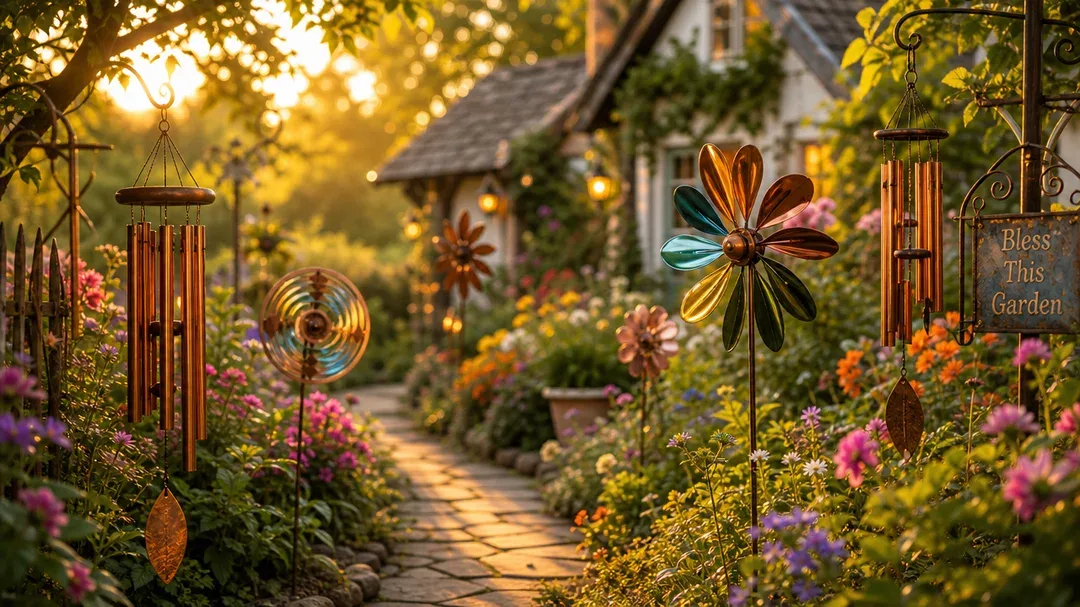
There’s something a little magical about garden art that actually responds to the world around it. Wind chimes and kinetic sculptures hit differently from static decorations because they engage more than just your eyes — you hear them, you watch them move, and they change constantly with the breeze. Handmade chimes built from driftwood, sea glass, copper pipe, old keys, or silverware create something deeply personal, a piece of functional art that brings a whole different atmosphere to your garden. And the process of making one? Totally doable in an afternoon.
Copper pipe wind chimes are a perennial favorite because copper produces such a warm, resonant tone, and it ages incredibly well, slowly developing that beautiful blue-green patina that looks right at home in any garden. For a basic version, you’ll need a wooden or driftwood bar across the top, several copper pipe lengths cut to different sizes for different notes, a central striker to hit the pipes, and a sail to catch the wind. The different pipe lengths are what give you varied tones, and playing around with the sizes lets you tune the chime so the pipes ring together in a pleasing chord.
Kinetic sculptures push the idea of moving art even further — pinwheels, spinning flowers, whirligigs, and rotating geometric forms that seem genuinely alive in the garden. A simple whirligig made from painted wooden paddles on a freely spinning dowel is a great starting point, or you could take on something more ambitious like a spiral spinner cut from flexible sheet metal or heavy-duty mylar. Group a few together in a cluster and you’ve got a focal point that shifts and changes throughout the day as the light moves and the breeze picks up and dies down.
Vertical Garden Art: Transforming Fences and Walls Into Living Canvases
Here’s something a lot of gardeners never think about: all that vertical space. Fences, walls, pergola posts, trellises — they’re just sitting there, doing the bare minimum, when they could be some of the most striking features in your entire yard. Once you start thinking of those flat surfaces as canvases, the possibilities open up fast. Painted murals, hanging installations, wall-mounted planters, framed outdoor artwork — any of these can turn a plain wooden fence into a genuine showstopper. It’s also a lifesaver if you’re working with a smaller yard where ground space is tight but vertical real estate is plentiful.
Pallet art is one of the most accessible places to start, partly because wooden pallets are often free — hardware stores, garden centers, and construction sites frequently give them away — and partly because they’re so versatile. Sand one down, paint it, and mount it on a fence as a backdrop for hanging planters or lanterns. Staple landscape fabric to the back, fill it with soil, and tuck small succulents through the slats for a living wall. Or just paint it with a bold pattern, a nature scene, or a favorite quote and let it stand as pure decoration. There’s really no wrong direction to take it.
Shadow box frames made from weatherproof materials like cedar or marine-grade plywood offer a more refined approach. Fill them with arrangements of pressed flowers, preserved moss in varying shades of green, driftwood, or objects you’ve gathered from your own garden and the landscape around it. Hang them in a grouping on an exterior wall or fence, spaced out like a gallery wall, and the effect is surprisingly polished — it brings a real interior-design sensibility to the outside. A coat of waterproof sealant over the finished pieces keeps everything looking good through multiple seasons of rain and sun.
Garden Sculptures and Three-Dimensional Art: Adding Dimension and Drama
Three-dimensional sculptures do something flat art simply can’t — they invite you to move around them, see them from every angle, and watch the light play across their surfaces as the sun shifts throughout the day. They bring real presence to a garden. The great news for DIYers is that genuinely impressive sculptures can be made from an enormous range of materials: welded metal, cast concrete, carved wood, assembled wire. You don’t need a professional setup to create something striking. You mostly need patience, curiosity, and a willingness to learn as you go.
Hypertufa is a longtime favorite among dedicated garden artists, and once you’ve tried it, it’s easy to see why. The material can be shaped into almost any form and cures into something that looks and feels like stone — like it’s been aging in a garden for decades. The basic mix is Portland cement, peat moss or coir fiber, and perlite or vermiculite combined with water. Press it over a mold (an old bucket, a cardboard box, a balloon, even crumpled newspaper) and you can create bowls, troughs, animal figures, or abstract shapes. Once it’s cured and you’ve encouraged some moss growth with a coating of yogurt or diluted fertilizer, the result looks genuinely antique. It works beautifully in cottage gardens, woodland settings, and formal gardens alike.
Wire sculpture offers a completely different look but is just as approachable for beginners. Using flexible armature wire or repurposed chicken wire, you can build the basic shapes of animals, abstract figures, geometric forms, or botanical motifs and nestle them among your plants for that whimsical, creatures-in-the-garden effect. Covering the frame with burlap strips dipped in concrete mix adds solidity and a rough texture; leaving the wire bare gives a lighter, more industrial feel that suits modern and minimalist gardens. Either way, the process of bending and shaping wire by hand is genuinely enjoyable, and the results are endlessly adaptable to whatever vision you’re working toward.
Lighting as Art: Illuminating Your Garden After Dark
Garden art doesn’t have to clock out at sunset. Some of the most enchanting DIY projects are specifically designed for after dark, when thoughtfully placed lighting turns your outdoor space into something that feels almost otherworldly. Handmade lanterns, mason jar lights, DIY solar stakes, and string light arrangements can all be genuine artistic focal points rather than just practical illumination. When you bring the same creative intention to your outdoor lighting that you bring to your daytime garden art, you end up with a yard that has two completely different — and equally beautiful — personalities.
Mason jar lanterns are a classic for a reason: the supplies are cheap, the process is easy, and the results are genuinely lovely. Drop a tea light or battery-operated LED candle into a jar with a bit of sand or small stones for stability, then hang the jars from shepherd’s hooks, tree branches, or a simple wire strung between posts. If you want to take it further, decorate the jars first — paint them with translucent glass paint in jewel tones, wrap them in wire to add geometric texture, or frost the glass with spray-on frosting for a softer, more diffused glow that looks beautiful from across the garden at night.
Solar-powered garden art is a particularly smart move for anyone who wants their outdoor space to glow without adding to the electricity bill. Small solar cells salvaged from inexpensive solar stake lights can be incorporated into a surprisingly wide range of DIY projects — embedded into painted wooden sculptures, mosaic stepping stones, or handmade clay figures so they quietly charge all day and glow gently after dark. It’s one of those rare projects that rewards your creative effort twice every day, looking great in the daytime and doing something completely different — and equally magical — once the sun goes down.








What do you think?
It is nice to know your opinion. Leave a comment.