










22 Rowdy DIY Backyard Games for Kids and Adults (2026)
Why DIY Backyard Games Are Making a Comeback
There’s something genuinely satisfying about building your own fun from scratch. In a world where screens compete for everyone’s attention, DIY backyard games are a welcome excuse to get outside, get hands-on, and actually hang out with the people you like. The 2026 push toward outdoor socializing has only added fuel to this fire, with more families than ever spending a weekend afternoon putting together lawn game setups that honestly put store-bought versions to shame.
And it goes beyond nostalgia. When you build a game yourself, you get to make it exactly right for your space, your budget, and whoever’s playing. A store-bought cornhole set might run you eighty bucks and look identical to half the sets in your neighborhood. Build your own and you can slap on your team colors, size it perfectly for your patio, and spend a Saturday afternoon getting the kids involved in sanding down the edges. That personal touch turns a simple lawn game into something you’re actually proud of.
There’s also the cost factor, which is hard to ignore. Most of the projects in this article only need basic lumber, PVC pipe, rope, pool noodles, or stuff you probably already have kicking around in your garage. A full afternoon of entertainment for twenty people can come together for under thirty dollars if you go the DIY route — which makes these projects a no-brainer for birthday parties, neighborhood get-togethers, family reunions, or any summer cookout where you want big fun without a big bill.
Classic Games Reinvented for the Modern Backyard
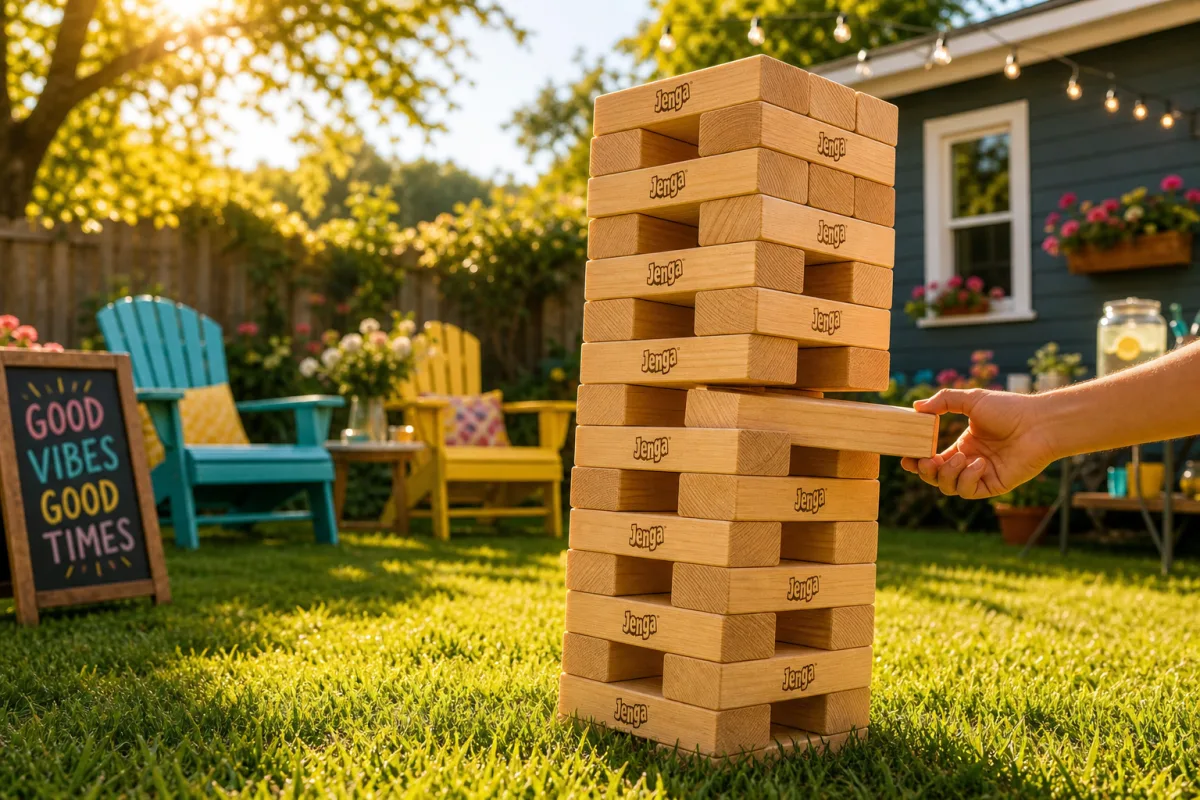
Taking a beloved classic and giving it an oversized or homemade twist is one of the most satisfying things you can do with an afternoon and a trip to the hardware store. Giant Jenga is a perfect example — it’s become a go-to at outdoor parties, but the store-bought versions never feel quite as solid or impressive as the ones you build yourself from two-by-four lumber, cut to uniform lengths, sanded smooth, and maybe stained or painted if you’re feeling fancy. The whole thing costs about fifteen dollars in lumber and an hour of your time, and it’ll hold up to years of rowdy play without complaint.
Ladder toss is another one that translates beautifully to a DIY build. With PVC pipe and elbow connectors from any hardware store, you can put together two ladder frames in under two hours — no special tools needed. The bolas, those weighted throwing pieces, are easy to make from golf balls and nylon rope. The whole setup breaks down flat for easy transport, so it works just as well at tailgates, camping trips, and beach outings as it does in your backyard. A coat of paint in contrasting colors adds a nice visual pop and helps teams keep track of which pieces are theirs.
Even classic horseshoes gets a fresh update when you swap the metal stakes and horseshoes for painted wooden stakes and foam ring tossers. It’s suddenly safe for little kids while keeping all the competitive energy of the original. You can also try a variation using large rope rings tossed over wooden dowels set at different distances, with a point system that rewards both accuracy and how far back you’re throwing from. Small tweaks like these open the game up to a much wider age range and save you from any anxious moments during an enthusiastic competitive round.
High-Energy Games That Get Everyone Moving
The best backyard games are the ones that get even the most committed lawn-chair-sitters up and involved. DIY obstacle courses are hard to beat for pure physical energy, and building your own means you can dial the difficulty up or down depending on who’s playing. Pool noodles pushed into the ground make great weaving poles. Hula hoops laid flat become stepping rings. A tarp tunnel or a low rope strung between two posts challenges everyone to duck and crawl through. The whole course can go up in thirty minutes and come back down just as fast.
Slip-and-slide setups have come a long way from the flimsy plastic sheet you had as a kid. A DIY version made from heavy-duty painter’s plastic, staked firmly into the lawn and kept wet with a garden hose, can stretch as far as your yard allows. Toss a small inflatable pool at the end as a landing zone and you’ve got something genuinely great. For adult parties, running a foam cannon or bubble machine alongside the slide turns it into a full centerpiece event — the kind of thing guests will still be talking about two weeks later.
Tug-of-war gets a serious upgrade when you use a good rope and mark a proper center line with chalk or spray paint. Splitting guests into teams by age, weight, or random draw creates the kind of competitive tension that gets a whole backyard buzzing. Want to crank up the chaos? Run it over a sprinkler line or a shallow kiddie pool so the losing team goes home soggy. Setting up multiple rounds with a tournament bracket drawn on a chalkboard keeps things organized and gives every team a real shot at redemption throughout the afternoon.
DIY Target Games That Test Skill and Precision
Target games have a great quality about them: they level the playing field. Someone who’d get lapped in a relay race might absolutely dominate a well-designed accuracy challenge, which makes these games some of the most socially comfortable options for mixed-ability groups. Cornhole is the undisputed king here, and building your own boards opens up a ton of creative room. Standard dimensions are two feet by four feet with a six-inch hole centered eight inches from the top edge, but once you’ve got that nailed down you can add custom artwork, team logos, or even LED strip lighting around the edges for evening play that looks seriously cool in photos.
Can knockdown games are among the simplest and most rewarding builds for families with younger kids. Save aluminum cans for a few weeks, spray paint them in alternating colors, and stack them into pyramid formations on a solid wooden shelf or table. Players take turns throwing beanbags, foam balls, or water balloons to knock down as many as they can. Assign point values to different tiers of the pyramid and keep score on a small chalkboard staked nearby. The crash of cans sends little kids into absolute delight every single time — it never gets old.
A DIY ring toss with scoring zones is another versatile option that spans age groups nicely. On a plywood base with wooden dowels of different heights, you can build a board where shorter, closer dowels are worth fewer points and taller, farther ones are worth more. The rings can be made from rope tied into loops and sealed with tape, or from PVC rings cut from larger pipe sections. Laminate a scoring chart and attach it right to the base and you’ll eliminate point disputes entirely, keeping the game moving smoothly even when a big group is cycling through.

Water Games Perfect for Summer Heat
Once the temperature climbs and the sun starts bearing down, water games stop being optional. The great news is that some of the most entertaining water games out there cost almost nothing to put together. Water balloon dodgeball only needs a bag of balloons and a hose. Split into two teams, lay down a center boundary line with chalk or a garden hose, and let it unfold. The mix of strategy, quick movement, and the deeply satisfying splat of a direct hit makes this one just as fun for adults as it is for kids — maybe more so.
A DIY water gun battle station takes a bit more setup but pays off in hours of sustained chaos. Arrange a few cardboard box forts or wooden pallet barriers around the yard, set up a central water station with buckets and water guns of different sizes, and send teams scrambling to claim their territory at the sound of a starting signal. Add a scoring element — a flag or a colored target that teams have to soak to earn points — and you’ve turned a free-for-all spray fight into a tactical team game that actually requires some communication and coordination. Older kids and adults will get genuinely into the strategy of it.
Frozen t-shirt races deserve a special mention as one of the funniest things you can spring on a summer crowd. The night before your party, soak t-shirts in water, fold them flat, and freeze them in a block. At race time, hand one to each participant and watch them try to thaw and put on a rock-solid shirt using only body heat, movement, and sheer stubbornness. The sight of grown adults and kids alike wrestling with icy, rigid clothing while everyone else laughs from lawn chairs is the kind of shared moment you genuinely can’t manufacture with a purchased game. It’s chaotic, it’s ridiculous, and it’s perfect.
Evening Backyard Games That Extend the Fun After Dark
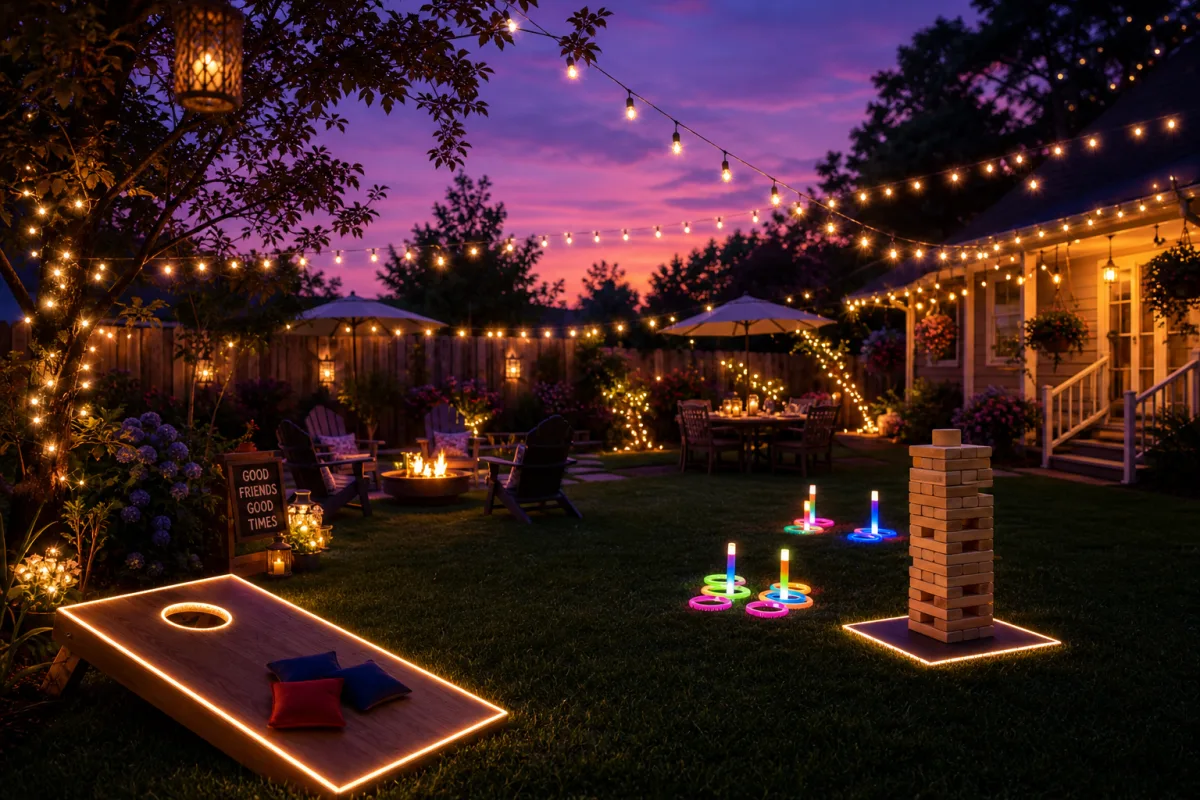
Any host worth their salt knows the party doesn’t have to stop when the sun goes down. Evening backyard games — many of them dead simple to DIY — can add hours to your gathering and often produce the most memorable moments of the whole night. Glow-in-the-dark cornhole is one of the easiest upgrades you can make: swap in glow-in-the-dark bean bags from any craft store, drop some LED strip lighting inside the board holes, and your daytime game becomes a visually striking nighttime one that looks amazing in photos.
DIY glow bowling uses glow sticks tucked inside plastic water bottles as pins and a glow-in-the-dark bouncy ball to knock them down. Arrange your ten-pin setup on a flat patch of lawn, mark the foul line and lane edges with painter’s tape or a garden hose, and you’ve got a backyard bowling alley that costs almost nothing but looks genuinely spectacular in the dark. Guests walking up from the street will spot the soft colored glow before they even reach the gate and head straight toward it without needing any convincing. Kids especially find the whole setup almost magical.
Flashlight tag and shadow puppet battles round out the evening with activities that cost nothing beyond the flashlights you already own. Shadow puppet battles projected onto a white sheet stretched between two poles turn competitive kids into surprisingly creative storytellers. For bigger groups, a DIY capture the flag using glow stick bracelets as flags and LED headlamps for visibility gives parents and teenagers a twilight strategy game they can play side by side. There’s a particular kind of magic to evening backyard games — the slight mystery that comes with the dark, the glow of lights through the grass, the feeling that the backyard has somehow become its own little world. That’s hard to beat.
Tips for Building and Storing Your DIY Game Collection
Building a great collection of DIY backyard games only pays off if you can actually keep them in good shape and get them out without a major production. Before you start any build, think about how it’s going to break down and store. Games that collapse into flat components or fit inside a single tote bin are so much more practical than ones that need their own corner of the garage year-round. PVC games can be pulled apart at the connector joints. Wooden games like cornhole boards or Jenga sets slip neatly into cotton drawstring bags. Planning for storage from the start means you’ll actually use these things instead of leaving them buried in the shed.
Weatherproofing is probably the single biggest factor in how long your outdoor wooden games last. Any lumber project heading outside should be sanded to at least 120-grit smoothness, sealed with an exterior primer, and finished with at least two coats of exterior paint or weatherproof polyurethane. It’s a small investment of time during the build that can stretch the life of your game from a season or two to a full decade. For any metal parts — hinges, hooks, stakes — go with stainless steel or galvanized hardware so rust doesn’t become a problem down the road.
Organizing your collection by occasion and age group makes grabbing the right games fast and painless. A simple handwritten list taped inside your storage bin that notes which games work best for young kids, which are better for competitive adults, and which work for everyone goes a long way. Jot down setup times too — knowing that one game takes five minutes to put together and another takes twenty can make a real difference when guests are already arriving and the party is warming up. Get this system dialed in and you’ll quickly become the house everyone wants to gather at, summer after summer.








What do you think?
It is nice to know your opinion. Leave a comment.