










20 Creative Garden Ideas Made From Wire: Transform Your Outdoor Space
The Timeless Appeal of Wire in Garden Design
Wire has been a go-to material for gardeners for centuries, and it’s easy to see why. Whether you’re working with galvanized steel, copper, aluminum, or humble chicken wire, this stuff is surprisingly versatile — and it has a way of fitting naturally into any outdoor setting. What really makes wire garden projects so appealing, though, is how accessible they are. Most of them don’t require fancy tools or a big budget, yet the results can look genuinely impressive, even artsy.
One of the things that sets wire apart from other garden materials is how well it gets along with plants. Wood and stone stay rigid, but wire structures slowly get taken over by climbing vines, moss, and trailing flowers in a way that feels almost magical. A simple wire frame can disappear entirely under a cascade of blooms, or it can stay out in the open as a sculptural element, catching the light and casting interesting shadows. Either way, it changes with the seasons, which means there’s always something new to notice.
From a practical standpoint, wire is also one of the most forgiving materials you can choose. Made a mistake? Undo it. Need to adjust the shape? No problem. Want to scale a design up or down? Easy. For beginners, that flexibility makes wire a low-pressure starting point that builds real confidence without costing much. And for more experienced crafters, wire turns out to have surprising depth — it can capture fine detail, fluid curves, and bold sculptural forms that harder materials just can’t match.
Structural Wire Projects: Trellises, Arches, and Frames
If there’s one place wire really earns its keep, it’s as structural support for climbing plants. A handmade wire trellis can be built to fit your exact wall, fence, or raised bed — no compromises, no awkward gaps. And unlike the off-the-shelf versions that tend to look a bit generic, one you make yourself can have its own personality: a fan shape, a geometric grid, a free-form design. Even before anything starts climbing it, a well-made trellis can be a decorative feature worth looking at on its own.
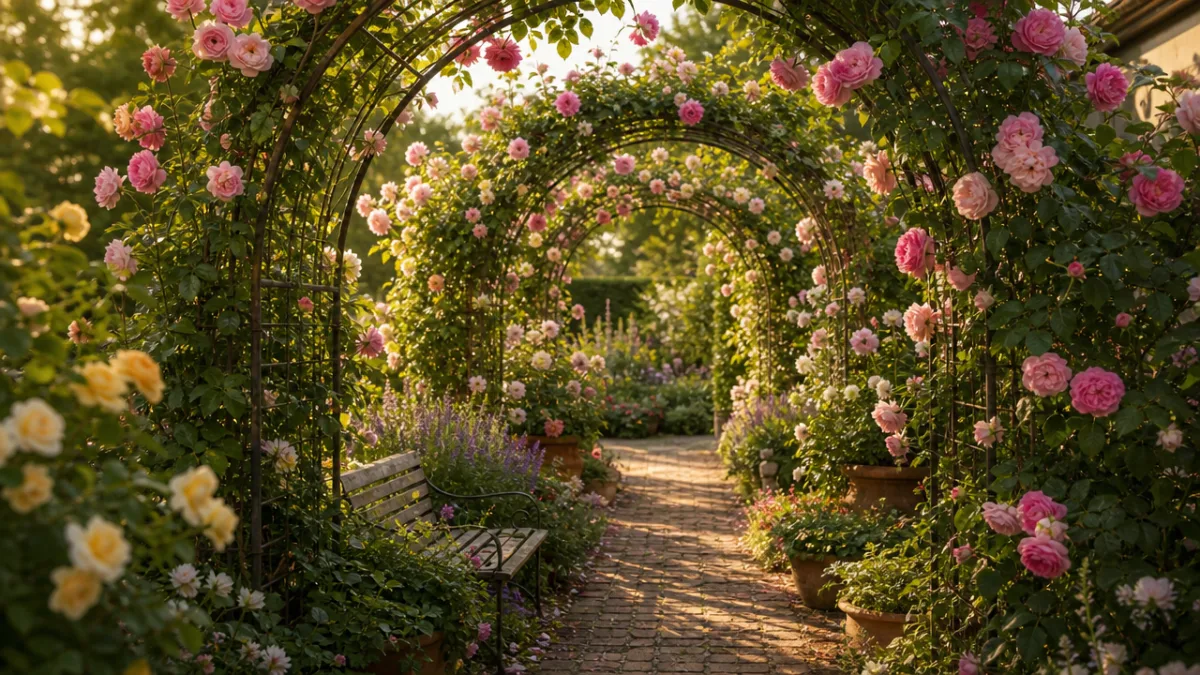
Wire arches are another project that’s well worth the effort. Bend heavy-gauge wire or conduit into gentle curves, anchor them at intervals along a garden path, and you’ve got the bones of something really special. Once roses, wisteria, or sweet peas start climbing through, you end up with one of those garden features that stops people in their tracks. Structurally, they’re simpler than they look — the arches can go straight into the soil or onto wooden stakes, and you just weave cross-wires between them for extra support without making the whole thing look heavy or cluttered.
Wire frames are incredibly useful in ways you might not expect. They can guide topiary plants into precise shapes, protect young seedlings, or just stand on their own as sculptural accents. Even something as simple as a square or circular frame pushed into the earth beside a flower bed instantly gives the planting a more intentional, considered feel. If you want to go bigger, you can build three-dimensional forms — spheres, cones, pyramids — that become real focal points in the garden. These aren’t as complicated as they sound, and the payoff in terms of visual impact is huge.
Wire Sculptures and Artistic Focal Points
Wire sculpture is a real art form, and the garden turns out to be a perfect place to show it off. The light shifts throughout the day, throwing different shadows from the twisted strands and giving even a still piece a sense of movement. Animals are a natural choice for garden wire sculptures — birds on fence posts, butterflies above a flower bed, a fox peering through ornamental grasses, a hare frozen mid-leap across a lawn. Once you get comfortable with a few basic bending and joining techniques, the results can be surprisingly lifelike.
Human figures and abstract forms work beautifully too, especially when you think carefully about where to place them. A wire silhouette of a gardener working near the vegetable patch, or a cluster of spiraling abstract forms tucked among ornamental grasses, brings a contemporary artistic quality that feels like it belongs in the space rather than being dropped into it. Because wire is transparent in a sense — you can see right through it — these sculptures never feel heavy or overpowering. They occupy space without blocking light or views, which makes them especially well-suited to smaller gardens.
Getting started with wire sculpture is really more about patience than skill, at least in the beginning. Working on simple flat silhouettes before moving into three-dimensional forms gives you a chance to get a feel for how wire behaves — where it naturally wants to bend, how much tension it holds, how to make clean joins. The tools you need are minimal: round-nosed pliers, wire cutters, maybe a pair of flat-nosed pliers for tightening things up. A lot of people find the whole process surprisingly meditative. There’s something about the focused, repetitive work of bending and shaping wire that quiets the mind in a way that’s hard to describe until you’ve experienced it.
Practical Wire Crafts: Planters, Baskets, and Containers
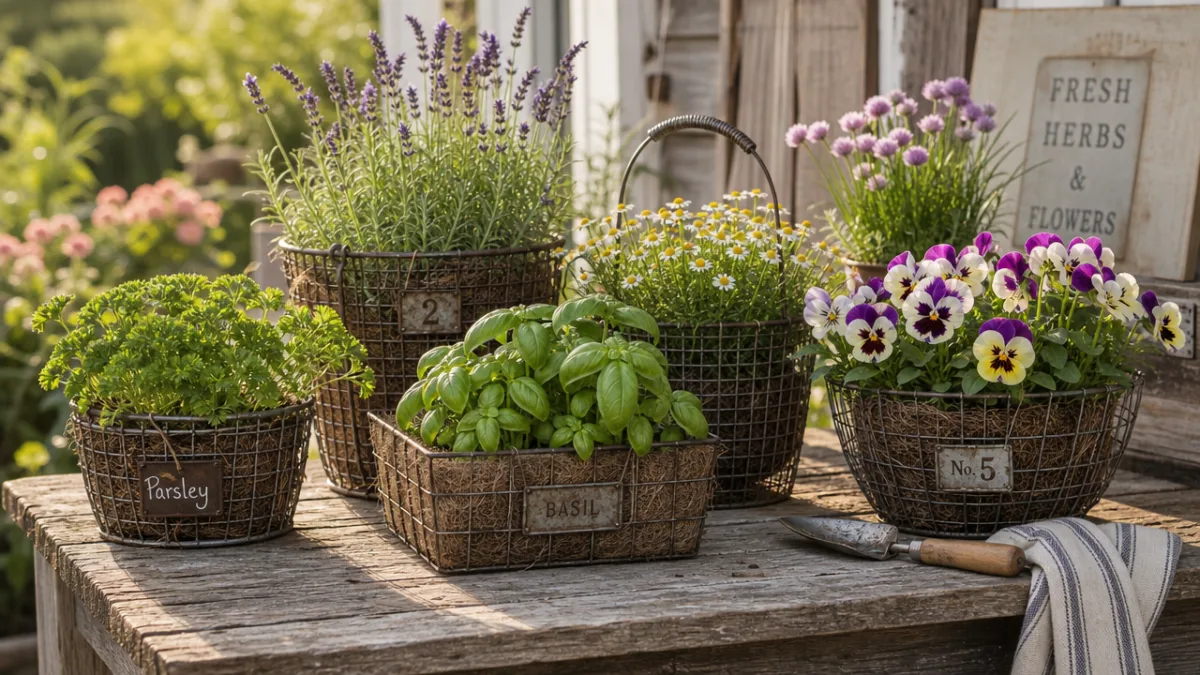
Wire mesh and chicken wire can be shaped into planters that are both attractive and genuinely better for your plants than many solid-walled containers. The open structure lets water drain freely and air circulate around the roots, which means healthier, more vigorous growth. Line a wire basket with coir fiber, moss, or burlap, fill it with good compost, and you’ve got an elegant planter that works hanging from a pergola, sitting on a garden table, or grouped with other containers in a mixed display.
Wall-mounted wire planters and window boxes bring a lovely rustic feel to vertical spaces. Shape some galvanized wire into a rectangular frame, fill in the gaps with finer woven wire, and you’ve got a container you can size exactly as needed — one that will hold up for years without rusting or falling apart. These planters are particularly good with trailing plants like lobelia, bacopa, and ivy, which spill over the edges and gradually hide the framework beneath, creating what looks like a floating cloud of color against a wall or fence.
Wire is also great for building tiered plant stands, hanging displays, and tabletop arrangements for succulents, herbs, or seasonal flowers. A tiered stand made from concentric wire circles connected by vertical strands and set on legs brings real height and interest to a patio while keeping plants organized and easy to water. Projects like these hit a sweet spot because they’re genuinely useful and genuinely good-looking at the same time — they solve a real problem and make the space more beautiful in the process.
Consider incorporating the following wire container ideas into your garden design:
- Hanging spherical wire baskets planted with cascading fuchsias and trailing nasturtiums for vibrant summer color
- Rectangular wall-mounted wire troughs filled with herbs such as thyme, rosemary, and mint positioned near a kitchen door for convenient harvesting
- Conical wire towers filled with compost and planted with strawberries to maximize vertical growing space in small gardens
- Large wire cloches placed over raised beds to protect tender crops from birds and light frost during the growing season
- Wire lantern-style planters filled with trailing succulents and positioned along garden steps or pathways for year-round interest
Wire in the Vegetable Garden: Functional Beauty
If there’s one part of the garden where wire really pulls its weight, it’s the vegetable plot. Pea netting on wire frames, bean teepees, tomato cages — these are the classics, and they work brilliantly. But here’s the thing: even the most purely functional wire structures don’t have to be an eyesore. A slightly tapered bean teepee, a tomato cage with a bit of pattern woven into it, wire supports painted in rich, deep colors — small touches like these can turn your working kitchen garden into something you actually enjoy looking at.
Wire cloches are one of the most useful things you can have in a vegetable garden. Arch a length of flexible wire mesh over your seedlings and you’ve got instant protection from birds, rabbits, and slugs, while still letting rain and light through. Unlike plastic cloches, which can get stuffy and humid inside, wire cloches let air move freely around the plants, which cuts down on fungal problems. And a row of wire cloches marching along a bed has a certain orderly, purposeful look that says the garden is being taken seriously.
Espalier and cordon training systems for fruit trees and bushes are another area where wire does heavy lifting. Building your own system — rather than buying one — not only saves money but lets you fit it precisely to your space and the specific growth habit of your fruit. Horizontal wires stretched between sturdy posts at roughly thirty to forty centimeter intervals give trained branches somewhere to be tied and guided over the seasons, gradually building up a productive living wall of fruit. It’s one of those long-game projects where the patience really pays off.
Decorative Wire Accents: Lighting, Furniture, and Garden Accessories
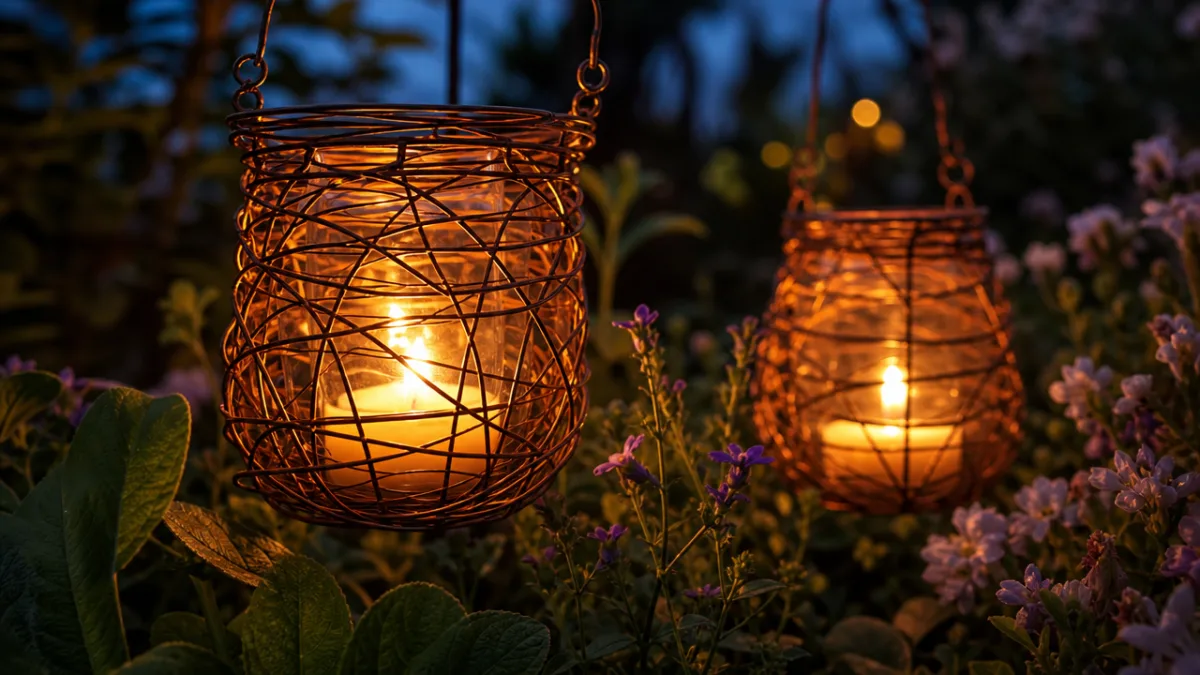
Some of the most charming wire projects in the garden are also the smallest and simplest. Wire-wrapped lanterns are a perfect example. Take a plain glass jar or bottle, wind some fine wire around it in spirals, geometric shapes, or leaf-like patterns, pop a candle inside, and the whole thing glows beautifully after dark, throwing intricate shadows across everything nearby. It’s one of those touches that genuinely transforms a garden in the evening, and it costs almost nothing to make.
Wire details on garden furniture bring a handmade, artisanal quality that’s hard to replicate any other way. Whether it’s wire inlaid into a tabletop, woven through chair backs, or used to create decorative panels on a storage bench, it adds texture and visual interest while being tough enough to handle whatever the weather throws at it. If you like upcycling, this is a great avenue — an old wooden chair can become something completely different with an ornamental wire panel in the back, especially if the design picks up on botanical or geometric motifs from the planting around it.
Wind chimes, mobiles, and hanging ornaments made from wire and natural materials like driftwood, shells, and stones bring movement and gentle sound into the garden. They respond to even a light breeze, and that constant subtle animation gives the space a lively quality that no static ornament can match. They’re also great projects to do with kids — simple to make, impossible to mess up badly, and endlessly customizable. Hang them in clusters or string them along a pergola, and they become a personal signature that makes the garden feel genuinely yours.
To get started with wire garden projects, you will need a basic toolkit that includes the following essential items:
- Heavy-gauge galvanized wire (approximately 2-3mm diameter) for structural projects such as frames, arches, and sculpture
- Medium-gauge wire (approximately 1-1.5mm diameter) for detail work, weaving, and connecting structural elements
- Fine gauge wire (approximately 0.5-0.8mm diameter) for wrapping, binding, and delicate decorative applications
- Round-nosed pliers for creating loops, curves, and coils with precision and control
- Wire cutters strong enough to handle heavy-gauge wire cleanly and safely without damaging the tool
- Flat-nosed pliers for tightening joins, bending wire at sharp angles, and flattening unwanted kinks
- A measuring tape and permanent marker for planning and marking wire lengths before cutting
Caring for Wire Garden Projects and Making Them Last
The good news about wire garden projects is that they’re built to last with very little fuss. Galvanized wire is your best bet for anything that’s going to live outdoors long-term — the zinc coating keeps the underlying steel protected from rust even through months of rain and damp soil. That said, cut ends do expose raw metal, and those spots can start to deteriorate over time. A quick coat of clear lacquer or rust-resistant paint on the cut ends when you’re building something is a small step that makes a real difference to how long a project holds up.
Copper wire is another great option worth considering. It has natural antimicrobial properties, and as it oxidizes it develops that gorgeous blue-green verdigris patina that actually protects the metal rather than damaging it. Far from looking worn out, a copper wire piece that’s been in the garden for a few years takes on a beautifully aged quality that fits right in with weathered stone, old timber, and established planting. Aluminum wire, meanwhile, is the most corrosion-resistant of the lot and needs essentially zero maintenance — the trade-off is that it’s softer and less rigid, so it’s better suited to decorative work than anything structural.
Getting into the habit of checking your wire structures at the start of each growing season is well worth it. Look for loose joins, frames that have shifted under the weight of plant growth, or any rust spots that need treating before they spread. Most repairs are quick and easy with the same tools you used to build the thing in the first place. With even a small amount of annual attention, a well-made wire structure will outlast wood, outlast plastic, and honestly just keep getting better looking as it ages into the garden around it.
Once you start thinking of wire as a creative medium rather than just a practical material, the possibilities for your garden open up in all sorts of unexpected directions. From a simple hanging basket to a complex sculpture that anchors an entire planting scheme, wire projects invite you to be both maker and grower at once — and that combination, the satisfaction of building something with your hands alongside the slower pleasure of watching things grow, is a big part of what makes gardening so endlessly rewarding, whatever size space you’re working with.








What do you think?
It is nice to know your opinion. Leave a comment.