










15 DIY Water Fountain Ideas That Will Wow Your Backyard
Why a DIY Water Fountain Transforms Your Outdoor Space
There is something undeniably magical about the sound of moving water in a garden. A backyard water fountain does more than add visual interest — it creates an atmosphere of calm that no other garden feature can quite replicate. The gentle trickle or bold cascade of water masks neighborhood noise, attracts songbirds, and turns an ordinary patio into a genuine sanctuary. Whether your outdoor space is a sprawling suburban yard or a compact urban balcony, the right water feature can completely redefine how you experience it.
What surprises many homeowners is how accessible fountain building has become. A decade ago, installing a water feature meant hiring a landscape contractor and spending thousands of dollars. Today, affordable submersible pumps, flexible tubing, and a vast array of repurposable containers have made DIY fountains a realistic weekend project for anyone with basic tools and a little patience. Online communities and hardware store staff have made troubleshooting easier than ever, lowering the barrier to entry even further for first-time builders.
Beyond the aesthetic reward, there are tangible wellness benefits to having running water nearby. Studies have consistently shown that natural water sounds reduce cortisol levels and promote a state of relaxed alertness. Creating a DIY water fountain is therefore not just a craft project — it is an investment in your own mental health and daily quality of life. Once you understand the fundamental components involved, you will see that most of these 15 ideas are well within reach, regardless of your experience level or budget.
Essential Components and Tools You Will Need
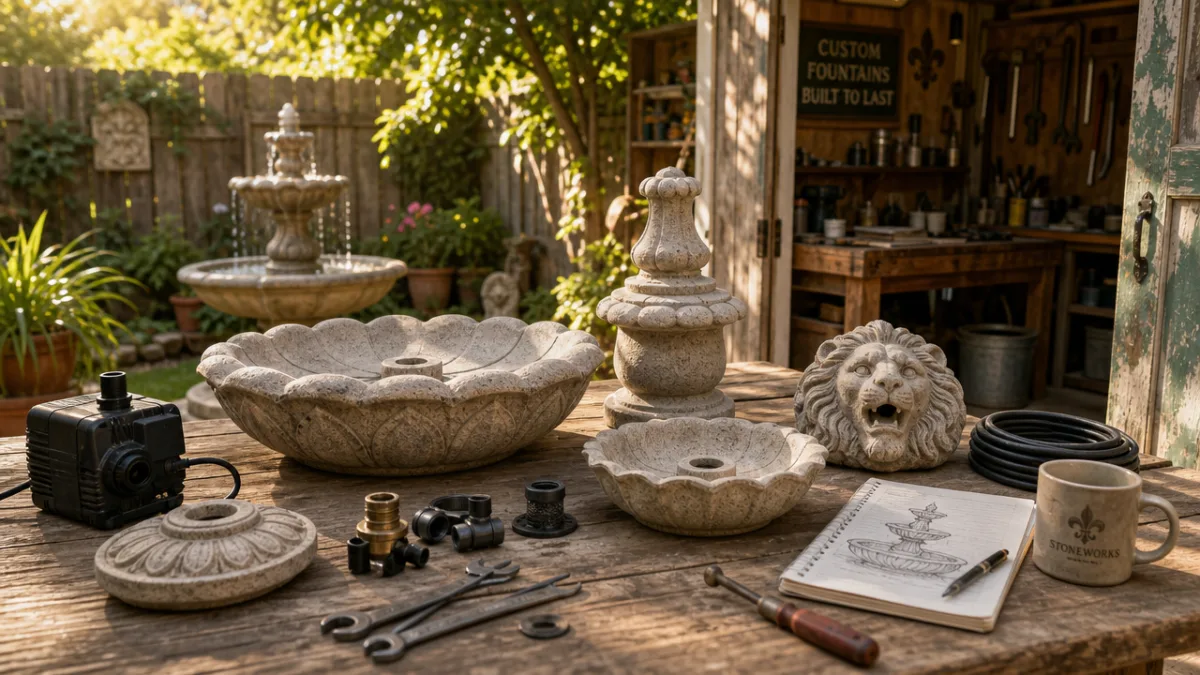
Before diving into specific fountain designs, it is worth understanding the core components that nearly every DIY water fountain shares. At the heart of every design is a submersible water pump, which circulates water continuously from a reservoir back up to the fountain’s source point. These pumps are rated by flow rate, measured in gallons per hour, and choosing the right size for your project is one of the most critical decisions you will make. A pump that is too weak will produce a disappointing trickle, while an oversized pump may spray water aggressively beyond your basin.
The reservoir is the second fundamental element. It can be as simple as a buried plastic tub, a ceramic pot sealed on the inside, a galvanized metal trough, or even a repurposed wooden wine barrel fitted with a liner. The reservoir must hold enough water to keep the pump fully submerged at all times, since running a submersible pump dry will burn out the motor within minutes. As a general rule of thumb, your reservoir should hold at least twice the volume of water that your pump can move in one minute, which gives you a comfortable buffer against evaporation and splash loss.
Tubing, fittings, and a drill with appropriate hole-saw bits round out the basic toolkit. Many builders also keep waterproof sealant, decorative river rocks or pebbles, and outdoor-rated extension cords on hand. Some designs call for additional materials like copper pipe, bamboo sections, or stacked slate tiles, but these are project-specific additions rather than universal requirements. Having all your components laid out before you begin assembly will save significant frustration and ensure a smoother building experience from start to finish.
Container and Pot Fountain Ideas for Beginners
Container fountains are the perfect entry point for first-time builders because they require minimal excavation, cost very little, and can be completed in a single afternoon. The most popular version involves stacking two or three ceramic or terracotta pots of decreasing size, threading the pump tubing up through the drainage holes, and allowing water to overflow from the smallest top pot down into each successive level before returning to a hidden reservoir below. The cascading effect is charming, highly customizable, and endlessly satisfying to watch on a warm evening.
Glazed ceramic pots in bold colors — cobalt blue, deep emerald, or burnt terracotta — add a Mediterranean or Southwestern aesthetic that pairs beautifully with drought-tolerant plantings like lavender, agave, and ornamental grasses. For a more rustic or farmhouse-inspired look, unglazed terracotta pots patina beautifully over time as moss and mineral deposits accumulate on their surfaces. You can accelerate this natural aging process by brushing the outside of dry pots with a mixture of plain yogurt and water, which encourages moss to colonize the surface within a few weeks.
Single-pot fountains are an equally compelling option for truly small spaces. A large glazed urn with a bubbling jet emerging from the top and disappearing into a bed of polished pebbles reads as a complete, self-contained design statement. Because the pump and reservoir are hidden beneath the pebble layer inside or below the pot, the effect appears almost effortless. This style works particularly well on covered patios, near seating areas, or tucked into a corner where you want to draw the eye and create a sense of destination within the garden.
Millstone and Barrel Fountain Designs
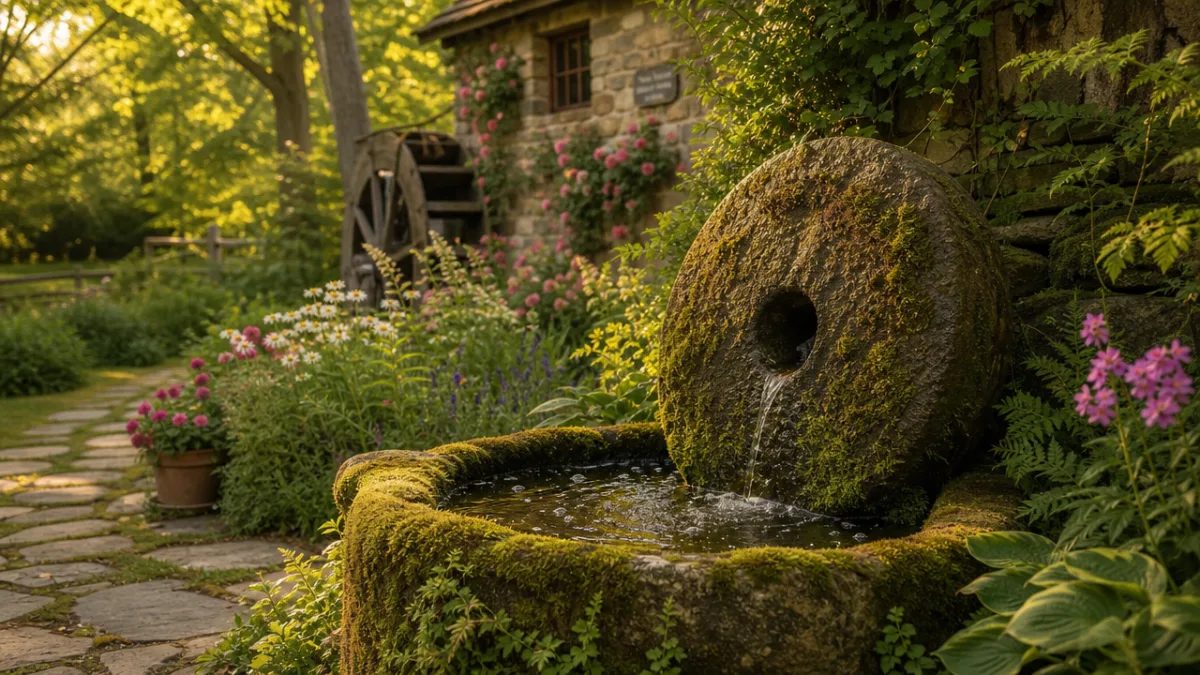
Millstone fountains have an old-world gravitas that few other designs can match. Authentic antique millstones are increasingly rare and expensive, but convincing concrete reproductions are widely available at garden centers and online retailers for a fraction of the cost. The stone is drilled through its center, the pump tubing is fed upward through the hole, and the stone rests over a buried reservoir. Water bubbles gently up through the center, spreads in a thin sheet across the stone’s textured surface, and drains down into the hidden basin below. The effect is hypnotic and deeply satisfying.
Wine barrel fountains bring a warm, inviting character that suits cottage gardens, kitchen gardens, and casual entertaining spaces particularly well. Half-barrels are sold at most garden centers and already have the round, deep reservoir shape that a fountain needs. After lining the interior with a pond-safe sealant or a flexible rubber liner to prevent leaks through the wood staves, you simply install the pump, add decorative elements like water hyacinth or a small spitter sculpture, and fill with water. The aged oak aesthetic pairs beautifully with surrounding plantings of herbs, roses, or climbing hydrangeas.
For those who want a millstone aesthetic without any drilling, flat stacked stone designs offer a compelling alternative. Layers of natural or cast stone are arranged over a buried reservoir, with tubing running between the layers to emerge at the top. Water then travels down the irregular surface of the stone stack, finding its own path through crevices and edges before returning to the reservoir. Each rainfall and mineral deposit subtly changes the water’s path over time, making the fountain a living, evolving element of the garden rather than a static installation.
Bamboo and Asian-Inspired Water Features
Few materials evoke tranquility as effectively as bamboo. The traditional Japanese shishi-odoshi, or deer scarer, is one of the most beloved water feature designs in the world, and for good reason — its rhythmic fill-and-tip motion combines sight, sound, and movement in a way that is almost meditative. Building one requires a length of thick bamboo cut at an angled spout, a pivot point, and a steady stream of water delivered by a hidden pump. As the bamboo arm fills with water, it tips, releases a sharp knock against a stone, empties, and slowly rights itself again in an endlessly repeating cycle.
Simpler bamboo spout designs skip the moving parts entirely and instead direct a steady stream from a cut bamboo pipe into a stone basin, ceramic pot, or wooden trough below. These designs are easier to build and maintain while still delivering the serene aesthetic of a Japanese garden. A grouping of three bamboo spouts at varying heights over a shared basin creates a layered, musical effect that adds dimension to the design. Surrounding the feature with plantings of Japanese forest grass, black mondo grass, and dwarf Japanese maple reinforces the cohesive cultural aesthetic.
Bamboo also works beautifully in combination with other natural materials. A bamboo spout feeding water over a bed of smooth river stones, a cluster of large basalt boulders, or a shallow slate basin each produces a distinctly different character. The material itself requires some maintenance — outdoor bamboo should be sealed annually and replaced every few years as it weathers — but many gardeners find the impermanence of natural materials to be part of the philosophy rather than a drawback. The Japanese concept of wabi-sabi, which finds beauty in imperfection and transience, aligns perfectly with the nature of a bamboo water feature.
Wall-Mounted and Vertical Fountain Concepts
Wall-mounted fountains are the ideal solution for gardens where ground space is limited or where a vertical focal point is needed to add height and drama. These designs attach directly to a fence, garden wall, or freestanding structure, with water flowing down the face of the installation into a trough or basin mounted at the base. The visual effect is bold and architectural, making wall fountains particularly well-suited to contemporary or minimalist garden designs. Because the reservoir is compact and contained, they are also among the easiest DIY fountain types to keep filled and maintained.
Repurposed materials shine in wall fountain projects. An old wooden window frame fitted with a copper or galvanized metal backing, a vintage cast-iron wall plaque with a lion’s head spout, or a section of reclaimed corrugated metal sheeting can all become the face of a stunning wall fountain with minimal modification. The spout is typically a short length of copper or PVC pipe connected to the pump tubing, positioned to release water at the desired point. A shallow trough made from a repurposed galvanized livestock feeder or a simple wooden planter box lined with pond liner serves as the basin.
For a more polished, contemporary look, flat slate tiles, stacked fieldstone, or smooth cast concrete panels can be mounted to create a feature wall that doubles as a water cascade. Water is pumped to a hidden channel at the top of the panel, then sheeted evenly down the surface in a thin, glassy film before collecting in the basin. This style photographs exceptionally well and creates a dramatic wow factor that is hard to achieve with ground-level fountain designs. LED lighting installed in the basin or behind the feature wall adds another dimension when used after dark, transforming the fountain into a glowing nighttime centerpiece.

Upcycled and Repurposed Fountain Inspirations
Some of the most creative and characterful backyard fountains begin not at a garden center but at a thrift store, salvage yard, or flea market. The upcycled fountain movement celebrates the art of seeing potential in discarded objects — a cracked colander, a stack of old teapots, a vintage bathtub, a retired watering can, or even a collection of mismatched coffee mugs can each become the centerpiece of a charming water feature. The key is identifying objects that can be drilled, sealed, and plumbed, then arranging them in a way that channels water in an interesting and pleasing path.
Stacked teapot or colander fountains are among the most whimsical and widely shared DIY water feature projects on social media. A series of ceramic teapots or colanders are positioned on a central pipe at alternating angles, each one tilted so that water pours naturally from its spout or holes into the next vessel below. The pump pushes water up through the central pipe into the topmost vessel, and gravity does the rest. The result is playful, colorful, and completely personal — no two stacked teapot fountains look alike because the arrangement depends entirely on the vessels you choose.
Repurposed galvanized metal objects — old watering cans, buckets, stock tanks, and livestock troughs — offer a farmhouse or industrial-chic aesthetic that has remained popular in garden design for years. These materials are naturally rust-resistant, inexpensive when purchased secondhand, and extraordinarily durable outdoors. A single vintage watering can suspended from a hook above a galvanized bucket, connected by tubing to a hidden pump inside the bucket, creates a charming perpetual-pour effect that looks effortless and costs almost nothing to assemble. Adding a few sprigs of water mint or a floating water lily to the reservoir brings the design fully to life.
Tips for Maintenance and Year-Round Enjoyment
A DIY water fountain will give you years of pleasure with remarkably little maintenance, provided you address a few key areas consistently. Topping off the reservoir is the most frequent task — evaporation and splash loss mean most outdoor fountains need water added every few days during hot weather. Many builders install a simple float valve connected to their outdoor water supply to automate this process entirely, which is particularly helpful for larger reservoir designs or for periods when you are away from home. Keeping the water level stable protects the pump and keeps the fountain operating at its designed flow rate.
Algae growth is the most common aesthetic problem with outdoor water features, and it is entirely manageable with the right approach. A small amount of algae in a pond is natural and even beneficial, but a fountain overtaken by green slime is neither attractive nor healthy for the pump. Adding a capful of white vinegar to the reservoir weekly inhibits algae growth without harming birds or other wildlife that may drink from your fountain. Barley straw extract, available at pond supply stores, is another effective and environmentally gentle option. Positioning the fountain in partial shade rather than full afternoon sun also significantly reduces algae growth by limiting the light available for photosynthesis.
In cold climates, winterizing your fountain properly will extend its life considerably. Most submersible pumps should be removed from the water, cleaned thoroughly, and stored indoors once temperatures begin to drop below freezing consistently. Water left in fountains that are not frost-rated will expand as it freezes and can crack ceramic pots, split bamboo, or damage reservoir walls. Draining the fountain completely, covering it with a breathable frost cloth, and storing any delicate decorative elements inside ensures that your fountain will be ready to delight again when spring arrives. Taking a few extra steps in autumn will protect your investment and spare you the disappointment of returning in spring to a cracked or damaged feature.
- Check and top off reservoir water levels every two to three days during summer to protect the pump from running dry and to maintain optimal water flow through all fountain tiers.
- Clean the pump filter or impeller monthly by removing the pump from the reservoir, disassembling it according to the manufacturer’s instructions, and rinsing any debris under clean running water before reassembling.
- Add a pond-safe algaecide, white vinegar, or barley straw extract regularly to prevent algae buildup on fountain surfaces and inside tubing without harming visiting wildlife.
- Inspect all tubing connections and fittings at the start of each season for cracks, wear, or mineral buildup that could restrict flow or cause leaks that drain your reservoir unexpectedly.
- Drain, clean, and store the pump and any delicate components indoors before the first hard frost to prevent ice damage and extend the operational life of all fountain components by several seasons.
With these guidelines in hand and 15 inspiring design directions to explore, your backyard transformation is well within reach. Whether you start with a simple stacked pot design or commit to a full millstone installation, the process of building your own water fountain is as rewarding as the result. The moment you plug in the pump and hear that first steady trickle of moving water, you will understand why gardeners throughout human history have placed water at the very heart of their most beloved outdoor spaces. Your backyard sanctuary is waiting — all it needs is a little water and your imagination.








What do you think?
It is nice to know your opinion. Leave a comment.