










Red Mapou: A Guide to Myrsine australis, New Zealand’s Beloved Native Shrub
Introduction to Red Mapou and Its Place in the New Zealand Landscape
If you spend any time wandering through New Zealand’s native bush, chances are you’ve come across Red Mapou — or Myrsine australis, to use its botanical name. It’s one of those plants that turns up everywhere, from the North Island to the South, quietly getting on with the business of holding forests together. Its warm red stems, neat foliage, and easy-going nature have made it a favourite with botanists, gardeners, and anyone who takes a moment to actually look at what’s growing around them.
The name “Red Mapou” comes straight from the plant itself — those young stems and branchlets have a lovely rusty-red colour that really does pop against the surrounding greenery. The Māori name mapou has been around for centuries, which tells you something about how long this plant has been woven into the life of the land and the people who’ve known it best. It’s not just a pretty shrub; it’s part of what makes New Zealand’s bush feel like itself.
Taxonomically, Myrsine australis sits in the family Primulaceae (it used to be placed in Myrsinaceae), part of a genus that spreads across tropical and subtropical regions worldwide — around 300 species in total. Locally, though, it’s one of the most familiar faces in regenerating and secondary forest. In many ways, getting to know Red Mapou is a shortcut to understanding how New Zealand’s forests recover and rebuild themselves over time.
Botanical Characteristics and Physical Description
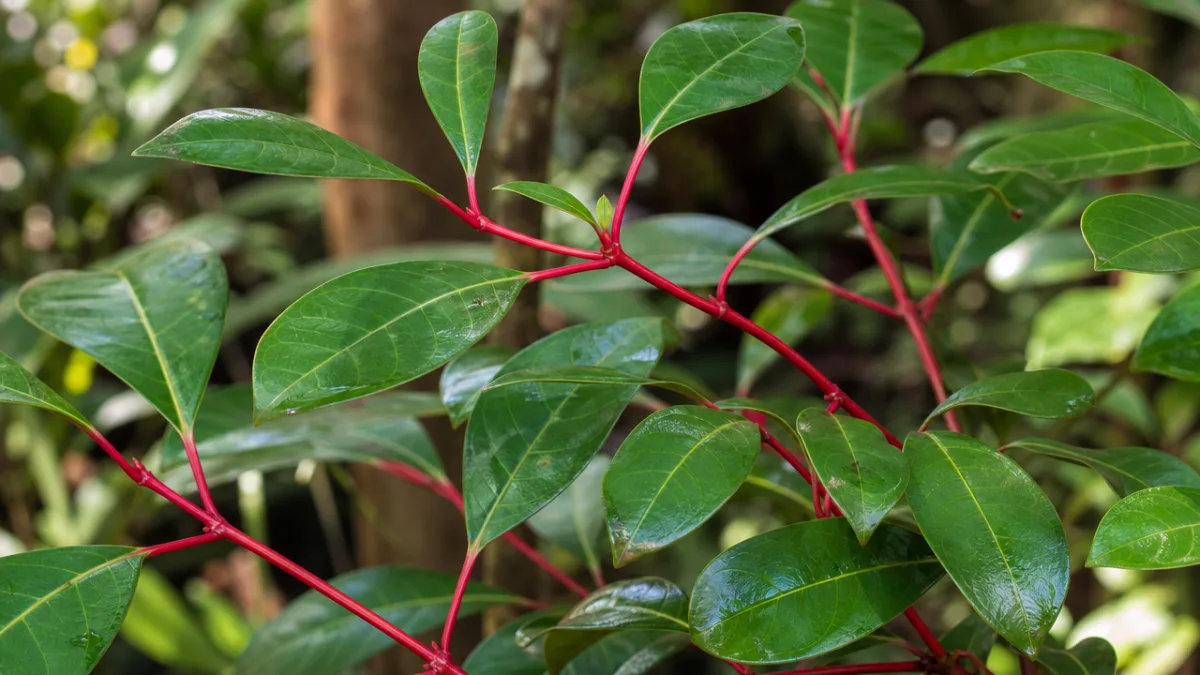
Red Mapou grows as a small to medium shrub or small tree, typically reaching somewhere between two and six metres tall, though it’ll push a bit higher when conditions are really in its favour. Young plants tend to grow upright, and as they mature the branches spread out to give the plant a pleasingly full, bushy shape. The bark on older stems goes pale grey or brownish — a nice contrast to the eye-catching reddish-orange of the younger growth, which is really where this plant earns its common name.
The leaves are pretty distinctive once you know what you’re looking for. They’re leathery, alternate, and broadly oval to elliptic — usually a couple of centimetres to about five centimetres long. The edges have a gently wavy, crinkled quality that catches the light nicely, and mature leaves have that deep, glossy green on top with a paler underside. New growth often comes through with a reddish blush before settling into green, keeping the red theme going right through the plant.
The flowers are small — you’re not going to mistake this for something showy — but there are a lot of them, clustered in tight bunches along the stems in spring, roughly September through November here in the Southern Hemisphere. They’re cream to pale pink or yellowish, and while each individual flower is modest, the overall effect of hundreds of tiny blooms studding the branches is actually quite lovely. One thing worth knowing: Red Mapou is dioecious, meaning male and female flowers grow on separate plants. Get yourself a female plant that’s been pollinated and you’ll be rewarded with small, fleshy fruits that ripen to a deep purple-black — and the birds absolutely love them.
Ecological Role and Wildlife Relationships
Red Mapou has a really important job in New Zealand’s native bush — it’s what ecologists call a pioneer or early successional species, meaning it’s one of the first woody plants to show up when ground gets disturbed. When farmland is left to rewild, when slips or fires open up new ground, or when a windfall takes out part of the forest canopy, Red Mapou is usually among the first to establish. It stabilises the soil, starts capturing organic matter, and begins building the kind of layered structure that later, slower-growing forest species need before they can get a foothold.
The relationship between Red Mapou and native birds is one of the nicest stories in New Zealand ecology. Those dark little fruits on female plants are a real drawcard for tui, bellbirds (korimako), silvereyes (tauhou), and native pigeons. The birds eat the fruit, fly off, and deposit the seeds somewhere new — sometimes quite a long way from the parent plant. It’s a classic mutualism: the plant gets its seeds spread, and the birds get a meal. That kind of interconnection is what makes New Zealand’s native ecosystems so fascinating when you start pulling at the threads.
But it’s not just about fruit. Red Mapou’s dense, leafy canopy provides shelter and nesting cover for smaller birds and invertebrates, and the spring flowers bring in native bees and hoverflies, which then become food for insectivorous birds and lizards. Skinks and geckos have been spotted tucking themselves in among the stems and leaf litter at the base. A single well-grown Red Mapou can end up being the hub of quite a busy little ecosystem.
- Tui and bellbird rely on Red Mapou fruit as a seasonal food source, especially in late summer and autumn.
- Silvereyes (wax-eyes) are particularly efficient seed dispersers, moving seeds across fragmented landscapes.
- Native skinks use the dense base of the shrub as thermal refuge and predator cover.
- Hoverflies and native bees are the primary pollinators, drawn to the small but scented flowers in spring.
- Fungi form mycorrhizal associations with root systems, aiding nutrient uptake in poor soils.
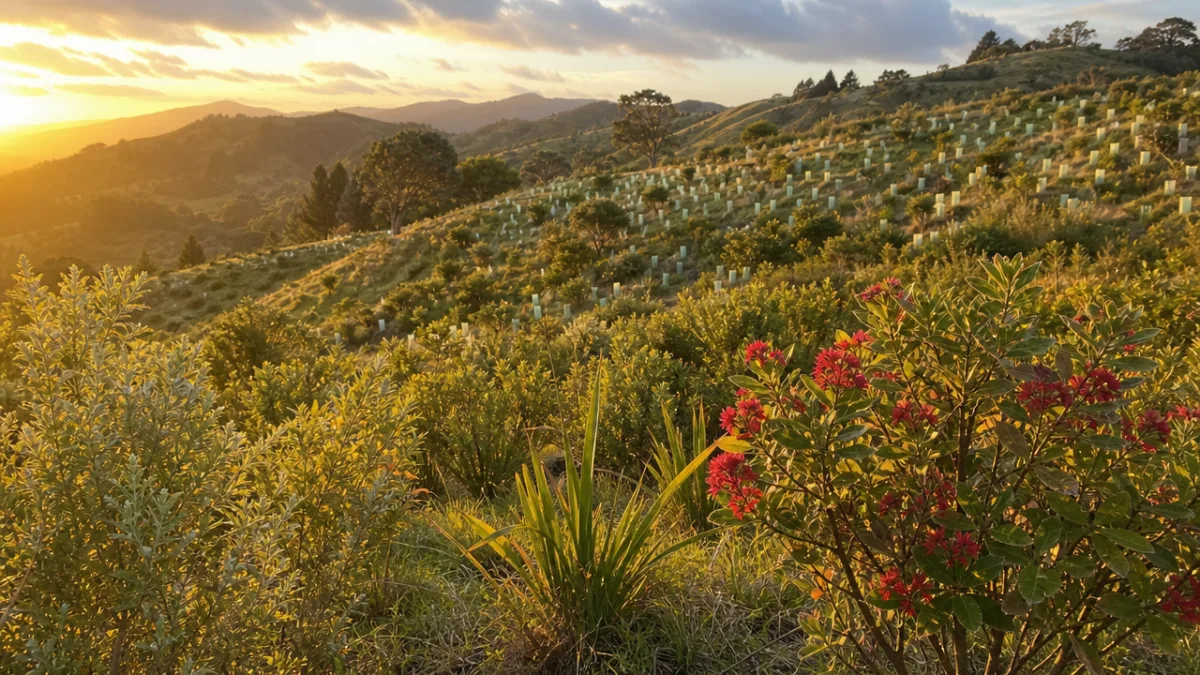
This ecological value becomes even more significant in places where native bush has been chopped up by farming, development, or invasive weeds. Even a few Red Mapou plants in a garden or shelter belt can act as a stepping stone for wildlife moving between isolated patches of bush. Conservation groups and restoration practitioners are well aware of this, which is why Red Mapou shows up so reliably in planting programmes aimed at bringing degraded land back to life.
Distribution, Habitat Preferences, and Climate Tolerance
Red Mapou is found across a wide sweep of New Zealand, from Northland at the top of the North Island down through to the Nelson and Marlborough regions of the South Island. It’s particularly at home in the Waikato, Bay of Plenty, Hawke’s Bay, and Wellington regions, where it’s a characteristic and often abundant part of regenerating lowland and montane forest. Further south it becomes patchier, but it’s still there in the right spots along the coast and inland.
Habitat-wise, Red Mapou tends to favour forest edges, stream banks, and disturbed areas where it gets more light than it would under a dense, closed canopy. It’s surprisingly unfussy about soils — clay, loam, sandy — as long as there’s reasonable drainage. It handles both full sun and partial shade well, which is actually quite unusual for a New Zealand native and makes it genuinely versatile in garden settings. It can grow up to around 1,000 metres above sea level in some areas, though it’s at its most vigorous in the lowlands.
What really sets Red Mapou apart as a practical plant is its toughness. It handles coastal exposure and salt-laden winds reasonably well, can take moderate frosts down to around -5 to -7 degrees Celsius (though prolonged hard frosts will stress young plants), and once established has decent drought tolerance too. Put all that together and you’ve got a species that can be grown across a remarkably wide range of New Zealand conditions — from humid Northland through to the drier east coast regions of both islands.
Cultivation, Gardening, and Landscape Use
Ask any experienced native plant gardener in New Zealand what they’d recommend for a reliable, low-fuss shrub and Red Mapou will almost certainly come up. It strikes readily from both seed and cuttings, which makes it accessible whether you’re buying from a nursery or having a go at propagating yourself. For seed, harvest the ripe fruit in late summer or autumn, clean off the pulp, and sow it fresh — germination rates drop significantly if you let seed dry out. Semi-hardwood cuttings taken in late summer also strike well with a bit of rooting hormone and bottom heat. Most specialist native plant nurseries will stock it.
In the garden, Red Mapou earns its keep in a few different ways. Its naturally upright, bushy form makes it brilliant for informal hedging and screening — it gives you year-round privacy without needing constant clipping. And those red stems really come into their own in winter, when a lot of other plants are looking bare and grey. Planted in a group, it knits together into a dense thicket that works as a windbreak and doubles as wildlife habitat. It’s genuinely one of those plants that looks good and does good at the same time.
As a design element in a native garden, Red Mapou plays well with others. The red stems are especially striking next to silver or grey-foliaged plants, and it combines naturally with kohuhu (Pittosporum tenuifolium), Coprosma species, cabbage trees (Cordyline australis), and flaxes (Phormium tenax and P. cookianum). If you’re planting with birds in mind, make sure you’ve got at least one male and one female plant within range of each other — that’s what gives you the fruit, and the fruit is what brings the birds in.
- Select a site with well-drained soil in full sun to partial shade for optimal establishment.
- Prepare planting holes generously, incorporating compost to improve soil structure where needed.
- Water thoroughly at planting and maintain consistent moisture for the first growing season.
- Apply a mulch of bark or wood chip around the base to retain moisture and suppress weeds.
- Minimal pruning is required; light tip-pruning in spring encourages bushy growth if desired.
- For fruiting, plant at least one male and one female plant within proximity of each other.
Cultural Significance and Māori Traditional Knowledge
The knowledge Māori developed about the plants of Aotearoa New Zealand over many centuries goes far deeper than simple utility. Plants weren’t just resources to be used — they were understood as living participants in a relational world, each with its own place and meaning. Red Mapou had a role in that world, and the name mapou itself is one of the oldest recorded vernacular plant names in the country, appearing in early accounts by European botanists who had learned it directly from Māori guides and informants.
Practically speaking, the wood was sometimes used for tool handles and similar purposes, though mapou wasn’t among the most prized timbers in traditional use. Its significance ran deeper than that. For someone with a thorough knowledge of the bush, seeing Red Mapou establishing in an area would have been meaningful information — a sign that the land was recovering, that succession was underway, and that given time, more mature forest would follow. That kind of ecological literacy, built up over generations, was central to how Māori managed their relationship with the natural world sustainably.
Today, there’s a growing and welcome recognition of Red Mapou’s cultural significance alongside its ecological one. Many iwi are actively involved in native restoration programmes where mapou is a key species, and you’ll increasingly see its Māori name used in nursery labelling, botanical literature, and public education. That’s not a small thing — it reflects a broader shift toward treating mātauranga Māori and scientific knowledge not as competing frameworks but as complementary ones, both of which have something essential to contribute to how we care for this land.
Conservation Status and Future Outlook
Red Mapou is currently listed as Not Threatened under the New Zealand Threat Classification System, and that status is well earned. Its wide distribution, healthy population sizes, and ability to bounce back in disturbed and modified landscapes set it apart from many of New Zealand’s more specialised native plants, which often struggle the moment conditions aren’t just right. This resilience is a big part of why it features so prominently in restoration planting — it works, reliably, in a wide range of situations.
That said, it’s not entirely without pressures. Habitat loss continues to be a background issue, and in areas where deer, goats, and possums are present in numbers, browsing on young plants can seriously undermine regeneration. If you’ve ever seen a young Red Mapou stripped back by deer, you’ll understand why pest control and good fencing aren’t just nice-to-haves — they’re often the difference between a planting succeeding and failing in rural or conservation land contexts.
Looking ahead, Red Mapou seems well placed to become even more widely used as climate adaptation planting and urban greening become higher priorities across New Zealand. Its combination of toughness, ecological value, and good looks makes it a natural fit for everything from large-scale watershed restoration to urban rain gardens and school planting days. As more New Zealanders develop an interest in native biodiversity — in their own backyards as much as in reserves and national parks — Red Mapou will keep turning up as the answer to a lot of different questions. It’s earned that reputation, and it’s not going anywhere.








What do you think?
It is nice to know your opinion. Leave a comment.