










Myristica fragrans: The Nutmeg Tree and Its Extraordinary Legacy
Introduction to Myristica fragrans
Myristica fragrans, commonly known as the nutmeg tree, is one of the most historically significant and botanically fascinating spice plants in the world. Native to the Banda Islands of Indonesia, this tropical evergreen tree has shaped empires, inspired exploration, and transformed global trade routes for centuries. Its remarkable dual-spice yield — both nutmeg and mace — makes it uniquely valuable among the world’s cultivated plants, and its story is deeply intertwined with human civilization, colonialism, and culinary tradition.
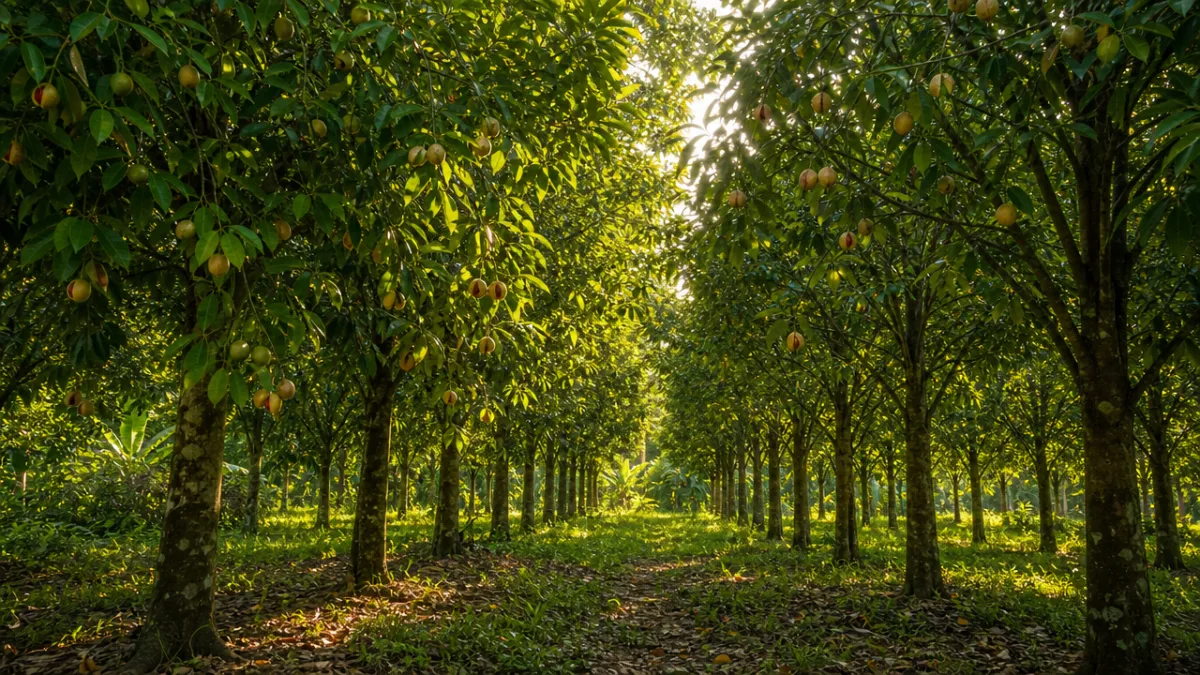
Belonging to the family Myristicaceae, Myristica fragrans is an aromatic evergreen tree that can reach heights of up to 20 meters in its natural habitat. The tree is dioecious, meaning individual trees are either male or female, and only female trees bear the coveted fruit. The canopy is dense and spreading, with dark green, glossy leaves that release a characteristic warm, spicy fragrance when crushed. In optimal conditions, a single mature nutmeg tree can produce thousands of fruits annually, making it an extraordinarily productive plant by tropical standards.
The name “fragrans” is derived from Latin, meaning fragrant or sweet-smelling, a perfectly apt descriptor for a plant that perfumes the air around it. For centuries, the nutmeg tree was so valuable that it was sometimes referred to as “brown gold.” Its cultural, economic, and medicinal significance has left an indelible mark on human history, from the spice markets of medieval Venice to the plantation systems of colonial Indonesia and the kitchens of modern homes across the globe.
Botanical Description and Taxonomy
Myristica fragrans exhibits a complex and beautifully structured anatomy that reflects millions of years of evolutionary refinement. The leaves are simple, alternate, and lanceolate to elliptic in shape, measuring between 5 and 15 centimeters in length. They are dark green on the upper surface and paler beneath, with a smooth texture and a distinctive aromatic oil content concentrated in specialized secretory cells scattered throughout the leaf tissue. The venation is pinnate and clearly visible, giving the leaves an elegant, structured appearance.
The flowers of Myristica fragrans are small, pale yellow, and intensely fragrant, typically appearing in axillary clusters. Male flowers are produced in longer clusters, while female flowers appear singly or in groups of two or three. Pollination is carried out primarily by insects and birds, particularly certain species of pigeons in the Banda Islands that have co-evolved with the plant. The flowering period varies depending on geographic location and climate, but in most growing regions, the tree flowers multiple times throughout the year, ensuring near-continuous fruit production in mature specimens.
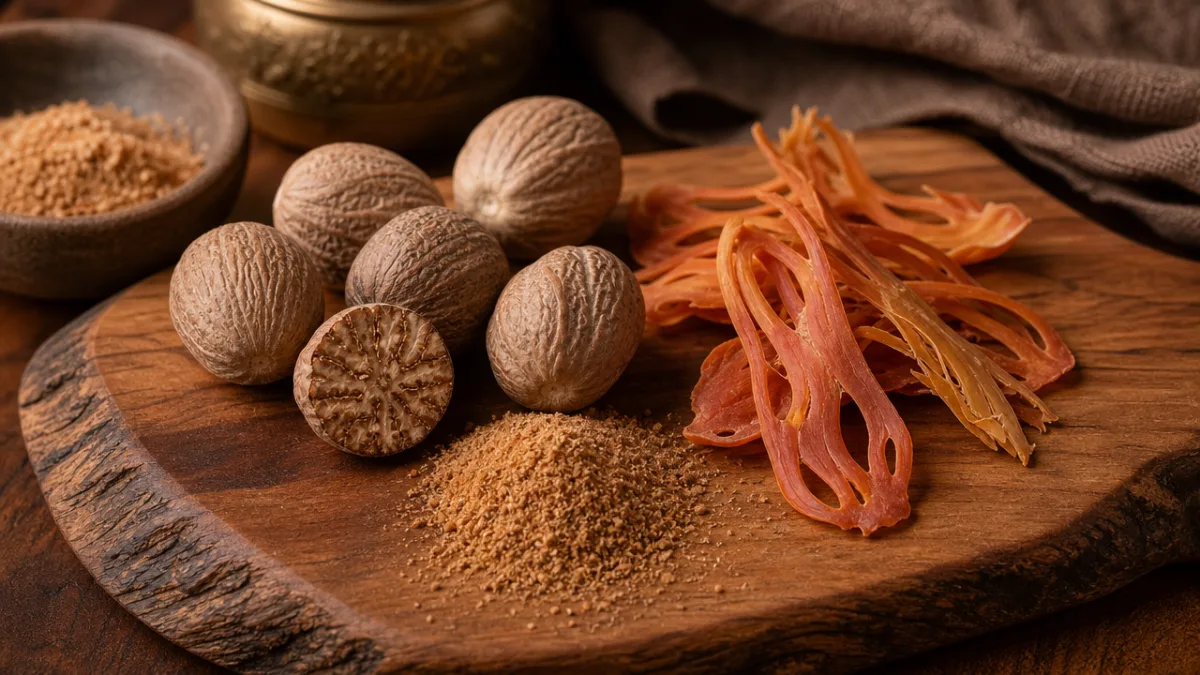
The fruit of Myristica fragrans is perhaps its most extraordinary feature. Roughly the size and shape of a small peach, the fruit is a fleshy drupe that splits open at maturity to reveal the seed inside. Surrounding the dark brown seed is a brilliant crimson or scarlet aril — this is mace, one of the two valuable spices derived from the tree. The seed itself, once its hard outer shell is removed, is the nutmeg. This remarkable botanical structure means that a single fruit yields two distinct and commercially valuable spices, a phenomenon almost unique in the plant kingdom and one that has made Myristica fragrans an object of intense human desire for millennia.
- Kingdom: Plantae
- Order: Magnoliales
- Family: Myristicaceae
- Genus: Myristica
- Species: M. fragrans
- Common names: Nutmeg tree, Pala (Indonesian), Muscade (French)
Historical and Cultural Significance
The history of Myristica fragrans is inseparable from the broader narrative of global exploration and colonial ambition. For much of the medieval period, nutmeg was among the most expensive commodities in Europe, traded overland through complex networks of Arab, Indian, and Venetian merchants who jealously guarded the secret of its origin. A single pound of nutmeg could fetch the equivalent of several weeks’ wages for a skilled craftsman, and the spice was used not only in cooking but also in perfumery, medicine, and as a highly visible symbol of wealth and status.
The Banda Islands of present-day Indonesia were the world’s sole source of nutmeg for centuries, a geographic monopoly that made them the most strategically important real estate in the global spice trade. When Portuguese explorer Francisco Serrão became one of the first Europeans to reach the Bandas in 1512, he effectively ignited one of history’s most brutal contests for territorial control. The Dutch East India Company (VOC) eventually seized control of the islands in the early seventeenth century, establishing one of history’s most ruthless colonial monopolies and reducing the indigenous Bandanese population through massacre, enslavement, and famine from an estimated 15,000 people to fewer than 1,000 within just a few decades.
The cultural significance of nutmeg extends far beyond economics and politics. In medieval European medicine, it was considered a near-universal remedy, prescribed for everything from flatulence and the plague to insomnia and liver disease. Islamic physicians wrote extensively about its properties, and it featured prominently in the elaborate spice mixtures used across the medieval Middle East. In South and Southeast Asian cooking traditions, nutmeg has been used for thousands of years, integrated into ceremonial foods, religious offerings, and traditional medicine systems long before Europeans ever encountered it. Its legacy continues today in the national identity of Grenada, which now flies an image of the nutmeg on its flag as a symbol of the island’s economic heritage.
Nutmeg in Trade and Economics
The economic history of nutmeg trade reads like an adventure novel filled with monopolies, espionage, and geopolitical maneuvering. Following the Dutch consolidation of control over the Banda Islands, they maintained an iron grip on nutmeg production and export for nearly two centuries. They regularly burned surplus crops to maintain high prices, patrolled the seas to intercept smugglers, and executed anyone found attempting to transplant living nutmeg trees or viable seeds. This ruthless control elevated the price of nutmeg to astronomical levels in European markets and financed much of the Dutch Golden Age.
The monopoly was eventually broken in the eighteenth century when the French managed to smuggle nutmeg plants to Mauritius and other tropical colonies, and the British subsequently established plantations in Penang, Sri Lanka, and the Caribbean island of Grenada. The democratization of nutmeg cultivation dramatically reduced prices and made the spice accessible to ordinary households across Europe and North America. Today, Indonesia and Grenada remain the world’s two largest producers, together supplying the majority of global demand, though the spice is now grown commercially across much of tropical Asia, Africa, and the Caribbean.
Cultivation, Growth Requirements, and Agroforestry
Myristica fragrans is a tropical plant with specific and somewhat demanding cultivation requirements that reflect its origins in the hot, humid, equatorial climate of the Indonesian archipelago. It thrives in areas with consistently high temperatures between 25 and 35 degrees Celsius, high annual rainfall of 1,500 to 3,500 millimeters, and high humidity. It grows best at lower elevations, generally below 1,000 meters, though it can be cultivated at higher altitudes with some reduction in yield and growth rate. Importantly, the tree does not tolerate frost under any circumstances, limiting its cultivation to strictly tropical zones.
Soil requirements for successful nutmeg cultivation are also exacting. The tree prefers deep, well-drained, loamy or clay-loam soils rich in organic matter, with a slightly acidic to neutral pH between 5.5 and 7.5. Waterlogging is particularly detrimental and can cause root rot and tree death. Growers in traditional cultivation regions often plant nutmeg on hillsides or sloped terrain to ensure adequate natural drainage. Shade tolerance is an important characteristic of young nutmeg trees, and they are frequently established beneath taller shade trees in the first years of growth, a practice that integrates naturally with agroforestry systems.
One of the most challenging aspects of nutmeg cultivation is the long juvenile period before trees begin bearing fruit. Under typical conditions, a nutmeg tree does not produce its first harvest until it is seven to nine years old, and maximum productivity is not reached until the tree is approximately twenty-five years of age. However, once a tree reaches full maturity, it can remain productively bearing for sixty to eighty years or more, making it a genuinely long-term agricultural investment. Growers must also contend with the dioecious nature of the species — because only female trees bear fruit, and sexing young trees is difficult before they first flower, commercial operations often graft known female material onto rootstocks or use molecular sexing techniques to ensure adequate ratios of productive trees.
Harvesting and Processing
The harvest of nutmeg is a labor-intensive process that has changed remarkably little over centuries of cultivation. Fruits are collected when they naturally split open, revealing the brilliant red mace inside. Harvesters use long bamboo poles with small baskets or cages attached to the end to reach fruits in the higher branches of mature trees. Fallen fruits are also collected from the ground, though these must be processed quickly to prevent spoilage. A productive female tree in full bearing can yield between 1,500 and 2,000 fruits per harvest cycle, with two to three harvest cycles occurring annually in most growing regions.
Once collected, the fleshy outer pericarp is removed and sometimes used to make preserves, jellies, and the local Bandanese delicacy of candied nutmeg peel. The crimson mace is carefully peeled away from the seed and flattened before being dried in the sun for ten to fourteen days, during which it transitions from its vivid red color to the characteristic yellowish-orange of the commercial product. The seeds, still in their hard shells, are dried separately for a period of six to eight weeks, during which the internal nutmeg kernel shrinks slightly and rattles when the shell is shaken — the traditional indicator that the drying process is complete and the nutmeg is ready for shelling and export.
Chemical Composition and Medicinal Properties
The remarkable aromatic qualities and physiological effects of Myristica fragrans are attributable to its extraordinarily complex chemical composition. The essential oil of nutmeg, obtained by steam distillation of the seed, constitutes approximately 7 to 16 percent of the kernel’s weight and contains more than a hundred identified chemical compounds. The primary aromatic constituents include myristicin, elemicin, safrole, eugenol, isoeugenol, and a range of monoterpenes including sabinene, alpha-pinene, and beta-pinene. These compounds collectively create the characteristic warm, sweet, slightly woody aroma that makes nutmeg so distinctive and versatile as a culinary and fragrance ingredient.
Myristicin, the compound present in highest concentrations in nutmeg’s volatile oil, has attracted particular scientific interest due to its documented pharmacological activity. In small culinary doses, myristicin and related compounds contribute to nutmeg’s traditional use as a digestive aid, carminative, and mild analgesic. However, myristicin also exhibits psychoactive properties at higher doses — ingestion of two or more whole nutmegs can cause hallucinations, tachycardia, nausea, and in rare cases serious toxicity. This dual nature of the compound as both a culinary seasoning and a potentially dangerous substance at excessive doses has been recognized in traditional medicine systems for centuries and is now well-documented in modern pharmacological literature.
Traditional medicine systems across Asia, the Middle East, and Europe have employed nutmeg and mace for an enormous range of therapeutic applications. Ayurvedic medicine uses nutmeg to treat digestive disorders, insomnia, and as a nervine tonic. Traditional Chinese medicine incorporates it for warming the stomach, stopping diarrhea, and treating kidney deficiency. In medieval European herbalism, nutmeg was prescribed for liver ailments, kidney disorders, digestive complaints, and as a general tonic. Modern scientific research has confirmed several of these traditional applications, demonstrating significant antimicrobial, anti-inflammatory, antioxidant, and hepatoprotective activities in nutmeg extracts, lending credence to centuries of empirical medical use.
Modern Pharmaceutical and Cosmetic Applications
Beyond its traditional medicinal applications, Myristica fragrans has found increasing relevance in contemporary pharmaceutical and cosmetic industries. Nutmeg essential oil is widely used in aromatherapy for its reputed stress-relieving, mood-elevating, and analgesic properties, and it features in topical preparations intended for joint pain, muscle aches, and circulatory stimulation. The oil appears in numerous commercial formulations for pain-relief creams and balms, where its warming action on the skin complements other active analgesic ingredients. It is also a valued fixative and middle note in perfumery, contributing warmth and depth to both masculine and feminine fragrance compositions.
The cosmetic industry utilizes nutmeg extracts and essential oils for their demonstrated antioxidant activity, which is attributed primarily to phenolic compounds including isoeugenol and eugenol. These compounds have been incorporated into anti-aging skincare formulations and topical preparations intended to protect against oxidative skin damage. Nutmeg powder is also used as a natural exfoliant in face scrubs and masks in the artisanal and natural beauty product sector. Ongoing pharmaceutical research continues to investigate the potential of isolated nutmeg compounds as leads for novel anti-inflammatory, antimicrobial, and neuroprotective drugs, with several studies showing promising results that warrant further clinical investigation.
Culinary Uses and Global Cuisine
In the culinary world, Myristica fragrans occupies a position of irreplaceable importance that spans virtually every major global cuisine. Nutmeg’s warm, sweet, slightly peppery flavor profile makes it extraordinarily versatile, functioning equally well in sweet and savory preparations. In European cooking, it is perhaps most famously associated with béchamel sauce, where a small grating of fresh nutmeg is considered indispensable by serious cooks. It also appears in sausages, meatballs, and other charcuterie across much of northern and central Europe, where it has been a standard seasoning since at least the medieval period.
In South Asian cuisine, nutmeg and mace feature prominently in spice blends including garam masala and biryani masala, contributing depth and warmth to complex spiced rice dishes, meat curries, and festive preparations. In the Middle East and North Africa, nutmeg is an essential component of ras el hanout and baharat, elaborate mixed spice blends used to season slow-cooked meats, stuffed vegetables, and rice dishes. Indonesian cuisine, which grows the vast majority of the world’s nutmeg, uses every part of the tree, incorporating the flesh of the fruit into jams, syrups, and a popular local drink called sirup pala, or nutmeg syrup.
Mace, the aril that surrounds the nutmeg seed, is a spice in its own right with a flavor profile similar to but distinctly more delicate and floral than nutmeg. It is particularly prized in pastry and confectionery, where its more refined flavor complements lighter preparations without overwhelming them. Mace appears in English potted meats, in the spiced wine drinks of medieval tradition, in Dutch and Scandinavian baking, and in the classic spice cake traditions of many northern European cultures. Both spices are used whole or ground, with freshly grated nutmeg being universally preferred by culinary professionals for its superior aromatic potency compared to pre-ground product, which loses volatile oils rapidly after milling.
- Béchamel and cream sauces — nutmeg is a classical European addition that rounds and deepens dairy-based sauces
- Garam masala and biryani — both nutmeg and mace feature in South Asian spice blends for rice and meat dishes
- Holiday baking — eggnog, pumpkin pie, gingerbread, and spiced cookies across North America and Europe
- Sausages and charcuterie — traditional German, Dutch, and Scandinavian meat products incorporate nutmeg
- Indonesian and Bandanese cuisine — nutmeg fruit flesh is used in preserves, syrups, and candied snacks
- Mulled wines and spiced drinks — nutmeg and mace feature in historical and contemporary spiced beverage traditions
Conservation Status and Environmental Considerations
Despite its widespread commercial cultivation, Myristica fragrans and several of its close relatives face meaningful conservation challenges in their native range. Wild populations of the tree on the Banda Islands were drastically reduced during the colonial period as Dutch colonizers systematically converted natural forest into managed plantations and the indigenous ecosystem was profoundly disrupted. Today, the broader genus Myristica contains numerous species that are listed as vulnerable or endangered on the IUCN Red List, primarily due to habitat loss from deforestation, agricultural conversion, and illegal logging across South and Southeast Asia where the family is most diverse.
The ecological relationships that sustain wild populations of Myristica fragrans are of particular conservation interest. The large, oily seeds of the nutmeg tree require specific animal dispersers capable of swallowing the whole fruit, and in the Banda Islands the now-critically-endangered Banda fruit dove played a critical historical role in this process. Disruption of these mutualistic relationships through hunting of fruit doves and other seed dispersers, combined with habitat fragmentation, creates a cascading threat to natural regeneration of the species and the forest ecosystems it inhabits. Conservation biologists have highlighted these relationships as important examples of how the extinction of animal species can threaten the long-term viability of plant populations even when the plants themselves remain relatively abundant.
Sustainable cultivation practices are increasingly important in the commercial nutmeg sector as consumers and regulatory bodies demand greater transparency and environmental accountability from tropical spice supply chains. Traditional Bandanese agroforestry systems, which intersperse nutmeg trees with a diversity of other tropical crops and maintain significant canopy cover, are now recognized by researchers and development organizations as models of relatively sustainable tropical agriculture that preserve biodiversity, maintain soil health, and support the livelihoods of smallholder farming families. Supporting and scaling these traditional approaches, rather than industrial monoculture production, is widely considered the most viable path toward a nutmeg industry that balances productivity with ecological integrity and the preservation of the extraordinary botanical legacy of Myristica fragrans for future generations.








What do you think?
It is nice to know your opinion. Leave a comment.